-
Notes from the CPM congress
A politics based on democratic welfarism could offer a political alternative. The Bahujan Left Front in Telangana comprising communists and Ambedkarites may show the way.
Written by Kancha Ilaiah Shepherd | Updated: April 24, 2018 12:06:00 am Indian Express
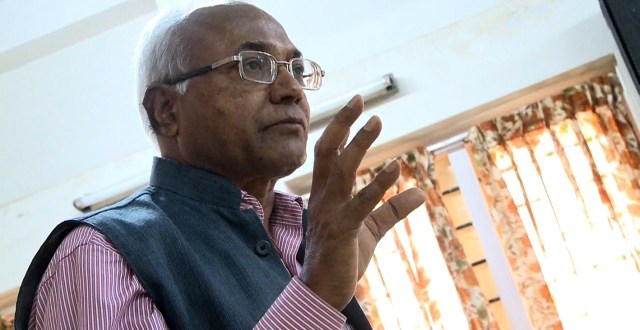
Last week, I attended the inaugural session of the 22nd party congress of the CPM in Hyderabad as a guest for the first time in my life. In my student and post-student days, I had worked with the CPI-ML Nagi Reddy group. Most ML groups are small groups who claim to be a party. Though working with that group gave me a theoretical and ideological base, it did not provide me the feeling of associating with a party that has a national presence. The CPM is a party with a national presence and experience of parliamentary rule. That it has run governments in three states and had a substantial presence in Parliament gives me the impression of a communist party that could even rule India from Delhi if it re-positions its ideology.
In 2004, the communists influenced the national economic and political policy. It led to the enactment of the Mahatma Gandhi National Rural Employment Guarantee and the Right To Information acts. In my view, the first UPA government that worked with the support of the communist parties improved the rural economy quite significantly. Communists in any government can be a check on individual and institutional corruption. During their 34 years in office in West Bengal, 25 years in Tripura and running coalition governments alternatively in Kerala since 1956, they did not leave any record of corruption.
The problem is they have not yet completely given up their path of non-parliamentary struggle. They still hang on to the theory that the parliamentary path is tactical, whereas the revolutionary path is strategic. This leaves enough space for the Congress and the BJP to remain as ruling parties in Delhi.
However, the tone and tenor at the 22nd congress was different. It gave the impression the CPM could work towards building a third alternative through the electoral path itself. The general aura of the CPM party congress was of discipline. The banner on the podium had a beautiful sketch of Karl Marx, the cover pages of the Communist Manifesto and Das Capital. But for Marx, the modern welfare democracies in the world would not have been what they are today. All the capitalist countries, including India, today implement democracy with social welfare of people as an integral part of the system.
The Marxists are better read and have more training in writing than other politicians. So, if they get to a position of influence at the Centre, they can bring in the knowledge of global trends in welfarism. They can do it much better than those from the Congress. There can be no comparison with the BJP leadership since the latter has little exposure to global systems. Besides, BJP leaders are exploring inward-looking Indian mythology, which does not contain theory or practice of people’s welfare. Democratic welfarism has to be advanced by studying all the global experiments.
For the first time in the communist movement (including the CPI and other small parties and groups), a communist party leader — CPM general secretary Sitaram Yechury — said the new experiment of building an alliance involving the communists and the Ambedkarites called the Bahujan Left Front (BLF) is the politics of the future. The Telangana CPM has formed BLF with several small Ambedkar-Phuleite SC/ST/OBC parties. These parties have on the banner figures such as Mahatma Jotirao Phule, Savitribai Phule, Ambedkar and Karl Marx. In other words, it is an experiment in Marx-Ambedkar theories of democracy and welfarism. Though Yechury did not go into the theoretical relationship between Marx and Ambedkar, the party affirmed the new experiment as a positive initiative, which could be expanded nationally.
If the communists reformulate their position that they should come to power in Delhi through electoral means, as the Nepali communists did by giving up the ultimate armed revolution agenda, that itself is acceptance of Ambedkar’s idea of democracy as change agent. Some radical changes could be brought about by combining Marxian welfarism with Ambedkarite socio-economic reform. The avoidance of violent revolution and coming to power through vote with a manifesto of time-bound welfarism for people is one of the key ideas of Ambedkarism.
It also means that the communists recognise that India is a caste-class society. Through a gradual means of democratic welfarism, both caste and class oppression and exploitation could be tackled. Though many eulogise Ambedkar today — including the Congress and BJP — they do not accept the core theory of Ambedkar that caste should be annihilated.
But the communists have the potential to work out a process of annihilating caste and abolishing class inequalities by formulating a new theory and praxis. In my view, this is the best way to follow, given the Indian specificity of caste and the global weakening of class revolutions and “pure socialism”. The BSP winning power in UP was a case of Ambedkarite caste-centered path, but it did not become a creative experiment at the operational level. There was no theoretical rigour in that experiment. No democratic transformation can be achieved based only on pure Ambedkarism because democratic welfarism is a universal experiment. The communists are better suited to combine the universal with the native if only they seriously examine Ambedkar’s thought. The BJP’s intellectuals study Ambedkar only to attack Muslims, not to deepen democracy or annihilate caste. The Congress thinks that Nehruvian democracy is inclusive of Ambedkarism. It is not, though there are many meeting points between Ambedkar’s thought and Nehru’s ideas.The BLF has come into existence in Telangana with the aim of achieving this broader goal by transforming the political and ideological discourse. It is meant to bring out the communists and Ambedkarites from their shells. It has initiated a discourse for Marx-Ambedkarites to capture power by transforming the social justice agenda and with a goal to deepen democratic welfarism. It is meant to address the school and college and university education system in terms of annihilating the caste mindset and class exploitation relations from childhood onwards. It is aimed at taking the discourse on secularism beyond religion and tackling caste class, religion, race and so on.
Marx and Ambedkar have given us enough theoretical tools to handle caste, class and gender inequalities. Reading one in the light of the other is very essential for the committed people working in communist parties as well as Ambedkarites working in the BSP and other organisations.
-
Making Sense of Dalit Spring in Hindi Heart Land
By Kancha Ilaiah Shepherd Source India Today (April 2, 2018, Page 28)
The April 2 Bharat Bandh, organised by non-political Dalit groups, has revealed a new capacity for mobilisation among the historically oppressed community in the Hindi heartland.Their fight to protect their constitutional rights seems to have acquired a new dimension during Narendra Modi’s regime,dispelling the myths of his slogan, ‘Sabka Saath Sabka Vikas’.
The Dalit crisis began when the BJP came to power in the Hindi heartland and western part of the country. While the Prime Minister claims to be from Other Backward Class, he has done little to secure educational or economic opportunities of the Dalits. This is because the BJP cannot independently run the government. The government machinery is actually run by the party’s mother ship, the RSS.
The RSS and the BJP have spread their network into every structure in the Hindi heartland and western India because that is their main operational base. For decades they have trained their upper caste cadre that the varnadharma, including the practice of untouchability, needs to be preserved to establish a Hindu Rashtra. The RSS has no cultural history of being Dalit/Adivasi/OBC-friendly. It has only worked for the economic and cultural advancement of the vyapari, pujari, sadhu, sanyasi and, of course, the cow. Its literature does not talk about the dignity of labour. As an organisation it has neither studied nor worked for the agrarian masses because in their literary/cultural history these people have never figured as the base of the Hindu motherland. Even the Shudras do not figure as the critical component of the ‘Hindu motherland’; only the dwijas—Brahmin, Vaishya, Kshatriya—are part of it. Their slogan ‘Bharat Mata ki jai’ is not an echo of an inclusive mood. Their Bharat Mata is a ‘Brahminc Mata’, an embodiment of the cultural code of Manudharama. The Dalit history and heritage are antithesis of this concept.
The north Indian Shudra/Dalits have started their anti-Brahmin movement quite late. In south India, social reforms happened rather smoothly, before an organised Brahminic force like the RSS could entrench itself, though caste and untouchability persist in the region. The RSS’ Hindu Rashtra agenda is an anti-social reform agenda. Though it does not have an agenda to reform caste-ridden Hinduism, it is highly motivated to reform the Indian Islam. In their “own Hindu society”, they are all for reversal of reform laws. The March 20, 2018 judgment of the Supreme Court on the SC/ST Atrocity Act reflects such an atmosphere in the central law ministry. There is a consensus in the Hindutva circles that all reservation laws must be reviewed. RSS chief Mohan Bhagawat has been consistently speaking against
reservation. The fear among Dalits/Adivasis is heightened because their middle class emerged from this reservation system.Unlike Indira Gandhi, Modi cannot bulldoze the administration to implement his promises to people. The party and his ministers are not under his control, they are in the RSS’ hands. Therefore, his call “kill me if you want to, but not my Dalit brothers” made no dent in the anti-Dalit mindset of the BJP/RSS ranks. Now more Dalits are being killed in the cow belt. The cow protection policy of the RSS has become a Dalit destruction policy. Dalits, across political affiliations, realise that in the name of cow protection the Dalit/Adivasi cattle economy and food resources are being destroyed. Scared that their reservation and scholarship would be withdrawn, Dalit students live in fear of the Akhil Bharatiya Vidyarthi Parishad in higher educational institutions. It is this fear that has made the new mobilisation possible. Call it India’s ‘Dalit Spring’.
-
Exception makes the rule
Apex court verdict will make the SC/ST Atrocities Act toothless, roll back social transformation
Written by Kancha Ilaiah Shepherd
The verdict of the Supreme Court’s two-judge bench stating that the SC/ST Atrocities Act 1989 is being misused — and a lot of checks are needed to prevent such misuse — will have huge implications on Dalit assertion in the country. The judgment was made possible by the Centre’s failure to place before the court the complete facts pertaining to atrocities against SC/STs. It also did not apprise the court of the details of the conviction rate in such cases.I am an OBC. All over the country, OBCs have been complaining that lot of false cases are being filed against them under the Act. In fact, on October 11, 2017, a BJP member, K Nagaraju, filed a case against me at Hyderabad’s Malkajgiri Police Station. Nagaraju argued that, as a Hindu Dalit, his sentiments — apart from that of the Arya Vysyas — were hurt by my book Samajika Smugglarlu, Komatollu. An FIR was registered and a notice was served to me by an officer of the rank of DSP. This is a clear case of misuse of the Act.
But should a national legal system go by such exceptional cases? Should it direct the country’s police system to ensure that no FIR be filed before a case under the SC/ST Atrocities Act is investigated by a DSP-level officer? The court also directed that no FIR should be registered against government servants without the approval of the appointing authority.
I will refer to another case in Telangana. Bharath Reddy, a BJP leader in Nizamabad district, forced two Dalits, Rajeswar and Lakshman, to take a dip in muddy water, beat them with a lathi, used foul language against them and videographed the episode — all this because they blew the lid on sand mafia activity in the area. Several Dalit and human rights organisations stood by the Dalits and ensured that a case under the SC/ST Atrocities Act was filed against Reddy. But after the FIR was filed, Reddy abducted the two Dalits. Even then, the police did not arrest him. They did so only after protests by the public at large.
The agrarian economy and the social structure in rural areas are such that conflicts are predominantly between the SCs and Shudras/OBCs. A number of cases are, of course, filed against the OBCs and Shudra caste like Reddys, Jats and Patels. But the arrest and conviction rate is very low.
There are a number of complaints about temple priests committing atrocities against Dalits, who want to enter the inner circle of the temples. But so far, no temple pujari has gone to jail for denying temple entry to a Dalit. In markets and at workplaces, Dalits face a variety of humiliating situations. Yet, there are no instances of shop owners or office workers being arrested under the SC/ST Atrocities Act. Untouchability is a major problem and the Act is meant to abolish this barbaric practice. In the process of implementation, some misuse could happen, a few innocent people could go to jail, but to make the Act toothless will amount to rolling back social transformation. That is what the Hindutva forces want.
The Ninth Annual Report of the National Commission for Scheduled Castes for 2015-16 was submitted to the President on August 16, 2016. The report was placed before Parliament on March 9, 2017. It says “There is a sharp increase in number of incidence of atrocities on SCs (from 3,36,55 in 2012 to 3,94,08 in 2013…as per data from 16 states, the tentative figures for 2014 are 51,672), rate of crime from increased from 16.7 per cent to 19.6 per cent in 2013. The crime rate was the highest in Rajasthan (52.98 per cent), Bihar (40.57 per cent) and Odisha (36 per cent)”. “There has also been a sharp decrease in conviction rate (from 29.6 per cent to 23.8 per cent) in the same period. UP has the best conviction rate, while West Bengal, Gujarat and Maharashtra have very low conviction rates,” the report notes.
The increase in cases of atrocities against the Dalits and the declining conviction rate is one aspect of the problem. We need to situate the issue in the current political context as well. Atrocities on Dalits have increased after the BJP came to power. Forces which practise old-fashioned untouchability have rallied around the BJP. Even the Shudra/OBCs who operate within the Hindutva ideological domain are against Constitutional reforms. They believe in the classical Varnadharma order in so far as the Dalit question is concerned. Such forces want the Act to go. The RSS mostly depends on these elements for its rural and semi-urban activities.
The untouchability question is central to the Hindu social order. The BJP/RSS wants to establish a Hindu Rashtra and nowhere have they promised to take take steps to abolish caste and untouchability. The Supreme Court’s Adhithayan Agamashastra verdict of 2015 affirmed the Agamashastra position. The verdict allowed the continuation of inherited Brahmin priesthood in temples and checkmated spiritual reform. As in the case of the SC/ST Atrocities Act, there was no serious intervention from the government in Adhithayan Agamashastra. The only reform that the BJP government has seriously worked for is the abolition of triple talaq.
Casteism and untouchability is a self-negating institutional mechanism that is built into Hinduism. If the courts do not examine this issue from the perspective of social equality — and continue to defend the right to practise untouchability by imposing all kinds of controlling mechanisms — they would end up harming Hinduism itself.
Prime Minister Narendra Modi promised many things to the SCs/STs in his election rallies, claiming that he is an OBC himself. But his government does not have the will to fulfill these promises because his party is a political wing of the RSS — not vice-versa — that is trained to maintain the varnashram dharma.
The writer is a member of T-MASS that works for social justice and reservation in the private sector -
To Be or Not to Be
In Hinduism, the right to spiritual equality is restricted. In glossing over the fact in his new book, Shashi Tharoor is playing into the hands of the proponents of Hindutva
Written by Kancha Ilaiah Shepherd Source
Shashi Tharoor’s latest book, Why I am a Hindu is political rather than academic or intellectual. The title is the very opposite to my book, Why I am Not a Hindu: A Shudra Critique of Hindutva Philosophy, Culture and Political Economy (1996). In Chapter 1 — My Hinduism — he answers, “Of course, that it is because I was born one”. This answer raises two fundamental questions: one, is one born into a religion or must be baptised into it, irrespective of one’s parents’ religion? The definition of religion rejects such a possibility. Second, with what status was he born into Hinduism? We come from the same South Indian Shudra background (Tharoor is a Nair from Kerala), but we have come to altogether different conclusions based on birth.I said I am not a Hindu because of the unequal birth of different communities in that religion. I also examined it’s negation of productive culture and maltreatment of productive communities. The Rig Veda that Tharoor quotes profusely starts with the divine theory that Brahmins are created from the head of Purusha, Kshatriyas from the shoulders, Vaisyas from the thighs and Shudras from the feet. This theory goes against the fundamental, universal religious principle that God created all humans equal.
In his writings, Tharoor does not let the readers know that he comes from a Shudra (Nair) background, as if he has no caste roots. He may think so, but the religion he writes about in this book does not think so. It did not allow others to operate outside the cultural frame of caste. Since Tharoor missed the core aspect of Hinduism in this book, he missed all of India and Hinduism, in a historical sense.
Nowhere in the book does he mention the social status of his family and the caste system of Hinduism. He writes as a politician. Having been born a Hindu, according to him, all the Hinduness he wears on his sleeve comes from the early poojas of his father, the stories told by his mother and grandmother and the received godhead. Is there no caste-centred restriction in that religious life? Is there no segregative systemic life in it?Instead of studying in a English medium school, if he were to study in a Sanskrit one like the elder sons of Kerala Namboodiris were supposed to, and because of this mode of imbibing Hinduism if he were to think of becoming a priest in the Guruvayoor Srikrishna temple, would he have been allowed to be one? No, because he comes from the Nair caste.This is exactly what the RSS also does. The structural Hinduism that Tharoor praises by quoting from the Vedas, the Upanishads, Adi Shankara, Ramanuja and so on, and the RSS-owned Hinduism, differ in very few respects. Every RSS theoretician approves of the scriptures and saints and justifies the Varnadharma system that it engendered. Tharoor is silent about it. He approves every aspect of the religion, as any Namboodiri writer from Kerala would do, and there is no attempt to suggest reforms.
The fundamental question, in wearing Hinduism on his sleeve, is: does he have anything in common with Nehruvian secularism, leave alone Ambedkarism? Ambedkar laid a radical foundation for the reform of Hinduism and Indian society: “I had the misfortune of being born with the stigma of an Untouchable (as Tharoor was born with the stigma of a Shudra). However, it is not my fault,; but I will not die a Hindu, for this is in my power.” He embraced Buddhism, which did not accept caste and untouchability in theory or practice.
But Pandit Nehru, who had many stakes in Hinduism, said: “By education I am an Englishman, by views an internationalist, by culture a Muslim and a Hindu only by accident of birth.” Nehru was the most celebrated PM of India for almost 17 years, and the masses liked him. Nehru was a Kashmiri Pandit, whose ancestors were said to have composed the Vedas. How could Tharoor, a Kerala Shudra, become more Hindu by birth than Nehru? Here lies the danger for the secular foundations he lays. The muscle power of Shudras is already available in the ranks of the RSS, willing to attack anybody who is not Hindu or critiques Hindutva. Shashi Tharoor has given them a theoretical weapon. Brahminism would be very happy with him.
Neither Indira Gandhi nor Rajiv Gandhi followed the Nehruvian secular conviction. Rahul Gandhi, I thought, would follow his grandfather but seems to be slipping into Tharoor’s idea of Hinduism. Not just one Tharoor, who deliberately wrote this book at this juncture when the Congress is trying to come back by mediating between RSS/BJP Hindutva and Hinduism, my fear is that Nehru’s well-defined secularism is being put on the back burner by the whole party.
It is clear that Tharoor has nothing to do with Nehru and Ambedkar, and certainly has something to with Savarkar, Hegdewar and Golwalkar, along with his venerable seers like Adi Shankara, Ramanuja and so on. He is only saying that they should not be politicised, and hence describes the RSS and BJP’s Hinduism as “Political Hinduism’’. His repeated reference to Mahtma Gandhi’s Hinduism does not make any difference because if only Nathuram Godse had not killed Gandhi, his idea of Hinduism would have fit into that of any other Hindu school of thought, including that of RSS. We know that Narendra Modi is owning Gandhi more legitimately than Tharoor could do. Gandhi was a Bania (Modi is an OBC Bania), Gujarati Hindu. Tharoor’s claim to his heritage is comparatively weak.If Tharoor were to join the RSS, he would not have been allowed to become the sarsanghchalak like Mohan Bhagwat because they look at caste background quite carefully. Shashi Tharoor, like Modi, can become Prime Minister because of the Constitution, not because of the Vedas or the Bhagvad Gita. But he could not be the priest of Tirupati or Guruvayur temple. In Hinduism, let alone Hindutva, the right to spiritual equality is restricted. However, since the Nair caste had been in a sambandham with Kerala Brahmins for long, claiming that the Shudras are “Hindu by birth” makes some sense. But if Tharoor were born a Pulaya in Kerala, would he have written a book with the same title? A scholar of KR Narayanan’s stature and attainments did not say, “I am a Hindu” with such facility because of the inherent contradiction in such a claim.
I am also surprised at the praise for this book from a sensible social science scholar like Neera Chandhoke, in another review. Caste-blind scholarship which draws a quick distinction between Hinduism and Hindutva is forcing the Congress of Rahul Gandhi to own Hinduism, as a strategy to bring the Congress back to power. While Gandhi calls himself Brahmin and presents himself as a temple-going Hindu, the Shudra upper caste Tharoor tries to provide a theoretical framework to ‘Congress Hinduism’ against the BJP’s Hindutva.
But in the long run, the nation is endangered by this competition to assign Hinduness to India, which is not a religion like Buddhism, Christianity and Islam. When Modi claimed that he was an OBC in 2002, I wrote that he was likely to become the PM of India. After reading Tharoor, I can only say that the Congress will be lucky if he does not join the BJP if it retains power after the 2019 elections. He has left enough room for a transit.
Kancha Ilaiah Shepherd is chairman, T-MASS, Telangana -
T-MASS: A New Experiment In Ambedkarite-Marxist Alliance
-
‘If You are Afraid, How Will You Build a Good Social Science? says Prof Kancha Ilaiah
Interview
By Hafeesha TB
Social scientist Kancha Ilaiah talks of the row over his recent Telugu book ‘Saamajika Smugglerlu Kommatollu’ and other controversies he has faced. Writer and social scientist Kancha Ilaiah Shepherd has been at the heart of a major controversy for many weeks now. The publication of an excerpt from his Post Hindu India in Telugu, under the title Samaajika Smugglerlu Komatollu (Social Smugglers: Komatis) drew pitched protests from Arya Vysya organisations, who alleged that the title and the content of the book insulted them by caste. Peace was finally mediated between Ilaiah and representatives of these groups on Sunday by the CPI.
Ilaiah, the author of a number of books like Why I am not a Hindu, Untouchable God, and Buffalo Nationalism: A Critique of Spiritual Fascism is no stranger to controversy. In an interview to Hafeesha TB, Ilaiah explains his stand on the current controversy and other issues affecting the Dalit Bahujan population in India.
Members of the Vysya community were protesting against your book for many weeks. What led you to write the book Post Hindu India?
It is a sociological book about each caste’s sociological, psychological and economic character. In this book, the Vysyas figured as one chapter. They think that nobody should write about thoem, whatever culture they have is great. Whatever the culture, Sociology has to analyse it and Anthropology has to examine.
The book is a sociological study of many castes like Adivasis, Madigas, Malas, Chakkali, Mangali, and the unknown engineers, iron smiths, gold smiths, carpenters, and pot makers. And then the food producers –Kapus, Kammas and Marathas. These are called productive castes. Then it comes to unproductive castes – the Banyas and Brahmins. I have examined their sociological nature and some of the anthrpological data was brought into it. If they say nobody should write on us, then how does it work? The Social Sciences have to study every caste and every community.
You have faced trouble not only from social groups, but some days ago also faced opposition from the police. How do you feel about this?
These things are expected from conservative forces – the forces who don’t want change, the forces who don’t want equality. They are social forces, but they are also political forces. When these forces are doing such things, you have to fight.
For everything if we are afraid, how do we build good Social Science, good Sociology, Anthropolgy or Political Science. We have to fight with our courage otherwise tomorrow they will not allow anybody to write anything.
What do you see as the serious problems that Dalits in India are facing today?
Dalits are facing several problems today. One is their food culture problem. After the BJP came (to power), their food culture has got into a crisis, and the cow ban (cattle slaughter rules) has reduced their food availability. And leather work has gone out of the market. So, jobs are not there for them.
They (the Vysyas) have privatised all the money, they have shifted the money to banks and from there to industrialists.
Then they (Dalits) don’t have jobs because there is no reservation in the private sector. So, it is a huge problem.
You have also faced controversy over the allegation that you have called Brahmins ‘lazy’. What was your actual statement?
I never said that. The chapter says that the Brahmins are spiritual fascists, that they don’t allow spiritualism to become democratic and that every caste in Hinduism can be equal. I am not saying ‘lazy’. They are out of production. They are not in the tilling of the land, they are not in the cattle rearing, they are not in the harvesting, they are not in the vegetable production, the meat and milk economy. So they are outside production.
The Hindu text Manusmriti was burned by BR Ambedkar and it was a milestone in Dalit struggle. Do you think such a revolutionary movement is possible today
Today, they may not allow it. Beacuse the right wing and those who are opposed to equality are in power. Naturally they don’t want change, they don’t want equality in the society, in the government and the system. That is the reason why I am facing these problems. Ambedkar faced different kinds of problems.But at that time British were in the power. Now it is the Indian castes which are outside production which are controlling the money and the political power. So the problems for people like me are more now because the British had some kind of positive view of change, whereas these two communities don’t like any change.
We constantly use terms like ‘Upper caste’ and ‘Lower caste’. What are your thoughts on these terms?
I don’t use those terms. I use Dalit-Bahujans and unproductive castes. So, they are not ‘upper’, they are unproductive. They don’t produce food or anything. Dalit-Bahujans are the productive castes. So I have tried to replace these terms.
On the celebration of Deepavali, you have said that Ravana is a representative of Dalit-Bahujans and Dravidians. What are your thoughts on this?
Historically, Ravana was a Dravidian and was pro-environment. Environmental maintenance, forests and so on are a part of Dravidian life. Actually, the first major environmental figure, while building a city, was Harappa. Harappa, who built the Harappa city in the Indus valley, was a man himself because similar names still exist in Karnataka and also parts of Telangana. So there are names like Birappa – a shepherd god –, Virappa, Yallappa, Mallappa. The Appas are human beings.
So we must really see the Dravidian culture in Harappa first, more than Ravan and Narakasura. Some of them are mythological, but Harappa was a real historical figure who built a city himself. In my view a major study on Harappa has to come. I was doing that work, but meanwhile this trouble started.
Could you explain why you changed your name to Kancha Ilaiah Shepherd?
The Brahmins and the Baniyas were abusing by my (caste) name in November 2015. Then I thought I should add a name from my occupation historically. Because Harappa himself was a shepherd. Shepherd, in the sense, of cattle rearers – they take care of everything. For example, Sri Krishna, who is known as the Yadava god, is also a cattle rearer. Actually, now they are show him taking care of only cows, but he was taking care of buffaloes, cows, sheep and goats. But later some writers distorted his role. He has also been portrayed negatively, that he steals butter and has some relations with all kinds of people. That is not correct. So any shepherd or cattle rearer was demonized like this in history.
What is the relevance of Dalit-minority-Left unity in the current time?
They have to unite. We have to take up the question of abolition of untouchability and the socialisation of the means of production and the opposition of present capitalism, which has become real capitalism. In order to do that, I think a new theoretical model has to be worked out.
You have talked in many places about your mother and her struggles. How has she influenced you?
She was a big fighter. She put us in school when we were going along with sheep. She got us admitted in high school by literally putting us a the feet of a landlord in a nearby village. She died when I was in Class 9. But she was a great fighter. She died because of attacks by police patels of the village. She was the real philosophical and ideological motive and force behind my evolution and thought.
What is your view on reservation policies in India?
Reservation, at the time of Ambedkar, was only a state issue – state jobs. And there was no big private sector.So he asked for the electoral reservations and state jobs. Now state jobs are gone and electoral reservaton is there. That is the reason why Indian feudalism has shifted into Indian capitalism. So the capital, Bombay Wall Street, is fully under the control of mainly Baniya capital. In order to change that into a diversified capital, there must be reservation in the private sector. They are talking about the merit. But where is the merit in non-producers when productive castes don’t have merit? The country lives with the production and not with some book writing and all. Even if I write a book, the country will not live with that book. Anybody can write a book. So my feeling is that it is the time for fighting for reservations in private sector and English education in government schools. Then if jobs are not available here, they can go to Australia and Canada. They can become global citizens also.
-
The Government’s Elaborate Nationalist Charade
By Published on: November 9, 2017
Dr. Kancha Ilaiah Shepherd, a political theorist and Dalit Rights activist has been in the eye of the storm ever since the Telugu translation of his book Post Hindu India came out. In one of the chapters of the book, he alleges that the Arya-Vysya community are social smugglers and have usurped the wealth that should have actually belonged to lower caste people. In this piece Ilaiah shares how he has been courting controversy and dealing with threats to his life.
The Sangh Parivar elements that worked hand in glove with Arya Vysyas, who wanted to lynch me at Parkal on September 23, after the TDP Parliament member T.G Venkatesh issued a threat on September 17, have shown their true colours. They caught hold of a 22 year old Dalit boy, sporting a big saffron tilak on his forehead. This boy said, “Kancha Ilaiah is dog! He criticized Hindu Dalits by writing Smajika Smugglerlu: Komatollu’’. They got case registered against me for atrocities against SC/STs. The media including the Business Standard felt this is a rare case of SC/ST atrocity so far registered. But this is yet another type of lynch-mob politics. They have filed several cases in several different places against me. As I have utmost respect for judiciary I am willing to go through the judicial processes.
I have fought the RSS, ABVP network in Osmania University and outside for thirty five years and now they think, they have a chance to lynch me in one form or the other. These forces never fight for the rights of Dalits/Adivasis/OBCs but whenever the Baniyas or Brahmins are in trouble they deploy all their forces including SC/ST/OBCs. Even the OBC/SC/STs are not allowed to go to the support of their own communities, whenever they face atrocities and humiliation. But their upper caste members—mainly the Brahmin-Bania members rush to the aid of any so called spiritual force, or cow related issues or in defense of their own upper caste networks. They do every possible thing to defame any Dalit-bahujan intellectual writing on Indian history, the labour related issues, wages, atrocities and so on. But they would never speak about increasing the agrarian wages, protecting the farmers from suicides.
They accuse all such defenders as Left and Anti-national. The defenders of rich, religious gurus (whatever could be their role in the society), they rush to their defense and proclaim that is nationalist act. So their nation constitutes the rich people, big business forces, religious gurus (whose contribution to production is zero) and cows. They never treat buffalo as Indian animal at all! I need to be lynched because I stand by the SC/ST/OBCs, buffaloes, soldiers serving on the borders and lowest rung of the police force, who again come from the lowest castes and communities. Anybody who speaks of human rights is anti-national. This is bizarre democracy they are running from Delhi now.
After they failed at Parkal, they think this atrocity case would kill me on my own ground, as I wrote extensively about Dalitisation of the Indian society as a process of de-casting and de-classing of it. I strongly defended their beef food culture (in the recent cow centered vegetarian campaign of the Hindutva). This only shows that they stoop down to any level to protect their funding Vysya coffers. My ‘Buffalo Nationalism’ has put them in fix, as it keeps on fighting their ‘Cow Nationalism’ politics.
The Two Dramas
When the Bharatiya Janta Party came to power 2014, it started enacting two dramas on the national stage. These elaborate charades, related to defense and glorification of India internationally, were aimed at ensuring the the BJP’s survival by showcasing them as the most nationalist party. Their approach was two pronged; they used cow protection — the so called Gaumata of the nation, and Yoga – the nation’s source of health and power, to further their own agenda.Around these two dramas, it deployed its upper caste leisure centered Rastriya Swayamsevak Sangh activists and retired officials from cozy jobs mainly coming from non-agrarian social background. More than all these forces the whole Peethadhipathi, Sadhu Sanyasi, yogi network, which mainly comes from the non-agrarian caste cultural, and non-productive backgrounds are deployed, to attack anybody who talks about cow as economic animal.
Even Prime Minster Narendra Modi also must have sold tea in his childhood but, never grazed cattle in the fields. Selling tea is also a business activity not a productive activity, like grazing cattle, tilling land, pottery, carpentry… manufacturing a plough to till or forging a wheel for transport. Mohan Bhagawat and Amit Shah have much less to do with grazing cows, leave alone buffaloes. Yet all of them made the cow protection, not cow grazing, as the national legal problem causing huge problem of food, employment, and law and order.
The question of yoga is a much more serious issue. Though Ramdev, a Yadav by birth, made it a big method of health protection among the middle class. The brahmnic thinkers, who never got involved in tilling the land or grazing the cattle, and supposed to be the authors of all funny theories, projected Yoga as the most useful nation saving body exercise. The BJP owned it as if that is the most suitable exercise for armed forces that need to fight mighty powers like China in the East and not so powerful Pakistan in the West.
The sports like running, high jump, long jump, the body exercise by working the productive fields have no TV shows. Their existence is now seen as anti-national. But the most serious question is should army recruitment adopt Yoga that is being promoted by the Prime Minister, his entire Government and the Sangh Parivar all over the nation as the measure of selection. Should police institution also adopt that sport, as a daily exercise to maintain their body?
National Icons
The great Sadguru who constructs an imaginary Yoga Guru (of black Shiva image) got it inaugurated by the PM. But they never talk about the first ever Indian city builder called Harappa (which name resembles the popular cattle grazer God called Beerappa about whom there is narrative in my book Why I am Not a Hindu) as great Indian. It was during Harappa period that the division of labour took place. Different sections of the Harappa society specialized in different things of city building. Brick making, carpentry, pot making, animal grazing, canal constructing, tank bund making, road laying and so on. It is this ancient labour centred Indian that would be an iconic model. But not an imaginary Yogi, who sits like dead stone in Coimbatore that would be a iconic model for developing nation.The BJP does not have interest in projecting dignity of labour, peasant economic hard work, the labouring masses as the essence of Indian being. Instead they project un-productive saint as the sole symbol of nation. The worst is that they hate those who talk about production, people’s philosophy of equality. They hang around mythological texts as essence of the nation. But to me the nation lives in the labour of people, which the BJP never wants celebrate.
The farmers and other productive mass of India have seen the two dramas—the drama of Cow and Yoga—that the BJP has been playing as just onlookers. Alongside these two dramas the more serious actions of De-monitization and GST imposition are having telling impact on their life. Let us wait and see how it unfolds in future.
(The author is Member, T-MASS, an organization that works for social Justice, dignity of labour and English education in Government schools in Telangana)
-
A Critical Defence of Kancha Ilaiah’s Voice
In these achhe din when the Hindutva bullet trail has killed people with impunity for speaking what it does not like, the recent threats against Kancha Ilaiah Shepherd should not be taken lightly. Of course, the Hindutva brigade is not known to warn its victims. Narendra Dabholkar, Comrade Govind Pansare, M M Kalburgi, Santanu Bhowmik, and recently Gauri Lankesh were not forewarned. In this case, both Ilaiah Shepherd as well as the representatives of the Arya–Vaisya community filed police complaints against each other. It does not mean that because the threat was publicly issued, the issuer would be marked if something untoward were to take place.
The Sanatan Prabhat, the mouthpiece of the Sanatan Sanstha, has issued a standing threat to all rationalists whom it wants to have killed as demons to establish the kingdom of god. When Dabholkar was gunned down, it had the temerity to justify the act in a celebratory tone, with no legal consequence. Contrast it with thousands of Dalits and Adivasis incarcerated for years just under the suspicion of being connected with Maoists!
In the case of Ilaiah Shepherd, Telugu Desam Party (TDP) Member of Parliament (MP) T G Venkatesh has said that people like him should be “publicly hanged.” Following him, Arya–Vaisya organisations have been holding protests in parts of Telangana and Andhra Pradesh and burning his effigies, seeking a ban on his book, Samaajika Smugglurlu Komatollu (Social Smugglers: Komotis). He has been receiving abusive and threatening phone calls. There was an alleged attempt to attack his car at Parkal town in Telangana, where some people hurled footwear and stones at him; he had to run into the police station for protection. Ilaiah Shepherd has not taken it lightly and has been living in self-imposed house arrest since the controversy broke out.
What Is Behind the Uproar?
The booklet in question is a Telugu translation of one chapter from his 2009 book, Post-Hindu India: A Discourse in Dalit–Bahujan, Socio-spiritual and Scientific Revolution. As such, there is no reason that the controversy be raised after almost a decade except that it is now available to a Telugu-language audience. Maybe the references to Modi–Shah and Adani–Ambani that existed in the book and are now available to the common masses to read are being resented. Maybe the Arya–Vaisya organisations, which are aligned with the Bharatiya Janata Party (BJP) or TDP, are being used as proxies to create the ruckus. The book is replete with caustic remarks about Banias like this:
Vysyas have always hated Shudras, Dalits and OBCs [Other Backward Castes] who are involved in the production of goods. They never take up the job of protecting the country—there is no baniya regiment in the Army. They are part of the ruling class—Narendra Modi and Amit Shah are baniyas—and they are backed by business tycoons like the Ambanis and Adanis. They are culturally vegetarians, so how can they fight mighty enemies like Pakistan and China if they don’t eat meat or beef?
Is there anything other than poor knowledge in this that should anger anyone? Are there no castes in India? Do the dwija castes, which he calls parasitic, not treat the Shudras and Dalits with graded disdain? Are they not a part of the ruling class? I would not care for their vegetarianism or not eating beef, or not being in the army or not being able to fight the armies of Pakistan and China, but if Ilaiah Shepherd wants to care for it, is that untrue? I am not sure though whether by this logic he wants to uphold the Kshatriyas.
It is not the first time Ilaiah Shepherd is writing or speaking like this, nor is he singling out only Vaisyas for such uncharitable references as “social smugglers.” In the same book, he has called Brahmins spiritual fascists; others he calls intellectual goondas, etc. This style of writing has an element of making people sit up and take note, like a marketing strategy. Incidentally, I reviewed this book for Tehelka magazine (Teltumbde 2009). I wrote:
Reading this book, it gives you a feel of travelling in a Maglev train—an illusion of running on rails but in fact levitating over a thin layer of air. While traversing through its arguments, the book creates an illusion of being based on truth but is distanced from it by a thin layer of prejudice. There is an overdose of culture and spirituality which could intoxicate readers without them realizing it.
Ilaiah Shepherd’s intellectual content may be severally problematised, but none has the right to deny his right to express it, and certainly no right to threaten him.
Condemnation and Beyond
Do the Arya–Vaisya organisations have the right to express their disagreement as they did? They do have a right to approach the courts as advocate K L N V Veeranjaneyulu did, to ban another book by Ilaiah Shepherd titled Hindutva-Mukt Bharat and a chapter in his Post-Hindu India too. But to issue death threats is surely a crime, and that too by a people’s representative. The Supreme Court rightly ruled that banning the book is in contravention of Article 32 of the Constitution. “When an author writes a book, it is his or her right of expression … every author or writer has a fundamental right to speak out ideas freely and express thoughts adequately,” the Court said in its order. However, several MPs, members of legislative assembly (MLAs) and even Telangana ministers do not agree. It is fairly clear, unless the Court takes suo motu cognisance of the death threats in the particular context of the recent spate of killings, the government is unlikely to act.
The issue has, as expected, created waves of condemnation all over the world, including in the United States Congress. Harold Trent Franks, representing Arizona’s eighth congressional district in the US House of Representatives, raised it on 12 October, the day the Hyderabad police registered a case against Ilaiah Shepherd for allegedly hurting religious sentiments. Franks, in his speech lasting over four minutes, had described Ilaiah Shepherd as modern-day B R Ambedkar. Indeed, following in the footsteps of Ambedkar, Ilaiah Shepherd has built up a strong cultural critique of the dwija caste culture, imparting it a materialistic hue from his early rendezvous with left politics. He would distinguish the lot as unproductive parasites as against his category of Dalit–Bahujan, the productive category. One need not smell Marx’s labour theory of value in this phraseology simply because it is just not that.
His explanation of social smuggling is even weirder. Writing in the Wire on 15 September Ilaiah Shepherd (2017) said he coined this concept to describe the Vaisya model of accumulation. He explained, “The process of social smuggling started from the post-Gupta period of 5th century AD and continues to operate even today.” This social smuggling, he explains, is the flow of “heavily exploited wealth” taken across “caste ‘social borders’” “to control the accumulated wealth within that border.” If you are still confused, he clarifies,
It [heavily exploited wealth] was used by the traders for their good life and gave enough to the temples for better survival of priests. The remaining surplus was hidden under ground, over ground and also in the temples. This process did not allow the cash economy to come back in the form of investment either for agrarian development or for promotion of mercantile capital. This whole process is nothing but social smuggling. The wealth did not go outside India but did get arrested and used only within the caste borders.
But this is simply a feudal mode that existed everywhere before capitalism entered. When capitalism came, this mercantile community of Vaisyas did become industrial capitalists, albeit preserving castes, following the capitalist schema of money–commodity–more money (SPAN STYLE=”font-weight: normal”>M–C–M’).
It is not necessary to agree with Ilaiah Shepherd’s theorisation, but there is no denying the fact that he has powerfully articulated his spiritual–cultural critique with fantastic details so as to reinforce caste identities of the Dalits, although his own coinage of “Dalit–Bahujan” still eludes him.
The Identity Appeal
In a caste society, to conceive Bahujan is theoretically problematic. But we should know what Buddha thought of Bahujans; in modern times, Kanshi Ram uses the category with much clearer meaning than Ilaiah Shepherd does. I cannot resist temptation to recall my review:
If one is not so “spiritually” intoxicated, one suffers from mundane doubts nibbling at his intellect: is this conjoint term “Dalit–Bahujan” sociologically viable, given the huge load of material contradictions between these two population groups that have been precipitating into most heinous caste atrocities? How and why did these worthy “spiritual democrats” or “spiritual revolutionaries” come to emulate the caste hierarchy of Brahmins, the spiritual fascists, within themselves and zealously preserve it? If the Dalit-Bahujans were so accomplished in terms of their scientific and technological prowess, how could they be enslaved by a handful of scheming and spiritually degenerate Brahmins for millennia? The book succeeds in establishing the superiority of Dalit-Bahujans, but doesn’t it essentially follow the very same Brahmanic ethos of superiority-inferiority? (Teltumbde 2009)
If one wears caste spectacles, Indian capital may appear as Vaisya capital, as they still dominate the world of business. But is that not an evolutionary phenomenon of mercantile capital transforming into industrial and financial capital? It is the fact that capital did rely on caste networks but with a pure business logic to depress transaction costs. It is not confined to only Vaisyas. There are a plethora of other castes. Dalits are the only exception (stray examples and spurious phenomenon of Dalit capitalism notwithstanding). Gounders (who built the biggest knitwear manufacturing hub in the world), Nadars (the lords of the match industry in Sivakasi), and Ezhavas, Patels, Jats, Marathas, etc (in various industries) covering the entire spectrum from Brahmin to Shudra, have made their mark in business, their supply chains cutting across castes, communities, and extending to global regions.
Ilaiah Shepherd’s writings remind us of the religio–cultural critique of Ambedkar, and hence the Ambedkarite Dalits nostalgically love them. They realise neither the difference in times nor circumstances. Ambedkar was struggling to locate the source of castes and simultaneously provoke the Hindus to rethink their traditions and customs with a hope that they might undertake reforms. His diagnosis was that castes came through the dharmashastra part of the Hindu religion and unless it was destroyed, castes would not be annihilated. He ended with embracing Buddhism. The issue before the intellectuals who wish to take up cudgels for the Dalits is to assess the past and move forward in the changed world. If at all they wish to follow Ambedkar, his vision of annihilation of caste or the society based on “liberty, equality, fraternity” should beckon them. He was against Brahminism, not Brahmins. Pandering to caste identities tickles one like intoxicants; it is certainly antithetical to this vision and damaging to the Dalits’ emancipation project.
References
Ilaiah Shepherd, Kancha (2017): “Explaining the ‘Social Smuggling’ That Has Angered Arya Vysyas in Two States,” Wire, https://thewire.in/177385/explaining-social-smuggling-angered-arya-vysyas-two-states/.
Teltumbde, Anand (2009): “Our Levitating Prejudice,” Tehelka, Vol 6, No 50, 19 December, http://www.tehelka.com/2009/12/our-levitating-prejudice/.
Social Media Image Courtesy: Screengrab from Youtube/ISEVideos
-
Kancha Ilaiah: For lives lived in labour
Kalpana Kannabiran, The Hindu
Childhood, marriage, markets, goddesses, worship, food, work — for Ilaiah, the lived village has always been the best textbook
I call Professor Kancha Ilaiah Shepherd and we talk about meeting and having a leisurely chat about his life, work and troubles in recent times. The past month has been particularly stormy. Ilaiah, a dear friend of three generations of my family, has been a trenchant and unrelenting critic of Brahmanical Hinduism and the insidious proliferation of dominant caste injustice for decades.
However, the recent publication in Telugu of the chapter from his 2009 book Post Hindu India, titled ‘Vysyas: Social Smugglers’, triggered protest from members of the Vysya caste, with a sitting Telugu Desam Party MP declaring that he should be hanged and Arya Vysya Sangham petitioning the Supreme Court to ban his book (dismissed by the Supreme Court last week).
Our phone conversations these past weeks have been short and hurried, moments snatched from meetings, during a commute, or in the middle of other work. Most of these calls have been to check that he is in good cheer and spirits, since I can never be sure when the strain of belligerent attacks can begin to weigh a person down — even someone like Ilaiah.
Looking back
As I think about the conversation we are about to have, my mind goes back to 1989 or thereabouts, when as a doctoral student interested in questions of caste, I presented what I thought was a cogent and painstakingly argued critique of caste. A minute after I was done, Ilaiah proceeded to take my paper apart most meticulously, chiding me for hanging on to Brahmanical anthropology that will always obstruct an understanding of caste.
His insistence that day that I must look at a different corpus if I am to make any sense of the structures of caste has stayed with me till today. This is a methodological point he elaborates on in our conversation.
We first agree to meet at his home but that does not seem possible because his family has other plans for the eve of Diwali, and he offers to come over to mine so that we can chat without interruption.
His date of birth according to school records, Ilaiah tells me, is October 5, 1952 — he is the fifth of seven siblings. In July 1960, his mother sent him and his brother (older by two years) to the newly established single-teacher school in his village, Papaiahpet, the first two children to be admitted in his village. When they had passed Class V, his mother took them to the landlord in Guduru and begged him to admit them to school. After passing Class VIII there, they moved to the taluka headquarters, Narsampet.
Early memories
When his mother died in 1967, his brother discontinued his education, was married to a 12-year-old girl, and took charge of the home, while Ilaiah continued with college and studied political science in Osmania University. In the early 1980s, his brother developed a serious heart problem, so Ilaiah moved the brother’s family to his home in Hyderabad. They have been together since.
His first memories of college in Warangal are of Haragopal, a young and dynamic teacher of public administration, with admirable communication skills, who told him at the end of an English debate where he “closed his eyes and spoke,” that his ideas were good but he needed to work on his English. This was the beginning of a long and trying journey to conquer English. He recalls reading The Communist Manifesto, not just for its content, but paying close attention to the English, the flow, and the expression.
In the Dalitwada, ‘labour is tomorrow’s survival’, and has been for centuries. Lives are only lived in labour, not in leisure, and there is no notion of property
Not having ever had a convent education, he listened to English news on radio every night, and practised reading and pronunciation in front of a mirror. He also speaks with admiration about seeing Kaki Madhava Rao, then Collector of Warangal — a Dalit officer whose doors were always open to those who had suffered any manner of injustice or deprivation — and of going to Musheerabad Jail in the middle of the night when Kista Gowd and Bhoomiah were to be hanged during Emergency, and of his long association with civil liberties advocate K.G. Kannabiran.
Bilingual is best
It is from his own struggles with breaking into mainstream academia that he has pursued the idea of English education in the villages with missionary zeal — facilitating the setting up of 107 English-medium schools from 2002, mostly for OBC, Dalit and Adivasi students. He beams with pride over the fact that children from rural Warangal are able to speak fluent English by the time they reach Class VI, easily substituting rote learning of the alphabet with active association with animals, plants and artefacts in their immediate surroundings. “How do these children change if English doesn’t go to rural areas,” he asks.
What is remarkable about the way the children learn the English alphabet is the fact that experience forms the basis of learning. Ant, not apple. Buffalo, not bat. This resonates with Ilaiah’s early thesis that one can only understand caste if experience provides the framework for debate — an argument he proposed in 1990 in an essay published in Economic and Political Weekly.
Far from arguing for English as a substitute for Telugu, Ilaiah argues forcefully for a robust bilingualism which, in his view, can only be achieved if an English-medium education complements socialisation in the mother tongue.
His own academic and political tracts have been in both English and Telugu. His tryst with English writing started with contributions to Mainstream and Frontier after the Emergency in 1977.
Early on, he, along with a few friends, started a progressive Telugu journal, Nalupu. By this time, he was active in the Organisation for Protection of Democratic Rights, and had been closely associated with the CPI (ML-Nagi Reddy) and had not yet begun to study Ambedkar seriously.
He was part of the Andhra Pradesh Civil Liberties Committee where he raised discomfiting questions about caste in organisational leadership. His involvement with civil liberties and left groups opened up a new world of suffering — journeys to Kashmir, the Northeast, Parvathipuram, setting up drought relief centres in Andhra Pradesh and addressing hunger on the ground.
However, it was the Karamchedu massacre in 1985 that was the tipping point in his articulation of caste in politics of all hues.
This was also the time when Ilaiah began to engage with Ambedkar’s writings and chose to work on Buddha’s political thought for his PhD.
Ilaiah believes experience forms the basis of all learning. Thus, Ant, not apple. Buffalo, not bat
Through these engagements, Ilaiah returned to his explorations of the experiential basis of understanding structures of thought, feeling and sociality. With no context of rigorous academic research, and a very ordinary education, constant comparisons between textual narratives and a structural approach to the village built on personal knowledge, opened out the field to an ethnography of a different kind.
Textbook of life
Childhood, marriage, markets, goddesses, ritual, worship, food, work, and the clear dichotomy between productive lives and lives outside production — the lived village was the best textbook. His celebrated work, Why I Am Not a Hindu, grew out of this ethnographic project. His later work, Post-Hindu India, takes this further through an exposition of the political economy of caste.
Importantly, Ilaiah does not see a dichotomy or separation between productive and reproductive labour — he draws intricate connections between the arguments on sexual division of labour by feminist philosopher Maria Mies and his mother’s understanding of productive and reproductive labour, or even the Dalit-Bahujan worship of goddesses like Pochamma bestowed with healing and regenerative powers.
‘The personal is the political’ is a slogan of the feminist movement. Ilaiah looks at this alongside ‘experience as a framework,’ in order to grasp the full contours of the Dalit-Bahujan experience of caste. For, in the Dalitwada, ‘labour is tomorrow’s survival’, and has been for centuries.
Lives are only lived in labour, not in leisure, and there is no notion of property. But there is an immense wealth of knowledge, wisdom, and ethics. The barber’s knife is an illustration — ‘a tool that cleanses, not a weapon that kills’. How does this compare with lives lived in leisure and accumulation of material wealth? This is the question in the eye of the storm today.
Having effectively subverted meritocratic arguments in mainstream academia, and having immersed himself in progressive politics, Ilaiah, now retired from Maulana Azad National Urdu University, has begun to chart a new course with the Telangana Mass and Social Organisations Forum, a broad-based political forum that will bring OBCs, Dalits and Adivasis together to fight for social justice and cultural transformation.
The author is a feminist sociologist and Professor & Director, Council for Social Development, Hyderabad.
-
Vishal Mangalwadi’s Hindutva Agendra
Mr. Vishal Mandgalwadi
A Muslim friend of mine, who seems to have written to you also told me about your facebook post. When I saw that I was shocked.
I never knew that you are such a liar. When did I tell you in 2001 that I am writing Post Hindu India? I did not even have an idea of publishing this book with that title. At that time I was working on my Ph.D theses to be published and that year only it was published. Then I worked on my Buffalo Nationalism book which was published in 2004.
I did not even know you by then except that one of your friends requested that I should write an introduction to one of your very bad books. With great dislike I did that. You talk as if you are my great fried. This is totally human receptivity.
You do not even understand the fundamental ideas that developed in my first book Why I Am Not Hindu. When I wrote that book do you know in 1994-6? At that time I did not even have single Christian contact. I met Joseph Desouza in 1999 that too after I became a columnist in well known English daily The Hindu. It was an accidental meeting. I told him about my English education agenda. He responded for that positively. But you, for that few hours I was with you after I released your book you talked only about conversion stuff. I was a left liberal working with civil rights movement for several years. I was never into your sin business and heaven politics of making money.
I realized how low your standard and academic stature is now. Did you read and understand my Post Hindu India. Do you think that that book could be written with $10, 000 from somebody. I never wrote books like you with money for money. The data that the book contains and philosophical arguments that it developed cannot be mobilized or collected by spending Crores of rupees. An OBC thinker like me cannot be enslaved by your foolish ideas of conversion. My struggle is to liberate my people, with an agenda of carrying the vision of Gautham Buddha, Mahatma Phule, Ambedkar and Periyar. I know cannot understand them at all.
My agenda for teaching English to the SC/ST/OBC children is not bound by your personal agenda of going to heaven. All your life seems to be nothing but sins and sins. If Joseph DeSouza was childish like you, I would not have made friendship with him even for a day. He is a great visionary therefore our friendship remained and that has a cause of English education of the poorest of the poor.
I understood that you are out to destroy the life of thousands of poorest of the poor children’s future. After this facebook you posted I realized you have never understood even an inch of Jesus’s liberative agenda of the slaves and the wretched of the earth. Stop this kind of nonsensical campaign against an historical cause. You seem to be worse than Paripurnanada Sway who said that Mother Theresa was women’s trafficking person. Do not expose yourself in future like this.
Prof. Kancha Ilaiah Shepherd
—

 Kancha Ilaiah Shepherd