-
Interview by Bar and Bench – “I will continue writing, nobody can stop me from doing that”, Prof. Kancha Ilaiah
Professor Kancha Ilaiah has never been one to mince words. But when he termed Baniasas “social smugglers”, he started receiving death threats and abusive phone calls.
His book Samajika Smugglurlu Komatolludrew flak from sections of society, leading to the filing of a petition calling for its ban. However, the Supreme Court would dismiss the petition while upholding his freedom of speech and expression.
Bar & Bench caught up with Ilaiah to discuss his writings, criminal proceedings pending against him, and more.
You don many hats. You are a Professor, an author, a Dalit rights activist and more. Can you describe the evolution of Kancha Ilaiah, the personality?
The evolution has been gradual. I was born into a poor family of shepherds, and started off attending the local primary school in my village, where, for some time, I was the only student. Thereafter, I studied in a village of landlords, where I witnessed atrocious behavior.
I went on to complete my higher secondary education in Narsampet Taluk, and ultimately received an PhD from Osmania University. In the process, I started fighting against oppression and became associated with the radical Left in my student days.
My shift towards caste began in 1985, after the Karamchedu massacre, where Dalits were murdered by the Shudra upper castes. Then came the Mandal commission, and the opposition of the upper castes to reservation. It was during the fight to secure reservation that I started conceptualising and finally wrote Why I am not a Hindu.
It was around the same time that I became involved in Civil Rights and Human Rights movements, and observed the absolutely wretched conditions people were living in. It was then that I realised that it wasn’t just general poverty, but caste that had a big role to play in the larger scheme of things.
My intellectual journey took a turn after the publication of Why I am not a Hindu. I was invited to write for publications such as the Hindu, Economic and Political Weekly, Asian Age and also appeared in television debates.
I focused on issues such as Brahminism, the symbols of both the Brahmins andDailtbahujans and the conflict between them. I then went on to write books such as Buffalo Nationalism. All of this brought me a certain degree of recognition.
A recent book published in English in which you refer to the Bania community as “social smugglers” has led to your receiving death threats. Police complaints were also lodged against you. Would you do things differently had you known that such consequences would arise?
I was warned by a close friend even before the book was published that there would be grave consequences, and he asked me to remove his name from the acknowledgements. I have also removed the names of several other people, including those of my family members.
Yes, I knew there would be consequences, but my endeavor is and always has been to better understand the socio-dynamics of caste among other things. It was only after meticulous research that I wrote what I did, in the manner in which I did. Whatever the consequences are, facts remain facts.
Freedom of expression comes with reasonable restrictions. Do you think your work comes within the framework of the Constitution?
My publishers, Sage and I had a long series of meetings and negotiations regarding the book, from which this excerpt with reference to the Banias has been published. It was only after a long consultation process with lawyers that the book was cleared for publishing.
I was assured that no legal cause of action could arise from publishing it. I was also told that some Brahmin editors refused to work on the book, and some even resigned. But the publishing house stood their ground and appointed new people. That’s how the book came to be edited.
As far as the question of disrupting communal harmony goes, the book, which is based on fact and research, merely distinguishes between productive and unproductive castes. Even in my previous works and lectures I have said that if theBrahmins, Banias and Jains were to form their own country, it would not survive, as they are unproductive. Their survival is dependent on the exploitation of the productive castes
Is it fair to paint a whole community with the same brush?
It is impossible to theorise without some degree of generalisation. There are certain common characteristics which are widespread through the community. Why do you call all Madigas (a scheduled caste)Madigas when some of them may not have the physical or social characteristics associated with the caste? I agree that a caste is made up of individuals, but like I said before, some degree of generalisation is inevitable in an academic pursuit.
The Constitution has afforded the Dalit community several privileges and safeguards. There is also the Prevention of Atrocities against Scheduled Castes and Scheduled Tribes Act. None of these have worked, according to you. Where does the solution lie?
These measures are like having a constable on duty at your door. He may prevent people from the outside from coming into your house and harming you, but if you step out of the house then he cannot guarantee your safety.
The solution lies in empowering the youth from these communities with English education, which will allow them to hold their own with those coming from more privileged backgrounds even at the highest levels of government and industry.
If they continue to be discriminated against despite this, at least they will have the opportunity to emigrate and become global citizens.
Do you think the impact of the Act has been diluted due to alleged widespread misuse?
The Act has been misused in certain instances. Implementation has also been a problem. In any case, seeing your enemy in prison is not the solution. The constable outside your door parallel I drew earlier applies to this Act as well.
The Telangana and Andhra Pradesh High Court has directed Police in the Prakasam District to furnish information on why criminal cases have not been lodged against you, despite complaints being filed. Are you considering filing an anticipatory bail application?
They have asked for a Central Bureau of Investigation (CBI) probe and also filed criminal complaints. I am meeting with my lawyer later today to discuss my legal strategy. We will file an anticipatory bail application if required. In any case, the Court must serve me notice before taking any action.
Do you fear for your life? Should the government be doing more to protect you?
An attack on me was pre-emptively thwarted by the police last night. I am meeting with the Commissioner of Police today to seek protection. If they give me this protection, I can continue with my speaking engagements and attend social gatherings. If they don’t, I will continue writing. Nobody can stop me from doing that.
Bar & Bench would like to thank Jangili Darshan, a research scholar at Osmania University, for his assistance in arranging this interview.
-
CLARIFICATION ABOUT MY ASSOCIATION WITH CHRISTIANS
One of the recurring accusations of the recent Arya Vysya agitators and their associate Paripurnanada Swamy, a hater of St. Mother Theresa and Christian human service, against me is that I have a Christian agenda behind my writing. This is absolutely false. I have some academic association with an organization called the Good Shepherd Society that established an English medium school in my village Papaiahpet, Chennaraopet Mandal, Waragal (rural dist) in 2002. This school provides English medium education from LKG to 10th class in that remote village. All most all it its students are SC/ST/OBCs.
I requested this organization to establish such schools in late the 1990s where, the poor can study English medium within in the village across the nation. I interact with my village students, parents and see that they are taught reasonably good English, mathematics and also Dignity of Labour. For this purpose I wrote “Dignity of Labour in Our Times’’ book around their own parental tasks. This academic year 376 kids are studying. This organization runs 107 such schools with an intake about 27,000 kids from SC/ST/OBC and minority background in very remote villages in the country.
From my village school four kids got into medicine, few got into NITs, and many are in good engineering colleges. But for that school they would not have dreamt of such course and study with a confidence. The society charges a fee ranging from Rs 3,220 per year for LKG and Rs 5,260 for class 10th per year. The SC students of the village pay only Rs 1000 per year. Hence they need help from outside. They mobilize such financial help. I have nothing to do with it or its management. I only give academic advice.
One Mr.Albert Lael, who worked with this organization got established one such schools in his own village, Kaukuntla, Devarkandra Mandal Mahabub Nagar (dist) and managed to put his own mother as principle. It appears that he wanted take over the school for himself and developed problems within the organization. Anyone can compare both Papaiahpet and Kaukuntla schools. Lael and Jerusalem Mattiah who mediated the vote for note (Revanth Reddy case) started a campaign in association with Paripurnanada, who attacked St. Mother Theresa as a person of women’s trafficking character, and who is also anti-Dalitbahujan and anti-English education for the SC/ST/OBCs in the villages. This is a dangerous trend. The English education for the SC/ST/OBCs is my long term commitment.
These forces which educate their children in urban Christian schools in English medium have no right to accuse me. Any harm for these village children’s English medium education is nothing but crime against humanity.
Kancha Ilaiah Shepherd (signed) Hyderabad, India
Member T-MASS
-
The Order of Supreme Court – Demising the Writ Petition to Ban Prof Kanch’a Books


-
Supreme Court rejects petition to ban Kancha Ilaiah book
The Supreme Court said that writers have to express their opinions within the purview of the law.Hyderabad: The Supreme Court on Friday refused to entertain a PIL by an advocate of Delhi seeking to impose a ban on the book Komatlu Samajika Smugglerlu (Komatlu Social Smugglers) published by Prof. Kancha Ilaiah.A three-member bench comprising Chief Justice Deepak Mishra, Justice A.M. Khanwilkar and Justice D.Y. Chandrachud was dismissing the PIL by Mr K.L.N.V. Veeranjaneyulu who appeared as party in person.He contended that the writer through his book was trying to promoting enmity among different groups in society and targeting the Vysya community with an intention to humiliate and insult them.The bench pointed out that banning the book would amount to infringing on the freedom of expression and speech guaranteed by the Constitution. The Supreme Court said that writers have to express their opinions within the purview of the law. -
Concern for Kancha Ilaiah’s Protection in U.S. House of Representatives
Mr. Trent Franks, is the U.S. Representative for Arizona’s 8th Congressional District, serving in Congress since 2003. He is a member of the Republican Party and brought issue of Freedom of Expression in India with reference to Professor Kancha Ilaiah’s Post-Hindu India book to draw the world’s attention.
The speech was delivered on 12th October, 2017 in the U.S. House of Representatives and the speech available at http://houselive.gov/MediaPlayer.php?view_id=2&clip_id=11904
The transcript of Speech by Mr. Franks is as follows;
Thank you Mr. Speaker.
Mr. Speaker, the first amendment of our constitution gives us this precious freedom of speech that we so cherish in America. Contrary to the heated debate in public opinion, we’re in the United States rarely facing the kind of persecution that necessitated this great protection. So I rise today to shed light on the abridgement of freedom of speech that is often widely discussed but few Americans ever have to endure. Individual freedom of speech is infringed. Sharing one’s views freely on the internet can be punishable, even by death. Late one evening in September, a well-known Indian journalist Gauri Lankesh was murdered outside her home. She was an establishment figure with a reputation for her fearless criticism of undemocratic elements within the parties in power. The circumstances of her death were strikingly similar to the murders of three additional Indian activists.
And just weeks ago, another India’s most prominent political journalist, Professor Kancha Ilaiah, who continuously questioning the caste social order and was threatened by BJP allied member of India’s parliament. This member issued a statement that ‘the professor should be publicly hanged’. He received numerous death threats. These threats had significant effect. A mob tried to attack Professor Ilaiah with stones. Prof. Ilaiah is now under self-imposed house arrest because he’s simply not safe otherwise. Was professor Ilaiah’s crime significant?
Kancha Ilaiah was called as modern day Dr. Ambedkar, the father of the Indian Constitution. The crime of Professor Ilaiah is that he was the author of “Why I am not a Hindu?” and a recent translation of his “Post-Hindu India” (2009) is what sparked the threats book was described in a polarized context of modern day India, specifically dealing with the productivity of ‘the dalits’ and ‘the lower caste’ and seemingly spiritual and monetary monopoly of ‘the higher castes’. These became more relevant in the crisis. This resulted farmers’ suicides due to hopelessness and massive joblessness due to the de-monetization and economic slowdown.
Mr. Speaker, I stand on the floor of the United States House of Representatives to state unequivocally that the United States and the entire global community is and should be deeply concerned about this threat to the life of Professor Kancha Ilaiah, one of the world’s well-known intellectuals. Our trusted ally and friend, India, is better than this, Mr. Speaker. Professor Kancha Ilaiah’s freedom of speech should not be infringed and his protection and that of those like him should be the utmost priority to the Indian government. I’m able to express freely this viewpoint because we have freedom of speech in this United States of America. Mr. Speaker. May we remember at what cost and for what purpose we were given this priceless freedom. Thank you, Mr. Speaker. I yield back.
-
‘Maybe they wanted it to be a mob lynching’
Interview with Kancha Ilaiah Shepherd, writer and political observer. By KUNAL SHANKAR
THE noted writer and political observer Kancha Ilaiah Shepherd, who is also the Director of the Centre for the Study of Social Exclusion and Inclusive Policy at Maulana Azad National Urdu University in Hyderabad, is the latest to receive death threats for his critical writings against Hindutva. He is also targeted for his theory of capital accumulation in India, which he calls “social smuggling” undertaken predominantly by Vaishyas and Brahmins—the country’s traditional trading and scholastic communities. This comes soon after the latest reprint of the Telugu translation of his English book Post Hindu India, published by Sage Publications in 2009, in the form of chapter-wise booklets. The threats began on September 10 from little-known leaders from Telangana and Andhra Pradesh who belonged to an outfit called the “Arya Vysya Organisation”. More powerful voices soon lent support to the threats. The Rajya Sabha member T.G. Venkatesh of the Telugu Desam Party from Telangana issued a “fatwa” against Ilaiah and sought a recall of his books. On September 18, he called for Ilaiah’s public hanging, though later he made light of his comments. On September 23, Ilaiah was returning from a public meeting in the newly created Bhupalpalli district of Telangana when his car was chased at two crossroads on the highway by two separate mobs. According to Ilaiah, his driver’s swift manoeuvres and the police escort from Parakal to Hyderabad saved the day. Ilaiah’s effigies were burnt in different parts of Andhra Pradesh and Telangana. Speaking to Frontline, Ilaiah said singling out Hindutva’s critics and killing or silencing them had become the norm under the current regime at the Centre. Excerpts:
What is the book about? What is the point that you have tried to make?
These are booklets that have been made controversial by the Arya Vysya Organisation. It is a reprint of the Telugu book published in 2011, which was again a translation of my original English book titled Post Hindu India. Hindi and Marathi versions are available.
The book was written in the context of our failure to get reservation in the private sector. I debunk the myth of “merit” used by the Banya and the Brahmin communities to avoid setting aside a certain percentage of jobs in the private sector. I make the point that tribal people, Dalits and the Sudra castes contribute the overwhelming bulk of wealth in our caste-based economic structure. I include in this category Other Backward Class groups like Gujjars, Jats and Patels. The control and accumulation of wealth in any kingdom that has ruled India from the Gupta period onward has been with the Vaishyas, that is to say, the Banya community. Contemporary capitalists like the Ambanis, the Adanis, Lakshmi Mittal, the Kirloskars and Birlas are from this community. They have gained the biggest control of Independent India’s wealth. And with their Brahmin nexus, a lot of it has gone to temples. Take for example the Sree Padmanabha Swamy temple in Kerala.
I have theoretically explained this process of wealth accumulation as “social smuggling”, that is to say, the accumulation takes place through the mechanism of business deals with other communities as India functions largely within a feudal framework. Take, for example, the village markets, the main area of operation for the rural trading community, the Vaishyas. There are several deceptive mechanisms such as a planned decision to undercut the price of produce. Several other tactics could be used, like saying the quality is bad or there is over supply and the use of faulty weighing machines. Finally, for the producer, there is no transparency in the sale of his goods. Therefore exploitation begins right at the village or in the grain market. There is no humanitarian relationship between the seller and the buyer, and the buyer keeps the whole wealth within his caste cabal. He does not invest it in any philanthropic work, for any nationalistic capitalist must have a positive philanthropic relationship with the producers. Take the farmers: they are committing suicide. The Banya sakhas in the village would not even visit the family of the person who committed suicide because of his inability to pay back his loan. This is what I mean social smuggling. The wealth accumulation is not because of the traders’ hard work or ethical business acumen, but because of the caste he belongs to.
My point, therefore, is today the state has privatised many things, and there are hardly any jobs in the public sector. Whether due to demonetisation, or GST [Goods and Services Tax], the companies that benefited the most are the Kirloskars, Vedanta, the Adanis, Ambani, and other Brahmin industrialists.
There is this debate about nationalism that has been raging after the BJP [Bharatiya Janata Party] came to power. We have been seeing that soldiers are projected as the most nationalist forces in the country. If soldiers are nationalists, have we looked at the castes they belong to? Which are the castes on the borders with Pakistan, or Bangladesh, or China today? What is their economic status? Are there any Banya or Brahmin soldiers on the front lines, the men defending various places in Kashmir?
They are the Dalits, Adivasis and Other Backward Classes. The overwhelming [majority of the] police forces in the country today come from these castes. They do so for the money and because the educational qualification required at the entry level is low—mostly class 10 for constables, even in the CRPF [Central Reserve Police Force].
The second thing is, historically there was a Mehar regiment—[B.R.] Ambedkar’s father himself was a soldier. There were Jat regiments, Yadava regiments, Gorkha regiments and Sikh regiments, but at no point was there a Brahmin or Banya regiment.
But was that not because of the communities’ physical attributes as well?
Yes, vegetarianism could have been a factor. Southern or western India, you look at any nationalist leader. Most of them were never soldiers.
The question is today political leaders, whether [Narendra] Modi or [Amit] Shah, say yoga is our national sport. But for Army selection yoga is not the main criterion; it is running, endurance and athletics—these are Sudra practices of hard work. So how does yoga help in our national defence? Can Baba Ramdev, Sri Sri Ravishankar or Sadguru, any of them, be posted on the Himalayan borders to fight Pakistani soldiers, or protect Indian borders?
There is now this debate about not eating beef—but then you say that if you are vegetarian you are not preferred in the Army. Therefore, you are humiliating the food habits of the people who are protecting your borders, and those you need to fight your enemies. Therefore, yoga and vegetarianism, predominantly Banya and Brahmin traits, are unfit to defend India.
The question is, what is the responsibility of the Banya or the Brahmin capitalists towards India’s national security and defence?
Can they not give one job to one family of the soldier who is on the front lines, if he has a qualified brother or sister, back in civil society, in cities or towns? Indian capitalists have so much wealth today, they fly from one country to another for a business meal. Do they not have a responsibility towards the soldiers’ families? Therefore, defending the nation requires merit. Why is it only looked at as something required for jobs in the private sector? So in a way, the Banyas and the Brahmins are deciding the soldier’s merit now. You insult the farmer’s merit, insult the artisan’s merit, insult the tribal person’s merit, but you say only these two non-productive communities are meritorious.
The argument for merit in the private sector is, therefore, according to me, an anti-national argument because it is confined to the well-being of two minuscule communities who have no contribution to the basic production of wealth in the nation nor participate in its defence.
Corporate capital is talking about CSR [corporate social responsibility], but it has never shown empathy or philanthropic gesture towards farmers’ suicides. So I want industries to create a farmers’ protection fund as a social responsibility. A fund of at least 1 per cent of your total annual profit, which comes to about Rs.3,00,000 crore in my assessment. This should be a farmers’ protection fund because farmers are the wealth creators in this country.
Another point I make is for preferential treatment to Adivasis, Dalits, dhobis and barbers—provide them 5 per cent of the jobs in the private sector.
Why has this book become so controversial now?
It was reviewed extensively and it sold well. The right wing also read it quite seriously, but why this controversy now? I think the atmosphere of creating controversies around those who have been critical of Hindutva, keeping a watch on them, with an intention either to stop them from writing or to kill them, has become the norm in India today.
How and when did these protests begin?
The first to protest was one Ramakrishna. He threatened physical attack, hunting me down, etc. Then came another statement on September 10 by one Ramana, that he would cut off my tongue. That’s when I lodged a case at the Osmania police station, on September 12.
On September 17, there was a fatwa issued by T.G. Venkatesh that I should be killed or hanged. This is the first time a Vaishyas, in fact, a Hindu person, issued a fatwa to another citizen of India. I filed a case against him on September 19.
Protests such as the burning of effigies have been ongoing since. I was at Bhupalpali on September 23. As we were returning from there, 10 to 15 people followed the car. They were Arya Vysyas. They came and rammed into my car from behind at a crossroads. My driver had the presence of mind to pick up speed. At Parakal, there was a mob of 30-40 people with stones and other weapons.
Bheenaveni Ramaiah, a lecturer in the sociology department of Osmania University, was with me. My driver took a quick turn to the right. We noticed a police station on the left, we went straight in. The constable closed the gate. Meanwhile, some Dalits and [people of] OBC communities noticed my car and came to my rescue. So the Arya Vysyas ran away. We filed a case, and with a Circle Inspector [CI] and a protection convoy we returned to Hyderabad. At Ghanpur, a business town in Warangal Urban district, there was another mob. The Ghanpur CI noticed that and rushed to our convoy on the way and shifted me from my car into his car and took a circuitous route to avoid the mob. There have been counter protests, meetings and seminars against the Arya Vysyas.
The September 23 attack seems well planned. It does not sound like a sudden act of rage.
Absolutely. From K. Rosaiah [former Chief Minister of Andhra Pradesh and former Governor of Tamil Nadu] to the man on the street, many people have asked me to apologise and withdraw the book. It [the protest against Ilaiah] was very well coordinated across two States, with leaders organising meetings in Hyderabad and Vijayawada.
The attack on you does not fit the pattern of the killings of critics of Hindutva or rationalist writers/academics. Why do you think this is so?
Maybe they wanted it to be a mob lynching in my case. The organisation [the Arya Vysyas] is not known to be violent, it is usually very peaceful. So a lynching would not be attributed to it. It seems to be something that appears to have sanction from high political bosses.
This is not the first time you are courting controversy. From your student days at Osmania University, you have taken a public stand against caste discrimination and have written several articles, and even a book—“Why I Am Not A Hindu”. Where you ever threatened this way?
This kind of a situation never arose. Even the last time that the BJP was in power, there was an attempt to thwart my writing, by some academic authorities—in 2002 when I wrote an article in Deccan Chronicle titled “Spiritual Fascim and Civil Society”. The academic community forced the Registrar of Osmania University to withdraw the letter directing me to stop writing. Last year, when I gave a speech in Vijayawada, when I said Brahmins never participated in productive activities since the Vedic ages—my effigies were burnt, protests broke out. That’s when they derogatorily referred to me as an Iligadu—a reference to someone who is a ruffian. That’s when I decided to add my caste title to my name. I am an ardent supporter of English education in government schools, and hence the caste title is in English as well.
-
Times’ Interview on Kancha’s Social Smuggler
Living under house arrest, I’m losing hope in democracy and free speech, says Kancha Ilaiah
Amulya Gopalakrishnan | TNNKancha Ilaiah Shepherd
Social scientist Kancha Ilaiah Shepherd has been facing heat from the arya vysyas, who have taken offence at his analysis of the community as ‘social smugglers’. After reprints of his book were circulated, a TDP politician called for Ilaiah to be hanged, effigies of him were burnt, protesters have urinated on his photograph, and he has been threatened on the streets.
The state, he says, has not offered any protection. In an interview to Amulya Gopalakrishnan, he explains his positionCould you explain what you meant by ‘social smuggling’? How does casteinteract with economic exploitation?
The notion of social smuggling, which I coined in my book Post-Hindu India, is meant to capture the idea of cultural and economic exploitation. From the post-Gupta period onwards, one caste controlled business. The banias or vysyas alone had that right, as per the Manusmriti, and as decreed by the Gupta rulers.
Smuggling is a process of illegally taking away goods and commodities or wealth out of a nation’s borders. Social smuggling, as I define it, draws wealth, grain, goods and commodities from all the productive (agrarian and artisanal) lower castes, into the boundaries of the bania caste. The bania business often involves deceptive mechanisms while buying and selling, which is called dandekottuta in Telugu. The lower the caste, the higher the level of exploitation by the shahukars at the village level. At higher levels, non-banias are either not allowed to enter business, or not allowed to survive in it. Bania social relations with others were/are very negative, without any element of “moral sentiments”, as Adam Smith would describe it. This is what leads to massive poverty among the lower castes and massive wealth in the hands of bania business and industry.
In ancient and medieval times, it took the shape of guptha dhana. Now, it has led to the massive accumulation of billionaires without any social responsibility. A 2012 study of corporate boards in India shows that vysyas make up 46% and brahmins 44.6%. Shudras, including all OBCs are a mere 3.8%, and SC-STs are 3.5%. The population of banias is so small, how do they control such a large share, right from the village grain market to the top industries? And okay, there is no problem if you have historical control, but what is your moral relationship with the rest of the productive market? There is no responsibility towards farmers and foot soldiers. Forget the sham of corporate social responsibility, there is no sense of social or national obligation. People keep asking the Modi government and state governments for jobs, but when they privatise everything, how can they give jobs? Why can’t the private sector give some jobs to lower castes, or create a fund? I have said I am willing to modify the book if these demands are met.
Instead, for taking these academic positions, I have been targeted by arya vysyas in two states, not in seminar rooms but on the streets. Their MP has issued a fatwa against me, and I have been attacked.
Why are some parties reacting so strongly to your book now?
The value of a piece of scholarship can’t be judged by politicians in press conferences or by angry members of a community, but by other scholars. If there is indeed a dispute, it should be settled by the courts.
So your analysis is a description of social conditions, rather than a claim about the essence of any person or group?
What I suggest is that caste is also an economic category that has material effects on living standards, and is not merely a social category.
Your view of free speech in India today?
In the ancient and medieval period, there was no right to speech for dalits and shudra castes. Now, they may have some space to talk freely about class, but not about caste. The moment one talks about caste exploitation, one becomes suspect. I have experienced this deeply. They say my methodology is suspect, my English is suspect, my academic morality is suspect. I am losing hope in democracy and constitutionally guaranteed free speech. That is the reason I am living in self-imposed house arrest. Nobody has to protect me after my death.
Was this always the case, or is there a new climate of intimidation?
Absolutely, it is on a new scale. Our food habits are now in danger — tell me, what will the lower-caste soldier fighting China at the border eat, if not beef? Journalists like Gauri Lankesh have been killed for speaking freely. My books have been in the market for a long time. Earlier, there was some space for disagreement. Now, it is fatwas and threats of violence, even from arya vysyas who claim to be peace-loving people and share a heritage with Mahatma Gandhi.
-
Editorial Note – The Fear of Ideas
The fear of ideas
The long winter of intolerance shows no signs of thawing. The script remains the same: Offence, weaponised, is ranged against ideas and intellectuals. The latest to be threatened with death and violence is academic and political theorist Kancha Ilaiah Shepherd for a work he published eight years ago. Shepherd’s Post-Hindu India is a critique of the caste system and its integral ties with the Baniya-dominated capitalism.
The row erupted when a publisher reprinted chapters of the Telugu translation of the work and distributed them in the form of booklets. One of the booklets, which described how business and trade in India became the monopoly of the Baniya caste, had the provocative title: “Social Smugglers”. In Post-Hindu India, Shepherd coins the phrase to put forward his theory that the wealth produced by all the castes in Indian society has been concentrated in the hands of one caste — the wealth is not smuggled out of the country, but it results in a near-total caste monopoly over capital in India. It also, he argued, blinds the Baniyas and Brahmins to the systemic exclusion behind the so-called “meritlessness” of other castes. This analysis of a structural inequity in Indian economic life has not been met with debate. Instead, the Arya Vysas in Telangana and Andhra Pradesh have accused Shepherd of insulting their community. A Telugu Desam Party legislator wondered at a press conference why Shepherd should not be hanged. Shepherd’s car was attacked and death threats have been issued to him over telephone and on television. In all of this, the Telangana government seems to be playing with fire. While no police protection has been extended to the writer despite requests, the home minister has threatened Shepherd with legal action and another minister has called for an apology from him.
As this episode illustrates, the argumentative Indian is now in full retreat. In her absence, what ought to be an academic debate is now being sought to be settled on the streets with violence and fisticuffs — and on social media with abuse and venom. Much worse, however, is the state’s reluctance to stand up for the constitutional rights of Shepherd’s freedom of speech and expression. The academic is a trenchant critic of the caste system, undoubtedly one of the most oppressive and humiliating systems of social organisation that exists in the world. By all means criticise his ideas and concepts, but to threaten him to silence is intellectual cowardice. The state government and the Centre, as well as the civil society, must stand up for Kancha Ilaiah Shepherd.
-
Interview – If govt can’t protect (me), other intellectuals not safe in country: Kancha Ilaiah Shepherd
Threatened over translated writings, Kancha Ilaiah Shepherd discusses caste system and his work with Indian Express.
Written by Amrita Dutta | New Delhi Indian Express
Kancha Ilaiah Shepherd has faced death threats, abuse and criticism from some members of the Arya Vysa community
After a publisher reprinted chapters of his book Post-Hindu India (2009) into booklets in Telugu, Kancha Ilaiah Shepherd, 65, has faced death threats, abuse and criticism from some members of the Arya Vysa community. In this interview given on the phone, the Hyderabad-based academic explains what he means by “social smuggling” and why that offends the castes that dominate Indian capitalism. Excerpts:
Why are the Arya Vysas (Baniyas) of Telangana and Andhra Pradesh protesting against you?
I wrote this book in 2009 in the background of a debate over merit and the demand for reservation in the private sector. It includes several chapters on various castes — a chapter on barbers is called “social doctors”, one on dhobis is called “subaltern feminists”, and so on. The chapter on Baniyas was called “social smugglers” and the one on Brahmins was called “spiritual fascists”. This June, a small publisher printed each chapter as a separate booklet, with caste names on the cover page. This has led to protests and violent abuses by the Arya Vysa community. Two people have threatened to take my life on television. A TDP MP, P G Venkatesh, said in a press conference that I should be hanged and killed as is done in the Middle East. On September 23, I was returning from a meeting when my car was attacked. I was saved because my driver managed to take me out and reach the police station. I have filed cases at the Osmania University police station and requested for full police protection. The state has done nothing — at least as much as CM Siddaramaiah has done to protect intellectuals in Karnataka.
Has anyone in the government reached out to you?
Ministers in my Telangana state, including the home minister, joined the Arya Vysas in condemning me. The CM is silent. The Andhra Pradesh Chief Minister has been sending out feelers that he will ban the book. Look at the climate in which I am fighting this battle — the murders of Gauri Lankesh and M M Kalburgi in my neighbouring state. This is the fear I have. Therefore, I placed myself under house arrest. I am telling the world that if the Indian government cannot protect an intellectual who is known in the country and world, then other intellectuals have no safety in this country.
What do you mean by calling Baniyas social smugglers?
Social smuggling is a concept I coined to capture caste-based economic exploitation, from the village upwards to the monopoly Baniya capital, which involves the Ambanis, Adanis, the Laxmi Mittals, and so on. Social smuggling is a method of deceptive business, which accumulates wealth in the Baniya economy itself, and does not let it go back to the producers, who are the source of the wealth. Historically, because of the nexus between the Baniya and the Brahmin priestly community, the wealth was also transferred into temples. This led to non-development of mercantile capital in the medieval and late medieval age, and later indigenous capital.
This encirclement of business is done through the spiritual dictum of Manu, Kautilya and Vedic texts. Unlike in the West, only one caste was allowed to do business in India. Smuggling means taking away wealth out of the borders of the nation illegally, but “social smuggling” means taking away the produce of all castes into the vaults of one caste — the Baniya, without any access to others. Wealth remains within the nation but in the control of one caste. It does not go back into the agricultural economy or the philanthropic economy or the education economy. This happened historically and is now happening even in the modern, privatised economy. That is the reason why 46% of the corporate directors in India are Baniyas, whereas their population is 1.9%. Brahmins come second, with 44.6% of corporate directors from their caste.
So, you are saying that in this form of capitalism, caste cannot be challenged.
It is this caste-controlled, socially smuggled capital which does not want to give preferential treatment or reservation in the private sector. They have been talking about our meritlessness. But we have proved our merit in producing the wealth, in the agrarian economy. Why are they not sharing this wealth with 90 per cent of the other castes, including Jats, Patels, etc, by giving them space in the private sector?
Is it true that you have set terms for withdrawing the book?
These are the conditions I have set (to the Baniya community to disprove that they are social smugglers). Look at our soldiers on the border. When the nationalism debate is taking place, Amit Shah and (PM) Modi are holding up the soldiers as an example. But, among these foot soldiers, there are no Baniyas or Brahmins. I am asking for one job for the family of each soldier serving on the border in the private sector. Look at the number of constables fighting in Naxalite regions or in Kashmir. Their family members should be given jobs in the private sector. Farmer suicides is one of the biggest issues in the country today. I am asking for a farmer protection fund from the entire industrial capital — at least 1% of their annual profit, around Rs 30,000 crore. Corporate social responsibility doesn’t fight the caste system, or help the tribal or Dalit issue. It should be a social responsibility.
What is the social consequence of this “socially smuggled capital”?
When Adam Smith wrote The Theory of Moral Sentiments, he said that without moral sentiment, a transparent capitalism cannot survive. The buyer and seller will have to be honest and treat each other with respect. In this Baniya-Brahmin capitalism, that empathy, that goodwill towards the poorest of the poor is missing. To the point of ignoring the death of the farmers, who is the source of wealth. Industries must prove their nationalism like the soldiers are proving their nationalism on the border.
Why do you think writers are facing such anger today?
Earlier, we have had writing which has become controversial when gods or prophets are involved, or women are involved. But this is an academic concept and as a research scholar I have full rights to formulate it. This is not an issue that can be settled on the streets. Tragically, and to my surprise, the Indian intellectuals or economists have not responded to this debate. In this environment of cow vigilantism, killings of intellectuals, if communists and liberals are silent, if the English media is not reporting this, it is very frightening. That scares me more. Why are our progressive intellectuals silent? Because I am a lower-caste intellectual?
-
Why are we silent on the grave threat to Kancha Ilaiah?
Written by Vidya Bhushan RawatThe professor must be provided all the security that he needs and those threatening to kill him must be prosecuted.

Professor Kancha IlaiahWhile it is nobody’s suggestion that India was a tolerant land some three years back and suddenly has developed intolerance, none can deny the fact that the goons threatening intellectuals and activists have certainly become more arrogant and encouraged by the absolute ‘disinterest’ shown by those in power. In the past few years we have lost number of persons in the cause of human rights and secularism and probes have reached nowhere even though links with organisations associated with Hindutva groups have been reported in the media.
Activists are being threatened; intimidated and street goons have taken it upon themselves to provide ‘justice’. Where the person is a bit powerful, cases are filed against him in the court while goons are let loose to physically intimidate him.
Kancha Ilaiah is a well-known Bahujan philosopher who has been actively critiquing the Brahminical social order and its injustices meted out to the Dalits-OBCs and adivasis. Should he not be allowed to do this under the garb of ‘hurt’ community sentiments? It is not the question of any outsider writing a critique but a person from the community historically denied right. The only difference this time was that his new book that has come out is about the Vaishya (also spelt Vysya) community which is basically a trading community.
Normally Brahmins are the target but this time the Vaishyas (Banias) have taken it upon themselves to protest against Ilaiah for writing against them. The main contention of the community is that they have been called ‘social smugglers’ by Kancha Ilaiah in his book. One Member of Parliament from Telugu Desam Party, TG Venktesh, has reportedly threatened to kill him and asked for his hanging. Yesterday, his vehicle was attacked and a prompt action by his driver saved his life.
So shocked was Prof Ilaiah that he felt deeply isolated and decided to confine himself to his home for the next one week. It is said that an intellectual at this stage is facing so much threat of physical violence and no assurances from the authorities for his safety. Now the issue is being deliberately being politicized to create a Hindutva frenzy in the state so that corrupt politicians can reap the benefit of the emotional blackmailing of people.
This is the ‘New India’ where the Brahminical Hinduism will come through violent means. No criticism would be allowed or countered through a fair critique. It is not that Ilaiah wrote for the first time. His thought provoking books are there in open and should be welcomed. One can disagree with him and for that we have all avenues to not merely protest peacefully but also to write counter arguments to denounce him but that is not happening.
With so much of the media and the publishing world in hand, these power elite are still fearful of a few who critique them. We are informed that Gandhi was a Bania. None deny that. We are not here asking anyone to be unhappy where they are born. None come here with a fixed birth record except in the Brahminical system where your caste and occupation are fixed with your birth. That is what we call caste based varnashram dharma and it must be rejected.
We cannot hide the fact that caste system and caste discrimination are the biggest obstacle in the development of this country. In fact the caste system remains our biggest hurdle in national unity and integration. The caste system creates prejudices in the minds of people and limits your mobility beyond your own castes. Once you confine yourself within your caste, everything outside it looks as suspect and dangerous. Can we have a united India with so many thousands of caste and each considering it superior to other?
Critiquing India’s notorious caste system is nothing wrong but will ultimately help India get stronger and united. Even then if Ilaiah has said anything academically or factually wrong then there are options before the people to go to the court or even write rejoinder, engage in a democratic debate. Huge number of upper caste members dominate our media, academia, intelligentsia and they can write a counter critique of Ilaiah. But the street protests that we are witnessing in Andhra and Telangana are merely for political purpose and need to be unconditionally condemned.
The videos of protest using innocent children to urinate in public on the photograph of Ilaiah is nothing but the sick mindset of people who are using children to reap the rich harvest of hatred during the election. It is deeply despicable and condemnable. Why should children be used in a debate which is academic debate? And even if they are used, is this the best way to use their ‘creativity’. Is this not an imposition of male supremacy as we find no girls or women in the protest?
Kancha Ilaiah has not killed anyone, nor is he spreading hatred against particular communities or people. He has not threatened anyone but only spoken through his writings against what he and many like him consider historic wrongs. Isn’t it his right to question and speak up against the social injustice that prevailed for centuries in our society?
Isn’t it for Indians to ponder as why one community is in business or knoweldge while other is purely for cleaning human excreta? Is this not a reservation which has existed in this filthy society where a few protested but those who enjoyed kept quiet? When this hegemony is challenged then the question of merit is raised as if all those in the Dalal Street in Mumbai are the most meritorious people. Caste system is nothing but hidden apartheid and you cannot hide from the fact that it needs to go and should be abolished as Dr Baba Saheb Ambedkar as well as many others like him, had wanted.
What is more disturbing is the failure of the two state governments of Andhra Pradesh and Telangana to provide him protection and take action against those threatening him. The way political protests have been launched against him is clear indication of the local politicians who are being encouraged by their respective parties to intimidate a scholar through street goondaism. The two chief ministers of Andhra Pradesh and Telangana are the same persons who refused to speak up against institutional murder of Rohith Vemula.
Even when the entire country stood up for Rohith’s cause, the two upper caste governments actually were determined to treat him as a ‘non-Dalit’, a deliberate ploy to divide people on caste lines and deviate from the real issue of the prevailing caste prejudices in their system. A Member of Parliament of TDP has openly threatened to Ilaiah him but there is no action from the party head and chief minister Chandrababu Naidu. The goons are openly attacking him and monitoring his physical movement but the two chief ministers remain shamelessly silent on the issue.
Another appalling thing is the conspicuous silence of intellectuals and political parties as Kancha has himself said. This is a very disturbing fact. We know he has been a critique of Brahminical system in our political parties and intelligentsia including the Left. This is not for the first time that any intellectual has spoken about the Left and other political organisations. It was a critique of Dr Ambedakr, Phule, Periyar and many others who have followed their path over the years. There are of course upper caste people who acknowledge their faults and happily engage in a fruitful discussion on the issue which is a welcome sign.
This is the period of a great crisis. Those who are targeting Ilaiah know it well that there are wide differences among the non-Hindutva groups. This is not merely the problems of the Left forces but also of the Ambedkarites and Bahujan forces. It is not the time to get into digging history and then taking a stand. In my opinion every Ambedkarite or a true intellectual of any variety, Left or socialist or freethinker will always defend an individual’s right to freedom of expression and engage in democratic debates.
Moreover, it is not a street brawl that Ilaiah has engaged in but a purely academic work which can and should only be countered through academic exercise or democratic protests. The pain is that we have not heard intellectuals, academics taking any stand on it particularly outside Andhra and Telangana except for some individual responses on social media. It is good that the Congress Party has issued a very strong statement in the media as their spokesperson Randeep Singh Surjewallah demanded action against the threatening MP and protection to Ilaiah. This is certainly a positive sign and we appreciate it.
India is fast becoming a mob republic where the power elite has developed various ways to not only intimidate you but also to put you in deep distress, go to the extent of physical hurt or even elimination. The mobs are being encouraged to take law in their hands and they have the fullest backing through the PR agents who can easily convert a wrong into right and the vice versa but then these should be the finest hours for all of us who are fighting against the subjugation and discrimination as it is the right time to see the truth, decide our stand and our attitude.
We need to develop a culture of debate and discussion as that is the only way to save us as a society and as a nation. Once people start taking law in their hand and deciding to judge everyone in the street we will have none to blame but ourselves. It is better to learn from the experiences of others. People in Sudan, Yemen, Afghanistan, Iraq, Pakistan and elsewhere know well the importance of democracy where in the name of identities and national interests people have killed each other. India survived as a democracy and fared well because despite all our weaknesses, we promoted ideas through constructive debates. We agreed to disagree.
If you don’t like Ilaiah or any one like him, don’t read him, switch off your TV or counter him ideologically through various mediums. Each one of have various options including social media and it should be used to strengthen debate. But don’t fall prey to the political goons who are only using sentiments to spread hatred and promote their political interest. Professor Ilaiah must be provided all the security that he needs and those threatening to kill him must be prosecuted.
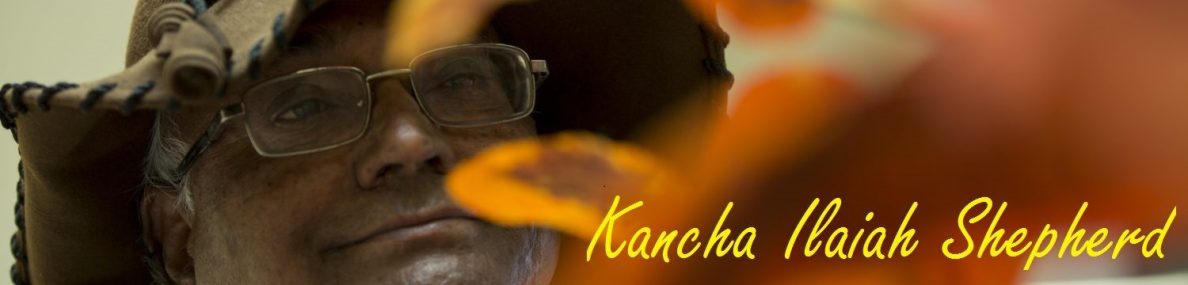
 Kancha Ilaiah Shepherd
You must be logged in to post a comment.