-
Sharad Yadav’s Efforts to Ensure the Mandal Report Was Implemented Shouldn’t Be Forgotten
All Shudra and OBC leaders, in whichever political party they are, owe their political status to this great fighter.
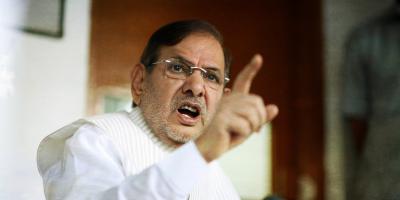
Sharad Yadav. Photo: PTI
The death of Sharad Yaday at 75 on January 12, 2023, has affected many of his followers and admirers across the country.
As a young anti-Emergency student leader from Madhya Pradesh he became a national leader after winning a parliament seat when he was just 27. From the 1974 Jayprakash Narayan movement, Yadav emerged as a socialist ideologue and a representative of the the Shudra and Other Backward Class social forces much before the concept and the category of ‘OBC’ became part of the national dictionary.
Though he was part of the young Shudra and OBC leadership that emerged in north India – chiefly from the socialist camps of Rammanohar Lohia and Karpuri Thakur – he went on to become a national face while others remained confined to their own states.
As Mulayam Singh Yadav, Lalu Prasad Yadav and Nitish Kumar went back and forth from national politics to state politics, Sharad Yadav remained in the parliament, as a seven-time Lok Sabha PM and three-time Rajya Sabha MP, often fighting pro-poor battles there. A fine speaker in Hindi and logical thinker, he was a political strategist.
It was his political strategy that forced V.P. Singh to implement the Mandal Report in the face of opposition from Devi Lal, the then Deputy Prime Minister and Jat leader.
Let me quote Sharad Yadav himself said from my book The Shudras: Vision For a New Path. Once the Janata Dal government was formed, Yadav says:
“We started mobilizing all socialist leaders and putting pressure on the Janata Dal government to fulfil its manifesto promise of implementing the recommendations of the Mandal Commission. We strongly believed that without this, no true justice would be served to Shudras. V.P. Singh’s entourage vehemently opposed the recommendations of the Mandal Commission. To overcome this, he established a committee under the chairmanship of Chaudhary Devi Lal, the deputy prime minister and a prominent Jat leader. He knew it was due to Chaudhary Charan Singh’s intervention that Mandal did not include Jats in the list of backward classes.
“However, many local Jat leaders and groups were putting pressure on their political leaders to be included in the reservation category. Taking advantage of the situation, V.P. Singh played a master stroke. He was sure that being the most prominent Jat leader, Devi Lal would not implement the Mandal recommendations without including Jats, despite the fact that he was against it. Chaudhary Ajit Singh, general secretary of the Janata Dal and minister of industry, also started campaigning for the rights of backward classes and asserted that Jats be included in the OBC list.
“Devi Lal was caught in a political dilemma: On the one hand, he did not want Ajit Singh to take credit for the inclusion of Jats as a backward class, and on the other, he could not risk the ire of his own Jat community by not including them. Therefore, V.P. Singh thought this would be the end of the discussion on the Mandal Commission.
“On 3 August 1990, V.P Singh called me in the morning and said, ‘Brother Sharad, I can’t tolerate Chaudhary Devi Lal any more.’ I assured him that I would speak to Devi Lal and close this chapter once and for all. But I requested him not to drop Devi Lal from the cabinet. To this, Singh replied that he had already sent the order to the president. This made me discontinue the conversation.
“The next morning at 7 a.m., the prime minister sent one of his close aides to my residence to request me to come over to his office. For three long hours, we discussed Devi Lal and his political stand. He wanted to take me into confidence so that I did not jump ship with Devi Lal, which would have meant that he would not have remained prime minister any more.
“Taking advantage of the situation, I urged him to announce the implementation of the Mandal Commission recommendations immediately. He first agreed to make an announcement on 15 August 1990 from Red Fort. I had to tell him clearly that if he wanted to implement the recommendations, he had to do it before 9 August 1990; otherwise I would have no choice but to join Devi Lal’s rally in Delhi. As I saw it, the implementation of these recommendations would fulfil the dreams of Ambedkar, Karpoori Thakur, Lohia and Jayaprakash Narayan, who believed and dreamt of an equitable society. The Janata Dal government he was leading and had emerged from socialist struggles.
“The backward classes who helped him get elected as prime minister, who were marginalized for more than thousands of years, were looking at him with just expectation to implement the recommendations submitted by the Mandal Commission. To save his government, Singh, after discussing it with a a few of his close political aides agreed to do so. On 6 August 1990, he called a cabinet meeting at his house at 6 p.m. with the main agenda of discussing the implementation of the Mandal Commission recommendations. Despite a warning from his close aides, the very next day, on 7 August 1990, the government accepted the Mandal Commission’s recommendations and announced that it would implement the reservation scheme under which 27 per cent jobs would be earmarked for OBCs.
“And finally, on 13 August 1990, it notified the implementation of OBC reservation. On 10 August 1990, the Dwija castes had started to protest against reservation. For about a month, students, bureaucrats and teachers participated in protests all over the country, public property was destroyed, and roads were blocked”.
But for young Sharad Yadav’s role in pushing the V.P. Singh government to implement the Mandal Commission Recommendation of 27% reservations and the pro- and anti-Mandal struggles on the streets, the Shudras and OBCs of India would not have had a crucial means to come where they have today.
But for the massive pro-Mandal social mobilisation of the Shudra and OBC population, even the Dwija-controlled Rashtriya Swayamsevak Sangh-Bharatiya Janata Party forces that opposed the Mandal reservations would not have allowed Narendra Modi, OBC leader, to lead them and become the prime minister of India.
All Shudra and OBC leaders, in whichever political party they are, owe their political status to this great fighter.
Kanca Ilaiah Shepherd is political theorist, social activist and writer. His books include God As Political Philosopher: Buddha’s Challenge Brahminism, Why I am Not a Hindu and Buffalo Nationalism.
https://m.thewire.in/article/politics/sharad-yadav-mandal-vp-singh-devi-lal
-
Yale, Oxford in India is Modi govt’s way to wedge divide, take OBCs, Dalits back to dark past
The RSS and BJP will turn India into an Indralok where the elites will enjoy the benefits of global education and Hindi-educated OBCs, Dalits will become its gatekeepers.
KANCHA ILAIAH SHEPHERD 11 January, 2023 11:53 am IST
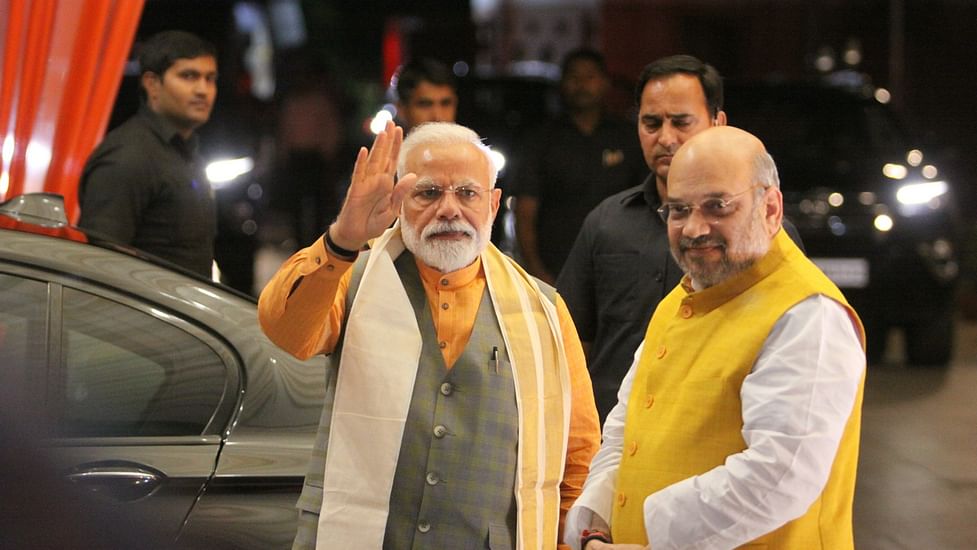
PM Narendra Modi and Home Minister Amit Shah | Praveen Jain | ThePrint File photo
The Narendra Modi government just opened India’s doors for foreign universities — Yale, Harvard, Princeton — to set up campuses in the country. The announcement was made at a press conference on 5 January held by University Grants Commission chairperson M. Jagadesh Kumar. According to media reports, “a foreign university intending to set up its campus in India should have secured a position within the top 500 in overall/subject global rankings.” It means that all these top universities of different countries will now eye new campuses on Indian soil. Obviously, courses will be taught in English with a globally competitive syllabus.
Isn’t it surprising that the Bharatiya Janata Party (BJP)-led government has allowed universities to teach courses of their choice in English?
The same government has been repeatedly saying that Hindi should be made the medium of instruction in higher educational institutions and the syllabus based more on India’s culture and heritage. The Centre is trying to force Vedic and Puranic studies into university syllabi.
Look at quality of education at home
The moot question is: Who will study at Indian universities in Hindi and who at foreign universities in English? Will foreign universities teach in Hindi with Vedic science, mathematics, and humanities as ‘global’ civilisational sources?
“The foreign university/HEI [higher education institution] will have to give the undertaking that the quality of education imparted by it at its Indian campus will be at par with that of the main campus in the country of origin, and the qualifications awarded to the students in the Indian campus will be recognised and treated as equivalent to the corresponding qualifications awarded by the foreign HEIs in the main campus for all purposes, including higher education and employment,” UGC chairperson Kumar added.
He also stressed on the autonomy that foreign universities would enjoy in India. “We are focusing on providing as much autonomy as possible. So there is not going to be any interference at all from the UGC from the operations point of view of setting up a campus in India, other than in terms of academic programmes and infrastructure in the campus,” Kumar said.
What about the quality of education in Indian universities and the employability of graduates? If the Modi government wants to further divide the country on caste and class lines with its ‘national’ versus global education, India will go back to a dark past. Shudras, Other Backward Classes (OBCs), Dalits, and Adivasis will be unable to access modern educational institutions. The benefits of reservation will amount to nothing. For the children of the productive classes, the Union government has Vidya Bharati — the network of schools run by the Rashtriya Swayamsevak Sangh (RSS). With such an education model, the RSS and BJP want Indians to become followers of the ‘great’ ancient civilisation and see advanced production, modern science, distribution of resources, and equality as ‘un-Bharatiya’. Varna-centred human relations and living in ashrams will become the ideals of society.
Meanwhile, foreign and Indian private schools and universities will educate the children of the elites and ruling class in English with Harvard, Oxford, and Yale syllabi that would connect them to the West and beyond. They will become the real vishwagurus or world leaders. Union Home Minister Amit Shah is the face of this ‘Hindutva nationalist’ education for India’s poor agrarian youth and Jagadesh Kumar that of global education for the country’s ruling class.
Not enough criticism
The secular and liberal Dvijas (twice-borns) do not lose much in this dichotomy. All of them know that their children would not be taught the Hindi-medium Vidya Bharati syllabus. Their criticism of teaching methods and pedagogy will remain vague — with no focus on the language and content — but they will talk about ‘quality’ education. What that quality would be, nobody will know.
Congress educationalists will not fight this model because they are responsible for formulating poor educational policies in the past — one reason why there are fewer English-educated intellectuals among the Shudras, OBCs, Dalits, and Adivasis.
For Muslim and Christian minority intellectuals, this educational divide may not be a bigger problem considering that a large number of Muslim students study in madrasas and Christian students in missionary schools, though they are dying. Even the Shudras and OBCs, who have been denied educational opportunities, aren’t bothered about the issue — a large number of them are hoping that Modi will deliver them from historical bondage as he is reportedly the first OBC prime minister with a Hindu samrat image.
India’s regional parties, too, do not take English-medium education for the masses seriously as that may go against their own linguistic chauvinism. OBC and Dalit organisations are more concerned about their share of reservation than the quality of education.
Equalising checkmate
The systematic backward push of the rural agrarian masses with the hypocritical education system of the RSS-BJP would have to be checkmated only by equalising school education in terms of both language and content. English-language instruction in all government schools with a superior and modern global syllabus alone will address the inequality that the Modi government’s education system will create.
The agrarian masses won a small victory by forcing the government to withdraw the draconian 2020 farm laws but never realised that their children are in greater danger with the RSS-BJP education conspiracy. Most of these foreign universities are likely to buy off the masses’ lands to set up their campuses without ensuring that their children get enrolled into them.
The ruling dispensation is planning to dismantle the educational potential of farmers’ children who would have a bleaker future due to its policies. Those from reserved categories who remain in government sector will suffer from inferiority complex once privatisation comes into full force.
The RSS and BJP will turn India into an Indralok where the elites will enjoy the benefits of global education and the Hindi-educated rural youth will become its gatekeepers.
Kancha Ilaiah Shepherd is a political theorist, social activist, and writer. He has been campaigning for English medium education in rural and urban government schools of India since the last thirty years. Views are personal.
(Edited by Humra Laeeq)
-
Opinion: RSS-BJP kill scientific thought by branding it as anti-national | The News Minute
In India, the road towards primitive controls on the thinking mind is being cemented further with each passing day, writes Kancha Ilaiah Shepherd.

PTI
FEATURES OPINION FRIDAY, JANUARY 06, 2023 – 18:06
Ever since the Rashtriya Swayamsevak Sangh (RSS) backed Bharatiya Janata Party (BJP) formed the Union government in 2014 and subsequently came to power in several states, the conflict between science and faith has occupied central space in the national discourse. Any critique of the beliefs of those who consider themselves as seriously religious, be it Hindu or Muslim, gets politicised in no time. Litigations around issues of hurt religious sentiments have increased several fold in the country. With faith being projected as the core value of the nation, science as a process of human thinking is not taken seriously, nor is it considered nationalist.
While this is the general atmosphere in the nation, Prime Minister Narendra Modi said on January 3 that India must produce more innovative science. He was speaking at the inauguration of the Science Congress. If he does not warn his own folks to not rush into every science vs faith conflict as agents of faith, how will innovative science develop? We have never seen RSS-BJP cadres and leaders defending science when there is a conflict between science and faith. They do not allow individual thinking in their ranks. The Arab rulers, or the rulers of Pakistan or Afghanistan, do not stand by any science-centred ideological position. If the present trend continues, India too will enter this trap of all faith and no science.
Today, there is a heightened tendency to project faith as nationalist and scientific thinking as anti-national. Ironically, the ruling BJP says that India is developing in such a way that it will be capable of challenging China and the West in the near future. They seem convinced that killing scientific thinking and the critical thinking abilities of children and adults is part of India’s civilisation and should become India’s agenda in the future. They also seem to be engaged in serious competition with far-right nations that treat scientific thought as blasphemy.Featured Videos from TNM
What is forgotten in the process is that human life takes form through a scientific process, and grows and develops with the help of scientific treatment in childhood. For example, when a child is born, feeding milk or other forms of food is a scientific process. From the breastfeeding stage to the solid-food-eating stage, faith does not enter a child’s life. Faith forms in a child’s mind either by observing a parent’s faith-related practices, or through a specific instruction process, like the schooling that the gurukulas and madrasas conventionally did. These institutions have no concept of scientific teaching. But the modern school is different.
The modern school system is meant to teach science and as part of it, some amount of faith-related subjects. If faith becomes the central theme of school learning, the human mind cannot work in scientific laboratories, because faith does not accept experimentation. The present political trend, which is heavily inclined towards faith, does not accept experimentation. If India is ruled by faith and faith remains the central theme of nationalism for long, the country is bound to retreat to the mediaeval age. The right-wing is likely to introduce laws that stop Indians from thinking scientifically, with the excuse that it is un-Indian and/or anti-national. The road towards primitive controls on the thinking mind is being cemented further with each passing day.
For the average Indian voter, a faith-based, non-scientific lifestyle will appear as the only way of life. We may use the science, engineering, medicine, or technology that emerged from the scientific thinking of the West as long as the supply chain from the West lasts, in the same way that we depend on oil pipelines from Russia or West Asia. Once their scientific thinking becomes inaccessible to us, we will start walking, return to primitive food habits, and live in old sheds, and still justify it all as our great civilisational values. This is inevitable as our own children are not allowed to think critically at home or on the streets. Once the young minds are not allowed to question their own and others’ practices, where will we as a country end up?
When our children see critical thinkers being attacked through TV channels and newspapers, they will begin to think that they should learn to not think like the ones their fathers abuse or mothers dislike. They too will surrender to faith and hate science. From such houses, one may become an engineer, a doctor, or a so-called scientist, through routine training. But there is no hope of developing a critical and creative mind in such a house that will, once put in a factory, hospital or lab, produce original innovations. Only the kind of faith-based ideological campaign promoted by the RSS-BJP will find acceptance in those spaces.
When there is only praise for the saint not for the tiller of the land; when there is only praise for the religious teacher not the teacher of science, from whom will a child want to learn? The leaders and cadres of the ruling RSS-BJP want to show the world the path of faith while other nations are busy expanding their base in science.
Kancha Ilaiah Shepherd is a political theorist, social activist and author. He has been campaigning for English-medium education in government schools across the country for the last 30 years. Views expressed are the author’s own.
-
Why Didn’t India’s Muslim Rulers and Thinkers Confront the Inequities of the Caste System?
Since caste was around before Islam arrived, how did Muslim clerics, scholars and rulers view it? After Islam came to India, the only writer who discussed the caste question was Alberuni in the 11th century

The dais at BJP’s Pasmanda Conference in Lucknow on October 16, 2022. Photo: By arrangement.
Last month, the South Asian Institute of Columbia University organised a seminar on ‘Afterlives of Babri Masjid: Thirty Years Later’. I made a presentation at that seminar on ‘Post-Babri Anti-Caste Movement: A New Awakening in India’.
In my abstract I said the following:
“The anti-caste movement of post-independent India has changed the track of Indian democratic discourse in the post-Babri context. I wroteWhy I am Not a HinduandPost-Hindu Indiain that context only. Though the anti-castemovement included the minorities in its agenda, the Muslims did not participate in that discourse. Muslim intellectuals remained caste blind, leaving the Dalit/OBC/Adivasis to defend themselves. Over a period of 30 years, the Dalit/OBC/Adivasis realised that caste and untouchability have destroyed their intellectual and organisational abilities to fight against Brahminism. Organised religions like Indian Islam and Christianity virtually left them to the mercy of highly English-educated and globalised Brahminic forces. This situation helped the post-Babri Hindutva forces attract them into their fold and gradually turn them into their vote bank. But at the same time a huge anti-caste ideology was developed by the post-Mandal Dalit/OBC/Adivasi intellectuals and political activists by foregrounding Ambedkar, Phule, Periyar and so on. Thissituation has created an anti-caste global ideological mobilisation. However, the future of Indian democracy and the question of a caste-free egalitarian India is still uncertain.”
After my presentation, some scholars questioned the relevance of discussing the role of Muslim intellectuals and Indian Islam’s history at a time when they are facing persecution in India. This concern was expressed even by American intellectuals working on India and other South Asian societies. While a Muslim scholar, Khalid Anis Ansari from Azim Premji University, made a presentation about the presence of caste among Indian Muslims and the ongoing oppression of Pasmanda Muslims by upper-caste Muslims, a few scholars expressed disappointment – arguing that this is not the time to raise caste discrimination within Indian Muslims as the Rashtriya Swayamsevak Sangh and the Bharatiya Janata Party are trying to exploit that division.
However, I believe it is important – even amidst the current political atmosphere – to discuss the role of Muslim intellectuals in Indian caste civilisation. This discussion is important to understand the Shudra/Dalit/Adivasi problem as well as the Muslim minority problem, so that the Muslim intelligentsia realises what the Shudra/OBC and Dalits find problematic about their relationship and history.
After the BJP came to power in 2014, there has been an intense debate about the relationship between the OBCs and Muslims, as the OBCs are seen supporting the BJP electorally and communally.
There is also a view that the OBCs participated in the Babri Masjid demolition in 1992. It is true that without OBC support, the BJP could not and cannot win elections as they are winning now. Prime Minister Narendra Modi presented himself as an OBC from Gujarat; perhaps that has also added to the BJP’s OBC mobilisation. Does it mean that the OBCs – as the historical Shudra agrarian and artisanal communities – hate Muslims? There is no evidence to support the claim that the Shudras have some theoretical or cultural antipathy towards Muslims. Whatever anti-Muslim writing there is in India has come so far from Brahmin or other Dwija writers and ideologues. The writings of V.D. Savarkar and M.S. Golwalkar are evidence.
This debate raises another question which is equally important – about the relationship between the Shudra/Dalit/Adivasi and Muslim? What was the historical role of Muslim rulers, writers and civil-spiritual intellectuals on the abolition or annihilation of caste after Islam as a religion took root in India? Did Muslims scholars and writers treat caste and human untouchability – which existed much before that religion arrived in India – as a system that could not be accepted in the world Allah created? Because Islam believes that everything – good and bad – is the creation of Allah. According to their understanding, nothing comes into existence or goes out of existence without Allah’s sanction. In that case, what about the caste system and untouchability that constructed an un-universal inequality, oppression and human degradation?
Since this system was around before Islam arrived, how did Muslim clerics and scholars view it? We would have been able to understand their view if only they had written something about it during the last 1,400-odd years of Islam’s existence in India. Unless scholars express themselves, either by writing or by preaching, even rulers will not know what to do with the system. However, it is clear from known history that India’s Muslim rulers – including the greatest of all, Akbar – did not open schools for educating the Shudras/Dalits and Adivasis. Even in kingdoms like Hyderabad, where Muslim rulers held state power till 1948, there is no evidence that mass education was provided to the Shudras/Dalits/Adivasis until some social reformers demanded such education in the Urdu language for those communities. Even then, only a handful of Shudra/Dalit/Adivasis were taught basic reading and writing skills in Urdu and Persian in Hyderabad state.
Persian and Urdu education was spread more among the Dwija castes like Brahmin, Kayastha, Khatri, Bania and Ksatriya in the whole of India, who had a Sanskrit education background. Muslim rulers and scholars also maintained caste barriers. Why? Is it because the rulers and scholars came from upper caste conversion, or is it because Islam as a religion failed to understand the evolution of the caste system and refused to study its relationship with divine creation and work out a scientific ideology to abolish that system?
In Brahminic history, caste and untouchability were practiced and written about as divinely ordained. The divine objects of the Shudra/Dalit/Adiavsis and the Dwijas differed in many aspects. But Muslims believed in one Allah. The question therefore is: what is the understanding of Muslim scholars about the relationship between Allah and caste system? Was it created by Allah as a positive and humanly necessary institution or was it created by humans?
There is a definite understanding of the relationship between men and women in relation to Allah’s creations. There is also an understanding about slaves and masters and relations between races and Allah. At the time of Prophet Mohammad’s life, all those categories of human society were present in all countries. But caste and untouchability were not there in any other nation except in South Asia, more so in the Indian subcontinent.
After Islam came to India, the only writer who discussed the caste question was Alberuni in the 11th century. Namit Arora writes,
“The four-fold varna system made a deep impression on Alberuni. He notes that members of each varna are forbidden to dine with members of other varnas. Below them are ‘people called Antyaja, who render various kinds of services’ and live outside the towns and villages of the four varnas. Then there are people called Hadi, Doma, Chandala and Badhatau, who ‘are not reckoned amongst any caste [and] are occupied with dirty work, like the cleansing of the villages and other services… In fact, they are considered illegitimate children; for according to general opinion they descend from a Shudra father and a Brahmin mother as the children of fornication; therefore, they are degraded outcasts’.”
Alberuni also disagreed with the Brahmanical view of human purity and pollution, which is the key notion for sustenance of human untouchability in India. Purity and pollution had huge implications to production. Way back in the 11th century, he said that Islam does not accept such ideas of human purity and pollution. What happened to this understanding? Why did Muslim scholars fail to educate Muslim rulers on abolishing caste and untouchability through legal firmans? The abolition of caste would have been possible even without resorting to conversion.
Many Muslim scholars are now saying that conversion did not kill caste practices within Indian Islamic society. What would have been a better way of abolishing caste practices? If such ideas were put on the record by Muslim scholars, Muslim kings may have agreed to make changes.
The fact is that Muslim scholars did not do any intellectual work to create anti-caste awareness among themselves and also among the Other – the Shudra/Dalit/Adivasis. Instead, till the post-Mandal realisation that without reservation the Pasmandas too would not progress came about, they did not talk about the caste system at all.
Unlike among the Shudra/OBC/Dalits, there was no focused spiritual denial of education for Muslim lower castes. Yet there is a caste distinction between the upper caste converts and the Shudra/Dalit converts. Where does the problem lie? In Hindu Brahminsm, there is a stated scriptural and practical forced denial of the right to education to the productive castes. The Shudra/Dalits did not fight because of divine fear, which was injected through the karma and punarjanma (rebirth cycles) theories. But what sustained caste in Indian Islam?
Among Indian Muslims, there were scores of English-educated intellectuals from the early days of the freedom struggle. Such modern English educated Shudra/Dalits were few and far between. Until Ambedkar emerged, nobody diagnosed the roots of caste from among them in a scientific manner. Muslim scholars claimed the presence of scientific enquiry in their intellectual history. The Brahminic intellectuals, whether modern English educated or classical Sanskrit or Persian educated, refused to study the roots of caste and work out abolitionist solutions because that would go against the ethics of Brahmanism.
Among Muslims, Sir Syed Ahmed Khan (1817–1898) promoted English education around the same time when Brahmins, Banias, Kayastas and Khatris started learning English and studying in England in the 19th century. Muhammad Ali Jinnah and Allama Iqbal (both of whom were upper-caste converts) and many other Muslims were educated in English in England. Aligarh Muslim University and Jamia Millia taught the Muslim youth in English medium from their early days. The Indian Muslim community had the intellectual resources to undertake studies on the caste system. Even after Ambedkar put the question of caste on the national map, not a single Muslim intellectual studied caste from the point of view their own religion and proposed a serious solution to the question. Maulana Abul Kalam Azad was totally silent about it in his writings.
This historical background brings us to the question: who is at fault? How can the Shudra-OBCs/Dalits who had no educational resources like Muslim intellectuals find a solution to Muslim backwardness, poverty, unemployment and casteism among them? Even now, Muslim intellectuals do not engage themselves with the much bigger problem of caste and untouchability. Shudra/Dalit/Adivasi intellectuals need to raise these questions.
Kanca Ilaiah Shepherd is political theorist, social activist and writer. His books include God As Political Philosopher: Buddha’s Challenge Brahminism, Why I am Not a Hindu and Buffalo Nationalism.
-
Why Some Telugu Groups in America are Opposed to Providing English Education to the Poor in Andhra? – American Kahani

DECEMBER 31, 2022
- Under the pretext of ‘saving the mother tongue,’ these NRIs are opposing English medium government schools — where Dalits and other marginalized groups get an education — even as they and their relatives in India provide their children with the best English education available. That’s hypocrisy.
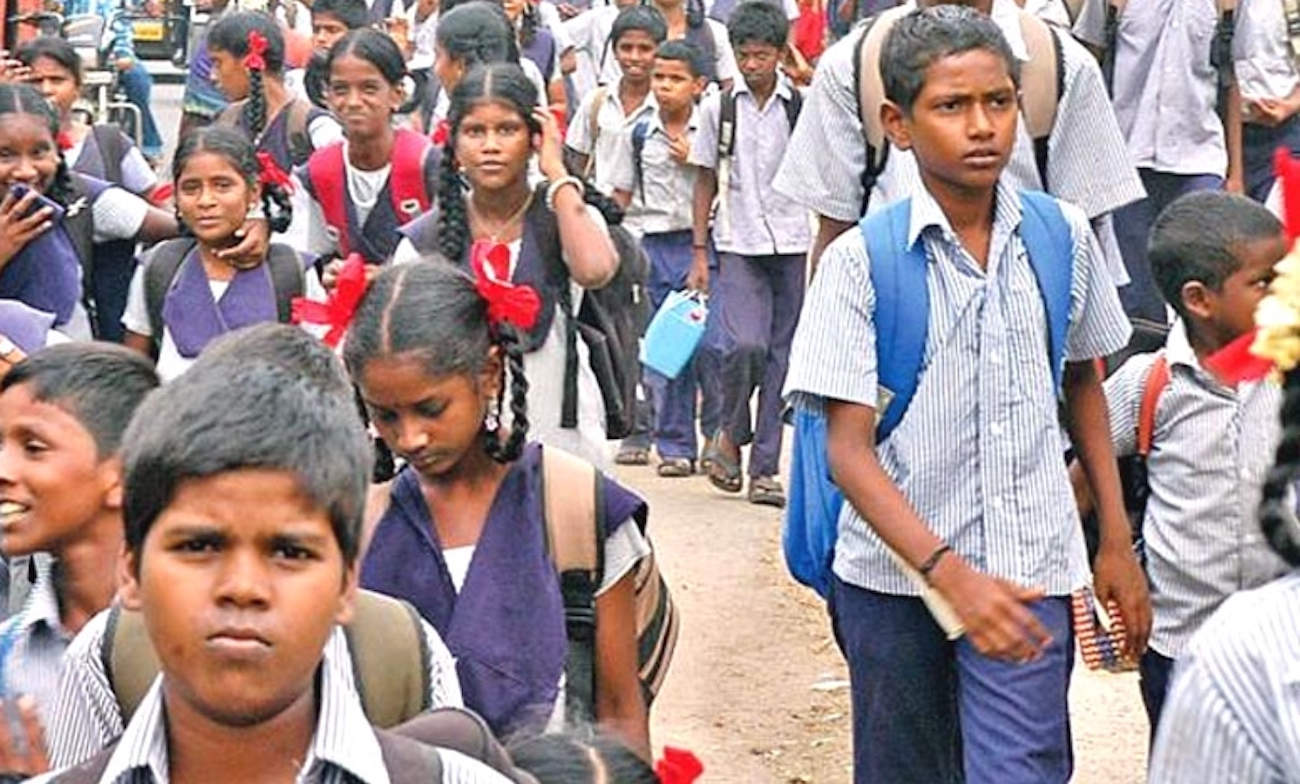
“Kuvempu took the knowledge that English had to offer while also delivering a blistering critique of the language as a vehicle of colonialism. If it were not for English, he would have been condemned (as a Shudra) to clean vessels in a Brahmin’s house.”
— Rajendra Chenni, a chronicler of famous Karnataka Shudrawriter and thinker, Kuvempu (1904-1994). Deccan Herald, 12/29/2022
The Telugu Association of North America (TANA), Silicon Andhra, TANA World Literature Platform and Siddhartha Academy have jointly organized World Telugu Writers Conference in Vijayawada on 23 and 24 December. The theme of the conference was: “Let’s protect our mother tongue! Let’s build self-esteem.”
Obviously, the conference was organized mainly to oppose English medium education in government schools in Andhra Pradesh, which was decreed by Y.S. Jaganmohan Reddy when he became the Chief Minister of the state in 2019. Before that, the poor Dalit/Tribal/Shudra and Other Backward Classes (OBC) children could only study in Telugu medium schools.
The chief minister, however, mandated English medium education in all government schools from the academic year 2019-20. Such a game-changing step in the school education system in India was resisted by many Telugu leaders including Chandrababu Naidu and Venkaiah Naidu. Several court cases and ideological battles had to be fought on this issue by the chief minister before he succeeded. Now his education model is influencing the whole country. Already the Telangana government which was earlier opposed had to come around and introduced English medium in all state government schools.
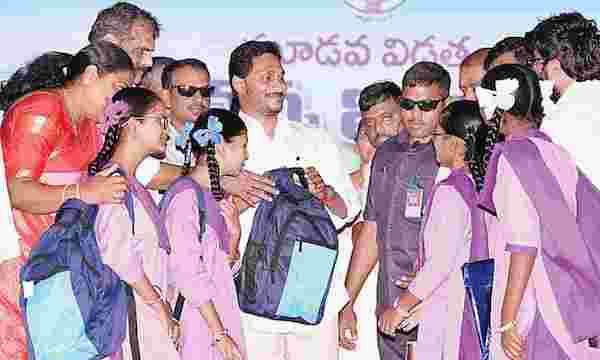
Andhra Chief Minister Y.S. Jaganmohan Reddy with school teachers and children. Top photo, representative image, courtesy of the Deccan Chronicle.PIN IT
The AP state government was the first to introduce English medium school education from class 1 to class 10 on par with the private English medium schools where the children of the rich study. The AP model stabilized English medium but has kept Telugu as a subject compulsory both in government and private schools. This is a new innovative experiment to strengthen English among the poor youth and also protect their native language.
Quite strangely, TANA leaders who live in the ‘English world’ are opposing teaching in the English language in government schools in India. How can people who went away from this region, and educate their children and grandchildren in world-class government-run English medium schools in America, protect Telugu in Andhra Pradesh?
Several Non-Resident Indians (NRIs) who support the Rashtriya Swayamsevak Sangh and Bharatiya Janata Party Government in Delhi, like the American Hindu Foundation, campaign for “One Nation One Language (Hindi)” while living in the U.S. and educating their children in English which gives them access to the best of science and technology and humanities. That’s hypocrisy.
Neither TANA members nor other NRIs send their children back to India to get Telugu or Hindi medium education. Most of them invest their dollars in private English medium schools and universities in India, into which the subsistence farmers, laborers and artisans cannot even dream of getting admission.
Even though these NRIs want their relatives in India to get rich and have the best jobs that the private English education provides them, or enable them to emigrate to America or Europe, they are opposed to Dalits/tribals and OBCs studying in English.
Not a single NRI has established a quality Telugu or Hindi or any other so-called vernacular language school or college in India and educated the poor free of cost or with minimum cost. India for them is the motherland for making more dollars in education-business, that too, only in English medium. It’s not social service.
These organizations and their leaders follow a classical Indian deceptive design that the Shudra/OBC/Dalit/Adivasis should not be educated in a language that prepares them for good jobs in India or gives access to the international job markets.
In India, access to lucrative careers and professions is controlled by upper castes educated in private English medium schools. Even some of the World Bank and IMF officials of Indian origin, who mostly live in America or Europe, think that English medium education should not be given to the productive masses of India. They speciously cite the example of African countries that are getting Anglicized by leaving behind their traditional tribal cultures.
But these same officials do not follow their ancestral Brahminic culture by studying in Sanskrit and following their traditions. They have instead studied in private English medium schools, put their children in either American or British schools and enjoy Western lifestyles.
Some of them argue that poor quality schools in the government sector with untrained teachers do not suit English medium education in India. That is not true because every graduate in India studies English from grade six, hence every school teacher is proficient in English. Besides, somewhere the shift has to take place towards educational equality in language and content. The AP Government has been giving basic training to teach in English and supplied mirror-image books to students and teachers (every textbook has one side of the page in English and the opposite side in Telugu). These textbooks make the job of teacher and student easy to read in both languages. Bilingualism is protected with this method and augurs well for teaching. Despite all these efforts, why are the NRIs opposed to English medium education in government schools and joining hands with anti-poor forces in India in the name of love for the mother tongue?
It is absurd that those children whose parents speak and work in English in the U.S. pretend that Telugu remains their mother tongue and they want to protect it from the danger of poor people in India learning English! Even though these NRIs want their relatives in India to get rich and have the best jobs that the private English education provides them, or enable them to emigrate to America or Europe, they are opposed to Dalits/tribals and OBCs studying in English. Could it be that they do not want the poor to compete with their upper-caste relatives?
That is the problem. For these NRIs, the American standards of equality are not for India. The class herd and caste mentality are deeply ingrained into their psyche. They don’t understand that language and culture are not the same. And that culture changes constantly. Many unused languages die and new languages emerge. What is important is human well-being, equality and modernization of societies.
The groups that went in search of a good life in foreign lands with the help of English and visit India once in a while to teach morals to those who are living there, is immoral. This emigre immorality does not serve the national interest of India.
Kancha Ilaiah Shepherd is an Indian author, activist and columnist. He is a retired professor of Political Science at Osmania University in Hyderabad. His well-known books include, “Why I am Not a Hindu,” “Post-Hindu India,” and “God As Political Philosopher.” He has written extensively about the relationship between Spiritual Democracy and Political Democracy. His book “Buffalo Nationalism” is a critique of cow worship and cow nationalism of the Hindutva forces. He believes that the dignity of labor must be integrative of spiritual philosophy to abolish caste and race inequalities. He has been campaigning for English medium education in government schools for the last three decades.
-
Not just BJP, Left has also kept masses away from English education – The Federal
Communist leaders preach and practise exactly what the Sangh Parivar leaders do — English medium for the netas and regional language education for the masses
6:30 AM, 27 December, 2022
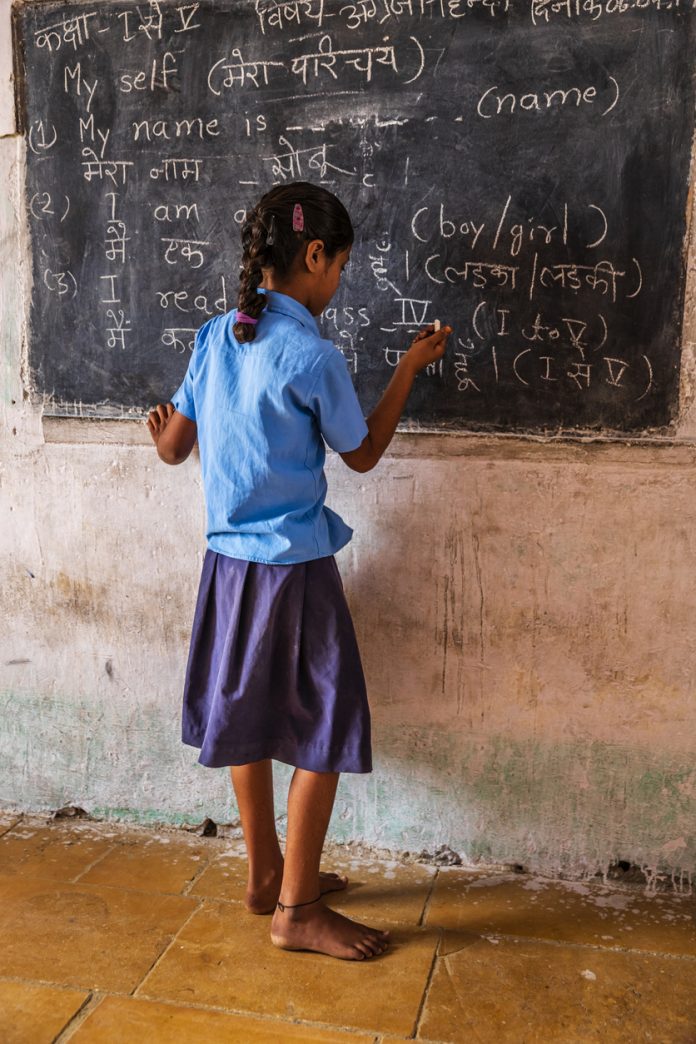
State governments should take steps to shift all government schools to English medium. Image: iStock
Rahul Gandhi’s stand on English medium education for all children on the basis of language and knowledge equality is a challenge not only to the RSS-BJP ruling class, but also to the Communist dual stand on the school education system. On the question of English-medium education for all classes, Communist leaders preached and practised exactly what the RSS-BJP leaders did — English medium for the leaders and regional language education for the masses.
Addressing a rally in Rajasthan’s Alwar as a part of the party’s Bharat Jodo Yatra, Rahul said: “BJP leaders don’t want English to be taught in schools. But the children of all their leaders go to English-medium schools. Actually, they don’t want the children of poor farmers and labourers to learn English, dream big and get out of the fields.”
He also said that all the RSS-BJP leaders, including Amit Shah, who is spearheading the movement for anti-English and pro-Hindi school college and university education in the government sector, send their own children to high-class private English-medium schools, colleges and universities. The RSS-BJP leaders’ nation is not ‘one’ when it comes to the life of their own children and the children of the productive masses, he added.
The CPI, CPM and other small Maoist/Naxalite group leaders have never taken a stand on the potential social, political and cultural revolutionary agent, English-medium education for all. At least, not like Rahul Gandhi took during his Bharat Jodo Yatra. They know very well that education is in the concurrent list of the Constitution and the state governments have full powers to implement equal language and content education for all — the working class and the bourgeoisie.
Dual education system
The Communist leaders of India mostly are petty-bourgeoisie and upper caste. They too educate their own children in the best English-medium schools available in their respective states and also in national institutions, and leave the children of the food-producing parents to regional languages with sub-standard syllabi.
But even in states like West Bengal and Kerala, where they were/are in power for a long time, they have followed a dual education system of private English and public Bengali/Malayalam. Their central committees and Politburos have never seriously discussed the role of English-medium education in India. After over 200 years of its existence, how can English still be called colonial?
The Left leaders know that all the major institutions of India conduct their business in English and if the rural people do not learn that language, they will be slaves in democratic India, too.
In fact, for a long time, they propagated the same kind of mother tongue chauvinist ideology like the RSS-BJP. The believers in Communist internationalism and in the theory of ‘Workers of the World Unite’ closed a channel of international communication for the working class of India by asking them to educate themselves in regional languages.
In what language should the working class of the world speak to each other if not in English?
English not a foreign language
Unlike the RSS-BJP leaders who read only Indian works like the Vedas, the Ramayana, the Mahabharata, and the Manu Dharma in Sanskrit or in regional languages, the Communist leaders read the writings of Marx, Lenin, Mao and, of course, some Indian books, in English. But they never realised that English as an international language must also reach the children of the working class.
After 75 years of Independence and about 100 years of existence of the Communist ideology in India, English still remains a foreign language for the working class but it remains the ‘home language’ of the top national level Communist leaders.
The idea that ‘English is a colonial language’ has become a tool in the hands of all political leaders to keep the working mass as modern blind followers without acquiring the ability to question them. In the RSS-BJP, at least many top leaders like Mohan Bhagwat, Narendra Modi and Amit Shah cannot speak and write good English. The situation among the Communist leaders is different. In their committee meetings, they use only English.
Rahul Gandhi comes from a family of three generations of prime ministers and the longest-serving Congress party president, Sonia Gandhi. But, unlike other leaders, he realised in the padayatra the difference between South and North, between English-medium educated youth and regional language-educated youth. He saw the difference in their dreams. He knows the opportunities in an advanced capitalist globalised and liberalised world for English-educated youth.
That is the reason why, to counter the Modi-Shah “One Language (Hindi) One Nation” theory, he said that with Hindi they cannot dream big, cannot get out of farm labour, cannot engage with America, Europe and so on. Is it not true?
Tool for communication
How can Communists not understand the basic truth that without English they cannot also speak to China, Russia and the whole of Africa, which was also liberated from colonialism much later than us? What is the national language of South Africa today? Is it not English? How can a Communist’s dialectical thinking miss out this fact?
It is for MK Stalin as the Chief Minister of Tamil Nadu and Pinarayi Vijayan, as the Chief Minister of Kerala, to take a call and introduce the Andhra Pradesh and Telangana model of English medium in government schools with one language (Tamil/Malayalam).
If the Congress comes to power in Karnataka in the next election, that government will have to follow the advice of Rahul Gandhi. Then the whole South would have shifted to English-medium education in government schools.
The Tamil Dalits are more sentimental about their Tamil nationalism. The Tamil Brahmins and Chettiars shifted to complete English-medium education a long time back. Gita Ramasway, in her memoir Land, Guns, Caste, Women, tells how the most conservative Brahmin families sent their girl children to Catholic Christian schools. She also tells how the children and the parents went through the trauma of confronting the cultural clash between primitive Brahmin family culture and liberating English-medium school culture.
Path to success
English-medium education has made most conservative Brahmins global citizens and rulers now. Kamala Harris and Rishi Sunak are outstanding examples of that transformation. All other castes would have produced such global rulers if they too were given English-medium education.
The Brahmin migrants to America are realising their American dream. US Vice-President Kamala Harris, Google CEO Sundar Pichai, and former Coca-Cola CEO Indra Nooyi are known big Tamil Brahmin names that got everything in the world with English language education.
The Dalits of Tamil Nadu and Kerala should not live in a fool’s paradise for long. The government schools currently teach only one subject in English from classes 1 to 10 in both the states. That is not going to help in the future. It should be English-medium school education for all with one subject in regional language.
The regional political leaders are afraid of hypocritical intellectuals and media network owners, who educate their own children in English medium private schools and preach about Tamil, Malayalam, Kannada sub-nationalist pride. Such an intellectual class must be opposed with all the strength at the command of Dalit/Adivasi organic intellectuals, and English education should be pushed into their families and communities. That is the only way out of their historical enslavement.
(Kancha Ilaiah Shepherd is a political theorist and author. He has been campaigning for English medium education in all government schools of India for the past 30 years.)
https://thefederal.com/opinion/not-just-bjp-left-has-also-kept-masses-away-from-english-education/
-
Indian education wedged a huge Hindi vs English class system. Only Rahul Gandhi can break it
From Nehru to Amit Shah, Indian leaders have been hypocrites toward English medium education. Congress must encourage all to adopt English as the national language.
23 December, 2022 11:14 am IST
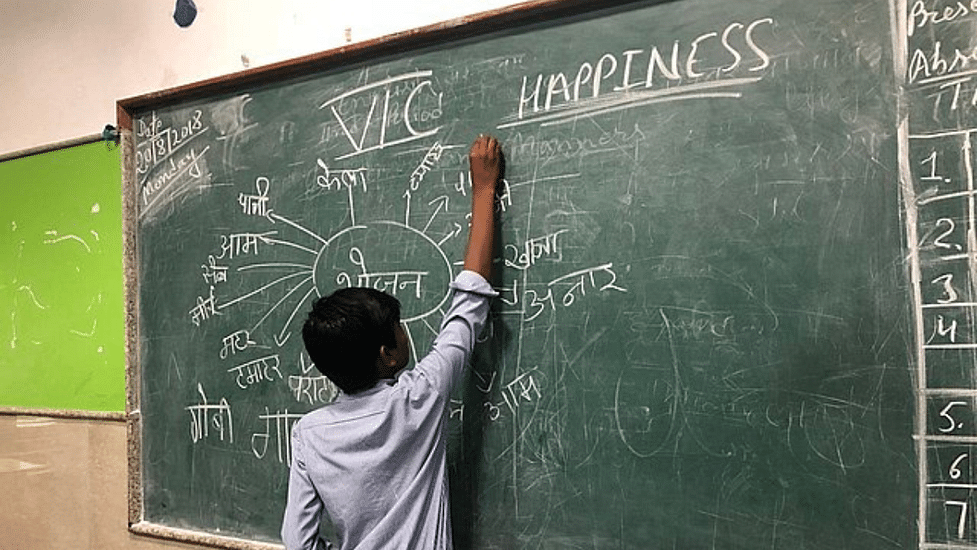
Delhi government school student defines happiness in a class | Wikimedia Commons
Addressing a rally in Rajasthan’s Alwar as a part of the Bharat Jodo Yatra, Rahul Gandhi said, “BJP leaders don’t want English to be taught in schools. But their children go to English medium schools. Actually, they don’t want children of poor farmers and labourers to learn English, dream big, and get out of the fields.” Having traversed through South India, where Andhra Pradesh Chief Minister Y.S. Jagan Mohan Reddy introduced English medium education in government schools in 2019 and Telangana followed suit, Rahul is now in the North to speak about it.
For the first time, a national leader has taken a clear stand against Prime Minister Narendra Modi and Home Minister Amit Shah’s push for Hindi in educational institutions — from schools to universities. The push is a part of the Rashtriya Swayamsevak Sangh’s (RSS) ‘One Nation, One Language’ agenda, which leaves English medium education to private institutions. Colleges such as Mumbai’s Dhirubhai Ambani International School, Haryana’s Ashoka University, or Noida’s Amity University would be available for the rich, but the agrarian and artisan communities living in India’s villages would be forced to learn local languages and have no global exposure.
Rahul Gandhi’s call for providing English medium education to India’s poor will generate a national debate on language politics and equality of education for all. Saying that this was the ‘Congress’ policy’, he has surprised the top RSS-BJP and Communist leaders. In whichever states the BJP has come to power, it has refrained from providing equal, English medium education for all. The Communists did not do that in West Bengal and aren’t doing it in Kerala either. The RSS and BJP are now trying to turn all government schools and colleges, including medicine and engineering in Madhya Pradesh and Uttar Pradesh, into Hindi medium institutions. The move has a clear direction at its core — ‘Hindi for the poor’.
75-year-old hypocrisy
Rahul Gandhi is all set to change the private English medium and public regional language education policy adopted during Nehruvian days. As the first Prime Minister of newly independent, communal India, Nehru was very much confused over the ‘English vs Hindi’ as the national language debate.
Babasaheb B.R. Ambedkar was all for English medium education in government institutions, but that resolution was defeated in Parliament by one vote — of the first Indian President Rajendra Prasad. But, at the same time, the children and grandchildren of all the big leaders — M.K. Gandhi, Nehru, Prasad — studied in private English medium schools. The same trend was later adopted by the RSS, the Bharatiya Jana Sangh, BJP, and Communist leaders. This hypocrisy kept the children of the productive masses in modern slavish conditions with poor regional language education. It was only challenged by Jagan Mohan Reddy in 2019.
Regional leaders must step forward
Now, with Rahul Gandhi taking a pro-English position alongside party president Mallikarjun Kharge, Congress will have to direct all its state units to work out modalities to put a new education policy in the party manifesto for the 2024 Lok Sabha election.
The regional parties of the Hindi belt have to seriously think about the future of the Shudra, Dalit, and Adivasi children getting Hindi medium education. Akhilesh Yadav in Uttar Pradesh and Nitish Kumar and Tejashwi Yadav in Bihar have to come up with their education policy, particularly on English language instruction in government schools. Many of these regional leaders are Hindi chauvinists; their children were sent to private English medium schools. They do not spend an adequate amount of the state budget on quality English medium schools and colleges. They all prefer to keep children in rural areas either illiterate or poorly educated in regional languages. To say the least, it is an anti-constitutional education system as it keeps the poor educated in regional languages that offer little use in real life. Constitutional equality, essentially, must provide equal opportunities in the domain of education and knowledge.
Apart from political parties, there are a number of non-governmental organisations in India that practise the same hypocrisy — educating their children in private English medium schools, but remaining silent on the push toward regional language education. Unless all sections of political and civil society assert that all children, irrespective of class, caste, or region, should have the right to English language education along with a second regional language, India cannot achieve equality. Unless all people speak one language, they will not be able to communicate with people from other regions. They will not be able to speak to the world either.
Abolish the language divide
Reaching out for opportunities is every child’s right. English language education should not create a new Indian class system where the rich have access to knowledge structures and the poor remain at the margins. All these years, the Indian education system has created a class system built on language politics. Now it must be done away with. Communist leaders who organised people to abolish the class system should take up this issue instead of being silent on educational equality all these years.
And RSS-BJP leaders cannot counter Rahul Gandhi when he talked about their own children getting private education in English.
Rahul, with his unshaven face and arm-in-arm with children on his padayatra, looks less a saint than just another of India’s poor reconnecting with the country’s ground realities. He is now prepared to spread equality in education, build peace and integrate life in a modern democratic nation. A common language to communicate with each other without any inferiority complex is the first requirement. One hopes that Rahul Gandhi’s Bharat Jodo Yatra encourages India to adopt English as its national language and make it accessible to every child in the future.
Kancha Ilaiah Shepherd is a political theorist, social activist, and writer. He has been campaigning for English medium education in rural and urban government schools of India since the last thirty years. Views are personal.
(Edited by Humra Laeeq)
-
The Anti-Caste Pen Force
By Kancha Ilaiah Shepherd
One who practices caste is a devil
That devil has to be driven out of India
India must be made a country of equality.The tiller must sow the letters of English
Our soil must become a global knowledge power
Caste has cultivated mindlessness
The anti-caste pen will have to change India.Nationalism is not casteism
Caste and race were born twins,
We lost the battles of bows and arrows
We lost the battles of guns.Now it is time for battles with pens,
Phule Ambedkar were first pen warriors
Walking ahead of us with books that lead us
They learned English to defeat Sanskrit.They are not dead but alive in letter and spirit,
Let us create an anti-caste pen force in every house
Let us make every village a pen force,
Let us liberate India from casteism and Brahminism.Kancha Ilaiah Shepherd is a political theorist, social activist. His autobiography is From a Shepherd Boy to An Intellectual–My Memoirs and Untouchable God
https://countercurrents.org/2022/11/the-anti-caste-pen-force/
-
ईडब्ल्यूएस आरक्षण : अदालतों में अनेकानेक आंबेडकर की दरकार – Forward Press
एक मत यह है कि संविधान में संशोधन कर उसमें जाति-आधारित भेदभाव से निपटने के लिए उपयुक्त प्रावधान जोड़े जाना इस दलदल से बाहर निकलने का एकमात्र तरीका है। लेकिन इसके लिए नागरिक समाज व विधिक और बौद्धिक क्षेत्रों में भी एक मजबूत आंदोलन आवश्यक होगा। पढ़ें, कांचा आइलैया शेपर्ड का यह आलेख
कांचा आइलैया शेपर्ड November 21, 2022

आर्थिक दृष्टि से कमजोर वर्गों (ईडब्ल्यूएस) के लिए आरक्षण के संबंध में उच्चतम न्यायालय की पांच जजों की संविधान पीठ का निर्णय अनुसूचित जातियों (एससी), अनुसूचित जनजातियों (एसटी) और पिछड़ा वर्ग (ओबीसी) के लिए सामाजिक-आर्थिक दृष्टि से प्रतिगामी है या प्रगतिशील, इस मुद्दे पर पूरे देश में एक बहस छिड़ी हुई है।
गत 10 नवंबर, 2022 को ऑल बार एसोसिएशन (एबीए) एवं ऑल इंडिया बैकवर्ड एंड मायनरिटी कम्युनिटीज एम्प्लाइज फेडरेशन (बामसेफ) द्वारा एक ऑनलाइन सेमिनार का आयोजन किया गया। सेमिनार का विचारार्थ विषय था कि न्यायपालिका व सरकार के हाथों ठगे जाने से उत्पादक ओबीसी, एससी व एसटी वर्गों को बचाने के लिए भविष्य में क्या किया जा सकता है।
उच्चतम न्यायालय की पीठ ने तीन-दो के बहुमत से सरकार के निर्णय को सही ठहराया। दो जजों, जिनमें निवर्तमान मुख्य न्यायाधीश यू. यू. ललित शामिल थे, ने अपने अलग निर्णयों में कई कठिन प्रश्न उठाए। एबीए से जुड़े वकीलों, जिनमें से कुछ याचिकाकर्ता की विधिक टीम में भी थे, का कहना था कि संविधान में कहीं भी जाति को एक ऐसी संस्था नहीं बताया गया है, जिसका उन्मूलन, जातिमुक्त और समानता पर आधारित समाज के निर्माण के लिए आवश्यक है।
संविधान का अनुच्छेद 46 कहता है– “राज्य जनता के दुर्बल वर्गों, विशिष्टतः अनुसूचित जातियों और अनुसूचित जनजातियों के शिक्षा व अर्थ संबंधी हितों की विशेष सावधानी से अभिवृद्धि करेगा और सामाजिक अन्याय व सभी प्रकार के शोषण से उनकी संरक्षा करेगा।”
इस तरह संविधान में ‘जाति’ शब्द का प्रयोग केवल ‘अनुसूचित जाति’ शब्द के हिस्से के रूप में किया गया है। संविधान में कहीं भी शूद्रों/ओबीसी को उनकी जाति के कारण दमित वर्ग नहीं कहा गया है। उन्हें केवल ‘पिछड़े हुए नागरिकों का वर्ग’ (अनुच्छेद 16) और ‘सामाजिक और शैक्षणिक दृष्टि से पिछड़े हुए नागरिकों का वर्ग’ (अनुच्छेद 15) निरूपित किया गया है। ओबीसी आरक्षण के मामले में ‘वर्ग’ शब्द के इस्तेमाल ने सभी पार्टियों के आरक्षण-विरोधी राजनेताओं, बुद्धिजीवियों, मीडिया इत्यादि को वर्ग-आधारित आरक्षण की मांग करने का मौका दे दिया। इसी मांग को पूरा करने के लिए संविधान के 103वें संशोधन के जरिए ईडब्ल्यूएस को आरक्षण प्रदान किया गया और इस निर्णय पर अब उच्चतम न्यायालय ने अपनी मुहर लगा दी है।
न्यायपालिका के अधिकांश सदस्य ऐसे किसी भी वर्ग, जिसमें सभी जातियां शामिल हों, को आरक्षण प्रदान करने के लिए इसलिए उद्यत रहते हैं क्योंकि इससे द्विज जातियों को भी लाभ होता है। आर्थिक मानदंडों पर आधारित आरक्षण से द्विज जातियों के अपेक्षाकृत कम समृद्ध सदस्यों को शिक्षा और नौकरियों में अधिक अवसर उपलब्ध हो जाएंगे। जहां तक समृद्ध द्विजों का प्रश्न है वे पहले से ही राज्य तंत्र पर हावी हैं।
संविधान के मूलभूत ढ़ांचे को परिभाषित करते समय उन प्रावधानों को भी ध्यान में रखा जाना चाहिए जो जाति, वर्ग, नस्ल, लिंग, जन्म स्थान आदि के आधार पर भेदभाव के निवारण की बात करते हैं। सन् 1990 के दशक की शुरूआत में मंडल आयोग की सिफारिशें लागू होने के बाद से ही वामपंथी, उदारवादी और हिंदुत्ववादी विचारक, आर्थिक मानदंडों पर आरक्षण की वकालत करते आए हैं, क्योंकि वे जान-बूझकर जाति-आधारित श्रेणीबद्ध अशिक्षा, गरीबी, असमानता, दमन और शोषण के महत्व और प्रभाव को कम करके बताना चाहते हैं। जजों व विधिवेत्ताओं द्वारा संविधान की व्याख्याओं में अधिकांशतः वर्ग पर जोर दिया जाता है। उनकी मान्यता यही है कि जाति नहीं वरन् वर्ग आरक्षण प्रदान करने का सबसे उपयुक्त आधार है।डॉ0 बी. आर. अम्बेडकर की प्रतिमा
दुखद यह कि डॉ. आंबेडकर के बाद एससी, एसटी व ओबीसी वर्गों से एक भी मेधावी विधिवेत्ता नहीं उभरा, जो उनकी मृत्यु के बाद लिए गए गलत निर्णयों का विरोध कर सकता है। इस कमी को दूर करने की जरूरत है। इस सिलसिले में एक मत यह है संविधान में संशोधन कर उसमें जाति-आधारित भेदभाव से निपटने के लिए उपयुक्त प्रावधान जोड़ा जाना इस दलदल से निकलने का एकमात्र तरीका है। लेकिन इसके लिए नागरिक समाज व विधिक और बौद्धिक क्षेत्रों में एक मजबूत आंदोलन आवश्यक होगा।
राष्ट्रीय स्वयंसेवक संघ (आरएसएस) व भारतीय जनता पार्टी (भाजपा) भले ही मुसलमान और ईसाई अल्पसंख्यक समुदायों के बरक्स हिंदुओं की एकता की बात करते हों, परंतु वास्तव में वे सभी क्षेत्रों में शूद्र ओबीसी, एससी व एसटी को पीछे धकेलने में लगे हैं। न्यायपालिका उनकी गतिविधियों का सबसे बड़ा केंद्र है। संविधान में राज्य के विभिन्न अंगों के बीच शक्तियों के विभाजन के चलते, न्यायपालिका ही लोकतंत्र की नियति की नियंता है। इसलिए यह जरूरी है कि न्यायपालिका को समावेशी बनाया जाए और उसमें ओबीसी, एससी व एसटी समुदायों के ऐसे व्यक्तियों को आनुपातिक प्रतिनिधित्व दिया जाए, जिन्हें भारतीय विधि के साथ-साथ दुनिया के अन्य देशों की विधि का भी समुचित ज्ञान हो। यह जरूरी है कि इन वर्गों के लोग आंबेडकर की तरह कानून के विशेषज्ञ बनें। न्यायसंगत समावेशिता के साथ संतुलित लोकतंत्र की स्थापना का कोई अन्य तरीका नहीं है। आम लोग मुकदमेबाजी की जटिलताओं को नहीं समझते। केवल ओबीसी/एससी/एसटी वर्गों के प्रशिक्षित व योग्य विधि विशेषज्ञ ही कानूनी लड़ाईयां लड़कर सही अर्थों में प्रतिनिधिक राज्य की स्थापना की राह प्रशस्त कर सकते हैं।
चूंकि कानूनों की व्याख्या करने का अधिकार न्यायपालिका को है, इसलिए जब तक न्यायपालिका के सभी स्तरों – विशेषकर, उच्च व उच्चतम न्यायालयों – में उत्पादक वर्गों के विधि विशेषज्ञों की मौजूदगी नहीं होगी तब तक न्यायिक प्रणाली में इन वर्गों के हितों की संरक्षा करना असंभव होगा। इस संदर्भ में अंग्रेजी भाषा के समुचित ज्ञान की महत्वपूर्ण भूमिका है। अंग्रेजी का अच्छा ज्ञान रखने वाले इन वर्गों के विधि विशेषज्ञों के अभाव में एससी, एसटी व ओबीसी हमेशा राजनैतिक और क़ानूनी चालाकियों के शिकार बनते रहेंगे। उन्हें पता ही नहीं चलेगा कि सत्ता के गलियारों, जो उच्चतम न्यायालय से होकर भी गुज़रते हैं, में क्या चल रहा है।
जन-आंदोलनों व संसद में तीखी बहसों से न्यायपालिका अप्रभावित रहती है। संसद में ओबीसी, एससी व एससी सांसदों का बहुमत है। इसके बाद भी सत्ता पर काबिज़ ताकतें बिना किसी रोक-टोक के बिजली की गति से इन वर्गों के हितों के खिलाफ नए कानून या संवैधानिक संशोधन पारित करवाने में सफल हो जातीं हैं, जैसा कि ईडब्ल्यूएस के लिए आरक्षण का प्रावधान करने के मामले में हमने देखा। संसद में अपने भारी बहुमत का लाभ उठाते हुए आरएसएस-भाजपा जिस धूर्तता से इन वर्गों के अधिकारों का दमन कर रही है, वैसा तो पूर्व की कांग्रेस सरकारों ने भी नहीं किया।
दरअसल समस्या यह कि चाहे वह बार (वकील) हों या बेंच (न्यायाधीश) – दोनों में एससी, एसटी व ओबीसी वर्गों के प्रतिनिधि बहुत कम हैं और जो हैं भी वे जो खेल चल रहा है, उसे समझने में अक्षम हैं। उत्पादक वर्गों को आंबेडकर के स्तर के मेधावी विधिक बुद्धिजीवी चाहिए, जो कपट चालों को समझ सकें और जो पूरे देश को यह समझा सकें कि उत्पादक वर्ग, जिन्हें पिछले कई सालों में कुछ भी हासिल नहीं हुआ है, अब और बेवक़ूफ़ बनने के लिए तैयार नहीं है। क़ानूनी लड़ाईयों के साथ-साथ उन्हें सड़कों पर भी लड़ना होगा।
द्रविड़ मुनेत्र कड़गम (डीएमके) के अलावा, किसी अन्य शूद्र / ओबीसी क्षेत्रीय दल में ऐसी लड़ाईयां लड़ने की हिम्मत और माद्दा नहीं है। वे अपने-अपने राज्यों के चंद द्विज वोटों पर अत्यंत निर्भर हैं।
एक अन्य समस्या यह है कि वे शूद्र जो ओबीसी आरक्षण के लिए पात्र नहीं हैं, जैसे जाट, पटेल, रेड्डी, कम्मा, वेलामा, नायर, वे भी ईडब्ल्यूएस आरक्षण का समर्थन कर रहे हैं क्योंकि उन्हें उम्मीद है कि इससे उनके समुदायों के युवाओं को शैक्षणिक संस्थाओं में प्रवेश व सरकारी नौकरियां मिल सकेंगीं। लेकिन केंद्रीय शिक्षण संस्थानों में ईडब्ल्यूएस कोटा के कार्यान्वयन के पिछले दो वर्षों के आंकड़ों से साबित होता है कि इन जातियों को इस प्रावधान से कोई विशेष लाभ नहीं हुआ है। इससे असली फायदा द्विज जातियों को हुआ है, जो शैक्षणिक दृष्टि से उच्च शूद्र जातियों से कहीं बेहतर स्थिति में हैं। भले ही उच्च शूद्र जातियां कुछ राज्यों में सत्ता में हैं, लेकिन राष्ट्रीय बौद्धिक विमर्श में उनकी निर्णायक उपस्थिति नहीं है। न्यायपालिका में भी उनकी ताकत बहुत कम है।
ईडब्ल्यूएस आरक्षण में रुपये 8 लाख वार्षिक आय की सीमा का भी द्विज लाभ उठाएंगें। ओबीसी के कथित ‘क्रीमी लेयर’ के सदस्य या आरक्षण के लिए अपात्र अन्य शूद्र, आने वाले कई सालों तक शिक्षा के क्षेत्र में द्विज युवाओं से प्रतिस्पर्धा करने के स्थिति में नहीं होंगे।
ईडब्ल्यूएस कें संबंध में निर्णय से यह साफ़ है कि न्यायपालिका में जो द्विज हैं, उनका यह पक्की मान्यता है कि आरक्षण और भ्रष्टचार भारत के पिछड़ेपन के मुख्य कारण हैं और इसलिए आरक्षण की व्यवस्था को धीरे-धीरे समाप्त कर दिया जाना चाहिए। अगर एससी, एसटी और ओबीसी इस सोच का कड़ा प्रतिरोध नहीं करेंगे तो मीडिया भी यही तर्क दोहराता रहेगा। यह कुछ इसी तरह की बात है जैसे इन वर्गों को सदियों से पढ़ाई जा रही है– “अगर वे खाना खाएंगे, तो कमज़ोर होंगे। अगर वे भूखे रहेंगे तो ईश्वर उन्हें और शक्ति देगा।” इस तरह के सिद्धांतों में विश्वास रखने वालों की कोई कमी नहीं है। अगर उत्पादक वर्ग बौद्धिक प्रतिरोध नहीं करेंगे तो द्विज, जिन्हें अंधविश्वासों को विज्ञान बताने में कोई संकोच नहीं होता, संविधान को एक मिथक घोषित कर देंगे। ईडब्ल्यूएस संबंधी निर्णय इसी दिशा की ओर संकेत करता है।
(मूल अंग्रेजी से अनुवाद: अमरीश हरदेनिया, संपादन : नवल/अनिल)
फारवर्ड प्रेस वेब पोर्टल के अतिरिक्त बहुजन मुद्दों की पुस्तकों का प्रकाशक भी है। एफपी बुक्स के नाम से जारी होने वाली ये किताबें बहुजन (दलित, ओबीसी, आदिवासी, घुमंतु, पसमांदा समुदाय) तबकों के साहित्य, सस्कृति व सामाजिक-राजनीति की व्यापक समस्याओं के साथ-साथ इसके सूक्ष्म पहलुओं को भी गहराई से उजागर करती हैं। एफपी बुक्स की सूची जानने अथवा किताबें मंगवाने के लिए संपर्क करें। मोबाइल : +917827427311, ईमेल : info@forwardmagazine.in
लेखक के बारे में
कांचा आइलैया शेपर्ड
राजनैतिक सिद्धांतकार, लेखक और सामाजिक कार्यकर्ता कांचा आइलैया शेपर्ड, हैदराबाद के उस्मानिया विश्वविद्यालय में राजनीति विज्ञान के प्राध्यापक और मौलाना आजाद राष्ट्रीय उर्दू विश्वविद्यालय, हैदराबाद के सामाजिक बहिष्कार एवं स्वीकार्य नीतियां अध्ययन केंद्र के निदेशक रहे हैं। वे ‘व्हाई आई एम नॉट ए हिन्दू’, ‘बफैलो नेशनलिज्म’ और ‘पोस्ट-हिन्दू इंडिया’ शीर्षक पुस्तकों के लेखक हैं।
https://www.forwardpress.in/2022/11/we-need-ambedkars-in-court-to-take-on-ews-reservation-hindi/
-
We need Ambedkars in court to take on EWS reservation – Forward Press
A strong view is that an amendment to the Constitution that incorporates a provision for addressing caste-based discrimination meaningfully is the way only out of this quagmire. For that, a strong movement both in civil society and in legal and intellectual spheres is an essential condition, writes Kancha Ilaiah Shepherd
Kancha Ilaiah Shepherd November 17, 2022
The Supreme Court’s five-member Constitution Bench judgment on reservation for the Economically Weaker Sections (EWS) has led to a contending discourse – whether it is socioeconomically retrogressive or progressive from the point of view of Scheduled Castes (SCs), Scheduled Tribes (STs) and the Other Backward Classes (OBCs). On 10 November 2022, an online seminar was organized by lawyers of the All Bar Association (ABA) and the All India Backward and Minority Communities Employees Federation (BAMCEF) activists. It examined a possible future course of action to prevent the judiciary and the government from misleading the OBC, SC and ST productive masses.Previous
On 7 November 2022, the 3-2 majority judgment upheld the government view and the dissenting view of two judges, including that of Chief Justice U.U. Lalit, asked some tough questions. The ABA advocates – some of whom were associated with the petitioners’ legal team – are of the view that the Constitution does not structurally talk about caste as an institution that needs to be abolished to ensure that the society advances towards caste-free egalitarianism.
Article 46 mentions caste thus: “The State shall promote with special care the educational and economic interests of the weaker sections of the people, and, in particular, of the Scheduled Castes and the Scheduled Tribes, and shall protect them from social injustice and all forms of exploitation.”
The word ‘caste’ thus appears only as part of ‘Scheduled Castes’. Nowhere in the Constitution the Shudras/OBCs are recognized as a people oppressed because of the castes they belong to. They have been treated as belonging to a backward class of citizens (based on Article 16) or a socially and educationally backward class of citizens (based on Article 15). This language of class in relation to OBC reservation gave ample scope for the anti-reservation politicians of all parties, intellectuals, the media and so on, to push class-based reservation for the EWS, which resulted in the 103rd amendment to the Constitution. Now the Supreme Court has given its stamp of approval.
Most of the judiciary is in agreement with reservation for a class in which all castes would be included because even the Dwija (twice-born) castes stand to benefit from such an arrangement. Any economic-criteria based reservation brings the relatively poor among the Dwija castes to education and employment, in addition to the well-to-do Dwijas who are already overrepresented in the State.
Yet another question is that while defining the basic structure of the Constitution, its provisions to neutralize potential causes of discrimination like caste, class, race, gender, place of birth have to be taken into account. Ever since the implementation of the Mandal commission’s recommendations in the early 1990s, all the left, liberal and Hindutva ideologues have been pressing for economic criteria for reservation with a deliberate view to underplay caste-based graded illiteracy, poverty, inequality, oppression and exploitation in society. Most interpretations of the Constitution by judges and legal experts have been class-oriented. They have been of the view that class and not caste is the most suitable category for reservation.
The SCs, STs and OBCs have not produced a giant legal luminary since Ambedkar to intervene in the event of misleading legislations and judicial pronouncements. There is a need to fill that gap now. A strong view is that an amendment to the Constitution that incorporates a provision for addressing caste-based discrimination meaningfully is the way only out of this quagmire. For that, a strong movement in civil society and legal and intellectual spheres is an essential condition.
The Rashtriya Swayamsevak Sangh (RSS) and the Bharatiya Janata Party (BJP) talk up Hindu unity by pointing to the minorities – Muslims and Christians – but their actual work in institutions in all sectors is to push back the Shudra OBCs, SCs and STs. The judiciary is their control centre. It is this branch in the constitutional structure of separation of powers that finally determines the fate of democracy. Hence, making the judiciary inclusive with proportionate entry of OBCs, SCs and STs with a good grounding in Indian and international law is essential. They need to become legal pundits like Ambedkar. There is no other way to establish a balanced democracy with justifiable inclusiveness. The general masses do not understand the intricacies of litigation. Only well-trained, competent legal experts from among the OBCs, SCs and STs can fight the legal battles to usher in a truly representative State. A statue of Dr B.R. Ambedkar
Since the judiciary is the authority to interpret the laws, unless there are strong contending legal intellectuals from the productive masses at all levels – particularly at the Supreme Court and High Courts – protecting their interests in the judicial system is impossible. The role of the English language in this battle is critical. In the absence of English-speaking legal experts, the SCs, STs and OBCs are left to become victims of legal and political manoeuvring. They cannot even sense what is happening in the corridors of power, which run through the Supreme Court, too.
Mass movements on the streets or loud parliamentary debates do not help change these judicial control mechanisms. The ruling forces make laws or bring about the amendments to the Constitution like the one allowing EWS reservations with utmost speed and skill even when majority of the MPs sitting in Parliament are OBCs, SCs and STs. With its huge parliamentary majority, the RSS-BJP have been undermining the rights of these deprived sections more cleverly than the Congress did earlier.
The problem is elsewhere. Both in the Bar and on the Bench, the SCs, STs and OBCs are either not there or even if they are there, they are unable to grasp the tricks of the trade. These productive masses need a legal intelligentsia that could match Ambedkar to understand these tricks and to convince the whole country that all the productive castes who have gained nothing all these years will not be fooled. Both street and legal battles will have to go to another level to change the situation.
Except the Dravida Munnetra Kazhagam (DMK), the Shudra/OBC regional parties have no courage and confidence to fight these battles. They are dependent on those few Dwija votes in their respective states.
Yet another problem is that the Shudras who are not eligible for OBC reservation like the Jats, Patels, Reddys, Kammas, Velamas, Nairs, Namashudras of Bengal and so on, are also supporting EWS-type policies hoping that their youth will get admission into public educational institutions and get government jobs. But the data of the implementation of EWS in the Centre-run institutions over the last two years seems to suggest that these castes haven’t really benefited. The real beneficiaries again are the Dwija castes who have an educational advantage over the Shudra upper layer as well. The Shudra upper-layer castes are in power in some states but they have not acquired any decisive space in the national intellectual sphere. Even in the judiciary they are not a force to reckon with.
Even in EWS reservation, the 8 lakh income ceiling will be used by the Dwijas to their advantage. The OBC so-called creamy layer or the other Shudras not eligible for reservation won’t be able to compete with the Dwija youth in the education sector for several years to come.
The EWS judgment affirmed a strong prevailing Dwija judicial view that reservations and corruption are the main reasons for Indian backwardness, hence the reservation system should be done away with gradually. This line of thinking will rule the entire media unless there is powerful resistance from the SCs, STs and OBCs. This is not unlike the superstitions the SCs, STs, OBCs have been fed with over centuries: “If they eat food they will weaken. If they starve, God will give them more strength.” There are still many believers in such theories. Unless the productive masses put up an intellectual resistance, the Dwijas, who have no qualms in claiming that superstition is science, will declare the Constitution to be a myth. This EWS judgment points in that direction.
Forward Press also publishes books on Bahujan issues. Forward Press Books sheds light on the widespread problems as well as the finer aspects of Bahujan (Dalit, OBC, Adivasi, Nomadic, Pasmanda) society, culture, literature and politics. Contact us for a list of FP Books’ titles and to order. Mobile: +917827427311, Email: info@forwardmagazine.in)
About The Author
Kancha Ilaiah Shepherd
Kancha Ilaiah Shepherd is a political theorist, author and activist. He has been a professor of Political Science at Osmania University, Hyderabad and director of the Centre for the Study of Social Exclusion and Inclusive Policy at Maulana Azad National Urdu University, Hyderabad. He is the author of ‘Why I Am Not a Hindu’, ‘Buffalo Nationalism’ and ‘Post-Hindu India’
https://www.forwardpress.in/2022/11/we-need-ambedkars-in-court-to-take-on-ews/


You must be logged in to post a comment.