-
‘Why I walked with Rahul Gandhi in Bharat Jodo Yatra’
With all his visibility, Rahul has to become a leader and visionary with a new moral grit to fight the RSS/BJP and revive the Congress. He cannot do that as PM candidate. I wanted to see whether a new Rahul is in the making.

Published:November 10
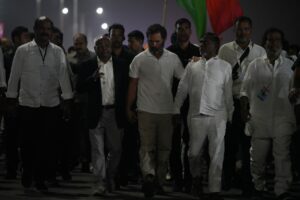
On the morning of 1 November, I suddenly got a call from Koppula Raju. He asked me, “Why don’t you walk with Rahul Gandhi [in the ongoing Bharat Jodo Yatra]?”
I know Koppula Raju from his days as Kurnool collector in the 1980s, when I was a civil rights activist. He stood by the Madduru Dalit land struggle and I had to meet him to get the land pattas for Dalits several times. He was the only collector who used to take civil rights activists in his official car to the victim’s village and talk to them in my presence. He helped them as much as he could and they got the land.
Rahul’s Bharat Jodo has a greater national purpose
I never was in any Congress committee or commission such as the knowledge commission headed by Sam Pitroda, or national advisory council that included former bureaucrats such as Harsh Mander and NGO leaders such as Aruna Roy. Nor did I seek a central university vice-chancellor position when they were in power from 2004 to 2014. But when the Delhi university proposed to ban my books from the political science curriculum in 2018, Rahul Gandhi as the president of the Congress condemned it in unequivocal terms.
I decided to walk with him as this yatra has a greater national purpose.
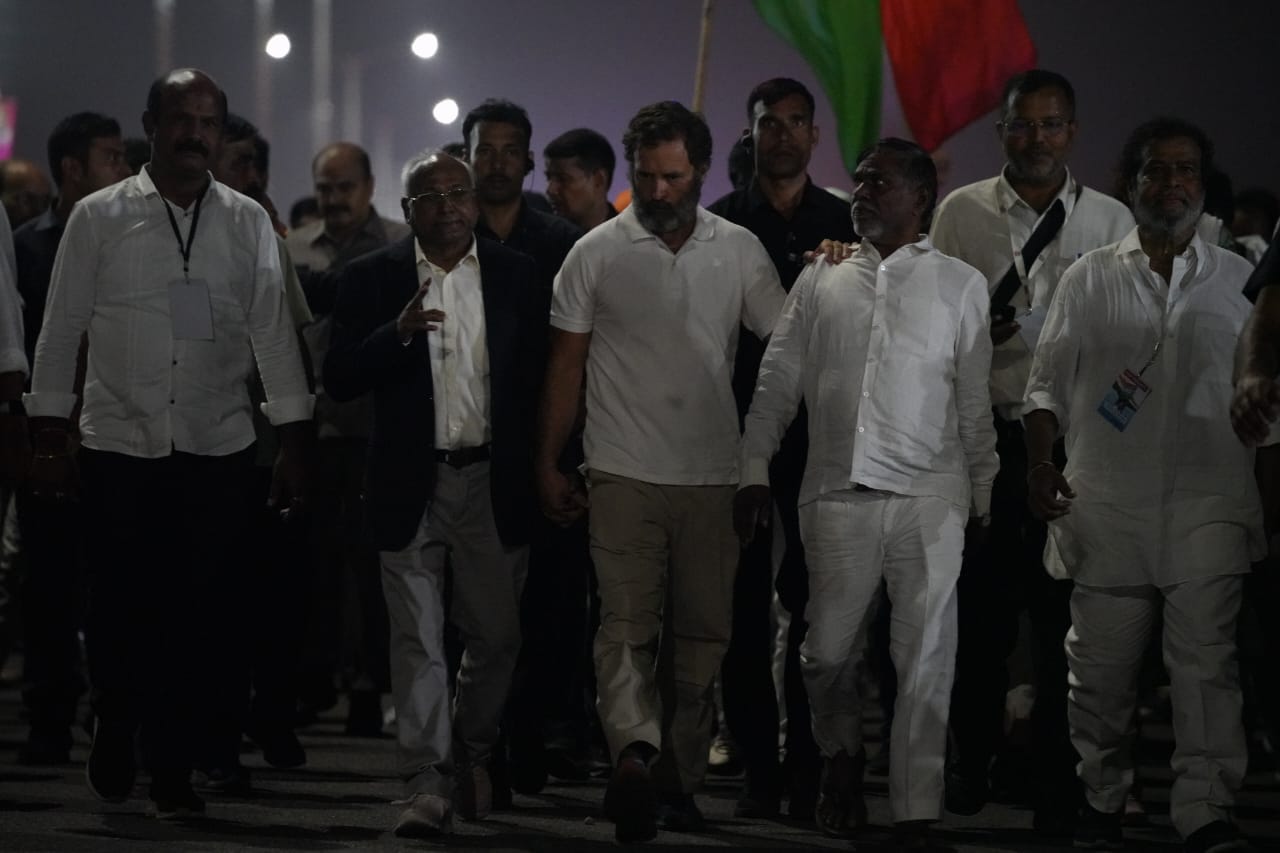
On 2 November, the Bharat Jodo Yatra was crossing Hyderabad city on its way to Kamareddy. I was asked to join Rahul after Medchal town by his organising team. It was their evening session after the lunch break.
From the Bharat Heavy Electronic Limited (BHEL) crossroads, the yatra started an hour earlier. A huge number of people lined up to have a glimpse of him on both sides of the road. There were old women, men, and children on either side of the road. There were also Congress leaders and workers of the area with flags and badges of Bharat Jodo in hands and on their bodies.Rahul Gandhi during the Bharat Jodo Yatra in Telangana (Facebook/Bharat Jodo)
The Bharat Jodo Yatra is taking place in the backdrop of Rahul and his mother getting grilled by the ED. He has been getting attacked by the BJP leaders as a dynast, pappu, prince, foreign tourist, and so on.
With all his visibility, he has to become a leader and visionary with a new moral grit to fight the RSS/BJP and revive the Congress. He cannot do that as PM candidate. That will give the ruling opponents the opportunity to use the old cliche of dynasty. He has to emerge a very powerful moral leader from the yatra. I wanted to see whether a new Rahul is in the making as I was walking.
Rahul Gandhi and the language debate
One good thing that the party and Rahul did was that they started the yatra from down South and went through all the southern states.
The support for federal rights and opposition against the RSS/BJP imposition of Hindi and so on is deeper in the southern states. Most of them want to keep the medium of instruction in the education system bilingual, with both the state language and English.
Already two states — Andhra Pradesh and Telangana — have adopted English medium from class one to higher education. They have overcome the legal hurdles. This was a great achievement for SC/ST/OBCs. But they are facing determined Hindi imposition from Delhi.
Rahul was educated in English medium private schools and did his higher education abroad. Narendra Modi and Amit Shah can speak in Gujarati and Hindi well. Many times, the subjective elements play a role in policymaking even for a nation.
I wanted to talk along the walk about Rahul’s view of the ongoing language tussle. The Congress so far has not made clear its policy on bilingual education for all children in the country.
The idea of gradual elimination of English from India as Modi and Amit Shah and also some Lohiaites like Yogendra Yadav (who is supporting the Bharat Jodo padayatra) are planning for the education system will kill all the new hopes of rural and urban poor.
These forces are not opposing English medium education in the private sector — a system that the Congress itself put in place.
So far the Telangana Congress also has not been given direction by the Congress high command on English medium in government schools. The danger of them changing the present system, if they come to power, is very much there. I wanted him to be clear on this issue.Kancha Ilaiah Shepherd with Rahul Gandhi during the Bharat Jodo Yatra in Telangana (Bharat Jodo team)
In our discussion, he said it needs a “mass high-end English training for all teachers as a first step, followed by the second step”. I told him that was done in Andhra Pradesh and Telangana and that the school books are printed in mirror image mode, where the student and teacher could read both versions to teach and learn. In other states too, that will be the job of the state governments. If they come to power in Kerala and Karnataka, they should follow the Andhra-Telangana model. Rahul said, “In principle, I am not opposed to the English medium in government schools.”
That position is enough to checkmate the RSS/BJP Hindi imposition at the national level. And in future, the Hindi-English issue is going to be a key battleground between the South and North.
Need Rahul the moral leader, not PM candidate
Rahul seems to have got an impression after walking through Tamil Nadu, Kerala, Karnataka, Andhra, and Telangana that even in the deeper rural areas, the South is far more developed than the North. It is because of the prevalence of a better education and health system in the South that its development is far better.
After this long padayatra from South to North, Rahul will have to help the Congress rework its ideology of development in the North as well. The North Indian welfare schemes do not match the South Indian ones.
The deep superstitious life of North Indians has become a helpful ground for the RSS/BJP to garner more votes. Religious sentiments but not good educational aspirations of the people work in favour of the RSS ideology. There, the temple is still central but not the school. There is a resentment towards the English language, which is part of the RSS ideology.
Rahul needs to take a bold position on the educational agenda and fight the RSS/BJP backward nationalism with futuristic nationalism — better modern education and improved welfarism. He has to carefully establish positive relations with regional parties even to make the Congress a powerful national alternative to the RSS/BJP and slowly assimilate them into the Congress.
The RSS/BJP freebies myth has to be fought without compromise.
As the prime ministerial candidate, which Mallikarjun Kharge and other Congress leaders want him to be, he cannot push the RSS/BJP into a crisis. Only as a moral leader, like Mahatma Gandhi during the freedom struggle from that very party, can he do that. During the Bharat Jodo padayatra, Rahul has been showing such signs.
(Kancha Ilaiah Shepherd is an Indian author, activist and columnist. His well-known books include Why I am Not a Hindu, Post-Hindu India, and God As Political Philosopher. He has written extensively about the need for English medium education in all government schools and also the relationship between spiritual democracy and political democracy)
https://thesouthfirst.com/telangana/why-i-walked-with-rahul-gandhi-in-the-bharat-jodo-yatra/
-
Why Bharat Jodo Yatra should not be seen in terms of immediate votes
Congress, with a moral leader within, should work to undo the fear-generating atmosphere created in the recent past; after all, RSS-BJP remained outside power till the 1990s and spread their ideology before becoming all-powerful
6:30 AM, 6 November, 2022Updated 6:53 AM, 6 November, 2022
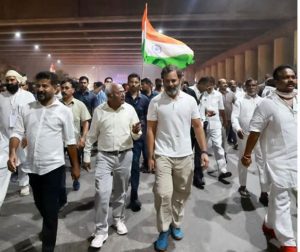
Rahul’s padayatra is totally the opposite of BJP’s Rath Yatra in character and message.
By November 2, Rahul Gandhi’s Bharat Jodo Yatra, by then 55 days old, had covered about 45 per cent of its targeted distance, as it went through Telangana. The yatra started on September 7 from Kanyakumari in Tamil Nadu and is expected to end in Kashmir, covering 3500 km.
It is a marathon walk in which hundreds of people have joined Rahul. Thousands throng the roadsides to meet and greet the Congress leader.The author with Rahul Gandhi on the outskirts of Hyderabad on November 2
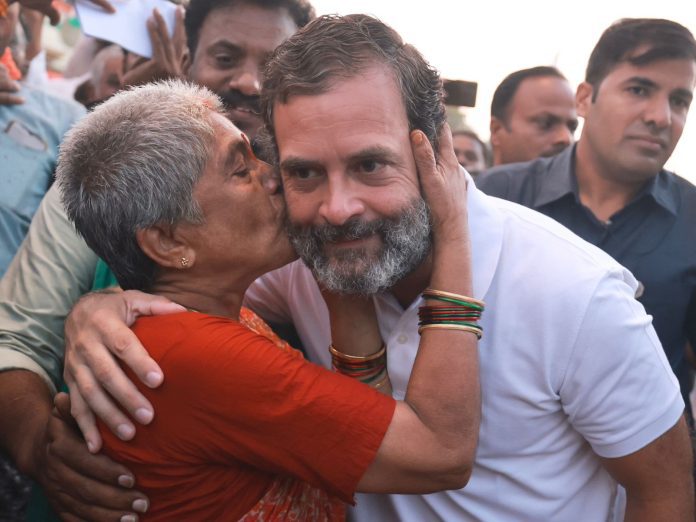
I joined him to wish the yatra well on the outskirts of Hyderabad on the evening of November 2. The march was on the way to Sangareddy. It was a spectacle to see. There were thousands of people—women, men, and children—lining either side of the road with enthusiasm to catch a glimpse of Rahul, click photos on their phones and, if possible, meet him. The security was so tight that nobody could reach him unless he himself broke the security cardon and reached out.
Rahul’s motive
Many are comparing this south-to-north padayatra to Adi Shankara’s journey in the 8th century to spread Shaivism, and also casteism, with a determined plan to uproot Buddhism from India. In my 20-minute discussion with him as I walked alongside, I realised that Rahul’s motive was the opposite of Adi Shankara’s.
This padayatra is meant to free present India from fear. Various sections of India, not just minorities like Muslims and Christians, are fear-stricken about what might happen to the Indian democracy, to the Constitution our great founding fathers and mothers put in place, with equal rights for every individual.
The Rashtriya Swayamsevak Sangh (RSS), which was opposed to this kind of democratic system—and also to the Constitution—in the 1940s and 1950s, is not only ruling but deploying very suspicious methods to rule India. Somebody must emerge as a moral leader to change this political atmosphere and give confidence to the masses, who are fear-stricken.
Message of fearless India
Before Rahul’s long march, two great Indians walked at length on this land to spread the idea of freedom, equality, and fearlessness. The first was Gautam Buddha. He roamed the eastern part of India on foot to spread the idea of samata, non-violence, and human equality. He established egalitarian sanghas without caring for caste inequalities. Dr BR Ambedkar re-invoked the Buddha in our freedom struggle with great legal wisdom and positive will and institutionalised a modern democratic constitutional system.
The second was Mahatma Gandhi during the freedom struggle. He walked 350 km to initiate a salt satyagraha. He combined this long walk with spreading his ideology of non-violence and self-rule.
Rahul has undertaken this long march with a positive message of fearless India after 75 years of India’s freedom from the British. The ruling RSS-BJP nationalism is built on the ideology of communal violence. LK Advani, the real builder of the present BJP, also undertook a Rath Yatra from Somnath temple to Ayodhya Babri Masjid in 1990 to oppose the Mandal reservation movement. En route, a lot of violence was deployed.
Rahul’s padayatra is totally the opposite of that Rath Yatra in character and message.
History’s winners and losers
On several occasions in human history, violent forces had decisive victories. But finally, human society survived and developed with the spread of non-violence, peace, and the philosophy of love and human equality.
Even Jesus Christ undertook a lot of foot travel from one end of Israel to the other, from Nazareth to the Sea of Galilee to Jerusalem, spreading the idea of peace and non-violence. He was brutally crucified. But that did not make him a loser in history. He became a winner, and murderers became losers in the long run. The ideology of hatred and bigotry cannot make positive history.
History did not care whether the agents of peace and human equality came from a dynasty of rulers or from among the poor and destitute. In human history, brutal killers came from royal families and so did great humanists. History has also shown us brutal dictators who came from very ordinary middle-class families without any record of political rule and destroyed nations. Hitler and Mussolini did not come from ruling dynasties. They came from very ordinary middle-class families, in Germany and Italy, respectively. We know what they did to their countries and the world.
In our own country, the Buddha came from a ruling family and became a great agent of peace, non-violence, and equality. King Ashoka came from a ruling dynasty and lived a very violent life until he became a Buddhist. But afterwards, he became a great Buddhist agent of peace, non-violence, and positive welfare state.
Mahatma Gandhi came from a Kathiawar ruling Bania family and became an agent of non-violence. Ambedkar came from the most “untouchable” family background, owned the Buddhist-Ashokan vision, and became the father of the Indian Constitution. Now, Indians in a big way own the Buddha-Ashoka-Ambedkar heritage in many spheres of life.
No hunger for power
Rahul has so far not shown any hunger for power. He could have become the Prime Minister in 2009 had he been hell bent on the position. He did not even opt for a Cabinet berth at that time. He could have continued as the party president after the 2019 elections. Or, he could have become that anytime later. He did not.
Yet, he was attacked, humiliated, and called names such as Pappu, Baba, Prince, and so on. His most docile mother, who never held a government office, was attacked in abusive language many times. Recently, both were interrogated by the Enforcement Directorate for several days.
All this did not go down well with millions of Indian masses. The people’s sympathy for Rahul comes from several such sources.
In this background, Rahul’s longest padayatra in modern Indian history gives a feeling of hope to millions of Indians and also foreigners, who respect human equality, human rights, and constitutionalism.
South Indian states are under attack by the present RSS/BJP regime, with the threat to impose Hindi and eliminate English from school and college education. There is a subtle opposition to South Indian advancement by the present Delhi regime, as it is North-centred.
Rahul’s position on English and Hindi is opposed to their position. He went to English-medium schools and colleges in India and abroad. He understands the avenues that are open to the future youth with English education, without giving up the home language learning.
There is no doubt that Rahul is the only Indian who has visibility within the country and outside with respect for human rights. This padayatra may reshape his role in the Indian socio-political system.
What Congress wants
He is a Congress leader. The Congress forces expect him to bring them to power in Delhi, and also in the states through which he is walking.
However, Bharat Jodo Yatra should not be seen from the point of view of immediate votes and power. The RSS/BJP remained outside power till the 1990s and spread their ideology. Now, they are in power, controlling every national institution.
The Congress, with a moral leader within, should work for a long time to undo the hate and fear-generating atmosphere created in the recent past.
Also read: Bharat Jodo Yatra, a success till now; can Cong build on it for 2024 poll?
Rahul and his team must learn and unlearn things by speaking to the productive and labouring masses in the different states. But ultimately, it is the people who make new history by changing the old one.
Bharat Joto Yatra is historic in many ways. It should achieve the objective of eliminating hatred, bigotry, and fear in civil society. It should embolden people to protect Indian democracy and the Constitution.
(Kancha Ilaiah Shepherd is a political theorist, social activist, and author)
(The Federal seeks to present views and opinions from all sides of the spectrum. The information, ideas or opinions in the articles are of the author and do not necessarily reflect the views of The Federal)
https://thefederal.com/opinion/why-bharat-jodo-yatra-shouldnt-be-seen-in-terms-of-immediate-votes/
-
Why Shashi Tharoor is not fit to take over the reins of the Congress party
Tharoor comes from a Shudra (Nair) community but wrote his book ‘Why I am a Hindu’ as if he was a dissident within the Sangh Parivar Hinduism and not as a leader with his feet firmly planted in Congress history, writes Kancha Ilaiah Shepherd
Kancha Ilaiah Shepherd October 15, 2022

Shashi Tharoor, the Thiruvananthapuram MP, is contesting for president of the Indian National Congress against Mallikarjun Kharge, an MP from Karnataka with a long experience in the political arena. Previous
On 13 October 2022, Tharoor said in a press conference, “We are holding elections after 22 years and there will be shortcomings. But in many places I travelled to, I felt some of the Pradesh Congress Committee Chiefs were not keen on meeting me. They never showed me the same warmth they have to Mr Kharge.” It is true that Tharoor is not getting, in any state that he has visited, the dignified reception that he should get as a Congress leader, let alone as a candidate for the party presidency. Previous
Tharoor is a diplomat-turned-politician with an elite intellectual aura in the media and also among sections of the middle class. Kharge is known as a politician in touch with the grassroots and has been consistently taking on the Bharatiya Janata Party (BJP) in Karnataka and in Parliament. Tharoor does not have even cordial political relations with the Congress leadership of his own state, Kerala. His grassroots exposure has been limited to a few meetings in his constituency.
Tharoor has more of a reputation as a writer and as a tightrope walker between the Congress and the BJP ideologies. Tharoor comes from a Shudra (Nair) community but wrote his book Why I am a Hindu as if he was a dissident within the Sangh Parivar Hinduism and not as a leader with his feet firmly planted in Congress history. That book does not challenge RSS/BJP but presents a slightly different version of their Hindutva ideology. If such a person becomes the president, where will he take the Congress party? Nobody knows.
I met Tharoor at the Mathrubhumi literary festival in Thiruvananthapuram in January 2020 just before the Coronavirus brought India and the world to a standstill. He told me that he belonged to the Nair community and they were Kshatriyas, not Shudras. According to him Nairs never considered themselves as Shudra. His is a strange understanding of Indian history and its productive communities. Nairs were Shudras with an agrarian productive culture and civilization. The Kerala Brahmins exploited them in every way possible. Tharoor’s Nair-Kshatriya theory helps the RSS/BJP more than the Congress or the OBCs, Dalits and Adivasis of Kerala.Mallikarjun Kharge and Shashi Tharoor
Tharoor has written a lot in English but he mostly draws on a bookish understanding of India. His writings are not not rooted in the day-to-day life of the people, their caste, culture and labour relationship.
The Dalits, Shudras and Adivasis in the Congress also do not trust him because in his entire parliamentary life he has never spoken about the problems of the agrarian and artisanal masses. He is on record as referring to the economy class in a flight as “cattle class’.
If this man imported from the United Nations service straight into electoral politics becomes president, the Congress party will not have any electoral advantage. Narendra Modi and Amit Shah, the battle-hardened politicians they are, would play the electoral game without even an iota of opposition under his presidency.
Tharoor has a discredited personal record as his second wife died in a suspicious manner. In fact, with an alleged affair with a Pakistani journalist not so long ago, his personal life would become a weapon in the armory of the BJP. That would make the Congress position much worse.
Shashi Tharoor’s liberalism that has no grounding in grassroots politics, his compulsive tweeting and so on would certainly create an organizational crisis.
In this transition period after 22 years of Sonia Gandhi-Rahul Gandhi in leadership of the party, irrespective of who they support, Kharge is the better candidate because he has proven his loyalty to the Congress party and his leadership qualities over the decades he has spent in the party. As a credible Dalit leader he may perhaps take decisions that challenge the BJP which is being run by an OBC leader Narendra Modi and Bania leader Amit Shah, with Brahmin leader Mohan Bhagwat behind the scenes.
The Congress grassroots workers know that Tharoor is not fit to take over the reins of the party. Then why is he travelling all over India, riding a discourse that is more useful for the RSS/BJP than his own party?
In the long run, the Congress should keep away bureaucrat-intellectual intruders like him who have already damaged it enough.
Forward Press also publishes books on Bahujan issues. Forward Press Books sheds light on the widespread problems as well as the finer aspects of Bahujan (Dalit, OBC, Adivasi, Nomadic, Pasmanda) society, culture, literature and politics. Contact us for a list of FP Books’ titles and to order. Mobile: +917827427311, Email: info@forwardmagazine.in)
About The Author
Kancha Ilaiah Shepherd
Kancha Ilaiah Shepherd is a political theorist, author and activist. He has been a professor of Political Science at Osmania University, Hyderabad and director of the Centre for the Study of Social Exclusion and Inclusive Policy at Maulana Azad National Urdu University, Hyderabad. He is the author of ‘Why I Am Not a Hindu’, ‘Buffalo Nationalism’ and ‘Post-Hindu India’
-
Opinion: Will Rahul Gandhi emerge a moral leader from Bharat Jodo Yatra to take on RSS?
The Congress needs a morally strong leader at the helm. Rahul Gandhi has shown that streak in thought and practice, but he has to internalise the moral base of that politics, writes Kancha Ilaiah.

PTI
NEWS POLITICS FRIDAY, OCTOBER 14, 2022 – 16:47
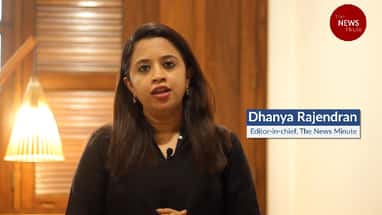
As Rahul Gandhi’s Bharat Jodo Yatra enters day 37 of its more than 100-day duration, there is already a view in the media – both mainstream and social – that his image is undergoing a change. Rashtriya Swayamsevak Sangh (RSS) and Bharatiya Janata Party (BJP) leaders and their supporters have curtailed, if not stopped, their usual attacks on the Congress leader with terms such as ‘Rahul Baba’ or ‘Pappu’.
While Mahatma Gandhi’s Salt Satyagraha march covered a distance of 385 km, Rahul’s padayatra aims to cover 3,500 km from one end of the country to the other. The ultimate result of Rahul’s padayatra depends on its culmination in Kashmir as planned, without relenting for whatever reasons. The RSS/BJP are not taking the threat of him emerging as a serious moral and political leader from his yatra lying down. Rahul should sustain the padayatra both with willpower and health, and also against the opposition’s strategies to obstruct it.
When MK Gandhi started his yatra in 1930 (he was not Mahatma then), he was 61 and his moral credibility was well established by his South African movement days. Rahul Gandhi is 52 now. He is known as a political leader from the Nehru family all over the world, but not as a moral political leader like Gandhi, Ambedkar and Jayaprakash Narayan. The country now needs just such a leader from the Congress to change the aggrandised politics and power games of the RSS/BJP.Featured Videos from TNM
In my view, the RSS/BJP cannot produce a moral leader from their ranks because their ideological framework does not allow that. That stream of politics came into existence with an ideology of building an enemy image and dividing the civil society and political society to gain power and control over every sphere of Indian life. Moral leaders like Ambedkar, Gandhi, JP, or Martin Luther King Jr in the US did not arise from such a divisive ideological base. They emerged from building an ideology of love and social reform.
The Indian National Congress still has a scope to produce a moral leader from its ranks, as it has a history of Mahatma Gandhi emerging from its ranks, and Ambedkar and JP working in tandem with the party in some form or the other. We know that Indira Gandhi changed it totally into a ruling ideology party with ruthless strategies.
There are a number of regional parties in India but they cannot offer a moral and political national alternative leader to the present political establishment. At best they can work out improved welfare schemes, but are not able to direct national policies or influence international relations and protect our Constitution and democratic institutions.
The Congress, not having established long-term workable organisational structures, is right now a personal promotion party. A morally strong leader at the helm alone can change this situation. Rahul has shown that streak in thought and practice, but he has to internalise the moral base of that politics and work hard for a long time to come.
To overcome the RSS/BJP’s massive attack against Rahul as hailing from the Nehru-Indira dynasty, he must shun the goal of aspiring to become the Prime Minister of India. During the course of the padayatra, he should locate young grassroot activists from all castes and tribes to promote as leaders and political administrators.
On holding positions of power, Rahul has so far given a reformist impression. He could have become the Prime Minister in 2009; he could have continued as party president after losing the 2019 election. His firm resignation was the right step.
Before the padayatra, it appeared that political struggle was not a 24/7 job for Rahul. Let us not forget that Ambedkar and Gandhi worked on national issues more than any Prime Minister. They fought every battle, travelled across the country, and also abroad when needed, and lived the values they professed. Ambedkar did so much in his short lifetime of 65 years. So far, Rahul has not written anything of his social, spiritual and ideological position to influence the minds of young Indians. Gandhi wrote Hind Swaraj and Ambedkar wrote Annihilation of Caste, and these small texts became pathfinders. Rahul still is a statement giving leader. He has to write a thesis of his own to influence the nation.
We know that Rahul’s childhood must have been fraught with fear and anxiety as his grandmother and father were brutally assassinated. He hardly had exposure to grassroot Indian productive and civil society culture, conflicts, strengths and weaknesses. All these years he was only a flying or driving politician. But now he has turned into a walking yatri among the masses, watching their strength and weakness, their culture and conflicts. He is walking amidst a society that has been pitched one religion against the other, one community against the other. His hugs help heal people’s bloodied wounds. Eating the food they offer builds bridges of empathy and love for life in an atmosphere where each community is made to hate the food culture of other communities.
A major problem for Rahul is with regard to the current party structure. Its top end consists of intellectuals who have no relationship with the life of the masses. They do not want to allow young leaders working among masses to emerge from the grassroots to a national position. What they want is simply for Rahul to bring votes with this padayatra and give them the best ministerial positions possible. Since they cannot win elections, they manage to enter the Rajya Sabha and rule. It was these bureaucratic intellectuals lacking roots in ordinary life who destroyed the party’s organisational structure.
During the course of the padayatra itself Rahul should rework the party structures by picking up young activists working among the masses for future leadership roles. If his moral stature grows during the padayatra, the fear of a non-loyal leader wresting the party away will vanish.
All political parties in democratic countries allow young politicians with talent and mass work to emerge as leaders and make the party structurally sustainable long-term. No party in the world allows a man or woman to wield power in the government without winning the election at the constituency level. Rahul has been doing just that. That is his strength.
Edited by Vidya Sigamany
Watch TNM’s video: Bharat Jodo draws crowds, will it help Congress or Rahul Gandhi’s image?
Kancha Ilaiah Shepherd is a political theorist, social activist and author. His most known books are Why I am Not a Hindu – A Sudra Critique of Hindutva Philosophy, Culture and Political Economy, The Shudras: Vision for a New Path (co-edited with Karthik Raja Karuppusamy), Buffalo Nationalism and Post-Hindu India.
-
It took Shantishree Dhulipudi Pandit, an OBC woman scholar, to study caste of Hindu gods – Forward Press
When serious intellectuals emerge from the organic social base of the productive communities like Shudras, Dalits and Adivasis, their own caste location begins to determine their consciousness irrespective of whether they come from the Hindutva school or the Communist school, writes Kancha Ilaiah Shepherd
Kancha Ilaiah Shepherd October 13, 2022

Shantishree Dhulipudi Pandit has come up with a new theory about Hindu gods and goddesses. Her theory inaugurates a discourse of departure from the right-wing Hindutva school from within. Her lecture on the theory at a programme organized by the Ambedkar International Centre in New Delhi in August 2022 was met with disapproval from her own camp – and a pretension of indifference from the secular left-liberal intellectuals, the result of which has been a serious intellectual loss for them and for the nation. The priestly forces are demanding her removal from position and arrest. They have threatened agitations and representations to the Prime Minister. Such threats need to be fought back. Their sentiments are as bigoted as that of the Muslim fundamentalists who attacked Salman Rushdie. Previous
Shantishree is the first OBC woman intellectual raising new questions from a position of power at a time when the Hindutva forces are ruling the nation. She is the first woman vice-chancellor of JNU. She succeeded a military-minded vice-chancellor who was against dissent and intellectual engagement. Now her initiating a discourse unmindful of the consequences from her own camp is a refreshing illustration of academic freedom. She is raising intellectual questions that have implications to society at large. Even from among the Indian woman intellectuals of the feminist, liberal and Marxist ilk, I have not come across an OBC intellectual with such seriousness and willingness to take on the patriarchy of Brahmanism.
The most positive aspect of her initiative is that she, from within the right-wing camp, has taken Ambedkar more seriously and taken on Manu’s position of caste and the brahmanical spiritual system. Manu is a sacred thinker for all Hindutva Brahmin writers and leaders like M.S Golwalkar, Deendayal Upadhayaya, Mohan Bhagwat, Ram Madhav and so on. But he is a regressive anti-women casteist ancient thinker for Shantishree. She is absolutely right.
Though Shantishree said that all (non-Muslim, non-Christian) women are Shudra and only by virtue of marriage to a Brahmin man they become Brahmin, most “Brahmin” women writers, historians and social scientists operated exactly with the opposite position and understanding. They lived, and wrote as Brahmins. I was witness to their anti-reservation politics (except a handful) during Mandal struggles. Men and women historians, sociologists, anthropologists, political scientists of JNU, let alone other universities, have not in their writings condemned Manu as regressive, as Shantishree just did. Liberal and Marxist historiographies and anthropological investigations have been used to protect the caste system from university positions.
Most respected leftist historians who wrote on ancient India like D.D. Kosambi, Romila Thapar, R.S. Sharma never wrote anything serious about Manudharma Shastra from the vantage point of a Shudra/Dalit/Adivasi, nor did they sympathetically read Ambedkar’s position on Manu and Hindu Dharma Shastras. Sociologists and Anthropologists like M.N. Srinivas, Andre Beteille, Dipankar Gupta never examined the caste location of the Hindu gods and goddesses. Shantishree says that there is “no Brahmin in the pantheon of Hindu gods and goddesses and many are either from Kshatriya heritage or from Shudra/Dalit/Adivasi heritage. When she said Shiva could be a Dalit or an Adivasi and Jagannath of Puri was an Adivasi she deconstructed the divine forces from an anti-caste point of view. Their anthropological position could be ascertained from the brahmanical ancient Sanskrit texts themselves. Against the names of some godheads, caste is mentioned. Those caste names correspond to the existing castes among the Indian people.Shantishree Dhulipudi Pandit, vice-chancellor, JNU
When Shantishree is talking about the anthropological location of Hindu gods – which every Brahmin scholar man or woman wanted to avoid – it is a scientific examination. Even the most radical left intellectuals have avoided these questions. Avoiding the discourse about institutions of huge inequality and oppression from the ancient days does not help the nation or a given religion. All forms of inequalities need to be problematized by thinkers and philosophers in order to build a nation with human equality and dignity of labour. We know today for sure that the brahmanical castes are anti-labour and hence anti-development. Dignity of labour and production are interrelated.
Earlier in her presentation at a seminar in Delhi University she had said that Draupadi and Sita were the first feminists in Indian history because Sita was the first single mother and Draupadi was the first autonomous woman who opposed all five husbands on many issues. This itself was quite an un-Hindutva position.
Indian anthropology had a problem in that the practitioners were as brahmanical as anybody else. They never examined the present and the past from a human perspective. Their own caste cultural consciousness determined their methodology and description. For example, for M.N.Srinivas, purity and pollution were central to his study of the Indian social system. Production, equality/inequality and the labour power of the productive communities never occupied centrality in his analysis.
When serious intellectuals emerge from the organic social base of the productive communities like Shudras, Dalits and Adivasis, their own caste location begins to determine their consciousness. Whether they are from the Hindutva school or from the Communist school, if they acquire serious intellectual curiosity and the ability to grasp the fundamental flaws of society they begin to raise new questions. The questions that Mahatma Phule, Savitribai Phule, Ambedkar, Periyar raised are qualitatively different from the questions that Brahmin intellectuals of their times raised. Shantishree, as an OBC woman scholar, has taken a progressive position in evaluating the brahmanical spiritual system.
Shantishree is the only intellectual from the Hindutva camp to raise new questions in my lifetime. She will face challenges and as an intellectual she has to fight it out. As an alumna and now as the vice-chancellor of the same JNU her proposition attracts attention.
JNU is known for the Western stream of social-science knowledge. They seriously study Western scholars and quote them in their research and the teachers encourage the students to do so. That method has not played a great creative, transformational intellectual role. It has produced some good scholars and administrators who can operate only in familiar Western structures. No JNU scholar or thinker has produced a groundbreaking work so far. While defending herself Shantishree also said that she was a serious academic and not an original thinker like Ambedkar and therefore only paraphrased his ideas on gods and goddesses in a seminar. As I see it, at this stage of the Indian sociopolitical system, Indian universities must produce original scholars and thinkers like Ambedkar. Let us not forget that he was a product of Columbia University. When the Western universities could produce original scholars, thinkers and philosophers, why not Indian universities?
In a country like India any serious social-science student has to examine ancient, medieval and modern structures from the point of view of people’s philosophy. As Shantishree herself claims, JNU is the number-one university in producing social-science ideas but that the status is based on a comparative assessment. All Indian universities have been engaging with Western ideas. Within that list, JNU has been doing better.
The religious system is critical. A critical analysis of Indian religious structures and its divine and social figures plays an important role in building advanced social-science knowledge. To make India a competitive nation, our universities must allow critical thinking to thrive. I hope Shantishree continues her dissenting studies while being in that position.
Forward Press also publishes books on Bahujan issues. Forward Press Books sheds light on the widespread problems as well as the finer aspects of Bahujan (Dalit, OBC, Adivasi, Nomadic, Pasmanda) society, culture, literature and politics. Contact us for a list of FP Books’ titles and to order. Mobile: +917827427311, Email: info@forwardmagazine.in)
About The Author
Kancha Ilaiah Shepherd
Kancha Ilaiah Shepherd is a political theorist, author and activist. He has been a professor of Political Science at Osmania University, Hyderabad and director of the Centre for the Study of Social Exclusion and Inclusive Policy at Maulana Azad National Urdu University, Hyderabad. He is the author of ‘Why I Am Not a Hindu’, ‘Buffalo Nationalism’ and ‘Post-Hindu India’
Related Articles
-
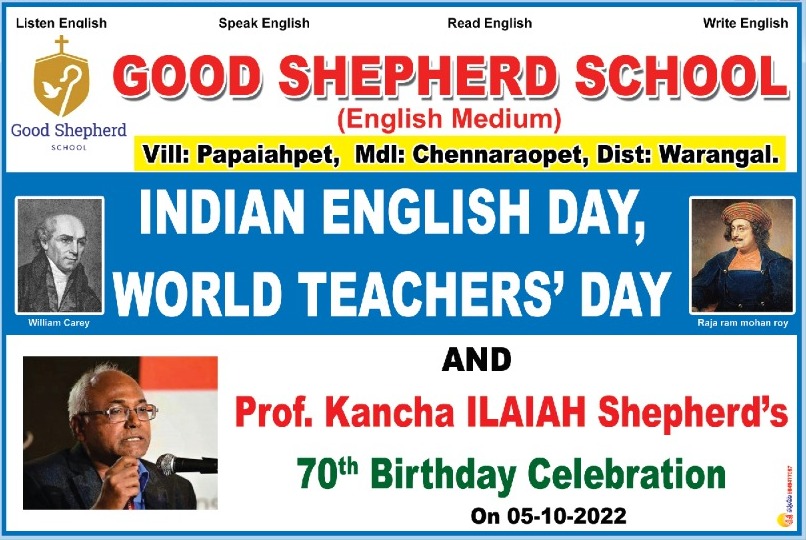
Indian English Day Celebration
-
English India In The Making
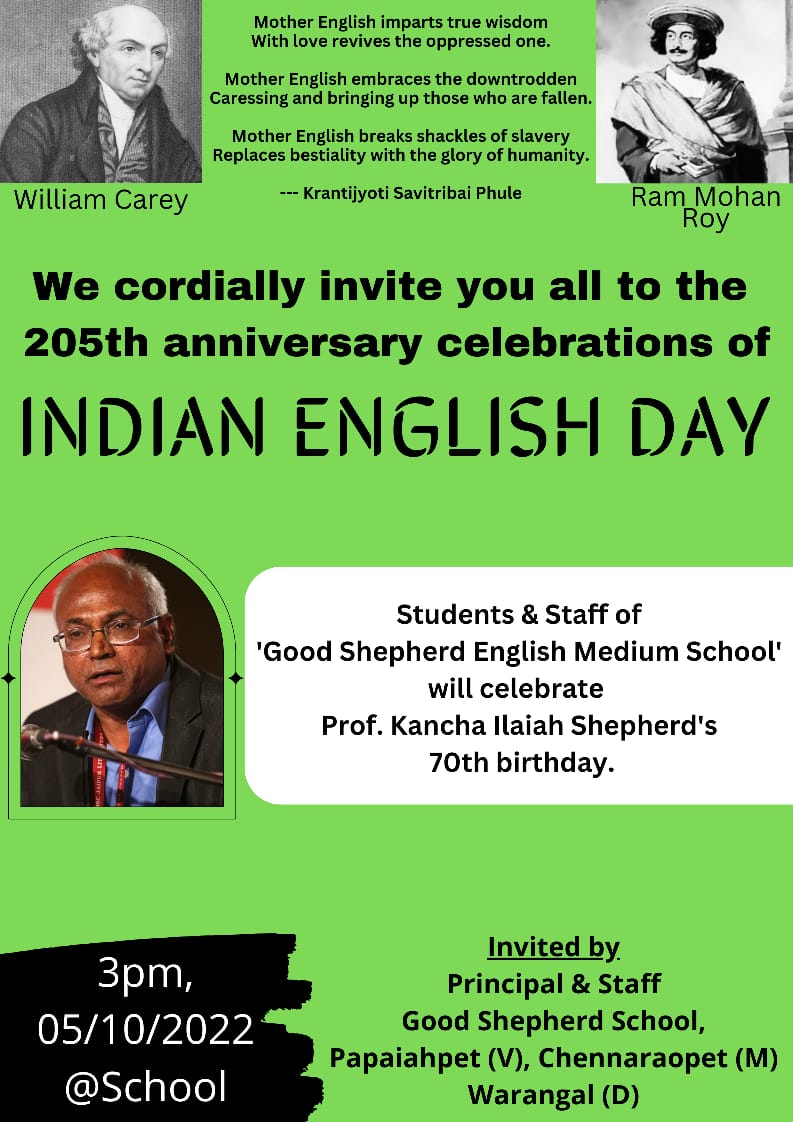
October 5th is International Teachers Day. It is also Indian English Day. English language education has a history of 205 years in India.
Incidentally October 5th is also my 70th birthday. My thirty years campaign for English medium education for poor children in the Government schools has come to a meaningful stage.
William Carey and Raja Ramohan Roy started the first English medium school in Kolkata (then Calcutta) in 1817. By 2022 where the world stands relieved with medical science, mainly developed using the English language as global communicator, has saved the world from devastation. If science and English were not to co-exist the world would have been a burial ground because of Corona.
So far in India two State Governments, Andhra Pradesh and Telangana have made English medium teaching compulsory in all the state Government schools. This is the beginning of an educational revolution in India. Already Nagaland has been teaching only in English medium in all the state Government schools for quite a long time. Most state Governments have started teaching English as a compulsory subject from class one in the recent past. Kashmir has started such compulsory English teaching from class one as a subject for a long time. The Aam Aadmi Party in Delhi upscaled English teaching in all state run schools.
This apart, there are thousands of private English medium schools all over India.
It is a known fact that the Rastriya Swayamsevak Sangh (RSS) and the Bharatiya Janata Party (BJP) are opposed to English medium education in Government schools. At the same time they are not opposed to private schools that teach in English medium with a design to keep the poor out of English education.
They know that English language education takes people out of poverty, conservatism and superstition.
After the BJP/RSS came to power in 2014 the private sector has opened more costly English medium schools, colleges and universities for the rich. But the central Government has been insisting that the poor–as they mostly are from Shudra/SC/STs–to study in regional languages. That is a varna dharma language policy.
MY ENCOUNTER WITH SOIL AND ENGLISH
In my 70 years of life I consciously interacted with this soil, animals, crops ever since I was five. In other words for 65 years I lived a conscious life on this soil, leaving five years of pure childhood. As a child I played in this land’s dust, mud, among lambs, calves of buffalos and cows. I also ate mud or dust as many children in Indian villages do.
In my childhood my caste people were speaking to humans and animals in a language called Kuruma Bhasha, which had its origins in Kannada Kuruba Bhasha. Very few people understood that language. It had no script. My total community was illiterate and was speaking a scriptless language within themselves. Other villagers did not understand that language.
All around my small village there were Lambada tribal hamlets. They were speaking Gor Boli (Lambadi Bhasha). Within the village there were few Muslim houses. Their children were speaking Urdu. Many castes which were around agrarian tasks were speaking Telugu in Telangana dialect with a lot of Urdu words in it. There was hardly any communication between groups. People’s communication from language to language was broken one and symbolic.
As I grew up we shifted to Telugu from our caste language. But still we were broken people in terms of our different languages, leave alone caste. Shifting from one language to another was a difficult journey.
In the last 65 years of my conscious and communicative life a slow and silent revolution took place. English has come into all houses, literate, illiterate, rural or urban, slowly. That began to bring a change.
The name Rice replaced what we called biyyam, Motton replaced, mansamu, Fish replaced chepalu, Chicken replaced kodi kura, Vegetable replaced koora kayalu in all communities in the deeper Andhra Pradesh and Telangana villages and hamlets.
Not only that Water replaced neellu, Milk replaced paalu, Salt replaced uppu. Oil replaced noone. Shirt replaced angi. Pant replaced laagu. Labour replaced cooli.Many such English words and names of commodities have become common. Main functions like pendli in Telugu is Marriage now.
The anti-English pundits are crying about Mammi replacing Amma. Dady replacing Nanna. They are blissfully ignorant about all markets even in villages being full of English words and names. Not just in Telugu region but all over India. The English words have replaced similar names and words of day to day use for commodities. Slowly but surely Indian life is getting anglicized.
My childhood memory of linguistic culture that could not communicate with one another changed now quite drastically. My childhood language Kuruma Bhasha died irretrievably. In the villages, towns and cities the English words replaced all their so called mother tongue words among all sections of people.
For Telugu, Urdu or Lambadi language speaking people English words connected with their daily used food items names and new technologies. The newly coming English words into their (not language) life repositioned their future.
As of now few hundred English words are known to every villager, male or female.
Today the same people are using machines that speak English with English names called Cell Phone. There are no words for Cell and Phone in their so-called mother tongue. Regional TV channels use 30 to 40 percent English words and sentences. Morning news, Evening news, Burning topic, Gun shot, Big fight, Big Debate, News Express and so on are very common on so called Telugu TV screens. It could be true of other language TV channels. Those channels that use only regional languages have no viewers.
THE HISTORY OF LANGUAGE CHANGE
The process of English names and words entering into our families, villages and cities did not start recently. It started a long time back.
in my childhood in the 1950s they found new English words like Bus and Train in the villages, as they just occasionally started travelling in them. Along with those names machines they also learnt the words like Ticket and Conductor. Several English words, names of instruments, machines have come into their life year after year. This happened in every state, in every region–tribal or non-tribal.
I am not at all sad that my early childhood kuruma bhasha died. I was happy when I started speaking Telugu, with many Urdu words, as my village was located in the former Nizam state, which could be understood by more people in the village or in the nearby town.
Now slowly but surely Telugu is being replaced by English words in most communications. As that was happening I was becoming happier. Because with a word or name usage without speaking in a grammared language more people were communicating with each other. The village production language was never grammar centred. It was/is communication centred. The English words expanded their communication range and circle.
In my very lifetime my villagers started engaging with machines that have only English names; their parts were also named in English. For example in the early 1960s a cycle with the name Cycle came into their life; chain was only Chain; handles were only Handles. Current came to their village with the name Current only. Oil engine came only with the name Oil Engine. All, mostly illiterate, people understood their role and functions with those names only.
Along with oil engines came pipes, tubes and so on. By the late 1960s Current Motors came along with several interconnected instruments only with English names into villages. All these English words and names of machines, instruments were used by farmers totally disconnected with one another working under the sky all day. Neither Sanskrit nor their local language connected them with day to day life changing new vocabulary. Neither RSS nor other mother tongue pandits could stop spreading English in their fields, homes. For example, along with the current bulb, wire, swich kind of names and words in English entered their own homes to light their dark houses, they too loved that language to live a better life.
This revolutionary replacement of English words of all language speakers happened among all ideological families. Whether the RSS/BJP or Congress or Communist or regional parties supported or not the language revolution did not stop. This replacement happened among Hindus, Muslims, Christians, Sikhs, Buddhists, Parsese and so on. This revolution could not be avoided by religious practices or conservatism or communalism. Market with English words became a master of change.
I could see that. Neighbours who could not understand each other’s language in villages began to understand better after the English words connected them to the market.
The village people with English words became Indians. English made them nationalist. Earlier they were disconnected locals. Across India people understood those words and names. Suddenly communities living in small language clusters without any communication with each other, became Indian in understanding the names and functions of the technologies in English, grammar or no grammar. No other language of regions–including Hindi–would have done that.
Unless a language has a close link to the technologies at the time of their discovery the relationship between that technology and the language that tells about that technology would not get communicated to the user. English and modern science are twins. Hence India cannot become a scientifically advanced nation without all the productive masses knowing English better than what they do now.
However, English has come to them over the last sixty five years as part of their market relations, not with systematic education. All this happened in the post-colonial period. But the Dwija elite acquired English during the colonial period because of private English medium education.
My realization that English would liberate the caste-class oppressed masses did not come from my exposure to Oxford, Cambridge or Harvard education or intellectuals who got imported from there. As I have shown above, my realization came from changes that the English words and names of the new technologies brought in the Indian village life right from my childhood.
Now the whole world is shifting to English language communication. Former colonies of French and Portuguese are now shifting their education system to English. China that was opposed to English is investing hugely on English education of their children and youth.
The the private English educated rich in India want to deceive the masses even in this age wherein very advanced technology and communication are deeply linked with English. English education gives hope to poor mothers when their daughters and sons get that. In this present situation of darkness all around, English education in Government school that comes free of cost, is certainly a ray of hope.
https://countercurrents.org/2022/09/english-india-in-the-making/
-
English India In The Making
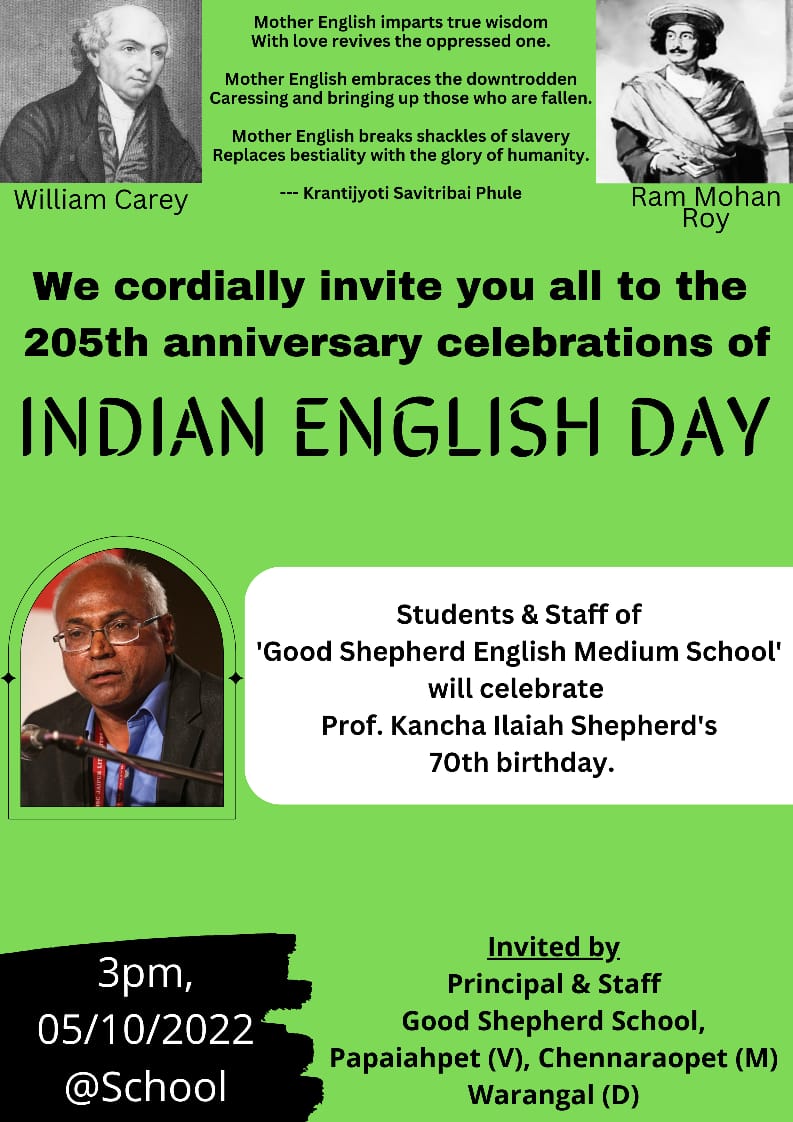
October 5th is International Teachers Day. It is also Indian English Day. English language education has a history of 205 years in India.
Incidentally October 5th is also my 70th birthday. My thirty years campaign for English medium education for poor children in the Government schools has come to a meaningful stage.
William Carey and Raja Ramohan Roy started the first English medium school in Kolkata (then Calcutta) in 1817. By 2022 where the world stands relieved with medical science, mainly developed using the English language as global communicator, has saved the world from devastation. If science and English were not to co-exist the world would have been a burial ground because of Corona.
So far in India two State Governments, Andhra Pradesh and Telangana have made English medium teaching compulsory in all the state Government schools. This is the beginning of an educational revolution in India. Already Nagaland has been teaching only in English medium in all the state Government schools for quite a long time. Most state Governments have started teaching English as a compulsory subject from class one in the recent past. Kashmir has started such compulsory English teaching from class one as a subject for a long time. The Aam Aadmi Party in Delhi upscaled English teaching in all state run schools.
This apart, there are thousands of private English medium schools all over India.
It is a known fact that the Rastriya Swayamsevak Sangh (RSS) and the Bharatiya Janata Party (BJP) are opposed to English medium education in Government schools. At the same time they are not opposed to private schools that teach in English medium with a design to keep the poor out of English education.
They know that English language education takes people out of poverty, conservatism and superstition.
After the BJP/RSS came to power in 2014 the private sector has opened more costly English medium schools, colleges and universities for the rich. But the central Government has been insisting that the poor–as they mostly are from Shudra/SC/STs–to study in regional languages. That is a varna dharma language policy.
MY ENCOUNTER WITH SOIL AND ENGLISH
In my 70 years of life I consciously interacted with this soil, animals, crops ever since I was five. In other words for 65 years I lived a conscious life on this soil, leaving five years of pure childhood. As a child I played in this land’s dust, mud, among lambs, calves of buffalos and cows. I also ate mud or dust as many children in Indian villages do.
In my childhood my caste people were speaking to humans and animals in a language called Kuruma Bhasha, which had its origins in Kannada Kuruba Bhasha. Very few people understood that language. It had no script. My total community was illiterate and was speaking a scriptless language within themselves. Other villagers did not understand that language.
All around my small village there were Lambada tribal hamlets. They were speaking Gor Boli (Lambadi Bhasha). Within the village there were few Muslim houses. Their children were speaking Urdu. Many castes which were around agrarian tasks were speaking Telugu in Telangana dialect with a lot of Urdu words in it. There was hardly any communication between groups. People’s communication from language to language was broken one and symbolic.
As I grew up we shifted to Telugu from our caste language. But still we were broken people in terms of our different languages, leave alone caste. Shifting from one language to another was a difficult journey.
In the last 65 years of my conscious and communicative life a slow and silent revolution took place. English has come into all houses, literate, illiterate, rural or urban, slowly. That began to bring a change.
The name Rice replaced what we called biyyam, Motton replaced, mansamu, Fish replaced chepalu, Chicken replaced kodi kura, Vegetable replaced koora kayalu in all communities in the deeper Andhra Pradesh and Telangana villages and hamlets.
Not only that Water replaced neellu, Milk replaced paalu, Salt replaced uppu. Oil replaced noone. Shirt replaced angi. Pant replaced laagu. Labour replaced cooli.Many such English words and names of commodities have become common. Main functions like pendli in Telugu is Marriage now.
The anti-English pundits are crying about Mammi replacing Amma. Dady replacing Nanna. They are blissfully ignorant about all markets even in villages being full of English words and names. Not just in Telugu region but all over India. The English words have replaced similar names and words of day to day use for commodities. Slowly but surely Indian life is getting anglicized.
My childhood memory of linguistic culture that could not communicate with one another changed now quite drastically. My childhood language Kuruma Bhasha died irretrievably. In the villages, towns and cities the English words replaced all their so called mother tongue words among all sections of people.
For Telugu, Urdu or Lambadi language speaking people English words connected with their daily used food items names and new technologies. The newly coming English words into their (not language) life repositioned their future.
As of now few hundred English words are known to every villager, male or female.
Today the same people are using machines that speak English with English names called Cell Phone. There are no words for Cell and Phone in their so-called mother tongue. Regional TV channels use 30 to 40 percent English words and sentences. Morning news, Evening news, Burning topic, Gun shot, Big fight, Big Debate, News Express and so on are very common on so called Telugu TV screens. It could be true of other language TV channels. Those channels that use only regional languages have no viewers.
THE HISTORY OF LANGUAGE CHANGE
The process of English names and words entering into our families, villages and cities did not start recently. It started a long time back.
in my childhood in the 1950s they found new English words like Bus and Train in the villages, as they just occasionally started travelling in them. Along with those names machines they also learnt the words like Ticket and Conductor. Several English words, names of instruments, machines have come into their life year after year. This happened in every state, in every region–tribal or non-tribal.
I am not at all sad that my early childhood kuruma bhasha died. I was happy when I started speaking Telugu, with many Urdu words, as my village was located in the former Nizam state, which could be understood by more people in the village or in the nearby town.
Now slowly but surely Telugu is being replaced by English words in most communications. As that was happening I was becoming happier. Because with a word or name usage without speaking in a grammared language more people were communicating with each other. The village production language was never grammar centred. It was/is communication centred. The English words expanded their communication range and circle.
In my very lifetime my villagers started engaging with machines that have only English names; their parts were also named in English. For example in the early 1960s a cycle with the name Cycle came into their life; chain was only Chain; handles were only Handles. Current came to their village with the name Current only. Oil engine came only with the name Oil Engine. All, mostly illiterate, people understood their role and functions with those names only.
Along with oil engines came pipes, tubes and so on. By the late 1960s Current Motors came along with several interconnected instruments only with English names into villages. All these English words and names of machines, instruments were used by farmers totally disconnected with one another working under the sky all day. Neither Sanskrit nor their local language connected them with day to day life changing new vocabulary. Neither RSS nor other mother tongue pandits could stop spreading English in their fields, homes. For example, along with the current bulb, wire, swich kind of names and words in English entered their own homes to light their dark houses, they too loved that language to live a better life.
This revolutionary replacement of English words of all language speakers happened among all ideological families. Whether the RSS/BJP or Congress or Communist or regional parties supported or not the language revolution did not stop. This replacement happened among Hindus, Muslims, Christians, Sikhs, Buddhists, Parsese and so on. This revolution could not be avoided by religious practices or conservatism or communalism. Market with English words became a master of change.
I could see that. Neighbours who could not understand each other’s language in villages began to understand better after the English words connected them to the market.
The village people with English words became Indians. English made them nationalist. Earlier they were disconnected locals. Across India people understood those words and names. Suddenly communities living in small language clusters without any communication with each other, became Indian in understanding the names and functions of the technologies in English, grammar or no grammar. No other language of regions–including Hindi–would have done that.
Unless a language has a close link to the technologies at the time of their discovery the relationship between that technology and the language that tells about that technology would not get communicated to the user. English and modern science are twins. Hence India cannot become a scientifically advanced nation without all the productive masses knowing English better than what they do now.
However, English has come to them over the last sixty five years as part of their market relations, not with systematic education. All this happened in the post-colonial period. But the Dwija elite acquired English during the colonial period because of private English medium education.
My realization that English would liberate the caste-class oppressed masses did not come from my exposure to Oxford, Cambridge or Harvard education or intellectuals who got imported from there. As I have shown above, my realization came from changes that the English words and names of the new technologies brought in the Indian village life right from my childhood.
Now the whole world is shifting to English language communication. Former colonies of French and Portuguese are now shifting their education system to English. China that was opposed to English is investing hugely on English education of their children and youth.
The the private English educated rich in India want to deceive the masses even in this age wherein very advanced technology and communication are deeply linked with English. English education gives hope to poor mothers when their daughters and sons get that. In this present situation of darkness all around, English education in Government school that comes free of cost, is certainly a ray of hope.
https://countercurrents.org/2022/09/english-india-in-the-making/
-
205th Anniversary Celebration of Indian English Day
-
Why naming the new Parliament building after BR Ambedkar would be a true step towards decolonisation
Indian democracy and Ambedkar have almost became synonymous.
Yesterday · 09:00 am

Prakash Singh/AFP 

In recent weeks, there has been a demand for the new Parliament building being constructed on the revamped Central Vista in New Delhi to be named after the architect of the Constitution and anti-caste leader BR Ambedkar.
On September 14, the Telangana Assembly passed a resolution urging the Centre to name the new Parliament building after Ambedkar. The Bharatiya Janata Party was absent during the debate about the resolution.
The next day, the Telangana Rashtra Samithi-led government declared that the new secretariat in the centre of Hyderabad would be named after Ambedkar. Chief Minister K Chandrasekhar Rao added that he would write to Prime Minister Narendra Modi requesting him to name the new Parliament building in Delhi “Ambedkar Parliament”.
The demand is finding resonance among civil society groups too and has led to social media discussions as well as public mobilisation. But two questions arise:
Should a Parliament that makes laws for a nation over a long period of time be named after one leader, whatever be their stature and acceptability? Does Ambedkar deserve such a pedestal over all other founders and leaders of India’s parliamentary democracy?
Usually, a parliament building should not be confined to the name of one individual, however great that individual was. Since Parliament represents the whole nation, it should be the “Indian Parliament”.
However, it is a cultural practice in India to name all manner of things after noteworthy individuals. Logically, why not name the new parliament building after any great individual who contributed significantly enough to build parliamentary democracy in India?
The second question requires a comparative evaluation of three personalities who played a key role in institutionalising constitutional parliamentary democracy in India: Ambedkar, Jawaharlal Nehru and Vallabhbhai Patel. MK Gandhi had little to do with the making of the Constitution. Gandhi’s role ended with India achieving freedom as he chose to remain outside the constituent assembly, which drafted the country’s Constitution.
Of the three founders mentioned, the current ruling dispensation holds a hostile view of Nehru, his ideological, theoretical and administrative roles as freedom fighter and as the first prime minister of India. With Nehru as the father figure of the Gandhi-Nehru family that ruled for several years, Modi has positioned himself in direct confrontation with him.
The others that the Modi government may be positively inclined to view then are Ambedkar and Patel. This is evident from the past eight years of the Bharatiya Janata Party’s rule.Jawaharlal Nehru, MK Gandhi and Sardar Vallabhbhai Patel in 1946. Credit: Kulwant Roy, Public domain, via Wikimedia Commons.
Ambedkar and Patel have competing status, no doubt. Evaluating their struggle, theory, practice and the impact of their role on democratic principles and ideals makes them both serious contenders to name the new parliament building after. However, for philosophical and ideological reasons, rather than Patel, it is Ambedkar’s name that should take precedence.
Patel, who hailed from a Shudra agrarian landed family, rose to become a towering freedom fighter, activist, leader and administrator. He went on to unify the country with determination and strong will, persuading the rulers of the many princely states to merg with the Indian Union. Patel was a lawyer and had a successful practice in courts – but he was not a legal philosopher, historian or economist.
Ambedkar, on the other hand, was from the most oppressed category of “untouchables”. He was also a fighter, activist, leader and administrator in his own way. Additionally, Ambedkar was a profound legal and moral philosopher. He trained himself in several disciplines such as history, sociology and politics and economics.
He was a powerful speaker with a command over English, Hindi Marathi and also Sanskrit. He was also well-versed in multiple schools of thought – Buddhist, Vaidic, Jain, Islamic, Christian and more. At the same time he had a command over Euro-American history, philosophy and legal systems.
While steering the drafting of the Constitution and getting articles passed in the Constituent Assembly, his initiations and interventions surpassed those of the rest. Ambedkar’s intellectual power convinced friend and foe in the Constituent Assembly that his conviction to establish a democratic system in India was unmatched.
Yet, as long as the Congress was in full control of the power structures in Delhi, Ambedkar was ignored. India began rdiscovering Ambedkar in the post-Mandal era – after the Mandal Commission report recommending affirmative reservation for backward classes in education and jobs was published in 1980.
From courts to universities and mass movements, Ambedkar’s writings and speeches in the Constituent Assembly and outside became weapons to defend Indian democracy as it entered crisis after crisis. Indian democracy and Ambedkar almost became synonymous.A design of the new Parliament building. Credit: Central Vista website.
The Mandal era resurrected Ambedkar’s commitment to India as a nation. Though Ambedkar knew that Western constitutional ideals evolved in many countries particularly, England and the United States, he drew more relevant principles from Indian history. Thus, Ambedkar made Indian nationalism more grounded than anybody else’s. Buddha’s parables, Mauryan emperor Ashoka’s administrative principles and symbols were made relevant in modern times because of Ambedkar.
He often repeated the three cardinal principles of democracy – liberty, equality and fraternity – from ancient Indian history, not French thought. Ambedkar’s nationalism was not rooted in mythology but in the productive life of the Indian masses. He helped bring from the margins the concerns of the historically oppressed into the constitutional framework.
The Dalits, Adivasis and shudras today owe to him their slowly but surely transforming lives. If the new parliament building is named after Ambedkar, it would be clear that a serious civilisational transformation is underway in India. The complete and true de-colonisation of India will set a new benchmark.
Kancha Ilaiah Shepherd is a political theorist, social activist, author. His books include God As Political Philosopher-Buddha’s Challenge to Brahminism, Buffalo Nationalism and The Shudras-Vision for a New Path, The Weapon of the Other and others.


You must be logged in to post a comment.