-
Indian English and a new spring of hope
KANCHA ILAIAH SHEPHERD·OCTOBER 4, 2023
On October 5, Indian English Day, Kancha Ilaiah Shepherd gives a clarion call to make English accessible for the marginalised and the downtrodden of India.
October 5, 2023 is the 206rd Indian English Day.
English education came into our national life in 1817 and paved a new way. Two reformers of our education system, William Carey and Rammohun Roy, opened the first English-medium school on October 5, 206 years ago.
In the two hundred six years of its survival in India as an administrative language, English has remained a rich people’s property. Only the very rich or the properly employed regular salary earners manage moderate-to-high class English-medium education for their children.
All politicians of all parties educate their children in English-medium schools. National parties such as the Indian National Congress that ruled the country for the longest period from Delhi and the Bharatiya Janata Party that has ruled the nation more than 15 years, have kept the English language as a preserve of the rich. English-medium government school education is given the least priority in their model of development.
Universal English-medium education is imparted in government schools only in small states in the Northeast such as Nagaland.
Where children from the economically vulnerable sections or marginalised castes and tribes managed to get English-medium education, it was despite the system in place rather than due to it.
A new hope in Andhra Pradesh
But Y.S. Rajasekhara Reddy Congress Party (YSRCP) president Y.S. Jaganmohan Reddy had dented this elite English-medium education model in a short duration of four years.
Universal English-medium education is imparted in government schools only in small states in the Northeast such as Nagaland.
In my 71 years of life, I have seen several chief ministers in united Andhra Pradesh, which has now been bifurcated into Andhra Pradesh and Telangana. I have travelled in many states, and read about the administrative methods of chief ministers and prime ministers. But no chief or prime minister spent as much time on the agenda of school education as the current Andhra Pradesh chief minister is spending.
As a person who was born in a remote village in a backward Nizam State, without even a proper Telugu-medium school, and having gone through the tortuous course of learning English, I never imagined a chief minister of a state would focus so much on promoting English in government school education as Jaganmohan Reddy is doing.
Under the model he has instituted, the children of agrarian labour, Adivasis, artisans, and even those of the poorest of the poor, are getting not just English-medium education, but a model of education that is entirely different from the conventional practice.
Also read: The necessary politics over NEET
I spoke to Siddaramaiah when he was the chief minister in his earlier term in Karnataka, and Pinarayi Vijayan, the chief minister of Kerala for two terms, and requested them to introduce English-medium education in the government schools of their respective states.
Both were scared of upper caste intellectual backlash. Until today, even Karnataka, Kerala and Tamil Nadu have not gone for English-medium education for the poorest of the poor in government schools.
No chief minister spends as much money, time and energy on school education as Reddy does to keep on reviewing the working of the education system of the state.
Jaganmohan Reddy has repeatedly said, “I want to give the best education to my state’s children as that will be their future property”. School- and college-going children’s mothers get about 35 thousand rupees per year in their bank accounts. They spend that money on the educational needs of their children.
The chief minister reviews the quality of children’s shoes, bags, midday meals and toilet facilities on a regular basis. In no part of India was school infrastructure so good as Andhra Pradesh children have at present.
The construction of government school buildings was never defined as development of a state’s infrastructure. Jaganmohan Reddy has changed the idea of development from enriching big contractors to assigning work to small contractors.
Such small contractors spend money in the village and town markets. Labourers who used to receive wages in construction work only in big cities and towns have been able to spread out to villages and smaller towns. This model does not concentrate development to big cities. Village markets are booming with this model of development.
The chief minister reviews the quality of children’s shoes, bags, midday meals and toilet facilities on a regular basis. In no part of India was school infrastructure so good as Andhra Pradesh children have at present.
I have seen the first five years of N. Chandrababu Naidu’s rule in the same state of Andhra Pradesh and ten years of rule of K. Chandrashekar Rao in Telangana. They never reviewed the school education structures in their respective states. The chief minister’s office was never a place of discussions on the lives and development of children of poorer sections of their society. Their governments are known for handing over school and college education to corporate business houses.
Jaganmohan Reddy, on the other hand, not only keeps on reviewing school education but also keeps on adding national and international innovative educational techniques to village schools, apart from providing Wi-Fi internet and smart televisions to village schools.
This is the background of the country and states run by national and regional parties in which we need to celebrate Indian English Day this year. All regional languages get celebrated by those who send their children to rich private English-medium schools.
I saw Chandrababu’s son Lokesh and his daughter-in-law Brahmani speak on TV channels after he was arrested. Their English is much better than their Telugu. Why? They were educated in top English-medium schools and also in the US.
That family and his party opposed introducing English-medium in government schools in 2019. Jagan had to fight court battles and media battles to introduce English-medium in government schools.
Also read: Fraudulent promise of education: The case of Patna
Former vice President of India M. Venkaiah Naidu and former Chief Justice of India M.V. Ramana, both of whom hail from Andhra Pradesh, opposed the policy of English-medium government school education. Yet Jaganmohan Reddy stood firm.
What has been the result of the policy?
Children of labourers have spoken in United Nations education conferences and also in the US White House with courage and confidence. They got applause from the audience wherever they went. This is certainly a motivational example for the future school education system of India.
Conclusion
This year, on Indian English Day, we must reiterate the need for children from poorer backgrounds and from rural areas to learn English.
The fruits of that language have not yet reached the children of agrarian masses and urban poor. No educationalist coming from the high-end English-medium school education fights for the right of an equal medium of education.
This year, on English Day, we must reiterate the need for children from poorer backgrounds and from rural areas to learn English.
Nobody is opposed to celebrating the regional languages of our country. But at the same time, celebrating Indian English and expansion of the global language into our villages shapes our own variants of English.
For 206 years, English has remained a preserve of the upper-caste rich people. It is a crime to confine the language to rich houses, high-end offices, malls and airports. It should reach out village markets, village bus stops and agrarian fields. That is where it will acquire Indianness more and more. No language should be treated as the property of one class alone.
Jaganmohan Reddy’s government has taken that first step. Let us celebrate Indian English Day from now every year and make our children and youth read a book on that day.

Kancha Ilaiah Shepherd is a political theorist, social activist and author. He wrote a book in Telugu with an English title Birth Without Birth Day as his parents, like many Indian villagers, were kept illiterate as they were Shudra-Shepherds. However, his school teacher created a birthday for him and that is October 5, 1952.
https://theleaflet.in/indian-english-and-a-new-spring-of-hope/

-
Why we should Celebrate October 5 as the ‘Indian English Day
by Kancha Ilaiah Shepherd
All lovers of equality should celebrate October 5 as the Indian English Day. We declare that ‘English is Indian’. We study in English and preserve our buffalo cultural nationalism as against the unproductive forces of cow nationalism.
English teaching started in Calcutta sometime in October 1817 by gathering a few Brahmin male children both by British educationalists and Indians. In 2017 we need to celebrate the 200th year of English education in India. In the last few years we, the Osmanians at the Osmania University’s Monumental Arts College, built by the famous Osman Ali Khan, the last Nizam, celebrate October 5 as the ‘Indian English Day’. Everyone knows that October 5 is the ‘Inter-national Teachers Day’. Some of us thought that it should also be celebrated as the ‘Indian English Day’.
In 1817 English teaching started by imparting English alphabets to some Brahmin children because in those days there was no scope for the Dalit bahujan or even the upper Shudras to study in any school. Even persons like Raja Rammohan Roy, who were associated with these initiatives, were casteists. Roy thought of reforming the Brahmin women’s life but never took any initiative for educating the lower castes.
The first educated modern Shudra in India was Mahatma Jotirao Phule, in a Scottish English medium school in Bombay province. That was much later in the 1840s as Phule was born in 1827. The Calcutta province was in the grip of the Britishers and Brahmins. No caste reform movement was initiated by the Bengali Brahmins. A shudra ruler like Shivaji resisted Brahmin hegemony in the Bombay region and initiated some changes there.
Subsequently, his grandson, Sahumaharaj, took a serious step of anti-Brahmin mobilisation of Shudras and Dalits. Thus, English education began in the land of the Dalit bahujan. If Calcutta province represented the Brahmin English, the Bombay province represented the Dalit bahujan English.
Dr B.R. Ambedkar was the first Dalit to get the English medium education and later on a world-class higher education. Even the Muslims of India were pushed back in English education because they were for Persian and Urdu education. Sir Sayyad Ahmmad Khan pushed the ideology of English education into the Muslim community. Now there are several English-educated Muslims in India due to Universities like Aligarh Muslim University and Jamia Millia.
Today the Dalit bahujans and Muslims and other minorities are in the present position because of English education, though they are the least educated. If a person like me, having come from a totally illiterate shepherd family, could challenge the mighty Brahminism that controls the state power, temple power, even the educational power structure, it is because of English (earlier Sanskrit), though learnt under a tree, at a very later age in my village.
The celebration of the Indian English Day is to checkmate the Hindutva forces from confining the SC/ST/OBCs to regional languages and to educate the rich and upper castes in private English medium schools with their money power. Our struggle is to establish common medium and syllabus-based schools for all children—the rich, poor of any caste.
I appeal to all those lovers of equality to cele-brate October 5 as the Indian English Day and tell the diabolical convent and foreign English educated people—you cannot stop us from learning good English education in our village schools with the bogus theory that English is not an Indian language. We declare that ‘English is Indian’. We study in English and preserve our buffalo cultural nationalism as against the unproductive forces of cow nationalism.
Kancha Ilaiah Shepherd is the Director, Centre for the Study of Social Exclusion and Inclusive Policy, at Maulana Azad National Urdu University, Hyderabad. The views expressed here are his own.
-
BJP Must Choose: Either Sanatan Dharma or Constitution
The Constitution of India symbolises anti-sanatan rebellions over the ages.
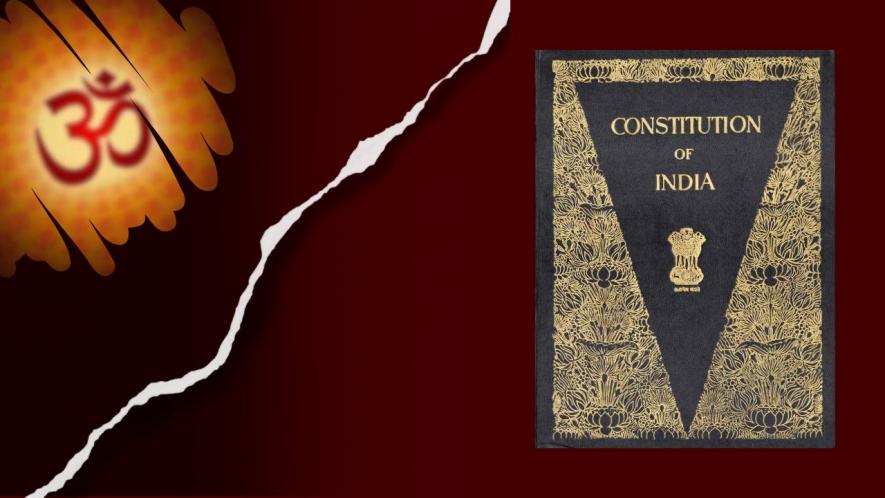
The Dwija leaders of the Bharatiya Janata Party, speaking from their ruling position in Delhi, are trying to mislead the nation about sanatan dharma and its “inclusiveness”. Moving away from their usual Hindutva or Hindu religious rhetoric, they have put forward the notion of sanatan dharma. Though they started this by opposing DMK minister Udayanidhi Stalin’s statement about “eradicating sanatan dharma”, it is the primary internal ideological agenda of the Rashtriya Swayamsevak Sangh (RSS), the progenitor of the BJP, to push the Shudra-backward castes and Dalit-Adivasi forces to their pre-constitutional status.
The RSS and BJP seem to have concluded that the Muslims and Christians have already been pushed into a shell during their ten years in power at the Centre and in several states. Their ultimate agenda, especially of the classical Dwijas who operate through the RSS, seems to be that the backward castes and Adivasis must now be pushed back to their classical enslaved and semi-enslaved status.
Whether it is possible or not is a different issue—their drive is crystal clear.
How BJP Defines sanatan dharma
While attacking Udayanidhi in a press conference, Ravi Shankar Prasad, a senior BJP spokesperson, defined sanatan dharma as “eternal law”. But what is this eternal law? Prasad did not elaborate. Is it an eternal natural law or an eternal spiritual law? This, too, nobody knows. Per the Vedic rules, Sanatan only means traditional or old religious practice.
As we know the RSS-BJP understanding of it, sanatan dharma has three characteristics:
1) Maintaining the caste order without allowing the Shudras, Dalits or Adivasis liberation from bondage;
2) Performing yagnas and consuming ritual food after animal sacrifice;
3) The top two Dwija castes—Brahmins and Kshatriyas—are never supposed to work in the productive fields and should make the Shudras do those jobs in perpetuity.
Therefore, sanatan dharma defines the eternal duties of the Sanatans, Shudras, Dalits and Adivasis.
Revolts Against Sanatan Dharma
The first revolt against such an order came from Vardhamana Mahavira, the last of the 24 Tirthankars and founder of Jainism. Jainism turned to complete vegetarianism around the 7th century BCE as a response to the large-scale Vedic sacrifices (yajna) in which animals were killed. It allowed members of any caste to join the Jain sect as equals, and opposed the killing of any life form as violence.
Union Home Minister Amit Shah, a Jain, now supports sanatan dharma—which Jainism has opposed since the ancient period.
The second revolt came from Gautama Buddha. This was well-formulated with many of the earliest humanitarian principles. Buddhism opposed the caste system and supported the sramana philosophy as natural to all human beings. For them, working on farms or grazing animals was as dignified as preaching the Vedas.
Buddhism opposed animal sacrifices and proposed a balanced food culture of meat and non-meat (or vegetarian, as it is now known) as the everyday foods for humans. It saved animal life and allowed animal use for agricultural tasks, like the bull used to plough. Sanatan dharma opposed all these Buddhist ideas as anti-Vedic.
The Buddha described sanatan dharma or Vedism as unnatural and inhuman. According to him, human equality was part of the law of nature, while sanatan dharma believed in the opposite—permanent human inequality. The conflict between Buddhism, Jainism and the Sanatana school continued until the Muslims captured India from the North West.
History is mostly silent for quite some time after that.
Medieval Revolts
The subsequent major revolt against sanatan dharma and Indian Islamic spirituality came in the medieval era from Sikhism. The Guru Granth Sahib laid down several principles that respected the dignity of labour. No Sikh guru accepted the caste system, particularly Brahmanism, as a humane or respectable practice. That was why, right since inception, Sikhism stressed that all its adherents must participate in agricultural work.
The strong rural production ethic of the Sikhs of Punjab came from the indignity of labour in sanatan practices. It never asked the followers to go into seclusion or isolation—the tapasyapractice by an individual—to realise divinity or perfect one’s soul. Sikhism rejected the idea of Brahman as divine.
It asked its followers to work and worship in communes. Though in actual practice, it has some elements of caste, there is no permission or religious sanction in the Guru Granth Sahib for caste and untouchability. Any Sikh child can go for training in the priesthood. This created a crisis in the Brahmanism of Western India.
If the RSS-BJP rulers make sanatan dharma the ruling ideology of India, it will spark a Sikh revolt. That is one reason why Dr BR Ambedkar wanted to embrace Sikhism as an alternative to Sanatanism.
Revolt of Arya Samajists
In the 19th century, Swami Dayanand Saraswati, from the Punjab region and the Brahmin community, emerged with a new interpretation of Vedic spirituality. He believed Varna dharma and yagyas were introduced by unethical Sanatanists. He started recruiting people from all castes into the Arya Samaj. Consuming food together—vegetarian, of course, but ignoring the traditional caste hierarchy—was made normal in the Arya Samaj. Women were recruited to study the Vedas and preach them.
Therefore, his contemporary Sanatanists opposed the Arya Samaj, its admitting people from any caste and women into the study of Sanskrit and mantra patana. This enraged the Brahmins and Kshatriyas and massive clashes erupted in North India between the Sanatanists and the Arya Samajists. Finally, his believers say, the believers in sanatan dharma killed him by poisoning his food. Though Arya Samaj was anti-santana, it was not as well-organised as Buddhism and Sikhism. Hence, it remained a weak movement.
Phule-Ambedkar Anti-Sanatan Movements
Mahatma Jyotirao Phule’s Satyashodhak Samaj(truth-seeking society) and BR Ambedkar’s Annihilation of Caste awakened the Shudras and the Dalits in a new, modern, universalist and democratic way. They critiqued the entire history of sanatan dharma and assessed the role of anti-sanatan schools. Phule proposed an entirely new religion, while Ambedkar embraced Buddhism and gave it a new modern direction called Navayana Buddhism.
The BJP-led central government has entered into a profound contradiction by supporting sanatan dharma and Ambedkar’s Constitution simultaneously. The Constitution of India embodies all anti-Sanatan struggles.
Anti-Sanatan Movements in South India
In the southern states, the Basava movement of Veerashaiva was a powerful anti-santan revolt in the 12th century. Basava, though born in a Brahmin family, revolted against the sacred thread or janeu, fought the caste order, and promoted numerous women and men from the so-called lower castes. The Shudra Lingayat and Vokkaliga communities became followers of Basava, rejecting Brahmin and Kshatriya authority.
As happened during the Sikh rebellion, mostly the Shudra agrarian castes in Karnataka became the followers of the Lingayat spiritual movement. They established their mutts, which operate with Shudra mattadhipatis or chiefs.
In Karnataka, the Adishankara peethas established by Brahmins with the new philosophy of Advaita parallel the Lingayat peethas.
The Anubhava Mantapas of Basava were casteless spiritual congregational centres. The Lingayat religion gives women a major place. Akka Mahadevi, a Kuruba (from the shepherd community) in medieval times and Gauri Lankesh, a Lingayat in our time, became strong followers of Basava. Remember that Lankesh was killed by the believers in sanatan dharma.
From the same tradition emerged Sree Narayana Guru, who opposed sanatan dharma and mobilised the Ezhava community, which, in the late 19th and early 20th centuries, was treated as an untouchable and un-seeable community by the Brahmins in Kerala. Narayana Guru has become a counterbalance to Adi Shankara in the same state.
Periyar’s Dravida Movement
The final blow to sanatan dharma in the South came from Periyar Ramasami’s Dravida Khazgam movement. It defined sanatan dharma as an “Aryan racist” and “Brahmin casteist” religion. They drew a subtle difference between sanatan dharma and Hinduism. This was the most intensive and tension-ridden movement against the Sanatan Brahmanism of the Dravida Shudra-Dalit social forces in South India.
It became a prominent political and electoral issue for the first time. Though Periyar began the movement as an atheist thinker, he drew a line between the agrarian Shudra-Dalit spiritual and Brahmin spiritual culture.
Annadurai and Udayanidhi’s grandfather Karunanidhi emerged as powerful mobilisers of the movement, giving the Tamil masses an unparalleled opportunity and ability to fight the vegetarian Tamil Santana Brahmanism. They used political, cultural (including cinema) and literary forms in their struggle. Karunanidhi used his ability to write film scripts to mesmerise the Tamil cultural and spiritual social base.
Udayanidhi is also a popular film actor; and is part of a tradition that uses cinema to take on the RSS and BJP’s Sanatan revivalist efforts. The BJP’s External Affairs Minister at the Centre, S Jaishankar, and Union Finance Minister Nirmala Sitharaman represent the Tamil Sanatan Brahmin saga. Periyar fought the Sanatan Brahmin representative C Rajagopalachari. Karunanidhi and Annadurai contested Jawaharlal Nehru and Indira Gandhi’s Brahmanical mediation-ism and stood by the Shudra, OBC, Dalit masses and defended their right to representation.
Tamil Nadu Chief Minister MK Stalin and his son Udayanidhi realise that the BJP is pursuing Sanatanism with a new diabolism that includes spewing vitriol against Muslims and Christians. They know its ultimate goal is to subdue the Shudras, Dalits, Adivasis and women with a slow but systematic revivalism of sanatan dharma. However, this agenda of the BJP is likely to prove self-destructive.
The author is a political theorist, social activist and author of ‘The Shudras: Vision For New Path’ with Karthik Raja Kuruppusamy. His next book will be The Shudras: History From Field Memories. The views are personal.
-
The Clash of Cultures review: A primer on ground reality of Dalits, OBCs in Modi’s India
The controversy over caste census and the demand by the OBCs for reservations in iobs and education lend Kancha Ilaiah Shepherd’s The Clash of Cultures the immediacy it needs
John Dayal
21 Sept 2023
The Hindu right wing, which has been ruling India for the last ten years, considers Professor Kancha Ilaiah Shepherd one of its most stinging gadflies outside of the parliamentary Opposition in the country. For over thirty of his 70 years of life, he has punched holes in the policies of the Prime Minister Narendra Modi, calling his doles and statements on Dalits as not only mere lip service, but a sinister act to deny agency to the former untouchable castes, while further strengthening the upper castes and crony capitalists who uphold his parent political group, the Rashtriya Swayamsevak Sangh (RSS).
In doing so, Modi, his Bharatiya Janata Party and the RSS provide sinews to an Islamophobic and anti-Christiaan rhetoric that poses a constant threat to the unity of India, its constitutional secularism, and its otherwise pacific culture.
I have known Kancha Ilaiah (Ilaiah ought to be pronounced like you would the name of the Prophet Isaiah, he told me once so very long ago) for about thirty years, call him a friend, and follow his writings as indicative of a bridge between the early intellectuals and leaders from mahatma Jyotirao Govindrao Phule (1827-1890) and DD Kosambi (1907-1966) to Bhimrao Ambedkar (1891-1956), and the modern writers from the Dalit and backward communities who too are treading a brave and often lonely path in the national discourse heavily invested with violent religious and nationalist rhetoric.
The genie of hate and a deaf state
Despite strong criticism from fellow academics and abuse from Modi’s surfeit of friends in the media, Professor llaiah has been unsparing and unafraid in his criticism of the varna system, the caste stratification which provides the steel frame of the Hindu, or Santana faith which is the religion of 80 per cent of India’s more than 1.30 billion population (estimated, as the 2011 decadal census has not yet been carried out).
He has taught political science at Osmania University in Hyderabad, north capital of Telangana. He was one of the early ones to testify internationally on the continuance and possible strengthening of the caste stranglehold despite decades of Independence. He spoke at the US Congressional hearing on ‘The Abolition of Untouchability: the Key to Stability in India’, describing the roots and the ongoing reality of violence and discrimination against Dalits.
For those who may not have seen his many books, the collection of his many essays published in newspapers, magazines, academic journals, and pamphlets, The Clash of Cultures: Productive Masses Vs Hindutva-Mullah Conflicting Ethics is an important primer on the ground reality of the Dalits and the Other Backward Classes (OBCs. The current controversy on whether India should have a caste census and the demand by the OBCs for reservations in jobs, education, and political presence, provide the volume the immediacy it needs in this age of Google and 30-word news capsules.
Ilaiah sets the tone, and brings us up-to-date, in his 10-page introduction which by itself deserves place in any contemporary anthology someone may want to edit on the million mutinies – that hackneyed phrase which still serves a purpose – in contemporary India where an impending general election in 2024 has released the genie of communal and targeted hate that often leads to violence, and a state which, by turns, is deaf to the developments, or causes its agencies to add fuel to the fire. The police, as always, look on, or turn away their gaze.
Brahminism and Islamism
He writes “Brahminism and Islamism have become bitter enemies after demolition of Babri Masjid in 1992. Brahminism took revenge against the Indian Islamic culture by deploying the Shudra and Dalit muscle power and now it is in control of political power at Delhi with a total grip on the productive masses of India.”
“Brahminism yielded to Islamism for centuries. It lost power to the British. But it has been in control of the Shudra/Dalit/Adivasi masses for millennia. Brahminism was in control of them during the Muslim rule and the British rule. But so far the Shudra/Dalit/Adivasi forces never established their control over Brahminism. If there is a cultural war between Brahmanism and Islamism, who wins? We do not know. Globally speaking, Islamism is bigger and stronger. But Brahminism is more cunning. It can make the Shudra/Dalit/Adivasi masses cannon fodder in the name of ‘We Are All Hindus’.”
He wrote these weeks before Modi declared India would henceforth be known as Bharat. The Constitution had called it “India that is Bharat”. A subtle but well-marked difference.
Ilaiah picks on the PM almost instantly. “Modi declared himself as an Other Backward Class (OBC) person, without telling the nation whether his family/caste has roots in the Shudra or Bania (as many Banias also acquired OBC certificates) heritage. The Shudra/OBC masses have a culture of production of a whole range of food and civilizational commodities, technologies and instruments which is different from what the RSS/BJP top leaders believe and practise. That will lead to cultural clashes as the RSS/BJP top leaders keep hegemonising their own culture over the other cultures.
A democratic state, slowly subverted
The book explores this in well-chosen articles bunched in three sections dealing with each of the groups he discusses. In some ways, he is at his best while analysing the standoff between the Dalit-OBC and the BJP, while his brief discussions on Islam touch upon the critical support needed for the religious minority’s existential struggle. However, there are also areas of criticism, particularly with regard to the role of the Mullahs and the political elite that have held control, but failed to shepherd the community in the years since Independence.
llaiah is right in saying that sections of Catholics – wrongly singled out Jesuits who have often challenged the regime – have been roped into the RSS/BJP networks and they are willing to serve them. Similarly, a section of Shia Muslims (the majority of Indian Muslims, over 85%, belong to the Sunni branch of Islam) has been roped into the RSS/BJP ranks and they played a critical role in stabilising the RSS/BJP. During the BJP/RSS rule, India is likely to become an unstable and conflicting civil society, and even the democratic state may be slowly subverted.
Islam, which occupied vast regions of the Islam, which occupied vast regions of the Indian sub-continent, built a strong counterculture to the age-old Aryan Brahminic culture. In a way, Islam weakened Aryan Brahmanism more than Indian Christianity because Islam took away Afghanistan, Pakistan, and Bangladesh historically from the fold of Aryan Brahmanism and established a big Islamic cultural Asia.
The clash of civilisations
The Sangh Parivar is using the international and national tension between Muslims and Christians to their advantage, he writes. The anti-Muslim feelings that grew after 9/11/2001 terrorist attacks in several parts of the world fixated the Muslim position. The Hindutva forces used the occasion to establish more controls on not only Muslims but others as well. The disunity and unfriendly atmosphere between Muslims and Christians helped the Sangh Parivar to win the 2014 elections. Subsequent to that^ election, they have mounted a series of cultural attacks on Muslims and Christians through their campaigns of Ghar Wapsi, Love Jihad, Cow protection, beef ban, Triple Talaq, Uniform Civil Code, FCRA issues and so on.”
llaiah says the Sangh Parivar intellectuals celebrate Samuel P. Huntington’s ‘Clash of Civilization’ thesis, which predicted a major clash between the Christian and Islamic civilisations. What Huntington talked about was that those two biggest religious cultures of the world – Christian and the Muslim – would create conditions of World War Ill. The Sangh thinks that such a clash between the Christian culture and Islamic culture would give scope to the Brahminic culture to gain global acceptability. If World War Ill is fought on cultural issues, India will become the epicentre of that war.” Islamic Pakistan, and India, brandish nuclear weapons.
The Cold War protagonists, with their nuclear arsenals, were 5,000 kilometers apart. India and Pakistan share a border. Ilaiah is no military strategist, but he may not be far from what many others in civil society fear.
About the Author
John Dayal is a human rights activist and author
-
Bharat, a Casteist and Patriarchal Name
Kancha Ilaiah Shepherd | 20 Sep 2023
The RSS-BJP’s idea to reframe Hinduism as Sanatana Dharma and India as Bharat are interlinked and damaging to India.
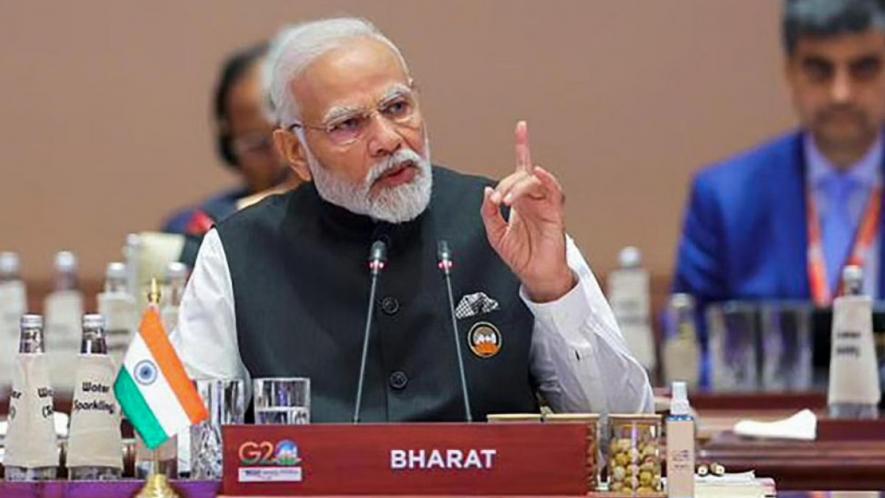
Image Courtesy: PTI
Under the leadership of a Prime Minister who claims a backward class identity, the central government is trying to unsettle the idea of calling this nation “India”. At the G20 Summit, his government showcased the name Bharat instead of India, the name most commonly used by ordinary people, governments, civil society, and writers and thinkers globally. It is by the name “India” that this modern democratic nation is known to the world.
In India, too, when universities build universally understandable knowledge, research centres work, or in the English media, whether print or visual, the name India has featured right from the days of the freedom struggle.
Bharat and Hindustan are used within India in language discourses and writings. Most Muslim leaders and scholars, and even Hindutva leaders and scholars, use the name Hindustan in their speeches and writings. But in every state, writers and speakers, especially in the South Indian languages, use Bharat or Bharata Desham.
Simultaneous to the Bharat idea, the BJP power structure has thrown up another discourse—obviously with the OBC Prime Minister’s approval—to use “Sanatana Dharma”, not “Hinduism” as much, to describe the religion.
Both ideas—Sanatana Dharma and Bharat—are interlinked. They originated in ancient Sanskrit literature—the Vedas, Upanishads, Ramayana, and Mahabharata, up to Kautilya’s Arthasahstra and Manu’s Dharma Shastra. They reflect the cultural heritage of the ancient Brahmin, Kshatriya and Vaishya communities. The ancient Shudras (today’s backward classes or OBCs), the Mlecchas (Dalits) and the Vanavasis or Adivasis were oppressed and exploited in that cultural domain. The Kshatriya kings, Brahmin saints, and priests treated the productive masses worse than animals.
Even when the name Bharat was adopted for India, a modern free country, it came from two sources—the Ramayana’s dynastic male king, Bharata, who was said to have ruled for the fourteen years when Rama was in vanavasa (dwelling in the forest). The second source is Dushyanta’s son Bharata in the Mahabharata. Does not an OBC Prime Minister know that during the Vedic era, the OBCs, then known as Shudras, had no rights? They could not read and write or even perform tapasya (religious penance).
Does the Prime Minister not know that women in those times had no rights in any sphere of human life? Leave alone the Shudra or Chandala women—even Brahmin, Kshatriya and Vaishya women had no spiritual, social or economic rights.
After considerable debate in the Constituent Assembly, it was decided Article 1 would use the name “India, that is Bharat”, but the fundamental philosophical direction of the Constitution of India is in the Preamble. And the term used there is “We, the People of India”. The word Bharat does not feature in the Preamble. It does not say, We, the People of India, that is Bharat”.
Why did Brahmin, Kshatriya, Vaishya, Kayastha and Khatri (Dwija) members of the Constituent Assembly accept “India” in the Preamble without Bharat? After all, Dr Rajendra Prasad, who belonged to the Kayastha community, was the chairman of the Constituent Assembly.
It is because the name India has its roots in the Indus civilisation—it did not emerge from a particular caste ruler’s name, male or female. Nor did it arise from any dynastic source. By contrast, the name Bharat is not only the name of a male ruler but a Kshatriya dynastic one.
The OBCs, Dalits and Adivasis must oppose the Prime Minister, his party and the Rashtriya Swayamsevak Sangh (RSS)—their mother organisation—if they try taking India back to a classical Varna-dharmic and dynastic name. Those who follow Buddhism, Sikhism and all Dravidian sects must fight against it, too.
On the one hand, the BJP says it is against dynastic rule—how can it then promote the dynastic and patriarchal name of an ancient monarch for a modern nation?
The followers of Buddhism, Jainism, Sikhism, the Lingayats, and Dravidians of all sects and faiths cannot accept the mono-name Bharat. Indian civilisation was shaped through achievements far advanced for its times. The ancient Harappan towns and cities throughout the Indus region are a testament to its achievements.
That civilisation was created with the collective efforts of our ancestors long before the institutions of caste, patriarchy, monarchies and dynasties evolved. It was built before religious books were written, and today’s religions arrived on the scene. That civilisation was not based on what was written in some books but on the agrarian, artisanal, animal and fish economythat people of those times built. If even Mesopotamia and Jericho could not match that civilisation, why don’t the RSS and BJP want us to own that civilisation? It is because India of the Indus civilisation had nothing to do with race or caste, as the name India makes clear. Those are the value-neutral roots of all Indians living here today and who will live here in the future—which the casteist, patriarchal and anti-production culture cannot accept or tolerate.
But that civilisation, the roots of the human tree on which the Shudras, Dalits, Adivasis Buddhists, Sikhs, and Dravidians have advanced, cannot allow the recapture of this nation by bulldozing the foundational name, India.
India stands for a plural, secular, productive and scientific origin. Why does the BJP want to erase a pre-Vedic civilisation—in which Shudras, Dalits, Adivasis, Brahmins, Kshatriyas, Vaishyas, Kayasthas, Khatris Muslims, Christians, Buddhists, and Sikhs all belong—and impose a name on the nation that mirrors the Brahmanical history of post-Vedic times?
How does an OBC Prime Minister, who is said to command all central structures, allow such an anti-OBC, anti-Dalit and anti-Adivasi agenda to take precedence over a civilisational identity that represents all Indians?
When the Prime Minister promised in 2013 that he would pursue Sabka Saath, Sabka Vikas, Sabka Vishwas (run a government for all Indians), did he tell all Indians that the casteist, dynastic patriarchal name Bharat would come to represent all Indians?
This is not Sabka Saath. It is misleading the OBC, Dalit, and Adiavsi working masses—including those in his government and party.
The Narendra Modi government projected India as a vegetarian nation at the G-20 Summit. The RSS and BJP have every right to promote vegetarianism, but its bounds are within these organisations. The Prime Minister might be a vegetarian by training or choice, but India as a nation is not vegetarian. Lust for power has them draining this historical civilisation of its lifeblood in the guise of pursuing the non-violence of vegetarianism. Globally, no sensible human being accepts such partisan bulldozing of this nation’s civilisation and culture with one-sided projections.
The BJP rulers are not greater nationalists than those who fought the British and institutionalised democracy and constitutionalism in this country. They are slowly moving in the opposite direction than the vision unfolded before the nation during the campaign before the 2014 Lok Sabha election. The trajectory the RSS and BJP have put India on will cost the nation much more than can be visualised now.
The author is a political theorist, social activist and author of ‘The Shudras: Vision For New Path’ with Karthik Raja Kuruppusamy. His next book will be The Shudras: History From Field Memories. The views are personal.
-
Kancha Ilaiah Shepherd | Bharat, symbol of brute power
‘India’, an inclusive term, embodies our social, spiritual and civilisational roots. ‘Bharat’ has drunk deeply of Sanatan Dharma’S brutal brew of caste, race and masculinity. Dalits/adivasis must oppose its adoption
(Illustration by Tanmoy Chakraborty)

ISSUE DATE: Sep 15, 2023
After opposition parties adopted the acronym INDIA (Indian National Developmental Inclusive Alliance), Prime Minister Narendra Modi and other BJP leaders attacked it as an indication of the Opposition’s colonial mindset. Followed by RSS sarsanghchalak Mohan Bhagwat, they asked people to use “Bharat instead of India” to instil a sense of “national pride”. Thus started the name-change game plan of the RSS/ BJP. They are now trying to project it as part of their decolonisation agenda. Dr B.R. Ambedkar’s final adoption of the name ‘India’ in the Preamble of the Constitution—“We the people of India”—has priority over the way it was used in Article 1: “India, that is Bharat”. Why did he prioritise India over Bharat as the name of the country, though both were used in the Constitution?
The oppressed castes of India were starting to be conscious of their rights by the time the Constitution was adopted in 1950. The name Bharat stemmed from the Sanatan heritage in post-Vedic times and has caste/ racial connotations. The name of the subcontinent, India, is more acceptable as it mirrors our most ancient advancement. It unites all under a common identity—Dravidian, Aryan and Mongoloid races and the teeming agrarian productive masses. Most such productive masses exist now in social categories like Shudra (OBC), Dalit and Adivasis. The name of this country must reflect their contribution too. ‘Bharat’ has no such civilisational significance; it does not encompass the long-existing productive civilisation of this subcontinent.
The name India indicates the subcontinent’s social, spiritual, cultural and civilisational roots, not just of the present land mass of the nation-state. It encompasses the Buddhist, Jain, Sikh, Muslim, Christian and Vedic religions.
‘Bharat’, whether it originated from Dasaratha’s Kshatriya dynasty in the Ramayana or Dushyanta’s Kshatriya dynasty of the Mahabahrata, has its roots in male dynastic upper-caste rulers. Why should it be acceptable to women, apart from Shudras/ Dalits/ Adivasis, who all have problems with the Kshatriyaness of the name? It symbolises monarchical brute power, not our ancient republican heritage.
The Indus civilisation, from which the name India emerged through several—Greek, Latin, Persian etc.—twists and turns, reflects collective labour power, as well as the science and technology devised by our ancestors from pre-patriarchal Vedic times. The Indus source is a secular one; it does not hark back to our religious/ caste roots.
If colonial use of ‘India’ is the main cause for changing it, the term ‘Hinduism’, which was popularised and used widely in colonial times, also needs to be dropped. Before colonialism, all extant records have ‘Hindoo’ or ‘Hindu’, while the Brahmanical religion was referred to as ‘Sanatan Dharma’. Muslim rulers and the East India Company coined ‘Hinduism’ to mean the Sanatan Dharma. The name Hinduism for that religion did not exist in any written text—either in Sanskrit or regional languages—before Muslim and British rulers used it. Muslim rulers did not use ‘India’, but the name Hindustan. That name incorporates both religion (‘Hindu’) and land (‘sthaan’).
The use of ‘Hinduism’ should thus be relinquished by the RSS/ BJP forces to oppose both Muslim and British rule. An ideal nationalist name for their religion could be ‘Sanatan’. Then the Shudras/ Dalits/ Adivasis can draw a clear line between them and Sanatans. The concept of Sanatan stands for varna dharma. Dr Ambedkar and E.V. Ramasamy ‘Periyar’ have written about the close ties between caste and Sanatan Dharma.
The BJP in general and Narendra Modi in particular keep on attacking the dynastic rule of the Nehru family. How come the same BJP/ RSS forces now prefer a Kshatriya dynastic name for the country itself? The PM’s aircraft already has ‘Bharat’ written in Hindi. The government used ‘Bharat’ at the G-20 summit. If the country’s name is changed to Bharat during the Modi regime, all the PM’s speeches against dynastic rule boil down to hypocrisy.
Ambedkar had an idea that a name like India shall reflect his vision where there should not be oppression of caste, religion, class or gender. He rejected many Sanatanists’ demands in the Constituent Assembly that India should be named Bharat, not India. If ‘India’ is dropped by this government, Shudras/ Dalits/ Adivasis of India must oppose the move with all the might at their command. n
—Kancha Ilaiah Shepherd is a political theorist, activist and author
-
If only the Indian communists emulate the path of ‘Gaddar’!
KANCHA ILAIAH SHEPHERD· SEPTEMBER 16, 2023
Gummadi Vittal Rao—Gaddar— lived a life of song, dance and revolution. The State put six bullets in his body. Not only did he survive, he nursed one of them for 25 years. That bullet is now buried with him as a testimony of his life and times.
GADDAR’S unexpected death on August 6, 2023 and his Buddhist burial as thousands thronged to catch a last glimpse of the dearly departed shall pave a new way for Indian communists.
Gummadi Vittal Rao, also known as Gaddar, was active in the Naxalite–Maoist insurgency, as well as the movement for Telangana’s statehood.
Prior to his death, he was known as a communist revolutionary singer, lyricist and stage performer.
A life of public performance as a revolutionary singer in villages and cities, facing state repression for decades, took his songs to almost every house.
Even the few years he spent underground did not douse his popularity. In fact quite the contrary.
He faced bullets fired by State agencies in 1997. He nursed a bullet in his body for the rest of his life and it has now been buried along with him. It stands witness to the trials and tribulations of this balladeer for centuries.
Communists, socialists, ex-communists and atheists must realise that Gaddar turning to Navayāna Buddhism in his death was a revolutionary counterpoint to the Hindutva forces in the present atmosphere.
If only his body was burnt to ashes, the ash from his burnt flesh and bones would have suffused the bullet with an unintelligible memory. In that case, no one would be able to decode the amalgamation as historical testimony, though!
A Maoist, Buddhist and Ambedkarite; and an eternal revolutionary
Gaddar lived the life of a Maoist and, later, as a Buddhist Ambedkarite, but his death with a Buddhist ritualistic burial made him a representative of peace after having been a sufferer for 25 years of painful days and wounded nights.
Despite his struggles, he never stopped writing, singing and dancing till his death.
Communists, socialists, ex-communists and atheists must realise that Gaddar turning to Navayāna Buddhism in his death was a revolutionary counterpoint to the Hindutva forces in the present atmosphere.
His path has become that of a communist-Buddhist nationalist alternative to Hindutva nationalism.
There is a major solution here.
Atheism does not perturb Hindutva forces as they have created an atmosphere of ‘religion as superstition’ with a grip of mantric mysticism over the masses.
If all communists, socialists and atheists follow the path of Gaddar, who lived as an unparalleled revolutionary all his life with a most creative message through song, dance and speech that no contemporary communist could do, India will surely find a new path.
He was a philosopher effectively communicating his philosophy through lyrics and music.
He was a master singer with a melodious tone and the best of performers, whose handsome face and robust body worked like a rubber robot on the dias in public.
Normal cultural heroes do become social-spiritual reformers. But Gaddar blended many anti-Hindutva essences into one inside himself.

After Dr B.R. Ambedkar, it is Gaddar who has shown a new path for the Dalit family, communist culture and Telugu land, which was the place of the first major anti-feudal armed struggle of Telangana.
The Rashtriya Swayamsevak Sangh can claim Jyothi Basu, Charu Majumdar, Puchalapalli Sundarayya, Kondapalli Seetharamaiah, Tariela Nagi Reddy, Devulapalli Venkateswara Rao and Chadra Pulla Reddy as Hindus.
Normal cultural heroes do become social-spiritual reformers. But Gaddar blended many anti-Hindutva essences into one inside himself.
But these people never understood the alternative spiritual and caste-centred Hinduism, which is now being equated with Sanatana Dharma.
In India, given the history of Brahmanism that takes the shape of every snake, it can incorporate anybody but certainly not Buddha, Ayothidasar, Ambedkar and Gaddar, because they left evidence in every step of their life alternatives to Brahmanism, Sanatanism and Hinduism.
Sitaram Yechury, Prakash Karat and D. Raja also cannot escape their enlistment in Hinduism, if they do not swiftly declare their spiritual alternative.
Gaddar’s Navayāna Buddhism can counter the false Hindutva nationalism with a blend of communism, socialism and nationalism.
He lived with a bullet sitting in his spine for more than 25 years. That life is unparalleled in human history. He survived six bullets that pierced different parts of his body.
We do not know any soldier who fought any war, including World War I and II, who survived six bullets in the body and lived with a bullet in the body for such a long time. Gaddar’s life is unique in human history.
Such a life made him a man of massive popularity and loving respect.
In the united Andhra Pradesh before bifurcation of the state in 2014 into two states, Andhra Pradesh and Telangana, Gaddar had a huge fan following for his songs and dance.
His commitment to the cause of human liberation from hunger and exploitation made him live a life of suffering, while singing and dancing.
Though later some Andhra people might have disliked his role in the Telangana movement that fought for separation of the state from 1996 till 2014, he remained very popular in Andhra Pradesh after the division too.
As a writer and artist he was a unique political, literary and cultural icon known all over India.
The manifest symptoms of a malady
His divorce from the Maoist party in 2012 was about serious ideological issues that he put before his underground party.
He proposed that the party should fight against caste and class, by recognising Jyotirao Govindrao Phule, also known as Mahatma Phule and Ambedkar, along with Karl Marx, Vladimir Lenin and Mao Zedong, to suit the Indian conditions.
He also started writing songs and started performing about caste’s negative role in India.
The Maoist party rejected his proposal and issued a show cause notice against him in 2010. His work was considered anti-party and his understanding was dubbed anti-Marxist.
As he had anticipated his expulsion, Gaddar resigned from the party in 2012.
His efforts to change the line of his party to suit Indian caste–class exploitation should not go unrecognised.
He openly declared his spiritual and social allegiance to Ambedkarite Navayāna Buddhism and wrote several songs on Dalit and women’s oppression.
His song on women’s wage-free work at home “O my husband, what is the wage for my washing clothes and dishes; what is the wage for my sweeping the house and giving birth to a baby and feeding the baby to become a future human being” tells about the deepest human essence in him.
He was not a mechanical Marxist, Buddhist or Ambedkarite, but a human being of the highest sensitivity. He continued to be a thinker, writer, singer and dancer till his last days.
Just before his death he wrote an elegy in a song about his own death. In that he mourned, “Who will preserve the bullet sitting in his body?”
Of course, it is now preserved in his grave as fossil evidence of the rulers’ brutality on humanity.
It is a known fact that communist leaders in India never accepted social reform as a necessary issue along with class struggle.

Indian social reform encompasses spiritual reform along with dignity of labour and women’s equality with men.
He was not a mechanical Marxist, Buddhist or Ambedkarite, but a human being of the highest sensitivity. He continued to be a thinker, writer, singer and dancer till his last days.
The final form of that would be annihilation of caste, abolition of poverty, hunger and women’s inequality.
However, in spiritual terms, the Indian communists declared themselves as atheists and basically focused on class questions as economic determinists.
But in reality most of them die as Hindus. Their atheism in day-to-day life does not relate itself to any form of social reform.
Gaddar gave them a major social and spiritual reform programme in his death.
Caste-blighted birth redeemed by a death seeking freedom
Ambedkar said: “I had the misfortune of being born with the stigma of Untouchability. However, it is not my fault. But I will not die a Hindu, for this is in my power.” He became a Buddhist and died.
Gaddar was born as an Untouchable, as it was not in his power.
He worked in the communist revolutionary party which had many armed squads. He was their Parja Youdda Nauka (the ship of a people’s war).
After decades as a mover of that warship he realised that without Ambedkar, who used the power in his hands at the time of his death to die as a Buddhist with a message of peace, change would be possible.
The guns he supported all his life cannot liberate from Untouchability. He, therefore, became a Buddhist and got liberated from Untouchability.
More importantly, as a person who fought against that a State system that burnt hundreds of dead bodies, killing people in fake encounters after torturing them so that no evidence of torture could be left behind, Gaddar wanted his body and the bullet to be buried at a marked place in the premises of the English school that he built for the children of his basti.
If those so-called encounter bodies were buried even after decades they could have been exhumed and re-examined. Gaddar, therefore, preferred to be buried along with the bullet in his body.
It was Chandrababu Naidu who had blood on his hands as he was the ruler of the undivided Andhra Pradesh at the time.
The guns he supported all his life cannot liberate from Untouchability. He, therefore, became a Buddhist and got liberated from Untouchability.
Interestingly, the party was named by Naidu’s father-in-law as Telugu Desam Party and Gaddar is the most powerful Telugu writer, singer and communicator that the Telugu land has ever produced.
The nation will excuse if Chandrababu, at least now, goes to his body and the bullet in the grave in the school, Mahabodhi Vidyalaya, prostrates, and tells the truth about what happened on April 6, 1997 when he was the chief minister of Andhra Pradesh.
He can certainly live as a human being after that confession for the rest of his life.
Kancha Ilaiah Shepherd is a political theorist, social activist and author. His latest book, The Shudras: Vision for a New Path co-edited with Karthik Raja Karuppusamy, examined many issues of Shudras. Currently, he is also working on a book titled, The Shudra Rebellion: History from the Field Memories.
-
BJP’s Sanatana Dharma is another form of Manu Dharma
The practice of human untouchability, anti-dignity of labour and women’s inequality have deep roots in Sanatana Dharma. Yet, the BJP wants Sanatana Dharma as the eternal law of this karma bhoomi.

Tamil Nadu Minister Udayanidhi Stalin
12 Sep 2023
Sanatana Dharma was a religion of three castes in ancient and medieval north India—Brahmins, Kshatriyas and Banias—and it has now become a religion of five castes with the inclusion of Kayasthas and Khatris. Sanatana Dharma defined production as pollution and kept the Dwija castes (who wear janeu) outside. Shudras/Dalits and Adivasis were defined as slaves, Mlecchas and Vanavasis. In other words, Sanatana Dharma was/is against production, Shudras and women. Any other definition of Sanatana Dharma is unsustainable.
Sanatana Dharma has been defended by BJP’s top ministers Amit Shah, Rajnath Singh and Nirmala Sitharaman, apart from the party president JP Nadda and Assam Chief Minister Himanta Biswa Sarma. Sanatana Dharma was an ancient philosophy of Brahmanism, with its roots in Rigveda. It evolved through other Sanskrit texts. By the time Manu Dharma was composed, the practice and spiritual theories of Brahmin writers got synthesised as “Sanatana Dharma,” which stood against productive labour and productive social mass—Shudras, Chandalas and Vanavasis. Now, the BJP’s top ministers and leaders have owned that philosophy as theirs.
Addressing a press conference, BJP’s senior spokesperson Ravishankar Prasad defined Sanatana Dharma as eternal law. According to him, those who oppose it will face consequences. How can all Shudras, Dalits and Adivasis accept this? Finally, Prime Minister Narendra Modi said, “It needs a proper response.”
Now, the cat is out of the bag. The BJP is for Sanatana Dharma, which is nothing but Manu Dharma, which is also nothing but Brahminism of ancient mode. The theory that production is pollution has its roots in Sanatana Dharma itself. Though it looks as if the Union government has declared war against Udhayanidhi Stalin, a young man of 45 years, it is a classical mode of war against all Shudras/Dalits and Adivasis.
This weapon, ‘Sanatana Dharma’ held by the Union government, is to show all Shudras/Dalits/Adivasis their place in the 21st century. In ancient times, it was a spiritual weapon against Shudra agrarian producers. Today, it is against all three categories (Shudra/Dalit/Adivasi) of wealth producers. It is the weapon of Brahmin, Bania, Kayastha and the Khatri and Kshatriya rulers from Delhi against the majority voters of India.
From Hinduism back to Sanatana
Hinduism is known as a way of life with various spiritual paths. It is also controlled by Brahminism through temple and religious practices. However, the name Hinduism to the religion, like the name India to the country, was also given by colonial rulers. Perhaps, along with India, the BJP wants to discard the name ‘Hinduism’ too. That is good. Both these changes suit their ‘parampara’ theory.
This newly revived ancient Sanatana ideology became BJP’s core while attacking Udhayanidhi Stalin and the INDIA alliance. Udhayanidhi, the grandson of Karunanidhi and son of MK Stalin, the Chief Minister of Tamil Nadu, suddenly became an all-India Dravidian ideological hero with a firm stand against Sanatana Dharma.
A temple priest puts a bounty on Udhayanidhi’s head. The BJP is silent about it. Such violent fatwas, known only in the Islamic world, are now extended to Bharat, and the BJP seems to approve of the Sanatana cultural fatwas. Sanatana Dharma forced kings to cut the tongues of Shudras who tried to learn Sanskrit and pour lead into their ears if they heard Sanskrit shlokas.
What did Udhayanidhi say?
Udhayanidhi addressed a conference organised in Chennai by the Tamil Nadu Progressive Writers and Artists Association on ‘Eradication of Sanatana’ on September 2, 2023. He said, “Some things cannot be opposed. They should only be abolished. We can’t oppose dengue, mosquitoes, malaria, or coronavirus. We have to eradicate this. That’s how we have to eradicate Sanatana. Rather than opposing Sanatana, it should be eradicated.”
Udhayanidhi defined Sanatana Dharma as an ideology of caste inequality and anti-social justice. The BJP ministers have defined Sanatana Dharma as eternal law. Though it is well-known that Sanatana Dharma describes caste hierarchy – Brahmin, Kshatriya, Vaishya and Shudra – and the Shudras (including Dalits) as slaves in ancient times, the BJP ministers are projecting the historical category Sanatana is for everyone who is not a Muslim or Christian perhaps. Quite strange.
Sanatana Dharma and Varna Dharma
Sanatana Dharma was a combination of Varna Dharma and Varnashrama Dharma, as it was formulated in ancient Sanskrit books. Varna Dharma was meant to give all the authority only to Dwijas – Brahmins, Ksatriyas and Vaishyas – in ancient times. The Dwija category has two more castes Kayasthas and Khatris, added to it. All five castes refuse to do any productive work even now. They forced the Shudras, Chandalas and Vanavasis to work without expecting phala (wage) in ancient days. That was their duty. Now they receive some wages, but the Dwijas have a huge surplus.
According to the Varnashrama Dharma, the Dwijas must learn in school in childhood, run a family life in youth and in old age, involve themselves in penance.
The present Shudras/Dalits/Adivasis are not allowed to study in Sanskrit theological schools and they cannot become priests in Hindu temples. Even now, the situation remains unchanged. Yet, the BJP wants Sanatana Dharma as the eternal law of this karma bhoomi.
A war against Shudras/Dalits and Adivasis
The focus of RSS/BJP seems to have shifted from Muslims and Christians to Shudra/Dalit/Adivasis. After Independence, whether during the Congress regime or now during the BJP regime, the idea of Sanatana Dharma was understood as anti-Shudra/Dalit/Adivasis of India. The practice of human untouchability, anti-dignity of labour and women’s inequality have deep roots in Sanatana Dharma. After the Vedic texts, Manu Dharma synthesised the ideology of Sanatana Dharma. Dr Ambedkar and Periyar Ramasamy Naikar deeply analysed the whole process. Hence, Periyar attacked Manu Dharma, and Ambedkar burnt it as it represented Sanatana Dharma.
For a long time, the Congress protected the Sanatana ideology under the garb of secularism. But the RSS-controlled BJP wants to preserve such Sanatana by declaring war on the very idea of abolition of caste, untouchability, and indignity of labour from Delhi. The same BJP wanted to twist the arms of Shudra agrarian farmers through farm laws, but they fought back. Now, they want to attack the Dravidian strong anti-Sanatana Dharma base. That is why a young man’s critique of Sanatana Dharma was twisted as genocidal and blown out of proportion by Dwija forces in Delhi. The whole Union government is geared around this issue.
This is not a war against Muslims or Christians now. It is a war against the rising political and social forces of Shudras/Dalits and Adivasis by modern Brahminism. It is clear that the ruling BJP’s IT cell head Amit Malviya, deliberately twisted Udhayanidhi’s speech as genocide of 80% of people, as if Shudras/Dalits/Adivasis are part of it. This is a conscious step by a big ruling Hindutva party.
Dharma is not justice
The concept of Dharma has been twisted to mean justice. No, it never was equivalent to justice in the ancient Greek or European sense. Under this, the Shudras had to follow the caste rules framed by Brahmins and remain slaves and agrarian workers in Vedic times. It also meant that the Dwijas would never participate in productive labour as production was seen as pollution.
Leave alone the Shudra/Dalit/Adivasis, women of all castes have no place in Sanatana Dharma, and they suffered barbaric exploitation and superstitions that Sanatana Dharma imposed. The Shudra/OBC/Dalit/Adivasis working in the BJP/RSS have to seriously examine this new development. A few may enjoy powerful positions without any ideological control over the system by accepting Sanatana Dharma, but the majority of productive masses will be pushed back to the dark ages. If they do not resist such open support to Sanatana Dharma by the top ministers, who openly own such ideology and attack critiques of the primitive ideology, then the nation will go into a period of dark history.
Kancha Ilaiah Shepherd is a political theorist, social activist and author. His latest book The Shudras: Vision For a New Path, co-edited with Karthik Raja Kuruppusamy, has put forth a powerful argument that without the cooperation of Shudras with Dalits and Adivasis, caste inequality and oppression cannot be changed. Views expressed here are the author’s own.
-
The right to religion and the Shudra predicament
In conversation with Articles 15 and 16
KANCHA ILAIAH SHEPHERD·AUGUST 15, 2023
Shudras are the single-largest caste group in India, and there are more Shudras than all other castes and religions combined. Yet they remain a largely marginalised group because of lack of strong leadership and their exploitation by dvija Hindus in their fight against Muslims and Christians, argues Kancha Ilaiah in this piece.
—
BEFORE India adopted a democratic Constitution in 1950, the masses in the country had no idea that religion could be thought as part of the legal system.
After the formation of a civil society and a State in Indian history, the Indian Constitution marked the first instance when the idea of a right to religion was defined in Indian history.
No Indian philosopher wrote a comprehensive theory of the right to religion. Though there were many kinds of religious practices for centuries in this country, the notion of a right was not applied either for an individual or for a social group. It was never defined.
For example, the idea of religious sentiment was not known in India before the nationalist discourse was deployed around Hinduism and Islam.
Where do Shudras fit into the whole constitutional language? Before Ambedkar came to the scene, Dalits were also in the same predicament. Socially they were placed in the worst position.
Article 25 of the Indian Constitution states that: “Subject to public order, morality and health … all persons are equally entitled to freedom of conscience and the right freely to profess, practise and propagate religion.”
Further, Article 26 provides that all denominations can manage their own affairs in religious matters. The Article only talks about people who are consciously organised into a religion with equal spiritual rights. The concept “denomination” may mean a Vaishnavite, Shaivite, Catholic, Protestant, Shia or Sunni.
But where do Shudras fit into this whole constitutional language? Before Ambedkar came to the scene, Dalits were also in the same predicament. Socially they were placed in the worst position.
Now Dalits broadly identify themselves with Buddhism. The Adivasis had their own life without much control of Brahmanism over them. Gradually, the Adivasis turned towards Christianity.
Right now, we are witness to a conflict between Christian Adivasis and Hindutva Brahmanism in Manipur. The right to Christianity and Islam have been challenged by the Hindutva forces right from the days of the freedom struggle. The propaganda against these two religions was started by Brahmin intellectuals.
K.B. Hedgewar, M.S. Golwalkar and V.D. Savarkar were well-known Brahmin pioneers of Hindutva propaganda in the early days. Mohan Bhagwat and Dattatreya Hosabale of the Rashtriya Swayamsevak Sangh (RSS) continue their legacy today. Not a single Shudra or Dalit intellectual was integrated into the list, as the communities were mainly drawn into communal wars by Brahmanic intellectualism.
Puzzling Shudra predicament
Nothing in Article 25 solves the problem of Shudras who are now being defined as Hindu by Brahmin thinkers without giving them any spiritual rights that a religion has to give to its members.
Nothing in Article 25 solves the problem of Shudras who are now being defined as Hindu by Brahmin thinkers without giving them any spiritual rights that a religion has to give to its members.
Since Shudras have not yet produced thinkers who could understand their status in ‘Hinduism’, Brahmins and other dvijas (twice-borns) who control that religion are very safe when there is no intellectual force among Shudras.
To ensure long-term control over Shudras, Brahmins prohibited them from learning Sanskrit. Shudras are running the so-called majoritarian campaign against Muslims and Christians as minorities because Brahmins and other dvijas put Shudras in the basket of Hinduism to ensure they have massive muscle power at their command.
Shudras constitute around 52 percent of India’s population and once they challenge the definition of ‘Hinduism’ allotted to them, the efforts of the reigning powers to exploit their muscle power for violent acts and vote power for systematic control will ultimately collapse.
The consciousness of Shudras, who follow the Brahmanic diktat as a loyal social force, is puzzling. Though they have no spiritually equal rights with Brahmins and other dvijas,they follow any theory that Brahmin intellectuals propose.
Even though Shudras are a historical community, they have been unable to formulate a ‘freedom of conscience’. They follow a Brahmin-imposed conscience sans the right to examine whether a religion where Hinduism is restricted to Brahmanism would liberate them. They never pondered the question whether they would attain moksha (liberation) through this religion.
A small section of Indian Christians and Muslims knew what religion meant for them in reference to the Bible or the Quran respectively. However, even the masses in these faiths were credulous to believe what was injected into their consciousness and practised by priests and mullahs.
The saving grace is that in these religions, the path for religious intellectualism is not blocked for any community or caste.
First major debate on religion
A national-level debate about religions took place during the freedom struggle among the English-educated intellectuals of India. Mahatma Gandhi led the Hindu discourse and Mohammed Ali Jinnah led the Muslim discourse.
Gandhi wrote about his views on Hinduism but Jinnah did not write much on Islam. He seemed to have depended only on oral arguments on behalf of the Muslims.
Since Shudras have not yet produced thinkers who could understand their status in ‘Hinduism’, Brahmins and other dvijas (twice-borns) who control that religion are very safe when there is no intellectual force among Shudras.
The third idea with a concrete written argument was put forth by Dr B.R Ambedkar. In Gandhi’s Hindu discourse, all castes, including untouchables, were Hindu.
He never raised the issue of Shudra agrarian mass status in that religion. By then Shudras were allowed to enter Brahmanic temples (it is wrong to call them Hindu temples).
Also read: Significance of caste discrimination ban in Seattle
Shudras also had their own agrarian gods and goddesses temples. They had no other spiritual rights in what Gandhi called Hinduism. They had no right to Sanskrit gurukul education, no right to priesthood, no right to interpret the spiritual texts.
Such rights are central to any religion.
Many Brahmin intellectuals were fully involved in constructing Muslims and Christians as enemies. Shudras did not know what was happening in the intellectual domain. They followed the Brahmin priest’s guidance in the temple and general intellectual guidance in the civil society.
Dr Ambedkar’s dilemma
Dr Ambedkar wrote about the harrowing status of Shudras, based on Sanskrit texts and ideologies of varna-dharma. However, like Gandhi, Ambedkar considered Shudras to be Hindus, even dvijas, in his book, Who Were the Shudras?
He gradually delved deeper into determining the rights of Untouchables, and later amalgamated Shudras in a broader category of ‘caste Hindus’.
Contemporary universal religions like Christianity gave its followers a fundamental right to be an integral part of the religion, but Dr Ambedkar never examined this element to the core in the Indian context, perhaps due to the baggage of colonialism it carried.
British rulers were largely regarded as Christians, and Christianity, as against the Hindu spiritual system, remained largely unexplored.
By then, Islam in India had become feudal and oligarchic. Ashrafs, Mughals and Pathans dominated the religious community in the absence of a broad theory of public education and practice.
On the contrary, Indian Christianity became the source of English-medium education for all Brahmin, Baniya, Kayastha, Khatri and Kshatriya leaders.
In the medical sector, Christian missionary hospitals were the only option for the dvijas. The so-called Brahmanic ayurveda could not reach even all of the dvijas in India, let alone Shudras, Dalits and Adivasis.
No dvija writer, Gandhi included, wrote anywhere about the Christian seva centres. Pandita Ramabai understood the importance of both the advancements brought in by Christian missionary hospitals and the attempts by Brahmin intellectuals to side-line these advancements, and moved into Christianity, becoming a great social service leader despite her Brahmin background.
No Shudra intellectual of the stature of Dr Ambedkar, Gandhi or Nehru emerged from the Shudras during the freedom struggle. After Mahatma Jyotirao Phule and Savitribai Phule, Periyar Ramasamy rose as a prominent figure in the South as a Dravida activist leader rather than a theoretician. In the wake of the global communist wave, Periyar turned to atheism.
Patel’s indifference to intellectualism
Sardar Vallabhbhai Patel was the tallest Shudra leader in the freedom movement, but he did not fight the dvijas.
He became a follower of Gandhi, having accepted that he was also a Hindu like the Baniyas and Brahmins of Gujarat. However, Patels were not considered Hindus.
Dr Ambedkar wrote about the harrowing status of Shudras, based on Sanskrit texts and ideologies of varna-dharma. However, like Gandhi, Ambedkar considered Shudras to be Hindus, even dvijas, in his book, Who Were the Shudras?
They were humiliated by Brahmin Baniyas who treated them as Shudra agrarian tillers, and considered tilling the land to be polluting work. Jain Baniyas from Gujarat treated it to be violent work.
Also read: Why we must annihilate caste to save Indian democracy
If Sardar Vallabhbhai Patel were to ever ask Gandhi, a proponent of the varna-dharma system, whether Shudras could be considered Hindus without having the right to send their children to Hindu theological schools, or to become priests in temples, or to own ‘dakshina’ (repayment) economy, which was under Brahmanic control, Gandhi would have been forced to rethink his Hindu majoritarian idea.
At that time, Shudras did not even have the right to engage in business, which was under the control of Baniyas. Gandhi himself belonged to the Baniya business heritage and forced vegetarianism on Shudras, who were historically meat-eaters. Patel silently followed Gandhi on the path of food conversion, too.
If Shudras were to state that they were not Hindus, as it is a religion only for the dvijas, then the Bharatiya Janata Party (BJP) and RSS would not have amassed the power that they hold today.
Shudras catalysed the dvija majoritarian mobilisation by accepting the definition of Hinduism given to them, i.e., that all non-Muslims and non-Christians are Hindus.
The underlying issue was that even the Indian National Congress was under the control of the dvijas and Shudras lacked a creative, bold and intellectual leader to assess their position among the Hindus and in political parties. They were intimidated by the tyrannical spiritual authority of Brahmins for millennia.
Need for a Shudra leader
Both the Hindu Mahasabha and the RSS were purely dvija organisations headed by Brahmins and funded by Hindu and Jain Baniyas since their inception. Leading businesses were controlled by Baniyas and Parsis during the freedom struggle, who treated Shudras and Dalits as Untouchables.
Dr Ambedkar’s humiliating encounter in Baroda, where he was forced to leave a Parsi inn because he was a Dalit, is a prime example of the status of the lower castes, even though he had a rich educational background.
Shudras had no religious power or control over businesses back then and the situation persists even today. They have negligible political power in some regions where feudal Shudras established regional parties but they have no Central power.
Where were the Shudras in the temple economy and business economy? Nowhere. The temple economy even today mostly gets controlled by Brahmins and the big business economy is in the hands of Baniyas.
Shudras, by and large, work in the agrarian sector and India’s agrarian civilisation remains mostly undocumented in Brahmanic Sanskrit literature. If there were any highly English-educated pioneers among the Shudras, such as Dr Ambedkar, they would have condemned the ‘Hinduism’ given to them.
If a Shudra leader were to give them an identity different from Brahmins, Baniyas, Kayasthas, Khatris and Kshatriyas, who shared the right to wear a sacred thread, read Sanskrit books, and study Sanskrit in gurukulas (traditional schools), the present idea of Hindu majority would not have shaped up.
No Shudras in cultural nationalism
Members of the RSS have been propagating that they want to build the future of the nation centred around their ideology of cultural nationalism found in ancient Sanskrit books.
Sardar Vallabhbhai Patel was the tallest Shudra leader in the freedom movement, but had no formal training to read, write or fight.
The question is, do Adivasis, Dalits and Shudras, as historical communities, exist in Sanskrit books? Is there an ancient Sanskrit book about their life and contribution to society?
The Ramayana and the Mahabharata are the most widely read ancient Sanskrit books, which speak of Brahmin rishis (sages) and Kshatriya kings. Both these books are centred around wars and the morality that emerged from the terrain of war.
The narratives of agrarian production and artisanal life are disregarded.
There is no narrative of agrarian production and artisanal life in these books. Shudra, Dalit and Adivasi communities do not exist in the textual Kruta and Dwapara yugas.
Without Shudra and Dalit labourers, what did the saints and kings eat? Who built their castles, their homes and produced technology for their wars? Does the war culture of Brahmins and Kshatriyas solely represent an entire civilisation?
How does culture formulate itself without a narrative of production, the social relations during the process of production and their distribution?
A war zone does not construct culture, but the production field does. However, this production field finds no trace in any Sanskrit books.
Right from the days of building the Indus Valley civilisation, the agricultural and artisanal work of Dalits and Shudras built the Indian civilisation as a whole, rather than the wars of Brahmins and Kshatriyas.
The nation’s survival and growth are attributed to the efforts of Shudras and Dalits who inhabited the forests and focused on improving agriculture, animal husbandry and artisanal technology.
Brahmins, Baniyas, Kayasthas, Khatris and Kshatriyas played no role in any of the domains of production. They controlled Shudras and Dalits through the Brahmin varna-dharma system, which is now termed the Hindu dharma. They have started modern religious wars through their religious dogmas.
The muscle power of Shudras and Dalits was exploited in communal riots in Gujarat, Delhi and many other cities. Today, the Hindu Meitei tribe’s muscle power is being used against the Christian Kuki tribe in Manipur.
RSS’s Brahmin-run shakhas
The RSS and Hindutva forces refuse to use Brahmanism as an ideological category. They use the ‘Hindu’ category to carry Shudras with them and run shakhas (Hindu theological schools) to train Shudras in lathi rolling and physical fights.
If the RSS, as a Hindu organisation, wants a caste-free Hindu religious system, it should run Hindu shakhas and train all youth for temple priesthood and ritualist activities. However, this domain is completely entrusted to the Brahmins who run gurukulas and train only Brahmin youth.
Shudras are not allowed to raise any questions about spiritual social equality in the system devised by the RSS.
Despite regional Shudras having land ownership, wealth and State power, their history remains short-lived as there is no intellectual leader among them.
Apart from the Brahmin youth, Baniyas, Kshatriyas, Khatris and Kayasthas also do not get admission into the gurukulas but receive other benefits from the Brahmin religious structure.
It is in the best interests of the RSS and the dvijas to maintain the caste system, while Dalits and Shudras continue to be the main targets, owing to their labour and muscle power against the minorities.
Dalits have come to realise this and have converted to Buddhism and Christianity, making Dr Ambedkar their spiritual liberator. Shudras, however, remained stuck in Brahmanism, a mayavada philosophy that teaches that everything is an illusion.
Temple economy and Shudra rights
Shudras visit temples and give money to priests as dakshina, as they do not have the right to priesthood in Brahmin-run temples. They are also unaware about the extent of money collected in the temples, and how it is put to use.
The Sanskrit education imparted in gurukulas and the temple economy are interlinked with the system, as Baniyas conduct business in temple towns. Business establishments are largely controlled by Baniyas, who are at par with Brahmins in terms of their spiritual, social, and financial status. They are integrated into the RSS–BJP power structure now.
Also read: SC rejects Maharashtra’s plea to direct Centre to disclose data on OBCs as per 2011 caste census
In some states where temples are administered by endowment departments under the state governments, the chairperson of the temple trust may hail from a Shudra agrarian background and feel inferior to the head priest of the temple.
Some temples have massive financial resource mobilisation and priests are paid handsomely. The ruling RSS and BJP forces do not wish to make such powerful priestly positions inclusive.
The Congress’s governance operated under the rubric of secularism, thereby escaping most caste-cultural problems.
The Nehru family’s control over the Congress was multi-cultural and multi-religious, but the RSS and the BJP have systematically targeted their background, due to which Congress heirs Rahul Gandhi and Priyanka Gandhi are leaning towards the Hinduism fold. Rahul Gandhi claimsthat he is a janeu (sacred thread) wearing Brahmin.
The Congress was virtually run by the dvijas, but Shudras could not construct an identity of their own within the party’s culture, as it consisted mostly of foreign-educated Brahmins without bringing up issues regarding caste and religion. Dvija forces of the RSS and the BJP found their breeding ground during the Congress rule.
A national Shudra-entity movement
It is well-established that Brahmins and Baniyas flourished in all fields, especially in the educational, social, spiritual and economic spheres, whereas the identity of Shudra was completely erased.
Of the four varnas of ancient Brahmanism— Brahmins, Kshatriyas, Baniyas and Shudras— the Brahmin varna remained in a hegemonic position despite the change in political systems, spanning the monarchic and colonial, and ultimately the democratic rule since 1947.
Baniyas rose to power during the Gupta period in the fifth century CE and again during the freedom struggle, with Mahatma Gandhi fortifying them. Corporate businesses have been in the hands of the Baniyas since 2014 due to Narendra Modi and Amit Shah’s strategies.
Kshatriyas lost their identity significantly after 1947, but because of Yogi Adityanath and the new Sri Rama (Ram was a Kshatriya king) temple being built in Ayodhya, Kshatriyas will get more visibility. They are trying to consciously organise under the leadership of Yogi Adityanath.
Shudras must evolve their spiritual system by renouncing ‘Hinduism’ if they remain shorn of their basic religious rights.
As of now the Shudras are a more fragmented and regionalised social mass with various caste names based on their occupations.
Their social links are cut by regional languages and disconnected caste names. Though they have a huge presence in every state, their identity as Shudras is lost.
A section of them has now obtained a constitutional identity in the form of Other Backward Classes (OBCs). However, the identity is purely related to reservation in jobs and education. This identity does not reflect their history, religious location and civilisational contribution.
Other dvija castes, such as Baniyas, have also procured OBC certificates by nullifying the historicity of Shudras. Shudra identity-formation has other challenges as well. They are subdivided into reserved Shudras (OBCs) and non-reserved Shudras, who fall in the general category. The latter category comprises Jats, Kammas, Patels, Reddys, Velamas, among others.
Shudras who have gained financial autonomy have not overthrown higher caste English-educated dvijas who work on spiritual, philosophical and historical issues. Middle-class and upper middle-class Shudras are occupied with agricultural activities and the real estate economy.
Some caste leaders from the Kammas, Marathas, Patels, Reddys and Yadavs have their own regional parties with power in states such as Andhra Pradesh, but historical issues pertaining to civilisation, culture and divine agencies remain unaddressed.
Despite regional Shudras having land ownership, wealth and State power, their history remains short-lived as there is no intellectual leader among them.
Persons belonging to Dalit and Adivasi communities have now gained recognition pan-India. Dalits question of Untouchability began a global discourse, especially after the Durban United Nations conference on ‘Racism, Racial Discrimination, Xenophobia and Related Intolerance’ in 2001.
It has led to some US states making anti-caste laws, but Shudras and OBCs have negligible recognition internationally.
In my opinion, Shudras need a unified movement for spiritual equality within modern Brahmanism that is presented as Hinduism. Equality amongst all stratas of society is the need of the hour.
The right to priesthood, admission in theological educational institutions for children and youth, and employment on an equal basis in ‘Hindu religious institutions’ should be prioritised.
Right to priesthood must include the right to head the prominent Shaivite peethas, such as peethas and mathas established by Adi Shankaracharya, the eighth century Brahmin revivalist.
Shudras must evolve their spiritual system by renouncing ‘Hinduism’ if they remain shorn of their basic religious rights.
Kancha Ilaiah Shepherd is a political theorist, social activist and author. His latest book, The Shudras: Vision for a New Path co-edited with Karthik Raja Karuppusamy, examined many issues of Shudras. Currently, he is also working on a book titled, The Shudra Rebellion: History from the Field Memories.
The right to religion and the Shudra predicament
-
Telangana poet Gaddar, who told Maoists class struggle wasn’t enough—caste was important too
Maoist, pro-Mandal, Ambedkarite, Dalit, and Buddhist—Telangana poet Gaddar was the face of many struggles in India.
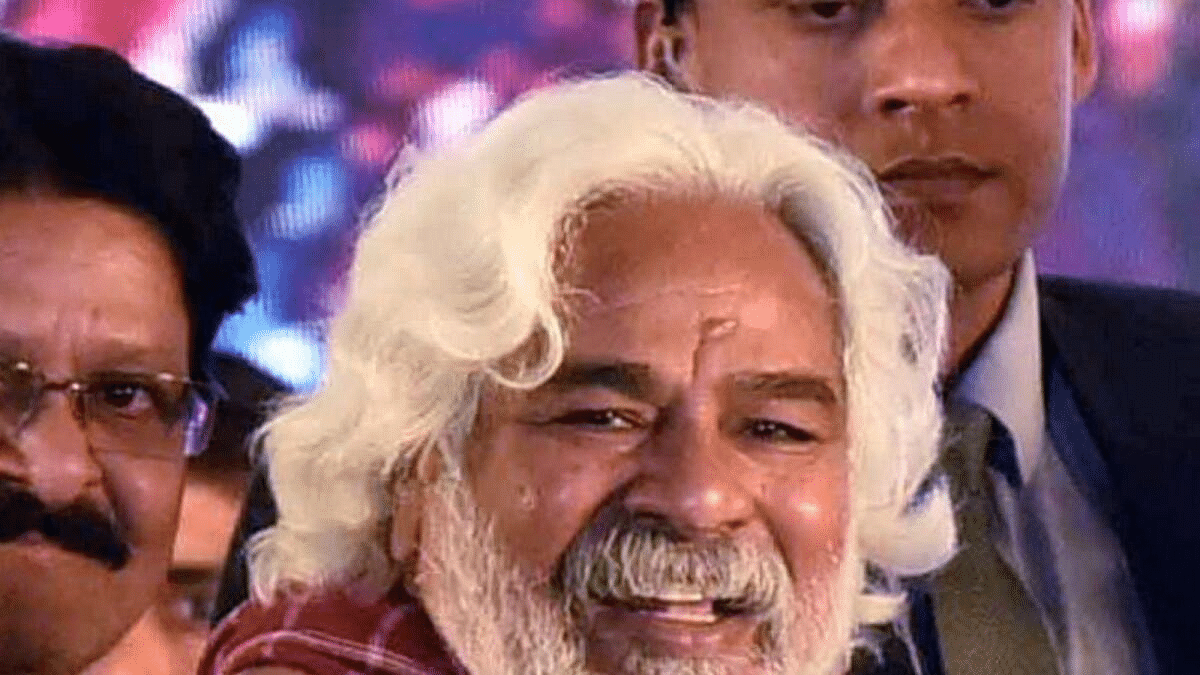
Telangana poet Gaddar | PTI
Telangana folk singer Gaddar, born Gummadi Vittal Rao, also popularly known as ‘people’s singer’ and ‘Praja Yuddha Nauka’, died on 6 August in Hyderabad. Leaving aside my decades-long friendship with Gaddar in the larger people’s movements, the poet was an organic legend as a lyricist and singer belonging to the productive masses who reflected the power and pain of labour and humanity.
A Maoist, pro-Telangana movement and pro-Mandal activist, politician, Dalit, and later an Ambedkarite and Buddhist — Gaddar was the face of many struggles.
A life of struggle
The poet’s most famous song, which he wrote when he was still maturing as an organic lyricist and singer in the 1970s, goes as follows:
“Sirimalle Chettukinda Lachumammo, Lachumamma
Yuvvu Chinaboyi Kusunna Vendukammo
(O mother Lachumamma, Why are you sitting
Under jasmine tree with such a sad face and body)”
This song depicts Gaddar’s mother’s life of labour and all its torture when she worked on a paddy field yet wasn’t paid and starved for days. It moved readers.
Gaddar belonged to a Marathi (Mahar) Dalit family that migrated to Hyderabad. His father, Toopran, an Ambedkarite, educated him and admitted him into the prestigious University of Engineering, affiliated with Osmania University, in the early 1970s.
But Gaddar didn’t complete his course — he was soon drawn into radical student movements and dropped out of college, taking up a job as a clerk at a national bank only to leave it soon after. Then he became a full-time singer associated with the communist revolutionary struggle, popularly known as the Naxalite movement.
Gaddar gradually came to be recognised as the face of the Communist Party of India (Marxist-Leninist) or CPI(ML) through his songs, which he sang in the streets, at public gatherings, and before audiences numbering in lakhs — mobilising all. He took India’s cultural realm by storm with his new genre in which he wrote and sang about agrarian productive masses and exploitation in novel style. For a long time, his alternative to the existing corrupt system was only the armed revolution.
The poet adopted the name ‘Gaddar’ as a tribute to the pre-Independence Gadar party, which opposed British rule in Punjab. The moniker soon became the Indian symbol of Maoist struggles. The songs that Gaddar wrote on the red flag, guerilla strategies, and armed struggles shook the State apparatus.
In 1997, the folk singer was shot by five unknown assailants at his Venkatapuram residence in Secunderabad. While surgeons managed to take out four bullets from his body, one had gotten lodged into his spinal cord that they didn’t remove to avoid further complications — and the poet reportedly called it a “symbol of State repression”. The bullet sat within his body till he died.
The Dalit course
A man of courage, conviction, wit, and humility, and yet was childlike, Gaddar felt strongly for the Dalit movement. In the 1985 Karamchedu massacre, when Kamma landlords, the dominant caste group in coastal Andhra Pradesh, brutally murdered six Dalits and raped three Dalit women, he wrote a mass mobilising song that went as follows:
“Karamchedu Bhoosamulatoti Kalebadi Nilabadi
Poruchesina Dalit Pululamma
(The Dalit tiger that fought against Karamachedu
Landlords like tiger)”
This song became a weapon to mobilise Dalits in the entire state. From then onwards, Gaddar started writing songs on untouchability, Ambedkarism, and constitutionalism.
The poet’s sympathies for the Dalit cause heightened in 1990 when Mandal Commission protests erupted all over the country and the VP Singh government received heavy criticism. Social justice versus merit had become the ideological anchors of pro- and anti-Mandal forces. Even the communist revolutionaries under the leadership of mostly upper castes wavered and avoided a clear stand.
Arun Shourie, who was then the editor of The Indian Express, was leading the anti-Mandal movement. Gaddar responded to Shourie through a song that became a weapon for pro-Mandal forces. It went as follows:
“Arun Shouriego Neeku Akaali Bademeruka
Neyyi Kada Nuvvunte Piyyikada Memuntam
(O Arun Shourie, what do you know about the pain of hunger
You live in the society that eats ghee
Whereas we live a life that lifts your community’s shit)”
The song was disliked by many ‘upper’ caste revolutionaries, but Gaddar went on singing it in public meetings to inspire the marginalised to fight and get reservation implemented.
Toward Telangana movement
Later in the decade, Maoists decided to rekindle the Telangana movement when the Telugu Desam Party was in power. Gaddar became the inspiration for the movement, writing several songs on the exploitation of the state’s resources. His most powerful song had the following lyrics:
Podustunna Poddu Meeda Nadustunna Kalama
Poru Telanganama….Bale… Bale…Bale
(On the rising sun the time is walking
The Telangana struggle is a time walker on the sun)
Today, the song is remembered as the symbol of the Telangana movement. Although Gaddar was never an open supporter of the Telangana Rashtra Samithi (now Bharat Rashtra Samithi), he led parallel radical pro-Telangana groups with Maoist support.
Despite his Maoist sympathies, Gaddar differed with the ideology on one aspect — class struggle was not enough, caste struggle should be taken up too. He saw the several strengths of the Constitution. The singer tried to convince Maoists to change their approach toward the Constitution and BR Ambedkar. Obviously, they refused to change their old line of class struggle.
Gaddar exited the CPI(ML), dissociated from the Maoists around 2010, and started working with other forces to defend the Constitution.
After the Telangana state was carved out in 2014, Gaddar moved closely with diverse political and ideological forces. Several cases against him — filed when he was a Maoist — still lay pending. His health was getting precarious. For some time, he worked with the Bahujan Left Front (BLF), supported by the Communist Party of India (Marxist) supported, along with me. But at the same time, he maintained good relations with the Congress, participating in public meetings that Rahul Gandhi conducted in the state. Gaddar met Rahul and Sonia Gandhi in Delhi too.
Gaddar’s life was a saga of restless wandering, singing his own songs except for two that he popularised. One was Bandenaka Bandikatti (Bullock cart after bullock cart), a famous one against the Nizam and written by Yadagari during the anti-Razakar and Nizam struggle in the 1940s.
The second one was Vuru Manadira, which had the following lyrics:
“Eevuru Mandira, Eevada Mandira
Dora Yendiro Vani Peekudendiro
(This village is ours, this locality is ours
Who is this landlord, What is his torture over us)”
This song was written by another famous Dalit singer and writer, Guda Anjaiah, during the revolutionary movement in the early 1970s. Gaddar took this song to almost every village in Andhra Pradesh. As he kept singing the chorus at processions, thousands would join him, charging up the feudal atmosphere in the villages and towns.
Gaddar was both a sophisticated and rustic thinker. When he turned toward Ambedkarism, he wrote several ballads against the caste system and untouchability. A feminist, he wrote philosophical songs on women’s life, labour, and humanity, speaking against kitchen drudgery and the pain of cleaning streets and homes. His song on the great service of the broom conveys deep meanings.
Gaddar adopted Buddhism, leaving his earlier communist affinities, to follow in the footsteps of Ambedkar.
The folk singer is buried in the school compound that he built for poor children. Gaddar’s love for equality and his songs that talk about the struggle for liberation will remain.
Kancha Ilaiah Shepherd is a political theorist, social activist and author. His latest book is The Shudras—Vision For a New Path co-edited with Karthik Raja Karuppusamy. He is currently working on a book, The Shudra Rebellion—History From Field Memories. Views are personal.
Telangana poet Gaddar, who told Maoists class struggle wasn’t enough—caste was important too


You must be logged in to post a comment.