-
The RSS/BJP leaders and their family members must be ashamed for studying in English Medium Schools, not Shudra/OBC/SC/STs

Amit Shah is Home Minister. I wish he had been minister for foreign affairs and made that statement on “English Shame”. Before making that statement, even as home minister he should have asked his son Jay Shah to resign from the chairmanship of International Cricket Council (ICC) and said so. All cricket council meetings take place in English, in India and abroad. Isn’t Amit Shah ashamed of having a son who only speaks in English in all meetings in India or outside?
Why did Amit Shah, a mother tongue nationalist, put his son in an English medium school? The internet source informs that he studied in English medium school and later in Nirma University in Ahmedabad. In which language his professors taught him? In which language did he write his graduation examination? Naturally in English. Was Shah not ashamed of putting his own son right from LKG in the English medium school?
Top Baniya industrialists of Gujarat like Mukhesh and Anil Ambani not only studied in top class private English medium schools, but ran the most expensive private English medium, Dhirubhai Ambani International school in Mumbai. Though Gautham Adani was a school drop out, his children studied in high end English medium schools. Adani Group runs a most expensive English medium school. Do all the young school going children, studying in those schools, speak in English or in Gujarati or Marati in schools with their teachers? Can Amit Shah convert all those private schools into Gujarati medium or Marati medium?
He should have asked the Mukesh Amabani’s family to convert the Dhirubhai Ambani International English medium school, into Marati medium. So also Adani’s International English medium school, Ahamedabad, into Gujarati medium. He should have sent a notice to Ashoka University, Haryana and other private universities to teach multi-regional languages based on the student’s mother tongue, who takes admission, not even in Hindi for everyone, because Hindi is not a mother tongue of every child born in India nor it is friendly language of all Indians as he is repeatedly propagating. Amit Shah out of total ignorance of languages keeps saying that the history of India remains enfolded in regional languages or in Hindi. Absolutely false. Peoples’ and nations’ history remains in the productive knowledge systems. English as a richest language of the world could grasp Indian history much better than in Hindi or in regional languages
HYPOCRISY IS NOT NATIONALISM
The RSS/BJP hypocrites are trying to destroy the future of the younger generation of Shudra/OBC/Dalit/Adivasis by promoting the private sector to use English language in every sphere, and forcing the Government sector systematically to remain in regional languages. Of course the Congress after Independence initiated the English medium in the private sector system and the State Governments were asked to the Government schools in their respectives regional languages. That restricted the regional youth mobility. The Shudra leaders including Sardar Vallbai Patel did not realize its implications to the future Shudra/Dalit/Adivasis rural agrarian masses.
The Bengali and Tamil Brahmins understood the future of English more than any other regional upper castes immediately after Independence. They captured the academic and bureaucratic power from the Nehruvian days because of English. Gita Ramaswamy, a Tamil Brahmin, who later became communist revolutionary wrote in her book Land, Guns, Caste, Woman that in the 1960s her conservative Brahmin parents put all five girl children in Christian English medium schools and used to hate Christianity at home. At the same time they used to buy a lot of English novels for children to read so that the girls could learn good English; allowed them to see English cinemas. She later became an English and Telugu book publisher.
This could be true of Bengali nationalist and communist Brahmins. But nobody from that background wrote an honest autobiography as Gita did. Hypocrisy is the inner essence of Brahmanism. Amit Shah wants to spread this hypocrisy as the Indian Hindutva nationalist ideology. All this is to keep the Dalit/Shudra/Adivasis forces as slaves in the globalized world. Even earlier the Brahminic intellectuals preached this kind of mother tongue theory to the productive masses, while educating their own children in Christian missionary schools. After the pro-Hindutva private English medium schools grew the present RSS/BJP regime is starving the Christian English mediums schools so they could be closed down.
The Western India Gujarati and Marati Brahmin/Baniyas understood the importance of English slightly later and captured the industrial power through the English language itself. Narendra Modi and Amit Shah are their representatives at Delhi. Their only problem is they cannot speak in English. There is no conscious intellectual force among Shudra/OBC/Dalit/Adivasis within the RSS/BJP structures to check this hypocritic propaganda within those organizations. Even in their own organizations English educated Brahmin/Baniya/Kayastha/Khatri/Ksatriya intellectuals deal with global issues. The Shudra/OBC/SC/STs are confined to rural organizational work.
Outside BJP only Rahul Gandhi and Mallikarju Kharge are fighting on an everyday basis even on the question of English and regional language status as well. Now they are saying all children must learn English and regional language. Rahul Gandhi’s consistent fight for equality in all spheres is changing the political scenario.
The Congress party must formulate its long term ideological position about public private English and regional language education. No power on earth can eliminate the English language from India. The RSS/BJP know that well. Their own financers, national and international, do not accept their children getting pushed into the regional language school education. Now the RSS/BJP need an internationally operative intellectual class. If that is not so, why did they choose only English speaking members of parliament across the world for global outreach after the India-Pak recent war? What is the other qualification of Shashi Tharoor except English communication skills?
SENTIMENTALIZING LANGUAGE ISSUE
The Modi Government and the RSS keep telling the innocent masses that they should not send their children to English medium schools by sentimentalizing that English is a foreign language. But for the Brahmin/Baniya middle class and upper middle class it is a mother tongue. What is the mother tongue of the India air-travel class? Is it not English?
The propaganda of English Shame is actually schemed one against the interests of the vast rural agrarian and artisanal masses who are slowly moving into English medium education. In Andhra Pradesh and Telangana after English medium Government school education is made on par with private sector English medium schools the NDA the rich forces of Andhra Pradesh started saying “If the poor study in English medium who will work in our agrarian fields?”. That is the real fear. Amit Shah is trying to protect that class interest by forcing the rural working class children to the regional languages.
In the recent past the nation noticed that some of the poorest family youth could manage to crack IAS and IPS competitive exams because of their English. This is because they too are accessing the English language and managing to acquire a grip on global knowledge. They cannot compete with the English educated rich if they too acquire skills in English language.
In states like Telangana and Andhra Pradesh, where Government schools were converted to English medium teaching and learning with the help of bilingual (mirror nor image) books, a new paradigm of education started emerging in the rural areas. Furthermore, with the availability of AI tools to learn English in any place a lot of rural children from working class families are changing the course of the rural education system. Spreading English among Dalits, Adivasis and OBCs is really scary for the RSS/BJP Brahmin Baniya forces who earlier controlled English as their preserve after Independence.
Amit Shah’s attack on Ambedkar in the parliament a few months back and making the most obnoxious statement against English language, while promoting private sector English medium education, in the private sector as a preserve of their own. Once the rural poor are educated in English medium they too become entrepreneurs. This is the real fear of Amit Shah and his class.
Rahul Gandhi’s stand that English should be learnt by all class youth along with their own regional language has thrown up a challenge to the RSS/BJP Government at Delhi. The RSS/BJP forces are anti-poor by their very operations. They want to permanently distance the productive masses from English education as their ancestors did with regard to Sanskrit. Their gaze now turned to SC/ST/OBCs as they thought they won over Muslims. Amit Shah is only an open voice. They want to smuggle the SC/ST/OBC future by keeping the English language away from them.
Unfortunately the regional parties and the communists, while ruling a state like Kerala have no clear stand on this decisive language issue. It is time that the OBC/SC/STs must turn against them also.
Kancha Ilaiah Shepherd is a political theorist, social activist and author. His latest book is The Shudra Rebellion.
-
Condemn Dattatreya Hosabole’s Anti-Secular And Anti-Socialist Statement
28/06/2025

I have been repeatedly saying that the RSS essentially is a Brahmin-Baniya organization with strong ideological and historical roots in Brahmanism. Mohan Bhagwat and Dattatreya Hosabole being Brahmins from Maharatra and Karnataka respectively have serious ideological, political, cultural and philosophical opposition to the idea of equality and castelessness in India. Their repeated statements against the fundamental principles of equality and de-Brahmanization of Indian society are clear to all. The recent statement by Dattatreya, who said that the concept of secularism and socialism, not just words, should be removed from the preamble of the constitution, comes from their cultural and historical roots.
If these two persons are replaced by Shudra/OBC/Dalit/Adivasi individuals in the same organization as head, he/she would talk about secularism and socialism as concepts like that? But that very change of a Shudra/OBC/Dalit/Adivasi heading the RSS seems to be impossible because of the very same historical heritage.
Secularism in India refers to casteless secular social relations in the society. An inter- caste marriage or heading a Hindu temple by a Shudra/OBC/Dalit/Adivasi is a process of making Hinduism as a secular religion by removing its historical casteist control. A Shudra/OBC/Dalit/Adivasi heading the RSS would make a beginning of secularization of that organization.
The idea of socialism in India evolved far more differently than what Marx and Engels envisaged. It is an idea of democratic socialism that allows the Dalit/Adivasi/OBC/Shudras to acquire their own share of wealth based on their number and also contribution of labour power to the production of wealth in the nation. Such a change was arrested by Kautilya and Manu, both Brahmin thinkers, who wrote the most influential books, Artha Shatra and Manu Dharmashastra in ancient India.
Mohan Bhagwat and Dattareya are working to arrest such a change now. No Shudra, even a man of Sardar Vallabai Patel’s stature, whom the RSS owns, would not accept those two thinkers nor would he accept what Mohan Bhagwat and Dattatreya Hosabole repeatedly talk about secularism and democratic socialism.
Unfortunately there is no Shudra/OBC/Dalit/Adivasi man or woman of Patel’s stature in that organization nor would they allow anybody to grow like him in that structure.
Hence I strongly condemn Dattatreya’s statement and appeal to Shudra/OBC/Dalit/Adivasi leaders and intellectuals, living outside and inside the RSS to oppose such proposals in the interest of their future generations.
Kancha Ilaiah Shepherd
-
Why doesn’t RSS have a medical institution like CMC? Learnings from Kancha Kattaiah
Kancha Ilaiah Shepherd
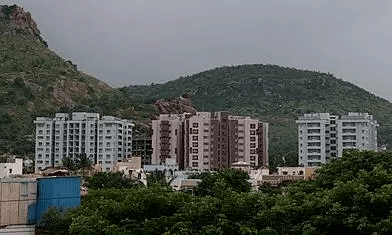
CMC Vellore was established as a nursing and delivery clinic by an American missionary woman, Dr Ida Sophia Scudder.
It has grown into a major world-class medical institution in India. Image: Wikimedia CommonsHad a Hindutva organ ruled India after Independence and closed down CMC, Kattaiah would have died young; he broke superstition to let modern medicine save his life
Kancha Kattaiah was born in 1948 in a small forest zone village, Papaiah Pet, Chenna Rao Pet Mandal, Telangana. After school education up to 11tt grade in a small town nearby, he dropped out and got married. He then entered into his family’s double occupational job, shepherding and agriculture.
In 1976, he developed a major heart disease.
According to doctors in Hyderabad, who examined him as an outpatient, he would not survive, as two valves in his heart were dysfunctional.
To CMC Vellore
It was found out that only in the Christian Medical College Hospital (CMC) Vellore, Tamil Nadu, the valve replacement could be done, if at all possible. Even in the then united Andhra Pradesh capital Hyderabad, there was no fully trained cardiologist at that time. There was no medical technology like an echogram as well.
Kattaiah was a courageous man. He pulled together his financial resources and went to Vellore CMC. With the help of his younger brother – this writer, whom he had educated up to a masters in Hyderabad’s Osmania University – he applied for financial assistance for medical purposes from the Nizam Trust.
The Trust, at that time, was allotting grants for chronic heart patients. Kattaiah got Rs 8,000. That was his first financial lifeline.
It was diagnosed at CMC that his mitral valve in the heart needed to be replaced, and it could be done. His admission number in that life-changing hospital, 912829, is archaic. For the entire operation, his family spent Rs 50,000, mostly borrowed.
With that medical opinion, he picked up courage and hope of life that was already declared to end soon. He was operated on on December 17, 1979. He lived for another 46 years and passed away earlier this month in his Hyderabad apartment, aged about 77.
Source of science
The question is: why was such a pioneering valve replacement done in a Christian missionary hospital, but not in a Hindutva missionary hospital?
The claims of the present ruling RSS/BJP forces are that Hinduism, from ancient to now, is the source of all science, and we do not have to learn anything from the West.
Of course, the Western scientific growth happened by challenging the Christian dogma. But the medieval ancestors of the Hindu dogma were never challenged by the Brahmin intellectuals, who were custodians of all knowledge.
The Shudras, Dalits, and Adivasis, who constitute the majority of people whom they claim Hindu now, were not allowed to study the Hindu dogmas and challenge them to create a scientific base. In fact, they were not allowed to learn the Hindu religious language, Sanskrit. At no stage were Galileo and Copernicus allowed to emerge in the Hindu history.
Weakness of past
The modern organisers of the Hindutva forces do not accept the weakness of their past. They want to project weakness as strength; their superstition as science.
This is where Indian universities and research institutions are in danger, particularly the medical institutions. They are forcing Indian youth to read Sanskrit books that promote superstition as religion and science.
No doubt, there is a subtle relationship between religion and science. The historical spiritual discourse around the conflict between science and religion is framed in terms of Evolutionism Vs Creationism. The idea of God is based on human speculation.
But ideas like Karma in Hinduism and Original Sin in Christianity are superstitious but religious. Superstition cannot negotiate with science. Medicine is a science. The hospital is its institutional base.
Islam that arrived in India in the medieval times has created its own superstitious myths – that Allah cures all diseases. Indian Islam has not created a hospital of CMC standards.
Kattaiah’s anti-superstition life
Kattaiah realised well before he became a heart patient that superstition does not allow villagers to prosper. It adds only to their financial distress. He did not encourage superstitious practices in his house after his mother and father died, and he took over the responsibility of the family.
The village cultural atmosphere in those days was very superstitious. People would spend a lot of money around mantrics and villages, regional temples and priests.
Kattaiah overcame such superstitious beliefs by the end of his school education.
Normally, such a health condition generates fear and makes a person run to anything that constructs a myth around life. Kattaiah while going to Vellore had to halt at Tirupathi. When the attendant brother asked him whether he would go for a darshan of the deity, he said, “If the surgeon who operates on me is good I will survive and if the physician is good and recommends proper medicines I will live long, but not with the darshan of divine images.”
He proved himself so right by living for 45 years and six months with a single valve.
Nehruvian science Vs RSS anti-science
India is a country of superstitions. Even educated men and women, with the campaign of organisations like the RSS, Hindu Mahasabha and Bajrang Dal, are spreading superstitions against the Nehruvian scientific spirit, which encouraged Christian missionary hospitals and schools.
The RSS did not establish a single hospital matching CMC in Nagpur or elsewhere.
While the CMC was established by a Christian missionary organisation, Hindutva organisations have organised Kumbh Melas, temple visits, Kasi yatras, Durga poojas, and so on, but never focus on modern medicine.
In fact, modern medicine was seen as British colonial medicine and against the ancient indigenous Ayurveda. But Ayurveda did not advance like what they abusively call
did not advance like what they abusively call ‘English medicine. They never differentiated between science and colonialism.
Even in Telangana, people were forced to believe that dipping in the Ganga (often it just means some water body nearby) would cure them of diseases. They did not distinguish between religion and superstition.
The Star Edward steel valve
To go back to Kattaiah, he wanted to live by all means. He got operated on in CMC and the valve was replaced at a cost of Rs 50,000, raised through loans. It was a huge amount way back in 1979.
Dr Stanley John operated on him and placed a Star Edward steel valve just brought into the medical market in America. Dr George Cherian was his physician. That was the first ever manmade valve in the world. It worked for over four decades before failing earlier this month, causing his death.
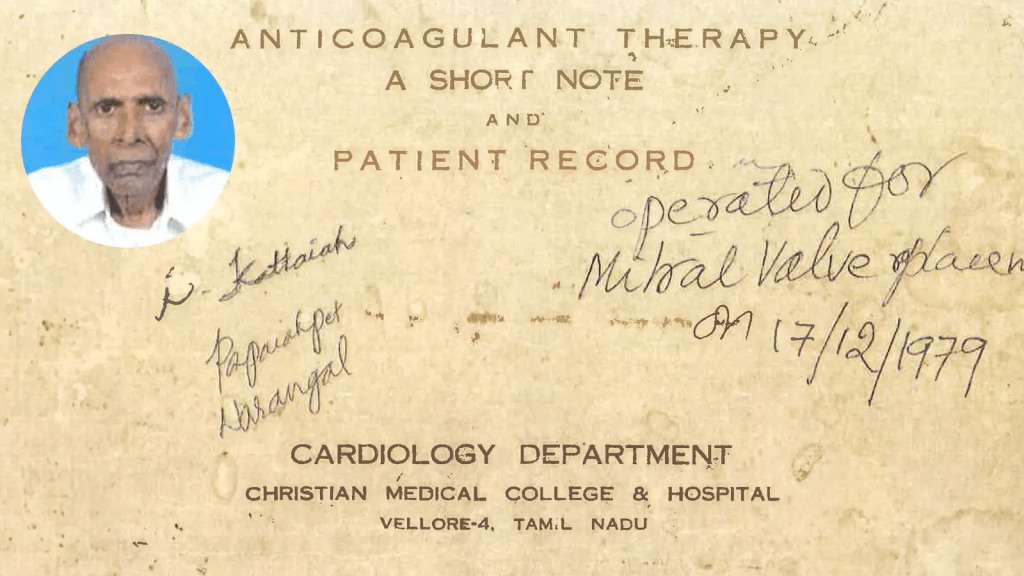
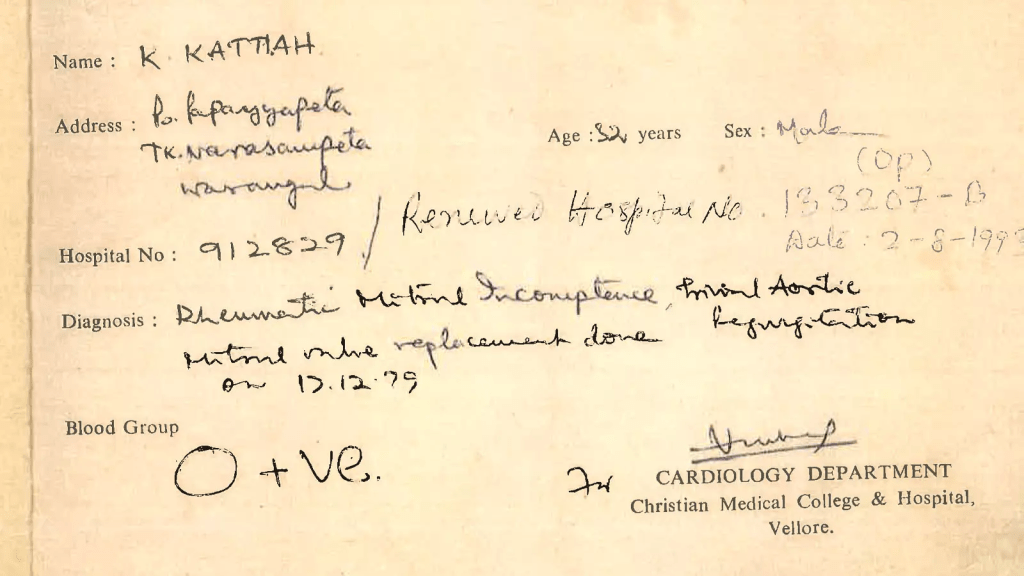
Kattaiah’s medical record. Nehruvian nationalism allowed Christian hospitals akin to CMC and advanced institutions akin to the Bhabha Atomic Research Centre.
The CMC was established as a nursing and delivery clinic by an American missionary woman, Dr Ida Sophia Scudder. It has grown into a major world-class medical institution in India. It developed with the help of foreign mission funding and also money collected from patients over time. The government in Delhi supported its growth by allowing fund flow.
Opposite entities
Imagine the RSS/BJP being the first ruling force in India. They may have closed down CMC as a ‘conversionist’ and ‘beef feeding’ hospital. Beef was sold in the CMC canteen at a subsidised price both for attendees and patients for protein supply. Doctors recommended beef for patients like Kattaiah. There was no force-feeding of any food item.
Science and superstitions are opposite entities and human practices. The RSS spreads superstition, which does not have any theoretical capacity to negotiate with both science and religion. This is where anti-superstition laws are needed in India. Many heart and other disease patients died depending on superstitious practices, even after spending huge amounts.
Constant feeding of superstition into people’s minds was used as a tool to keep them as slaves of casteism and Brahminism.
Caste construct
One of the main institutions that the ancestors of the RSS ideologues constructed was caste. The caste system
has built superstitious beliefs into the mind of most Indians now. Caste is not a religious institution. It is a superstition in itself.
Had an RSS (though it calls itself a social organisation) kind of political force come to power after Independence and closed down
CMC, Kattaiah would have died 46 years ago. He set a record in the history of artificial valve survivors in India, maybe in the world.
We now know that medical science in the world has advanced far more, and daily discoveries are happening. But India remains backward in that field, and RSS/BJP anti-science and anti-English language is likely to keep us more backward. There is no discourse around the scientific spirit in India now.
(The late Kancha Kattaiah was the brother of the writer.)
About the Author
Kancha Ilaiah Shepherd
Kancha llaiah Shepherd is a political theorist, social activist and author. His latest book is The Clash of Cultures – Hindutva – Mullah Conflicting Ethics.
https://thefederal.com/category/opinion/rss-science-cmc-kancha-kattaiah-christian-missionary-194284
-
Prof.Kancha Ilaiah Shocking Comments On BJP and About VP Singh | Caste Census | Eha TV
-
A Rational Heart: How Reason and Care Sustained One of India’s Longest Heart Valve Survivors

In a record-setting case, an Indian patient lived 46 years after receiving a first-generation Edwards-Starr heart valve at CMCH in Vellore in 1979. His survival defied medical expectations — a powerful testament to how science, institutional motivation, and family care can together extend human longevity.
In a world still reckoning with the aftermath of COVID-19, where health consciousness, structural inequality, and the social determinants of wellbeing dominate public discourse, it has never been increasingly important to understand how scientific belief and social care together intersect to shape human longevity — especially in the face of chronic illness. The life of Kancha Kattaiah — born on July 17, 1948, into a historically excluded shepherding caste in a remote village of southern India, and who died on June 7, 2025, in a small apartment in Hyderabad — offers not only an inspiring story of 77 years of survival, but also a compelling case study in how rational thought, family care, and access to medical science made one of the longest-surviving heart valve replacement cases possible.
Back in the late 1970s, when India’s life expectancy barely crossed the mid-50s, most advanced medical treatments remained confined to the privileged few. Open-heart surgery, particularly valve replacement, was considered miraculous and rare. For poor or rural Indians, chronic heart disease often led to quiet, early death. And yet, in 1979, Kattaiah — just 30 years old and already diagnosed with valvular heart disease — defied that future. He did not merely survive a complex heart surgery. He outlived expectations by decades, building a life that serves as a case study in how science and social support together can radically extend human life.
Born into a marginalised pastoralist community in Telangana, Kattaiah was no stranger to the systemic barriers that shape the lives of lower-caste Indians. His mother, Kancha Kattamma, was a formidable figure — a community leader known as Pedda Golla, who resisted feudal landlords and fought for grazing rights for shepherds. Her struggles sowed the seeds of critical thought and resistance in her children. Kattaiah, a bright student with a fiercely rational mind, carried that legacy into his youth. When local karanams—village tax officials—tried to prevent children from lower castes from accessing education, he confronted them directly: “Why do you send your children to school and stop ours in the name of tradition?”
Kattaiah did not believe in divine intervention. He was unambiguous about what could heal: “God will not save me from this illness. Only doctors, medicine, and proper food can cure sickness.” That belief would be put to the test when, at age 30, he was diagnosed with a severe valvular heart disease. The only solution was surgery to replace the damaged heart valve — an advanced procedure rarely available outside a few elite hospitals in India.
At the time, the Edwards heart valve, developed by the American company Edwards Lifesciences, represented a pioneering leap in cardiac care. Made from bovine or porcine tissue, this bioprosthetic valve mimicked the function of a natural human valve, improving blood flow and reducing the need for lifelong anticoagulation therapy. But such innovation came at a steep cost. The surgery at Christian Medical College Hospital in Vellore, Tamil Nadu, would cost Rs. 50,000 — an astronomical sum for any lower-middle-class family, let alone one from a marginalised caste background in late 1970s.
What followed, however, demonstrated the power of social care and institutional support. At the request of his younger brother, Prof. Kancha Ilaiah — with whom Kattaiah had lived his entire life — the Vice-Chancellor of Osmania University recommended a grant of Rs. 8,000, established by Nizam Trust for heart patients. Though it did not cover the full cost, the grant was more than financial aid — it was a signal that institutions, when guided by equity and humanity, can meaningfully extend life.
The surgery was performed at Christian Medical College and Hospital (CMCH) in Vellore, Tamil Nadu, by Dr. Stanley John — one of India’s first cardiothoracic surgeons and a recipient of the Padma Shri in 1975 — with Dr. George Cherian serving as the physician. Founded in 1900 by Dr. Ida Sophia Scudder, CMCH traces its origins to the work of American medical missionaries from the Dutch Reformed Church, among them Scudder’s own family, who had served in India for generations. Though established on religious principles, CMCH became a place where faith never stood in the way of science. Unlike many religious institutions that have long prioritised ritual over reason, CMCH embraced a more inclusive and scientific ethos. It stood out as a space where belief and medicine coexisted — welcoming patients like Kattaiah, who, though irreligious, believed deeply in the promise of science.
His surgery was successful. He survived. And with that survival came not just extended years, but dignity and purpose — a testament to what happens when medicine meets compassion, and rationality is met with support. Over the following decades, Kattaiah’s life became an emblem of resilience. He had outlived not only a grim diagnosis but the assumptions of a casteist, fatalistic society.
Kattaiah’s extended life, however, was not without struggle. His condition placed restrictions on what medicines he could safely consume, and even minor illnesses became serious. It was his wife, Kancha Bharathi, who became the quiet pillar of his long recovery. She cared for him with patience and strength, attending to his daily needs with the attention one gives to a child. During the COVID-19 pandemic, doctors advised against vaccination due to his heart condition. He complied with strict self-imposed quarantine, practicing social distancing long before such habits became common.
That is where his story still echoes powerfully. It forces us to ask: How many lives remain shortened not because treatment doesn’t exist, but because access is denied? Kattaiah’s decades-long survival stands in stark contrast to the many who never made it to the operating table. It also testifies to the endurance of belief — not in the divine, but in rational hope, grounded in human systems that choose compassion over caste, and equity over exclusion.
Today, as healthcare becomes increasingly commercialised, and as universal health coverage remains a distant goal in many countries, this story offers a quiet yet firm reminder. Life is not simply extended by science — it is sustained by a shared moral duty to apply that science equitably. When access is fair, when care is personal, and when science is driven not by profit but by humanity, even the most fragile hearts can beat long into the future.
Kancha Kattaiah’s story is perhaps one of India’s longest surviving cases of heart valve replacement. But more than a medical record, it is a human record — of what is possible when rational hope, care, and science come together. His life did not defy death by miracle. It did so through medicine, support, and a belief in something far more radical than faith: reason, science, and love.
-
‘English is power’: Rahul Gandhi slams Amit Shah’s ‘shame’ remark | Kancha Ilaiah Shepherd interview
-
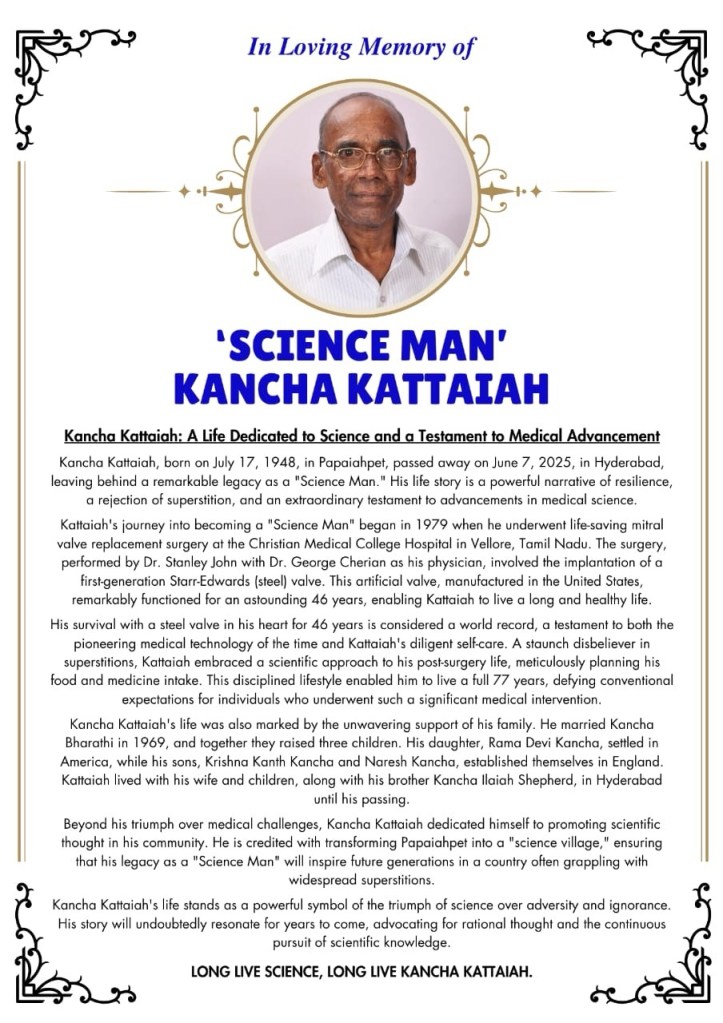
Memorial Service
-
Anti-Not Found Suitable Movement: Rahul Gandhi Enters The Fight

After having a discussion with Delhi University students on 27 May, 2025 the leader of Opposition in the Lok Sabha Rahul Gandhi, in a social media post, said that a practice of “not found suitable” was being followed in case of vacancies on SC/ST and OBC seats and called it a new form of “Manuvaad”. This was a very apt ideological statement. A national leader, not himself from the OBC/SC/ST background, has become a game changer in our higher education system.
REFORM IN HIGHER EDUCATION
Rahul Gandhi’s sudden initiative to reform higher education institutions marks a new beginning in contemporary India. The statement “Not Found Suitable is Manuvadi” on university recruitment after the interaction with research scholars and post graduate students came as pleasant surprise for hundreds of OBC/SC/ST scholars, getting rejected as ‘Not Found Suitable’ by the upper caste selection committees is also shocker to upper caste professors, who evolved this technic after Mandal reservations came into existence.
It was not a big meeting that he addressed, what usually a political leader of his stature usually does. He sat amidst a few students like one among them and asked what problems they faced in the present regime of RSS/BJP in the universities? It was a free-wheel discussion.
Many scholars told him that the OBC/Dalit/Adivasi students, though qualified do not get teaching jobs because the selection committees, mostly headed by upper castes (Brahmin, Bania, Kayasthas, Khatris and Skatriya) keep most reserved back log and newly released posts by adopting a simple technic “Not Found Suitable”.
Generally the open category posts do not remain unfilled because all the applicants in that category are treated as suitable and they select some among them and fill all the vacancies. But the selection committees feel sorry for not filling the other seats because they are reserved for “Not Suitables”. This idea of Shudras, Dalits and Adivasis being Not Suitable for education is age old and it is adopted by the Sanatana Dharma school. Manu Dharma Shastra turned that idea into Brahminic law. The Left Liberal upper castes had no problem using this theory against OBC/Dalit/Adivasi candidates. Now Rahul has punctured this Manuvad strategy even when it is fully operative, when an OBC Prime Minister rules the country with a new education policy.
In the RSS/BJP regime, all those affiliated to the Sangh networks, properly certified by one of powerful pracharaks gets selected as most suitable, whether one performs in the interview or not. Even for the reserved posts, properly trained OBC/SC/STs find themselves suitable in the shakas, not so much in the relevant subject. This model is akin to the model Bengal CPI (M) implemented when they were in power. Of course they were one step ahead, no caste hence no reservation.
During the non-BJP regimes, UPA ten years rule and earlier, the Congress had no shakha network of its own to systematically recruit its own ‘Suitables’.
All the Liberal and Left upper caste professor committees had their set of Found Suitable, foreign and Indian educated, caste network youth. They kept thousands of OBC/SC/ST posts as backlog with the same method of “Not Found Suitable” file noting.
In central universities, IITs, IIMS, best medical schools and so on, most OBC/SC/ST candidates who acquired their PhD in the same institute were written off as Not Found Suitable. In universities like JNU and Delhi university the upper caste Left-Liberal professors kept all the OBC/SC/ST posts as a backlog for the RSS/BJP force to come to power and fill, at least some, with their own Shakha members.
They rumoured a theory that the Shudra/OBCs own all the wealth in the villages and they only exploit Dalits, if they come into universities the merit will collapse. They reframed the Mahatma Phule time Brahmin language “If the Shudra studies Paap (Sin) will engulf Bharat. But all the professors born Punya Prada families have not improved our economy, science and philosophy to match China.
WE ARE MOST SUITABLE MOVEMENT
Taking clue from Rahu’s Samvad on Not Found Suitable a movement of the OBC/SC/ST students must start in all central universities and institutes. As Phule and Savitribai said in Film Phule India will fight the Western hegemony in the domain of knowledge only the youth productive Shudra/OBC/Dalit/Adivasi communities occupy high end positions. Seminars, debating sessions, reading competitions, not just slogan shouting, must be organised by inviting even the upper caste professors who have been using the Manuvad strategy “Not Found Suitable” to tell the nation what makes a candidate Suitable? Should one have a Ph.D on a topic ‘Production is Pollution’.Name: Email:
Prof. Kancha Ilaiah Shepherd is a prominent Indian social activist, political theorist, and scholar known for his influential writings on caste, social justice, and the rights of marginalized communities. A retired professor of Political Science at Osmania University, he has authored several groundbreaking books, including Why I Am Not a Hindu and Post-Hindu India, which challenge upper-caste hegemony and advocate for the empowerment of Dalits, Adivasis, and Other Backward Classes (OBCs).
https://countercurrents.org/2025/05/anti-not-found-suitable-movement-rahul-gandhi-enters-the-fight/
-
What if the real builders of Indian civilisation never got to write the story?
Kancha Ilaiah’s The Shudra Rebellion rewrites history from below, where spades built cities and obedience was not a choice.
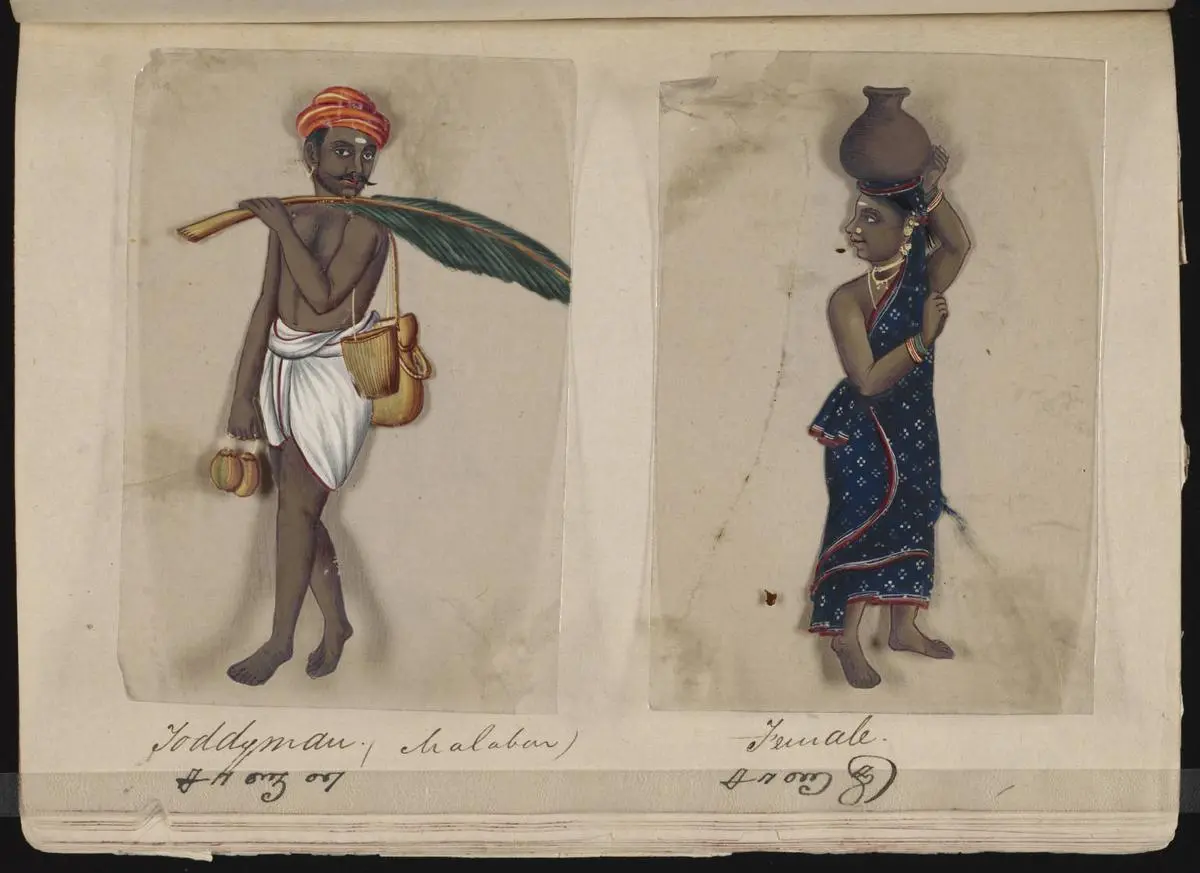
A depiction of a Channar couple from the illustrated manuscript Seventy-two Specimens of Castes in India (1837). | Photo Credit: Wikimedia Commons
In The Shudra Rebellion, the political theorist and Dalit rights activist Professor Kancha Ilaiah Shepherd attempts what few historians have done: he critiques Indian culture and civilisation by applying a new methodology that onboards the historically marginalised Shudras, who constitute both India’s productive labour and its numerical majority, into the mainstream narrative.
He brings the issue into the present by identifying the 2020-21 farmers’ agitation in Delhi as “the first ever major successful rebellion of Shudra collective consciousness”. According to Ilaiah, the farmers’ agitation “stands as an unprecedented movement against the monopolisitic ambitions of bania conglomerates to seize control of Shudra agrarian economy through the farm laws enacted by the RSS/BJP government in Delhi.” In this book, Ilaiah questions the idea that Indian civilisation began “with the writing of the Vedas”.
Historians and intellectuals have not challenged this “false picture” of dwijas (“twice-born” Brahmins) as builders of Indian civilisation. He suggests that the knowledge of production processes and the natural world in the Dalit/Shudra experience was not written down owing to the caste-based denial of access to language and learning.
Ilaiah states that Mahatma Jyotirao Phule (1827-90) was the first Shudra thinker who also wrote. Phule learnt English in a missionary-run school, read Thomas Paine’s The Rights of Man, and critiqued the Brahminical social order. Dr B.R. Ambedkar (1869-1956) later followed in Phule’s footsteps. Contrasting the “spade civilisation” of the Shudras with the “book civilisation” of the Brahmins, Ilaiah opines that these books say nothing of the skilled lives of the Shudras.
The “spade civilisation”
While the Shudra productive process involved passing on knowledge and skills acquired through practical work, Brahminical teaching made youngsters memorise already existing theory with little innovation. Shudras continued to produce, distribute, and innovate on all the necessities of human life but were denied literacy and thus prevented from documenting their production processes and knowledge.
The Shudra Rebellion
By Kancha Ilaiah Shepherd
SouthSide Books
Pages: 228
Price: Rs.500
Their innovations remained an untold story in the history of the Harappan civilisation, with its highly evolved civic infrastructure, the manufacturing of bricks for construction, the making of clay pottery and beads, agriculture, and even a form of script-based language which has yet to be decoded. Thus, a people who had built a large, technologically competent and complex culture were forced out of spirituality, politics, and the intellectual arena and relegated to being mere followers of Brahminical forces.
Ilaiah indicts the Brahmins’ “controlled cognition” of the Shudras for the profound negative impact upon their past, present, and future. The Brahminical theory equated production with pollution and considered soil untouchable, hence exempted the “spiritually pure” Brahmin from any field-based manual labour. He cites Kautilya’s Arthashastra to show how the four varnas were allocated roles in society and were expected to “devotedly adhere to their respective duties and occupations”, with the promise of svarga (heaven) if one followed it and the threat of “the world coming to an end” if one did not. This ideology subjugated even kings to the Brahmin, who became the source of political, social, economic, and religious/spiritual power.
Ilaiah also shows how Buddhism influenced kings until the 3rd century CE, causing Brahmins to be kept out of the state structure. But after Kautilya wrote the Arthashastra, he systematically planned the overthrow of the Nanda dynasty and set up the Shudra Chandragupta Maurya, whom he controlled. After this, Brahminical control over priesthood and the state was well established and continues in some form to the present.
In one of the chapters, Ilaiah discusses how Dalits were separated from Shudras, although this had not been the case earlier, and how those who worked with leather were forced into untouchability and permanent slavery as caste ideology took hold. While their engagement with the environment made the Shudras scientific and practical, the unscientific Brahminical idea that leather was polluting was detrimental to agrarian activities and prevented its use for a number of productive activities, including writing.
The ancient books of the Jews, Greeks, Chinese, and Egyptians were written on leather and have been preserved for centuries on scrolls; Indian manuscripts, which were written on palm leaves, have not survived as well. Leather workers were stigmatised and denied literacy. Over time, castes evolved into complex groups with elaborate superstitions governing social interactions.
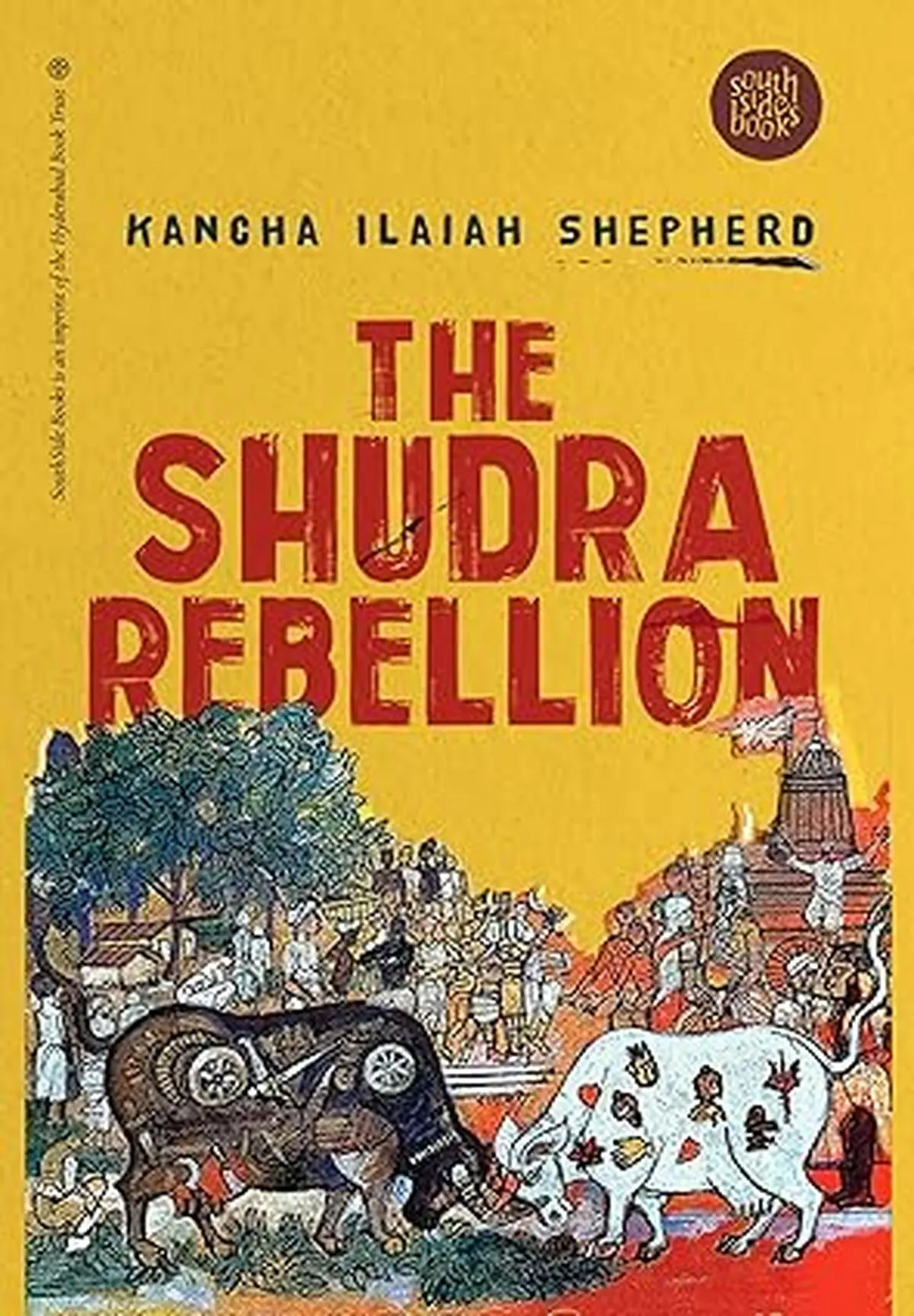
Ilaiah strongly believes that only a Shudra rebellion for the democratisation of language will “rekindle life in this nation”. | Photo Credit: By Special Arrangement
Ilaiah also unpacks the idea of how god operated among Shudras, Brahmins, and Jews. The Jewish god was an abstraction, a creator of the universe and the first humans, without nation, colour, caste, or creed. He worked for six days on the task of creation and rested on the seventh day. Thus, work was not only valued but was a fulfilling part of life, giving it meaning and purpose.
According to the Brahminical imagination, Brahma was god, Indian by nationality and of the Aryan race. Humans were created out of various parts of his body, with an implied hierarchy, the “highest” being the head/mouth (Brahmins) and the lowest being the legs (Shudras). Considered divine because they were created from the Creator’s head, Brahmins were exempted from work. In contrast to the Jewish system, work in the Vedic system was imposed as slavery so that the three varnas “above” the Shudras could enjoy more leisure and quality of life while the workers were exploited and lost dignity, agency, and remuneration for their work. There was no recognition of their intelligence and innovation.
Ilaiah contrasts this with the pre-Vedic work-based spiritual philosophy of the Harappans, who built a great civilisation based on land and animal economy. However, this civilisation did not survive the arrival of the Aryans, who discarded the work-based Harappan world view, relegated them to slavery, and erased their history. To this day, only a few samples of their written language/communication system, based on symbols, have survived, but it has not been deciphered yet.
In the later chapters, Ilaiah expands upon the Chinese philosophical school of agriculturalism, which flourished between 770 BCE and 221 CE and encouraged people to build skills in farming, woodwork, metal work, and leather processing. Even the influential Confucianism was not able to damage the material knowledge base of China’s people. By contrast, Brahminism in India treated farmers and pastoralists as untouchable and spiritually inferior; the Shudras could not counter this and thus lost their “philosophically respectable” status.
Ilaiah devotes the final chapters to tracing how the technically competent Shudras, with their production and scientific skills, were denied access to language, reading, and writing skills. This curtailed the expression of their critical thinking and philosophical skills.
The Brahmins also caused a separation of the spoken language from the “prayer” language, retaining Sanskrit for prayer and mantras but using Shudra languages for day-to-day communication even among themselves, effectively locking others out of even functional access to their own languages.
Ilaiah strongly believes that only a Shudra rebellion for the democratisation of language will “rekindle life in this nation”. He asserts that the Shudras’ philosophy—based on their interaction with the soil, plants, air, sunlight, and the natural rhythms of life—makes their spirituality a combination of science and god. Brahminical philosophical enquiry, on the other hand, deals with abstractions and mythical ideas that negate the Shudra scientific spiritual consciousness and rob it of the “capacity to reason out the process of life”, even triggering the decline of Indian agrarian and artisanal science.
Ilaiah argues that the remedy lies in the widespread study of English, especially among Dalits and Shudras, the development of a Shudra intellectual movement, and the rewriting of Indian history from the Shudra perspective. He calls for Shudra thinkers to bring a new approach to their historiography that focusses on the documentation of what remains of the production knowledge of the oldest civilisation of the world.
Cynthia Stephen is an independent journalist and social policy researcher who works in the areas of Dalit studies, affirmative action, and educational policy.
-
Caste Census: Who Wins When We Count Caste? Kancha Ilaiah Shepherd


You must be logged in to post a comment.