-
Kancha Ilaiah refutes rumours of joining Congress
Published – August 24, 2025
Prominent writer and political theorist Kancha Ilaiah Shepherd, who has been nominated to the OBC Ideological Advisory Committee of the Congress, denied rumours that he had joined the Congress party.
Mr. Ilaiah was one of the 23 persons nominated to the committee, from across the country, as per a list released by the party.
“I may have shaped the understanding of the party about the need for the caste census, but it is wrong to say that I have joined the party. This news is being spread by the right-wing forces with malicious intentions,” he said.
Mr. Ilaiah has been supporting Rahul Gandhi’s campaign for the protection of the Constitution and also nation-wide caste census. He recently worked as the vice-chairman of the Independent Expert Working Group that submitted a detailed report on Telangana Socio, Economic, Educational, Employment, and Political Caste survey
Kancha Ilaiah Shepherd named in Congress’s OBC committee; denies taking membership in party
In a recent blog post Kancha Iliah has slammed the BJP’s “pretension” of furthering the OBC agenda through token representations while also criticising the Congress’s negligence towards the community.
Dalit intellectual Kancha Ilaiah
Prominent Dalit rights activist and author Dr Kancha Ilaiah Shepherd has denied joining the Congress after his name appeared in the party’s OBC Ideological Advisory Committee.
Responding to rumours that he has joined the Congress, the former professor of political science at Osmania University clarified that he has not taken membership in the party and that his association with the OBC committee is purely ideological.
“They are spreading rumours that I have joined Congress. I haven’t joined Congress,” Dr Ilaiah told TNIE.
He added that he accepted the membership of the OBC committee as he felt the “need to expose the false narrative of the BJP and RSS” and show how they “cannot liberate” the Shudra, OBC communities.
Dr Ilaiah has been campaigning for a caste census for several years, one of the key political causes taken up by Congress in recent years. He recently worked as vice chairman of the IWG that submitted a detailed report on the Telangana Socio-Economic, Educational, Employment, and Political Caste survey.
Kancha Ilaiah has also actively supported Rahul Gandhi’s campaign for the protection of the constitution and was seen along the former Congress president during the Bharat Jodo Yatra.
In a recent blog post, Dr Ilaiah has slammed the BJP’s “pretension” of furthering the OBC agenda through token representations while also criticising the Congress’s negligence towards the community, which he claimed caused the weakening of the party.
“… in their hundred years of history, the BJP-RSS combine has not produced a single leader like Sardar Vallabhbhai Patel or Kamaraj Nadar from their organisation or party. Most of their OBC leaders were small, dependent leaders of no stature, who were given some visible political positions only after the Mandal period, more particularly after they started the Ram Temple movement,” he wrote.
“No OBC leader from RSS or BJP is known for leading an agrarian movement. Every ideological issue was decided by the Brahmin leaders in RSS. The only leader, as the media now tells us, as the leader of decision-making capacity is said to be Modi, that too during his first term as Prime Minister. His second term onward, he is also going by the RSS direction,” he added.
Kancha Ilaiah Shepherd named in Congress’s OBC committee; denies taking membership in party
In a recent blog post Kancha Iliah has slammed the BJP’s “pretension” of furthering the OBC agenda through token representations while also criticising the Congress’s negligence towards the community.

Dalit intellectual Kancha Ilaiah (File Photo)
24 Aug 2025
Prominent Dalit rights activist and author Dr Kancha Ilaiah Shepherd has denied joining the Congress after his name appeared in the party’s OBC Ideological Advisory Committee.
Responding to rumours that he has joined the Congress, the former professor of political science at Osmania University clarified that he has not taken membership in the party and that his association with the OBC committee is purely ideological.
“They are spreading rumours that I have joined Congress. I haven’t joined Congress,” Dr Ilaiah told TNIE.
He added that he accepted the membership of the OBC committee as he felt the “need to expose the false narrative of the BJP and RSS” and show how they “cannot liberate” the Shudra, OBC communities.
Dr Ilaiah has been campaigning for a caste census for several years, one of the key political causes taken up by Congress in recent years. He recently worked as vice chairman of the IWG that submitted a detailed report on the Telangana Socio-Economic, Educational, Employment, and Political Caste survey.
Kancha Ilaiah has also actively supported Rahul Gandhi’s campaign for the protection of the constitution and was seen along the former Congress president during the Bharat Jodo Yatra.
In a recent blog post, Dr Ilaiah has slammed the BJP’s “pretension” of furthering the OBC agenda through token representations while also criticising the Congress’s negligence towards the community, which he claimed caused the weakening of the party.
“… in their hundred years of history, the BJP-RSS combine has not produced a single leader like Sardar Vallabhbhai Patel or Kamaraj Nadar from their organisation or party. Most of their OBC leaders were small, dependent leaders of no stature, who were given some visible political positions only after the Mandal period, more particularly after they started the Ram Temple movement,” he wrote.
“No OBC leader from RSS or BJP is known for leading an agrarian movement. Every ideological issue was decided by the Brahmin leaders in RSS. The only leader, as the media now tells us, as the leader of decision-making capacity is said to be Modi, that too during his first term as Prime Minister. His second term onward, he is also going by the RSS direction,” he added.
-
Vice-Presidential Election: Congress OBCs Vs. RSS OBCs
In their 100 years of history, the BJP-RSS combine has not produced a single Shudra/OBC leader with an agrarian base, like Patel or Kamaraj, from their party or organisation.
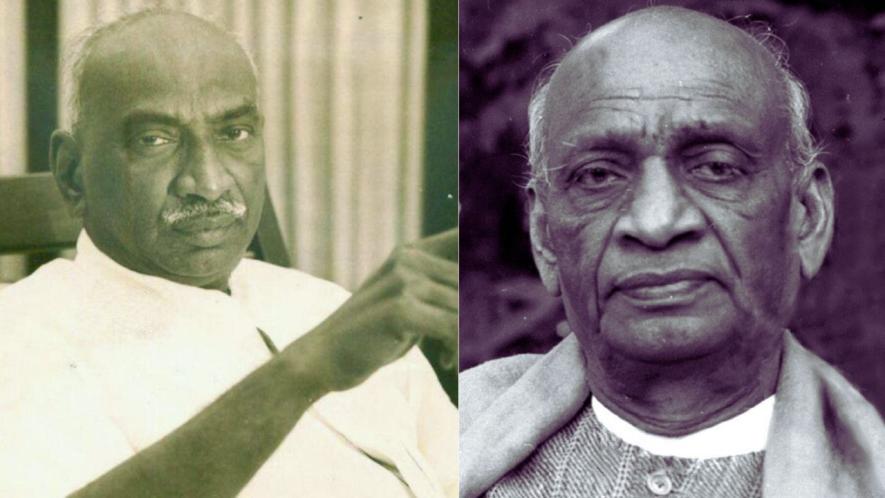
Kamaraj and Sardar patel. Image Courtesy: Wikipedia
In the context of the Congress OBC (Other Backward Classes) conference on July 25, 2025, in Delhi’s Talkatora Stadium, and the recent stand of Congress, particularly Rahul Gandhi, on the caste census, the ruling Bharatiya Janata Party (BJP) chose as Vice-President candidate, (technically as the National Democratic Alliance candidate) CP Radhakrishnan, the present Governor of Maharashtra, with the suggestion of the RSS or Rashtriya Swayamsevak Sangh. Now they have started a campaign that he is an OBC from Tamil Nadu in order to use this appointment to gain votes in Tamil Nadu. This is also to convey to Congress that they would promote OBCs from the South. Radhakrishnan comes from Goundar community, which is a middle rung OBC caste.
Tamil Nadu has been in the hands of OBC leadership ever since the DMK (Dravida Munnetra Kazhagham) formed its first Government in 1967, except for some time during Jayalalithaa’s rule. The BJP wants break that Dravidian ideological rock bed by promoting an OBC person.
It is a known that the BJP came to power on its own only with OBC support in a situation where the Congress lost OBC support in the post-Mandal period. The Congress party’s main support base till 2014 was Muslims, Dalits, adivasis and a section of upper castes. Its top leaders in governance were mainly from the upper castes
BJP-RSS Pretension of OBC Agenda
Historically, the RSS is known as an anti-Shudra agrarian force, without any ideological agenda to change the agrarian structure. It was always against land reforms. They opposed Congress Prime Minister Indira Gandhi’s land reform law in the early 1970s and openly supported princely states by opposing abolition of Privy Purses.
Even Narendra Modi was not known in his entire life before becoming Prime Minister, of taking a pro-agrarian OBC stand. He mostly worked with Gujarati business class support with an anti-Muslim ideology. The same ideology is deep down in his thinking and working process now. His pro-OBC rhetoric is basically electoral.
After choosing Radhakrishnan as its Vice-President candidate, BJP also started a vigorous campaign that its Prime Minister is an OBC, and it has several OBC Central ministers and two Chief Ministers. Thus, they are trying to counter the gradual shift of OBCs to Congress.
Interestingly its two Vice-Presidents— Venkaiah Naidu and Jagdeep Dhankar, were Shudra/ OBCs — Kamma and Jat, respectively. Those castes are Shudra agrarian in their lived history. Both Naidu and Dhankar were humiliated and sent out. We all know that Naidu was not at all willing to take up that position leaving his cabinet post. He was the only somewhat known Shudra leader in that party, as he served as BJP president.
But the BJP-RSS forced him to become Vice-President and retired him before he attained the age of 75.
OBC Category and Shudraness
The OBC category came into being as a legal and constitutional category, which includes 90% of Shudras. A small section of them remained outside the OBC reservation when the Mandal Commission Report was implemented in the early 1990s. Even before that, when some states gave reservation to Backward Classes, some top end Shudra agrarian castes remained outside the reservation orbit with a view that such a tag to their caste would humiliate them.
The Kammas in Andhra Pradesh and Telangana and Jats in North India remained outside reservations. In states like Tamil Nadu and Karnataka, all Shudhras are part of reservation.
Congress Relationship to Shudra/OBCs
Let us turn to Congress party’s history. The first ever tallest Shudra/OBC leader that emerged from that party was Sardar Vallabhbhai Patel. He was the first leader to start an agrarian movement, Bardoli, against the British. In the South, a major Shudra/OBC leader who built mass farmers and toddy tappers movements against the British was Kamaraj Nadar. He was the tallest OBC leader in the country after the death of Patel. He could have become Prime Minister as president of the party, but Lal Bahadur Shastri was made the Prime Minister. After Shastri’s death, he allowed Indira Gandhi to become Prime Minister.
From Maharashtra, Y.B Chavan emerged as a great national leader. From Karnataka, Nijalingappa, a Shudra/OBC, was one of the top Congress leaders at the national level. They all challenged Nehru and Indira Gandhi and were leaders on their own merit, with an ideological vision different from that of Nehru and Indira Gandhi, and with a commitment to the Constitution.
After the 1971 elections, Indira Gandhi did not allow any leader to emerge and hence the Shudra/OBCs started establishing their own leadership in different states and challenged Congress from outside. That gradually led to the weakening of the party.
The BJP-RSS combine has come out with a new image in 2014, that they will support OBC reservations and work for OBC welfare.
But in their hundred years of history, the BJP-RSS combine has not produced a single leader like Patel or Kamaraj Nadar from their organisation or party. Most of their OBC leaders were small, dependent leaders of no stature, who were given some visible political positions only after the Mandal period, more particularly after they started the Ram Temple movement.
No OBC leader from RSS or BJP is known for leading an agrarian movement. Every ideological issue was decided by the Brahmin leaders in RSS. The only leader, as the media now tells us, as the leader of decision-making capacity is said to be Modi, that too during his first term as Prime Minister. His second term onward, he is also going by the RSS direction.
The three farm laws that were meant to destroy the agrarian economy and hand over local markets from the Shudra/OBCs to monopoly industrialist houses were the handiwork of RSS. The strategy was planned by the RSS Brahmin leadership, and Modi implemented it because it helps his own corporate friends.
However, the farmers, who are essentially Shudra/ OBCs, fought and defeated the government agenda.
Rahul Gandhi Returns to Nehru Era
With his two agendas, Rahul Gandhi seems to have put the Congress on the Nehru era track. One is that he is fighting for a caste census at the national level and giving hope to the Shudra/OBCs so that they can play a critical national political role. Unless the Shudra/OBCs are part of the national party, they will just remain regional leaders. Now they hope to get a good position in the party and get the stature of Patel, Kamaraj Nadar, Nijalingappa, Y.B. Chavan and so on.
In the near future, the RSS-BJP combine will never give OBCs a position in the top leadership that can influence the ideology of the party or RSS. Whereas in the Congress, the Shudra/OBC leadership emerged and could compete with Nehru as Prime Minister. Sardar Patel and Kamaraj Nadar were such leaders. The RSS-BJP so far has not produced such Shudra/OBC leaders from agrarian bases. At best, they produced OBC leaders like Kalyan Singh and Uma Bharati, who played only anti-Muslim politics, that too from urban locations, with an anti-Muslim ideology.
To contest against BJP candidate CP Radhakrishnan, the INDIA bloc has chosen Justice Sudarshan Reddy from a Shudra agrarian background. He retired from the Supreme Court as a judge, and has a credible record of working to protect human and civil rights and constitutional guarantees all his life.
Recently, Reddy functioned as Chairman of the Independent Expert Group constituted by the Telangana government, to study the Socio, Economic, Educational, Employment, Political and Caste Survey, in which this author served as Vice-Chairman.
The nation should not take the propaganda of the RSS-BJP structures and monopoly media by face value, that they will empower OBCs by putting a doll-like OBC activist as Vice-President by RSS leaders.
The writer is former Director, Centre for the Study of Social Exclusion and Inclusive Policy, Maulana Azad National Urdu University, Hyderabad. The views are personal.
https://www.newsclick.in/vice-presidential-election-congress-obcs-vs-rss-obcs
-
How Congress brings Ambedkar and Sardar Patel on the same table
Until Rahul Gandhi, Congress didn’t realise that Patel and Ambedkar were not given their dues. The BJP helped Congress re-examine its nationalist roots and paved the way for research on these icons who have been relevant across caste and class lines

Rahul Gandhi’s engagement with the masses during his Bharat Jodo Yatra from Kanyakumari to Kashmir and Bharat Jodo Nyay Yatra from Manipur to Mumbai seems to have changed his understanding about Ambedkar and Patel.
In the Congress party’s recent national legal conclave on “Constitutional Challenges — Perspectives and Pathways”, photos of Mahatma Gandhi, Jawaharlal Nehru, Sardar Vallabhbhai Patel and B R Ambedkar were prominently displayed. Notably, this is the first time that the pictures of these four — pillars of our freedom struggle and our modern nation-building — were displayed in the Congress office that too in a public meeting.
Except for Ambedkar, the rest of them are from the Congress party itself. However, Patel was slowly sidelined after Nehru took over the party. Mahatma Gandhi and Jawaharlal Nehru were always considered the guiding lights of the Congress.
This was evident in the naming of the institutions — libraries, universities, airports, railway stations, and memorials — during Congress rule. The party made this mistake because it did not want to recognise the caste background of leaders like Ambedkar and Patel, and how their caste identities were shaping the electorate. Soon, the BJP appropriated Sardar Patel, which reached its peak when PM Modi built the tallest statue of Patel in Gujarat.
Ambedkar was first revered by Dalits, and he then slowly emerged as a social justice icon. His image is now used to mobilise voters. However, until Rahul Gandhi, Congress didn’t realise that Patel and Ambedkar were not given their dues. The BJP helped Congress re-examine its nationalist roots and paved the way for research on these icons who have been relevant across caste and class lines.
Rahul Gandhi’s realisation during Yatras
Gandhi’s mass contact during his Bharat Jodo Yatra from Kanyakumari to Kashmir and the Bharat Jodo Nyay Yatra from Manipur to Mumbai seems to have changed his understanding about Ambedkar and Patel.
Ambedkar emerged as one of the tallest national icons in the post-Mandal era, much to the chagrin of Hindutva intellectuals. Arun Shourie’s book Worshipping False Gods was written as a response to his ascent in the mass consciousness during this period. In the recent past, Shashi Tharoor, despite conflicting ideologies, also had to write a book on Ambedkar.
Shourie’s mindset could also be found in Union Home Minister Amit Shah, who in Parliament contemptuously said that it has become a fashion to say Ambedkar.
Immediately after that, Gandhi turned Ambedkar into his party’s icon with the slogan: Jai Bapu, Jai Bheem and Jai Samvidhan. He told Shah in no uncertain terms that Ambedkar had already joined Gandhi and Nehru in the nationalist imagination.
A new Congress in the making
Before 2014, PM Modi gave a call for a “Congress Mukt Bharat”. He started appropriating Gandhi, Ambedkar, besides Patel. Modi used Patel’s image both in Gujarat and outside the state. However, Patel, a Shudra/OBC, was the first rural man to connect the Congress nationalist movement with his Bardoli farmers’ agitation that was organised against increased land revenue taxes. It was only after that that Gandhi entered into the farmers’ struggles against the British. But Congress forgot to see the link between the farmers’ movements and Patel.
However, Rahul Gandhi brought Gandhi, Nehru, Patel and Ambedkar together and placed them on the party’s banner, along with their portraits on the walls of the new party office. His upholding of the caste census as “societal X-Ray and protection to the Constitution” during the 2024 elections also helped him make Patel and Ambedkar party icons. The erstwhile Congress leaders thought that caste discourse and secularism were contradictory. But that is a misplaced reading of the Indian social system.
This shift in the Congress under the leadership of Rahul Gandhi made the BJP fall short of the majority mark in the last Lok Sabha elections. “Pappu”, as Gandhi was scornfully called, has suddenly become a serious contender for the PM post.
While Modi turns 75 — the age that his party had set as an ideal retirement age for its leaders — Congress does not disappear from Indian politics. The Congress not only survives, but it appears to embrace a new phase after 140 years. That is a good sign.
The writer is a political theorist, social activist and author. His latest book is The Shudra Rebellion
-
Why the RSS and Jamaat-e-Islami Never Turned Ayurveda or Unani Into a CMC Vellore
Kancha Ilaiah Shepherd
1 Hour ago
A heart valve that saved a life for 46 years symbolises how Christian missions in India fused faith with modern science. Organisations which say they represent Hinduism and Islam have yet to match that achievement.
Representative image. Photo: Katherine Hanlon/Unsplash
Real journalism holds power accountable
Since 2015, The Wire has done just that.
But we can continue only with your support.Contribute NowFor centuries, Hinduism, Islam, and Christianity have been the three most visible religions in India. How each engages with superstition and science is a question worth close examination. Of all the modern sciences, the most important are the science of production and medical science. Both of them, however, are dependent on a modern system of education.
Let me share a story. On June 7, 2025 Kancha Kattaiah, 77, died peacefully while sitting on the commode in the washroom as the artificial valve fixed in his heart failed. It had been inserted in his heart 46 years earlier; the surgery was done at the Christian Medical College (CMC) Hospital Vellore, Tamil Nadu, in 1979.
It was a first generation steel valve developed by the Edward Life Science company of America in the 1960s. It was an innovation by the company to save patients from the dangerous heart disease of losing a valve due to rheumatic fever or for other reasons. Kattaiah had rheumatic fever over and above a massive smallpox attack in his childhood. In the process, he was diagnosed with a loss of the mitral valve in his heart. If the artificial valve was not invented thanks to the advanced and combined medical science of modern allopathy and surgery, he would have died when he was hardly 32 or 33.
Kattaiah was from a small village shepherd-farmer family from Telangana, which is 600 km away from Vellore. He travelled to CMC risking everything. According to doctors who operated upon such patients and replaced valves in recent times, his survival for so long with a single valve was a medical miracle. I know these details because he was my brother.
In 1960 Dr. Albert Starr, a surgeon at Oregon Health and Sciences University, successfully implanted the first Starr-Edwards mitral valve in the US. In India, the first such surgery was done at CMC Vellore in 1962. In those days, no other hospital in India had that kind of surgical equipment and trained cardiac surgeons.
Though it was a private hospital, it was compassionate in its culture and values. They were not in the money-making business like the private hospitals of today. Grace and compassion as human values were constructed into the Christian mission thought. Medical innovation in the Christian world was part of that thought.
CMC was started in Vellore by an American Christian missionary woman Dr. Ida. S. Scudder in 1900. This was the first ever established full fledged hospital in India. The government-owned AIIMS was established only in 1956 in Delhi. The Christian Medical College became a model medical college and hospital in India in the post-Independent period as well.
For a long time, the CMC survived with American mission mobilisation of resources, technology and trained manpower. The American church network helped this kind of medical science develop within America and also in other parts of the world. India is a major beneficiary of this mission work.
In Western India, the first schools, including a teacher training college, were started by the same American Mission. Savitribai Phule and Fatima Shaik were trained in that teacher training centre.
A question arises in my mind – why did Hindus and Muslims in India not develop Ayurvedic or Unani hospitals with their own innovations in surgical science like allopathic hospitals? After all, Hindus and Muslims claim the Ayurveda and Unani forms of medicine are part of their culture and traditions. Why didn’t Hindu missions or a ‘social service’ organisation like the RSS, which claims that it is unparalleled in the world, or a globally connected Muslim organisation like the Jamaat-e-Islami, develop their own Ayurvedic and Unani medical colleges and hospitals that could match the American Christian missionary one like the CMC, established 125 years ago in India?
The Satya Sai Baba mission established a major hospital in Puttaparthi, but with the same Western, allopathic medicine, not Ayurveda. Mata Amrutanandamayi, who runs her own mission, runsanother allopathy hospital in Kochi, Kerala.
The RSS’S claims and the reality
The ruling RSS claims in its post 2014 period of hegemony that ancient India – by which they mean Hindutva – is the repository of all knowledge. So why it did not develop Ayurveda as an equally advanced medical science like allopathy which the Christian missions did? While the RSS/BJP want to claim that Hindu texts contain all the wisdom of science, why did those books not produce an innovation of something like a valve which could save a heart patient like Kattaiah?
Unless the superstitious character of a religion is not fought with rational thought, scientific innovations do not happen. No individual scientist can innovate unless a rational secular society comes into being. But the RSS wants to remove the word secularism from the constitution. They need to study the CMC’s functioning to understand – and respect – how medical science operates in a combination of religion, reason and secularism.
Unless a religious philosophy is science friendly, as a sister evolutionary thought process, religion will just slip into more and more superstition without allowing science to emerge and advance from its fold. Unfortunately, the self-styled champions of Hinduism and Islam have done exactly the same in India. Hence they still depend on Christian education and health and other science institutions and innovations in the West.
In fact, for a long time before and even after independence, Christian schools and hospitals were the main source of education and health for the Hindu and Muslim elite. Shashi Tharoor, who wrote Why I am a Hindu, got his English education in St. Stephens College, Delhi.
When Kattaiah suffered from rheumatic fever in the 1960s, it was the Baptist Mission Hospital, Hanamkoda, Warangal that cured him. This was established in 1902. Kattaiah’s illiterate mother stayed with him as her son was treated for more than 20 days along with getting a free supply of food and medicines. This kind of medical help was possible because of the hospital’s spiritual philosophy of compassion and innovation.
Why haven’t the RSS or the Jamaat-e-Islami as religious mission organisations offered such service to Hindus and Muslims – not to speak of all Indians – in critical areas like health and education? If religious organisations keep on communalising their own civil societies, they cannot produce imaginative scientists. Communalism breeds fear and hatred of the ‘Other’ where compassion and grace towards people from other religions would be projected as weakness.
Twenty five years after the establishment of the CMC in Vellore, the RSS was formed as a missionary organisation. What have they done in the domains of education and medicine for Indians at large in the past hundred years?
This question is important because they oppose everything foreign. If that foreign artificial valve was not put in Kattaiah’s heart he would not have survived for 46 years after surgery.
In the medical field, the RSS and its other wings want to promote Ayurveda in schools and colleges. The RSS and its other organs like the Vishwa Hindu Parishad (VHP) and the Bharatiya Janata Party (BJP) keep propagating that their ancient medical knowledge is superior to Western knowledge. Why then did the RSS and its associates not establish a hospital like CMC and establish a life science research centre within the Ayurveda tradition?
Why the Muslim elite, like the Hindutva elite, rushes to allopathic medical centres
On the contrary, they went on promoting under their shadow several superstitious networks run by Babas, or remedies like cow urine therapy and so on, which are the opposite of established science.
The Muslim emperors and sultans who ruled large parts of India for more than a thousand years may have established some Unani medical centres but they also did not develop their own surgical medicine. The Unani medical centres work on oral medicine treatment. There is no surgical science developed by Unani medicine.
That is why the Muslim elite, like the Hindutva elite, rushes to allopathic medical centres for emergency and critical surgeries. In fact, the rich among them go to the US for treatment if it is a heart or brain surgical issue.
Leave alone ancient and medieval Hindu pundits, even the present Hindutva missionary networks like the RSS and others pushed Hinduism into the process of superstition. Indian Islam also did not allow Islam to emerge into a religion that could negotiate with science.
Christianity that started as a blind belief based faith slowly emerged into a religion that began to establish a relationship with science as its sister, slowly overcoming its superstitious dogmas. In my view Hinduism and Islam have deeper relations with superstition by not allowing science to co-exist with them.
Science and religion need to be treated as part of the same evolutionary process in human civilisation, whereas superstition is a negation of both.
Superstition needs to be fought on an everyday basis. If religion allows superstition to grow, like weeds in the crop, it kills the scientific thinking of humans. This is where these two religions need to undergo huge reform within themselves, allowing secular thought and science to develop in their civil societies.
Kancha Ilaiah Shepherd is a political theorist, social activist and author. His latest book is, The Shudra Rebellion.
-
International Seminar on Dalit Literature & Historiography'(Inaugural Session) {Organised by D/o English; Under the Guidance & Supervision of : Prof. M. Asaduddin- Head, D/o English, J.M.I.; Duration:- :01:04:55: hoursProduction:- J.M.I.; Language.:- English/Hindustani; Production Year:- 19-21/12/2013 (Thursday to Saturday); Subject:- Archives (J.M.I.)
-
How Sonia candidly sounded alarm on ‘ideological coup’ to remake India
Kancha Ilaiah Shepherd

In a rare theoretical broadside, the Congress veteran has accused the ruling dispensation of plotting an ‘ideological coup’ to replace constitutional democracy
RSS/BJP’s future direction in changing the present constitutional democracy into a
‘Theocratic Corporate State. She shared this in her written message at the party’s national legal conclave on ‘Constitutional Challenges – Perspectives and Pathways’, at Indira Bhavan, New Delhi,
She said ‘the Constitution is under siege as the ruling BJP is using its power to dismantle the very framework it long opposed.
Further, Sonia accused the BJP-RSS of plotting “an ideological coup” to replace “our democratic republic with a theocratic corporate state serving the powerful few”.
Congress takes up mantle
This kind of serious political economic formulation about the RSS/BJP’s agenda has not been done by any Congress politician in the past.
The communists have left the political arena to the Congress to not only fight the RSS’s socio-political and economic ideoloav, but to formulate new theoretical ideas. They are no longer in a position to formulate creative political economy concepts that could expose the RSS/BJP caste-spiritual ideology. This is because they have not yet grappled with the caste ideology.
The regional parties cannot formulate such impactful nationally and internationally useful concepts that draw battle lines for ideological and political struggles.
After Rahul Gandhi emerged as a powerful socio-political reformer and agenda setting
leader in the country, Sonia and Priyanka Gandhi seem to have decided to fully go with his fight against RSS/BJP.
Bringing caste into focus
The stand on caste census, Ambedkar’s ideology, ‘bringing back’ Sardar Vallabai Patel to the Congress fold, and openly attacking Manu Dharma Shastra, as an RSS foundational ancient text which is an antithesis of Ambedkar’s Constitution, is totally a new phenomenon.
The fact that Mahatma Gandhi, Ambedkar, Nehru and Patel’s photos were put very visibly on the conclave stage is an indication of a major shift in the ideological strategy.
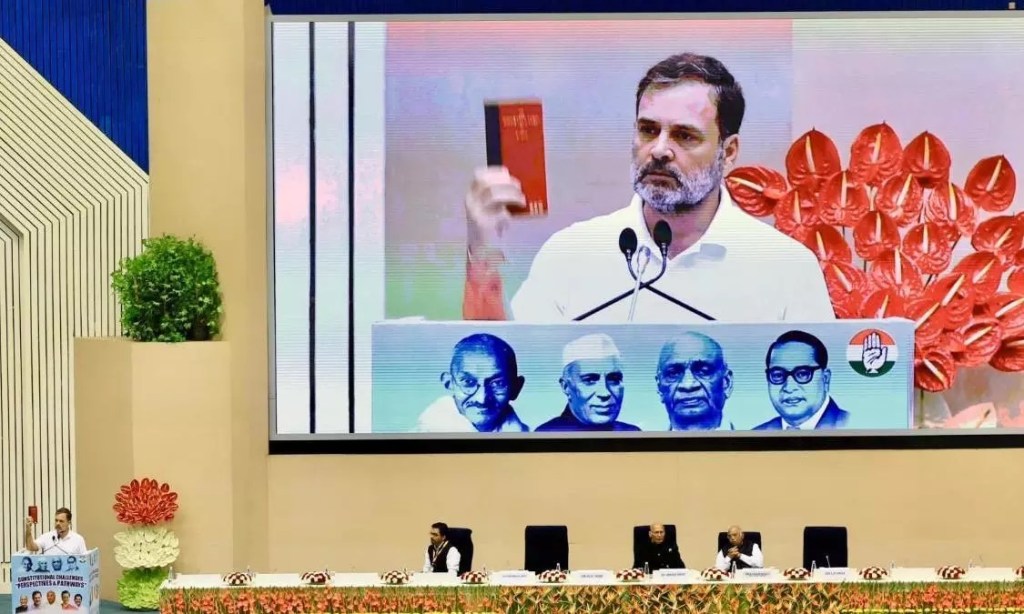
Photos of Mahatma Gandhi, Dr Ambedkar, Nehru and Patel put up on the conclave stage. Added to this, Sonia Gandhi for the first time acknowledged the role of Dr Ambedkar in a written statement as architect of the present Constitution in the context of the RSS proposal to remove the words ‘secularism and socialism’ from the preamble. This has a serious basis for her new formulation.
Taking a call
This may help the fence sitters in the Congress and those who are sceptical about Rahul Gandhi’s caste census, ‘Jai Bapu, Jai Bheem and Jai Smavidhan’ slogan may
come on board.
The caste census campaign of Rahul has already got Doubting Thomases in the party to come round. They have nowhere to go, as the RSS/BJP too has agreed to a caste census.
The Shashi Tharoor kind of leaders may move out for their future moral death. The RSS will use such leaders and throw them out. Sonia proved to be a person ready to face the consequences.
She said: “Now they seek to erase socialism and secularism, pillars of Ambedkar’s vision of equal citizenship. This is… an ideological coup replacing our democratic republic with a theocratic corporate state serving the powerful few.” She was also candid in saying that it “betrayed Dalits, Adivasis, OBCs”.
Theocratic Corporate State
The fundamental inbuilt ideological issue with the establishment of the Theocratic Corporate State is deeply related to the future life of Shudra/OBC/SC/STs in India.
Historically, the Manu Dharma is a pro-Varna Dharma legal framework, wherein the Dwija castes could have monopoly over the Shudra and Chandalas spiritually, socially, economically and politically. Though the RSS was known as a Brahmin-Bania organisation for a long time, during the Narendra Modi-Amit Shah regime it turned into a Bania-Brahmin monopoly network with Banias leading in many fields and with control over monopoly capital.
Modi’s OBC background is a mask. After 11 years of Modi-Shah rule, the way the RSS allowed them to ruin the agrarian and artisanal economy is a pointer to the caste control monopoly with a massive privatisation process. The three farm laws that were defeated by Shudra farmers were a pointer to that.
Kautilya’s Arthashastra
The framework of the Theocratic Corporate State that RSS wants to establish has theoretical foundations in Kautilya’s
Arthashastra as well.
Kautilya says, “The people consisting of four castes (Shudra, Skatriya, Vaishya, Brahmin) and four orders of religious (Hindu) life, when governed by the king with sceptre will keep to their respective paths”
When the RSS talks of Sanatana Dharma it talks about this central ideology of Kautilya, which got legalised through Manu Dharma that Sonia Gandhi is talking about in her message.
The Shudra/OBCs/Dalits/Adivasis have no ^ right to become priests in the spiritual realm and no right to become the owner of Dhana (wealth), which, in a monopolistic way, was turned into Gupta Dhana (untaxed wealth).
Under sceptre of Dwijas
The state is completely under the control of Dwija power wielders, which the RSS top leaders consistently believed. And also the wealth in a modern capitalist form, which Sonia Gandhi calls corporate capital, can never be allowed to be shared by the Shudra/Dalit productive forces.
The productive forces as per the RSS world view, must always be under the sceptre of Dwijas, who do not participate in production.
They come to own the phala (fruits) of their labour as property, wealth, land, industry, mall and so on.
Also read | With all credits for Sonia, Revanth govt retells story of Telangana movement
After Jawaharlal Nehru’s formulation of Democratic Socialism concept to make India a welfare state where all castes have a right to own wealth and duty to participate in wealth creation, the RSS attacked him as an un-Indian concept builder. He was attacked
as a lackey of communist Russia.
In an unexpected turn, Sonia Gandhi revealed what she described as the RSS’s underlying future vision for the political economy of Sanatana Dharma — a theocratic corporate state in which Shudras, OBCs, Dalits, and Adivasis would remain under complete control. Her remarks drew media attention, particularly in an environment where much of the corporate press is perceived as being anti-Congress.
We know that she hardly speaks in a theoretical language. However, she did now.
Threat to OBC future
No Shudra/OBC/Dalit/Adivasi working in the
RSS/BJP camp could understand its implication to his/her own children’s future because the notion of Hindu Rashtra is deep down in their mind and it works like Karma siddhanta. They are constantly made to seek solace in Kumbh Melas, Teertha Yatras and singing devotional songs.
Serious statecraft is out of their world view.
The OBC/Dalit/Adivasi ministers of BJP are kept busy in attacking the Opposition. They know that power is not given to them to oppose Manu Dharma but to advance it. But there lies the danger for all the Shudra/OBC/Dalit/Adivasis in future.
The theories of Hindutva political economy are being built by its foreign English educated intellectuals, while RSS/BJP keeps opposing English education for the productive masses. Hardly socio-political thinkers emerge from OBCs.
European context
In the European context, the role of Theocratic Feudal State was understood by Machiavelli in the early 16th century. But theocratic corporate state theory was not debated in the post-modern political economy in Europe because the state and religion were seriously separated.
The Muslim world is already living in a theocratic corporate state. The Indian Muslim thinkers also cannot fight the
theocratic corporate state. We are not sure whether the Dwija political economists, even sympathetic to Congress, enter into debate on Sonia Gandhi’s formulation.
There are caste interests involved in this battle, even if they pretend that they belong to ‘No Caste’, as the Telangana caste survey has shown millions exist in that category.
Now that this theory has come from Sonia Gandhi, a veteran leader of few words, let us wait and see how political economy pundits of varied ideologies of India debate the concept.
Kancha Ilaiah Shepherd
Kancha laiah Shepherd is a political theorist, social activist and author. His latest book is The Clash of Cultures – Hindutva – Mullah Conflicting Ethics.
-
Why Rahul Gandhi is Martin Luther King of India

After the Congress Shudra/OBC Bhagedary Nyay Sammelan ( Participatory Justice Conference) in Talkatora stadium of Delhi took place on 25 July, 2025 a new social justice discourse began in India. In 140 years of existence of the Congress party it was the first ever Shudra/OBC conference with a path breaking initiative of Rahul Gandhi, the Opposition Leader of Lok Sabha and well known Congress leader from Gandhi-Nehru family.
As a non-Congress special invitee I spoke in that conference. My seven minute speech has rattled the RSS/BJP ranks. What I spoke was as under:
“I really congratulate this revolutionary movement in congress history. Congress liberated us, particularly the OBCs Dalits, Adivasis from the British. Mahatma Gandhi, Jawarlal Nehru, Sardar, Vallavad Patel, and Ambedkar liberated us from the oppressive British. But after that, there was no leader of national stature, international stature, to liberate us from the caste oppression of RSS BJP type. And once this RSS/ BJP came to power, ruled for 11 years, all the OBCs started going into that oppressors’ fold saying oppress us more, oppress us more. We will be slaves.
I was crying in my bed. And I was listening to Rahul Gandhi speak about the country and the nation. In (year) 2021, in this very hall, women and men, we were just few hundreds, from the congress party fold, some intellectuals and party leaders, gathered and started this revolutionary movement in OBCs (This refers to 2021 OBC conclave in Talkatora stadium and passing of OBC Delhi declaration). And in the 21 first century, if there is no single leader who can liberate us from this bloody caste, which destroyed us, we will not be liberated because a Modi like leader has come to destroy us. And I found Rahul Gandhi is the only leader who can liberate us from this oppressive, destructive caste system. Today, he started (taking) steps.
His first step was Bharat Yodo Yatra. His second step was Bharat Yodo Nyay Yatra for ourselves. And the third step, he started getting caste census done. This was historic. And I’m the vice chairman of the expert committee that the congress government appointed (to study the Telangana socio,economic, educational, employment, political Caste Survey) data . We have seen Telangana congress data that, you know there are, (more than) 56% OBCs.
The Telangana government asked for 42% reservation for OBCs. Is it just or not? Tell us. Is it okay or not? 42 is okay or not?
42 (percent) we should achieve or not? We should achieve. Why? Because in Telangana, the upper caste are only 9.9%, but they are getting 10% reservation (under EWS quota). Look at the tragedy.
And Rahulji has come to change that entirely. That is a revolution.
Nobody imagined and I think BJP and RSS have never imagined that a person born in the Nehru- Gandhi family would give a slogan “Jai Bapu, Jai Bheem and Jai Samvidhan” (constitution) one day. That is Rahul Gandhi.So today, to liberate OBCs this meeting is organized. Once OBCs are liberated from BJP, BJP will not be in power. It will never come to power at all.
Rahul Gandhi is facing hundreds of cases. Wherever he goes, there are cases. There are now OBC lawyers , Dalit lawyers, Adivasi lawyers across the country. They must stand up for him and protect him from going to jail. That is our role.
We the intellectuals, the universities, the colleges, the students, and women have a role to play in this revolution. I have never seen a young woman (or man) who stood for women like Rahul Gandhi in my 73 years of life. That is the leader that the same Indira Gandhi, the same Rajiv Gandhi, the same Jawarlal Nehru, whom they are abusing, family produced. Therefore, this is the first historic major Congress meeting of all OBC leaders sitting here on the dais ever since the Congress was born. For the first time because of him.And lastly, yesterday, I visited Indira Bhavan. I was so thrilled. The moment I entered, there was a big Ambedkar’s photo. There was a Gandhi photo. There was Patel there, and there was Jaharlal Nehru. You know what their caste background is?
Gandhi was from Bania caste. Ambedkar was from Dalit caste. Patel was from Shudra, OBC caste, who liberated my own state from Nizam, and Nehru was from Brahmin caste. Rahul is a mix of all castes today. He’s a mix of all castes, and therefore, he is our liberator.
I SEE HIM LIKE MARTIN LUTHER KING IN AMERICA . And we will work with him. I’m an intellectual. I’m a writer. I’m not a congress member.
But as long as I live, my pen will work for writing for Rahul Gandhi and standing for this nation’s liberation”.Amit Malviya the media head of the BJP says this in his X, while tagging my entire speech.
“The intent of Congress’s “Bhagidari Nyay Sammelan” is under the scanner because of who they chose to promote. Kancha Ilaiah, notorious for his open contempt for Hinduism, its deities, and cultural practices, was given centre stage. His record of insulting Hindu gods and advocating for an Abrahamic shift is no secret. By giving Ilaiah a platform: •Congress has once again exposed its deep-rooted anti-Hindu bias, despite claiming to represent backward Hindu communities. •It’s a calculated attempt to detach OBCs and SCs from their Hindu identity and push them toward a divisive, anti-Hindu narrative. And Rahul Gandhi sharing the stage with Ilaiah isn’t accidental, it’s consistent. He has endorsed Ilaiah’s anti-Hindu books in the past, and now he’s openly legitimising him in front of millions. This is not empowerment. This is a direct insult to Hindu beliefs”.
A Brahminic Hindutva web news portal, The Commune, picks up the thread from Amit Malviya and writes an editorial in which parts of my speech was quoted. It says:
“On 25 July 2025 at the party’s OBC-focused “Bhagidari Nyay Sammelan”, Congress scion Rahul Gandhi shared the stage with anti-Hindu bigot Kancha Ilaiah Shepherd. This is my speech transcription according to the portal:
Look at the Sub-Title: Kancha Ilaiah’s Speech: Glorifying Rahul, Demonizing Hindus
“In his speech, Ilaiah painted a dystopian picture of India under BJP rule while hailing Rahul Gandhi as the messiah of OBCs, “Congress liberated us, particularly the OBC, Dalit, Adivasi, from the British – Mahatma Gandhi, Jawaharlal Nehru, Sardar Vallabhbhai Patel, and Ambedkar liberated us from the oppressive British, but after that there was no leader of national structure, international structure to liberate us from the caste oppression of RSS BJP type and once this RSS BJP have come to power, rule for 11 years, all the OBCs started going into that oppressors fold that oppress more, we will be slaves.”
He then emotionally declared, “I was crying in my bed, listening to Rahul Gandhi speak in 2021… In the 21st century, if there is no leader to liberate us from this bloody caste system, we will remain oppressed. I found that Rahul Gandhi is the only leader who can liberate us.”
Rahul Gandhi as the “Modern-Day Ambedkar”
Ilaiah went on to compare Rahul Gandhi to Dr. B.R. Ambedkar and Martin Luther King, claiming, “His Bharat Jodo Yatra, Nyay Yatra, and caste census are revolutionary… He is the mix of all castes – Baniya (Gandhi), Dalit (Ambedkar), OBC (Patel), and Brahmin (Nehru). That’s why he is our liberator.”
He further urged OBCs, Dalits, and Adivasis to rally behind Rahul,
“Once OBCs are liberated from BJP, it will never come to power again… OBC lawyers, Dalit lawyers, and Adivasi lawyers must protect Rahul Gandhi from going to jail.”The Commune also picks up all other arguments of Amit Malviya that I have been a Hindu hater and the editor picks up quotes from my writings and speeches about some Hindu-Brahminic deities and puts quotations to show me as a demon. In my speech in that conference there was no reference to Hinduism as religion or Hindu deities.
It was a panic reaction to my speech that received unexpected applause from the OBC masses gathered in the stadium and went viral online. Interesting aspect was I was the only person who spoke in English in that meeting. Irrespective of Central, South, North and East OBC Indians all understood that English speech and responded in a manner that no one imagined. Particularly when I said Rahul Gandhi is Martin Luther King Jr, in India of our times, the applause was not only massive, but spontaneous. The masses knew who Martin Luther King was and what they did to black slaves in America. They also seem to have known that he was the only socio-political reformer who got a Nobel Prize for fighting for the liberation of slaves in America.
My speech was a spontaneous one. It generated the mass response, enthusiasm and euphoria in the stadium. I knew that only Rahul could be such a leader in a 140 years old party’s life, who could allow such an exclusive OBC mass meeting of leaders, cadres could take place in the capital city. I know that the black slaves could be liberated only by a determined leader like Martin Luther King Jr and only Rahul could work for the Shudra/OBC liberation within the framework of Indian constitution as Martin Luther King did within the framework of the American constitution. My comparison was apt.
Rahul Gandhi has been facing serious life threatening situations and also cases– ED interrogations, court cases and humiliating abuse by the BJP/RSS leaders and cadre. No opposition leader in any global democratic country is facing as many cases on petty issues as Rahul Gandhi is. To survive the pro-RSS/BJP, leader, cadres and monopoly houses running media attacks needs a thick skinned leader with a commitment to common people. Rahul has been enduring it for the last eleven years quite bravely.
A MAN GROWN IN TRAGEDIES
Rahul has grown in an atmosphere of Indira Gandhi and Rajiv Gandhi’s brutal and unimagined murder. With the psychological crisis, trauma to enter into politics and survive at an early age in 2004 was a difficult decision. In his childhood and adulthood his life was always fear stricken. Only the ten years of UPA rule from 2004 to 2014 gave that family some confidence. But 2014 the RSS bringing Modi-Monopoly Bania capital combination to power has thrown that family into a much deeper crisis. From then on the RSS/BJP entered into the caste capital hegemonic new game. The Shudra/OBCs got into a new RSS/BJP Dwija cobweb. Modi has been playing a very tricky game with the life and economy of the Shudra/OBCs since then.
The BJP/RSS regime created an atmosphere for him and the family that needs to be understood with a culture ofgrace and positive human will. I think I do have such grace and human will. Hence I compared him with Martin Luther King Jr and the OBC masses understood me and Rahul. I was not indulging in sycophancy for any position of power from him. I did not seek any such position of power when he was in a position to give. My contact with him took place when he had no power.
His own determination made him fight for his own self-respect in a situation of all around attacks from the ruling dispensation at Delhi.
Till 2019 elections he appeared directionless. But once he resigned from the party president position owning the moral responsibility and began to fight as an ordinary member of the party there emerged a new reform-politician in Rahul. He was willing to face martyrdom for the sake of change.
A CHANGE MAKER FROM THAT FAMILY
A new change maker politician was born in Rahul Gandhi’s marathon Bharat Jodo Yatra from 7 September, 2022 to 19 January, 2023. It got synthesized in understanding caste and the Shudra/OBC question in his second Bharat Jodo Nyay Yatra from Manipur to Mumbai, starting from January 24, 2024 and ending on March 16, 2024.
In December 2021 he was to attend an OBC conclave (conference) in the same stadium. But he did not attend because the Congress party had not taken a clear stand on the question of caste census. More than his reading of literature on caste his personal contact with masses, talking to people, leaders and intellectuals, of which the majority Shudra/OBC/Dalit/Adivasi agrarian, artisanal and labouring masses, unemployed youth, in the two yatras, he seems to have formulated a clear idea that Caste is still very strong Indian reality. And also caste oppression does not persist among Dalits only. The Shudra/OBC oppressed status and the indifference of Congress to that massive number of productive forces of India benefited the RSS/BJP combine. Rahul had to take a difficult decision given the history of the party.
The Shudra/OBC masses constitute a vast majority, not just only in numbers but are backward in education, employment and ownership of industrial assets. Particularly they are far behind in English medium education that has become power in the job markets of India. Leave alone the ranks of RSS/BJP, even in his own Congress party no upper caste leader had such ground level touch and the human will to accept the truth as truth by then.
He formulated, perhaps, in his own way that the OBC question is key in Indian transformation. That is where he also learnt how to listen about the caste oppression of people. His Kashimiri Brahmin ancestral background played a role in hiding that truth from him from his childhood. Now he overcame that generation’s caste cultural burqa.
OBC PM HELPING ALL NON-OBCs AND MONOPOLY HOUSES
Whether the OBC Prime Minister Naredra Modi or the RSS Sarsnachalak Mohan Bhagwat had the will to learn the truth as truth is a serious question. They shifted the whole state and private wealth into the hands of the Dwija monopoly Bania houses is a known fact. Earlier many Congress leaders keep on talking as if the Caste, particularly the Shudra/OBC category, does not exist in India. This is pretentious ‘No Caste’ category leadership while using the upper caste privilege for their promotion.
Rahul has come out of such pretensions.
For example, in American history two major leaders emerged to fight racism and human oppression: one was Abraham Lincoln and the second major most reformist leader was Martin Luther King Jr. One fought for black slave liberation from power as the president of America in the 19th century, the second one fought black slave liberation and for their equal rights in a much more organized way, in the 20thcentury. American and global history remembers them much more than the American freedom fighters or presidents. Both of them were shot dead by the white racists.
In fact Martin Luther King Jr’s birthday is celebrated as a national or federal holiday because his contribution is much more important. Why? He was the liberator of most oppressed people in American history. The history of Shudras is a more complicated and long persisted slavery and semi-slavery.
Rahul’s speech in the Delhi Congress OBC Sammelan has shown his evolved understanding of the OBC question.
In my whole English speech there was reference to Hinduism in that Sammelan . How did Amit Malviya and the RSS/BJP media networks saw anti-Hindu talk there? The RSS/BJP ideologues in order to hide their Brahminic caste tirade on the Shudra/OBC food producers use the word Hindu to mislead the Shudra/OBCs. But that does not work for long.
Kancha Ilaiah Shepherd is a political theorist, social activist and author. His latest book is The Shudra Rebellion.
-
“Rahul Gandhi’s Caste Survey Push: A Milestone for Social Justice? | Prof. Kancha Ilaiah Speaks Out”
-
Black, But Beautiful

Illustration/Priti Gulati Cox O, Buffalo, you are black but beautiful.
You are black, but you give white milk.
You became our home animal,
When we were starving for meat and milk.
You became our tilling animal,
When we needed your labour power.
When we built our Harappan civilization,
You became our source of health and wealth.
You built our nation on the back of your body.
Alas, the forces that hate you treat you as a devil,
Never realized your beauty, love, and labour.
I do not want you to fight another animal,
Since they worship her as their goddess.
But you must fight for your rightful place in history.
Cows and bulls exist in all nations.
You exist as a household animal only in India,
Yet you do not exist in their books.
You are mother of the motherless,
By feeding them milk every day.
You adapted to the heat, cold and rains,
Of this tropical land, like glove to the hand.
You scorned at their ignorance,
When they refused to write on your skin scrolls.
You are not a Western animal,
But a worthy daughter of the East.
You are not an emotional animal.
You are a vegetarian being, as they are.
Yet they crucified your history on their sacred thread.
You gave them milk and protected their children.
You are as graceful and compassionate as Jesus was.
Kancha Ilaiah Shepherd is a political theorist, social activist and author. His latest book is The Shudra Rebellion.
-
Conflict Between Science and Faith in India
Shepherd-farmer Kattaiah, who survived for more than 45 years with a scientifically made heart valve, is an example of how science is the main source of life, not faith.
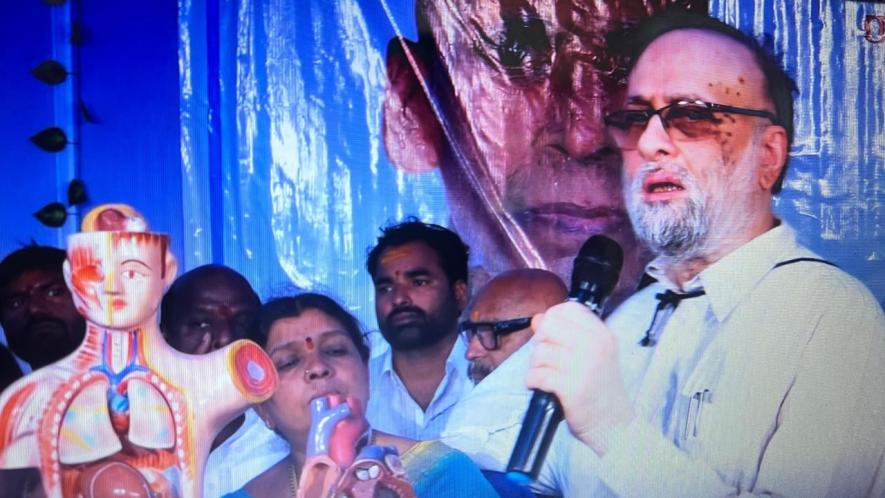
Padmashri Dr. Prasada Rao explaining how Kattaiah was operated and an artificial valve placed and how it worked for more than 45 years in memorial meetings in his village.
On June 7, 2025, a shepherd who became a farmer in his early days, and later a long-time heart patient, Kancha Kattaiah (77), died peacefully while sitting on the toilet commode in Hyderabad, Telangana. It appears that the Star Edward Steel Mitral Valve replaced in his heart on December 17, 1979, stopped working after 45 years and six months. This was the first-generation valve made by the Edward Company, the US. Kattaiah got this thoracic surgery done in the Christian Medical College (CMC) Hospital, Vellore, started by a Christian missionary woman doctor Ida.S.Scudder in 1900.
Though the procedure was beyond his means, as a man who believed in science and modern medicine, Kattaiah got it done by making several trips to CMC, which is 600 kilometers away from his village.
According to Dr. (Padmashri) Dasari Prasada Rao, who began the earliest bypass surgeries in the early 1980s in the Nizam’s Institute of Medical Sciences (NIMS), “Perhaps Kattaiah is the longest survivor with that single valve without going for re-surgeries in the history of Edward valves”. Dr Beerappa Nagari, now NIMS Director, a famous gastroenterology surgeon, says “Kattaiah’s survival for so long with the same valve is a medical miracle”. Hence, villagers, in a growing environment of superstition and many people dying with blind faith, call him the ‘Science Man’ of their village.
THE 1970s MEDICAL SITUATION
Back in the 1970s, there were no basic heart related diagnostic tools, such as ECG, Echo etc, in Hyderabad. Medical science in India was very backward in spite of the fact that the Nehruvian scientific spirit was around in academic discourses by then.
Even now, India has not evolved into a scientifically discoverer nation, medical or other. We still depend on the West for new discoveries. Hence, there is need for a serious discussion around science and faith in India.
After 25 years of the establishment of the CMC Vellore Hospital, which used advanced medical science to keep Kattaiah alive for more than 45 years after surgery, the RSS or Rashtriya Swayamsevak Sangh was formed as a Hindu missionary organisation.
While Western missionaries started schools and hospitals in India, the RSS focussed on an anti-Muslim and anti-Christian campaign, shifting the nation’s discourse from scientific temper to secularism versus communalism. Tonnes of material was written on this issue, but much less on science and how to overcome superstition and blind faith.
THE MAIN FOCUS OF RSS EVEN NOW
Ever since the RSS and Bharatiya Janata Party (BJP) came to power in Delhi in 2014 and also in many states, the conflict between science and faith and superstition is not a major debate issue. Critiques of blind faith, particularly Hindu or Muslim, are getting politicised on a daily basis. Litigations around issues of hurting sentiments have increased several-fold. The media is full of faith-based news. Science gets hardly any attention in the Indian media.
As the RSS controls the core structures of the nation, faith is being projected as the core value of the nation. But when people are sick or immobilised because of accidents and so on, they need to go to hospital, which is a place of science, and not to institutions of faith. Epidemics get fought with science, not with faith. We have seen and experienced that during the COVID-19 pandemic.
SCIENCE IS NOT PART OF OUR THINKING
Science as a process of human thinking is not at all taken seriously in India. Agriculture is a science itself. A farmer like Kattaiah, since he was not exposed to faith mobilisation, depended only on science. That is why he survived a major heart disease.
While the general atmosphere in the nation is such, even Prime Minister Narendra Modi and other ministers keep on speaking about faith. If this mode of thinking does not change in the governing elite, the nation will begin to think that science is foreign, not Indian. The RSS-BJP rule has pushed the nation into science versus faith-based conflict. The idea that faith cures every disease seems to be growing under this regime.
We do not see RSS-BJP cadres and leaders defending science when there is a conflict between science and faith. They do not allow individual thinking in their ranks. The Chinese and Russian communist parties did exactly the opposite. They did not allow any individualist faith-based thinking. That created its own problems when it was done from a position of power.
The Arab rulers or Pakistan or Afghanistan rulers also do not stand by any science-centred ideological position of individuals or groups. Do they have independent growth of their own science? No. They, too, are fully dependent either on Western science or on Chinese? If the present trend continues, India will fall into the same strap of ‘all faith, no science.’
There is an increased tendency to project that faith is nationalist and scientific thinking is anti-national. By way of killing scientific thinking or killing the constant questioning abilities of children, adults as part of Indian civilisation. But Indian civilisation developed around agriculture as science. The Right-wing school does not realise this.
What is being forgotten in the process is that human life begins with the process of science and it primarily grows with scientific treatment of children. For example, when a child is born, feeding milk or other forms of food is a scientific process. From the milk feeding stage to food eating stage, faith does not enter a child’s life. The idea of faith begins to be formed in the mind of a child either by observing the parent’s faith-related practices, like pooja or prayer, or with a specific instruction process through schooling.
The Gurukuls and Madrasas historically did this. But the modern school is different. It must turn to teaching science as a life process. Science is culture too. But the RSS propagates only faith as culture.
The modern school system is mainly meant to teach science and also some amount of faith issues. If faith becomes the central theme of school teaching, the human mind cannot not work in scientific laboratories at all. Because faith does not accept experimentation.
The present political trend, as it is heavily bent on faith, does not accept experimentation. If India is ruled by faith as the central theme of nationalism for long, the nation is bound to remain dependent on the West for science.
For an average human being, including the voter, this appears the only way of life. We may use science, engineering, medicine, or technology as part of the scientific thinking of Western humans. As long as the supply chain of science continues, we will live like this. If the scientific thinking supply chain becomes unavailable to us, we will start walking, eating our old food, and living in our old type sheds. Our own children are not being allowed to think critically in homes, in the markets. Once young minds are not allowed to question other’s practices and his/her own practice, where will we land?
When our children see critical thinkers being attacked on the roads, on TV channels, in newspapers, they begin to think that they should follow the mob. They surrender to faith and begin to hate science. In such an atmosphere, one may become an engineer by routine training, or a doctor or a so-called lab scientist. But there is no critical creative mind in that social milieu– in that factory, in that hospital or in that lab where innovations need to take place. The RSS-BJP kind of ideological campaign of faith makes us compete with another blind faith nation, like Pakistan.
Kattaiah, who survived for more than 45 years with a scientifically made valve to repair a damaged heart, should serve as an example that science is the main source of life, not faith. Faith is only a supplement for confidence-building, not a source of cure. Hence, the villagers were right when they shouted a slogan in his memorial meeting of celebration of his science life “Long Live Science” in his native village on June 16, 2025.
The writer is a political theorist, social activist, and reformer. His latest book is The Shudra Rebellion. The views are personal.
https://www.newsclick.in/conflict-between-science-and-faith-india


You must be logged in to post a comment.