-
How the Cockroach Janata Party Changed India’s Student Politics in India

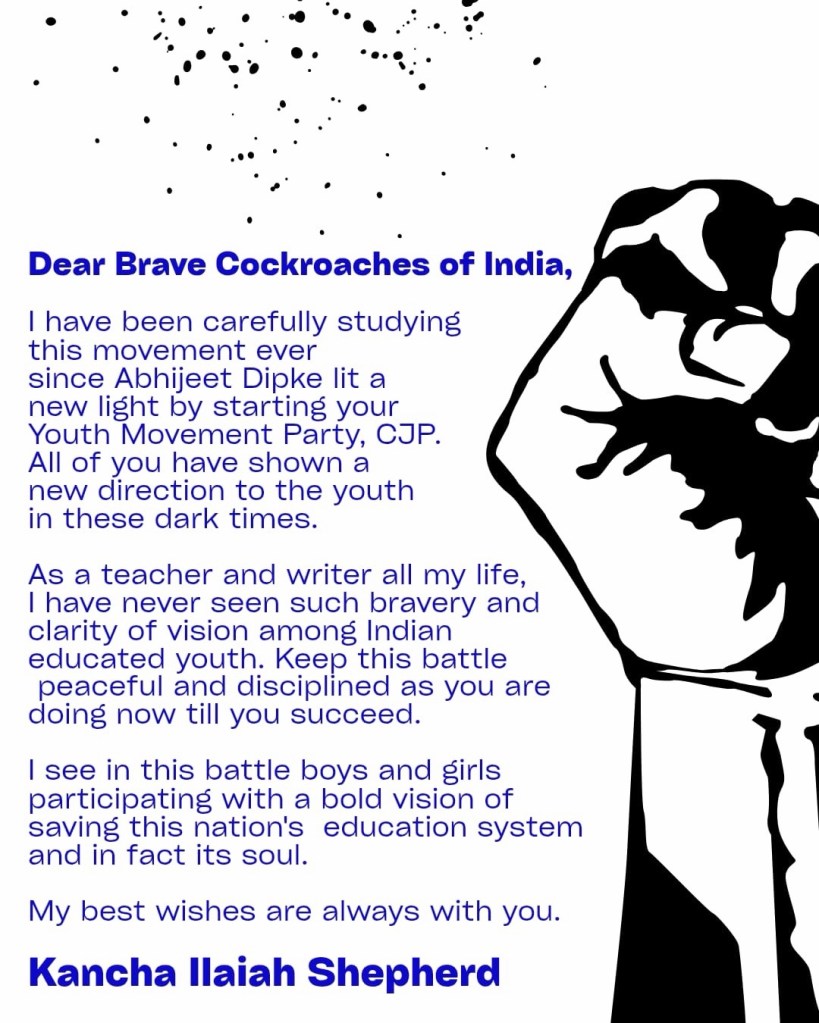
The victory of the Indian Cockroaches on 25 July is the first achievement in the process of awakening Indian youth, irrespective of caste, class, religion, and ideology. We all know that the Indian education system has been in danger since Independence. The Cockroach Janata Party re-ignited the discourse on the Indian education system through this protest. This Cockroach movement outshines the 1968 Paris Student Movement (PSM) against General De Gaulle and his right-wing educational policies in France. Though the world-famous 1968 Paris Student Movement awakened French youth and helped reshape the French education system, General De Gaulle was re-elected in the next election. Yet it remained the most popular student movement in human history until yesterday.
The Indian student movement of 2026 is much bigger, better organized, and better articulated in terms of the goals it set against the more religious fundamentalist regime of the RSS/BJP. General De Gaulle was not under the grip of an unregistered, 100-year-old Hindutva, small upper-caste-controlled organization like the RSS and its handpicked Prime Minister, Narendra Modi, and his cabinet colleagues. The name of the party, Bharatiya Janata Party, is only the outward face of the real power wielders. The real ruling is being done by the RSS, about which the world now knows much better. The RSS formulates the ideological basis of the Indian education system that the Government has no alternative but to implement.
The Indian Cockroach Youth Movement (CYM) won an immediate victory by forcing the Indian Education Minister, Dharmendra Pradhan, to resign, making the Government agree to pay compensation to the parents of students who died by suicide after the medical JEE (Joint Entrance Examination) was cancelled because of paper leaks across India, and securing the withdrawal of all FIRs filed against the protesting students. The students protested continuously for 36 days. It gave hope to those who had felt helpless for almost 12 years as the right-wing onslaught on the education system continued. No opposition criticism could change the functioning of the Government.
However, we have to wait and see how this movement helps reshape the Indian education system, which has been deeply damaged by the imposition of primitive ideological syllabus content and a religious teacher-student relationship. The RSS took control of every educational institution, while big business forces aligned with the RSS set up a parallel system for the rich, with which the RSS had no problem. There is a caste connection to the right-wing agenda as well.
The upper-caste rich have space in private-sector education and employment. The examination system that the BJP Government devised is meant to secure seats for the rich in top institutions through coaching and, much more disgustingly, through the paper leak system. Paper leaks are not an accidental process in this regime. They are systemic and allowed from above. Sometimes they are exposed, and many times they are managed through the channels controlled by the RSS/BJP and monopoly houses. If these paper leaks had affected only Dalit, OBC, and Adivasi youth, they would not have entered any media network. This time, however, even the upper-caste middle class, which is a regular vote base of the BJP, though not its financial support base, has also been victimized. Since the RSS/BJP have mastered managing votes through EVMs with the tacit support of the Election Commission itself, it appears they no longer care about the actual votes of upper-caste Hindus either. The RSS/BJP have reached a stage where they believe every Government institution supports them, as these institutions are filled with their own ideologically trained personnel. They also believe that the judiciary has now been brought under their control. How this entire system of governance will change the basic structure of the nation in the future remains to be seen.
It was in this atmosphere that a new Gen Z satirical party called the Cockroach Janata Party was born on the American internet through Abhijeet Dipke.
WHAT IS THIS FUNNY COCKROACH JANATA PARTY?
When any educated upper-caste person or foreigner heard the name Cockroach Janata Party, it would likely be dismissed as crude satire created by a semi-cracked individual. But this satire emerged in the background of a statement by the sitting Chief Justice of India, Justice Surya Kanth, who referred to unemployed youth as “cockroaches and parasites.” It challenged the stereotypical understanding of the cockroach. It would have been impossible for an upper-caste boy or girl to embrace the identity of the cockroach, which is commonly seen as an ugly species found in kitchen sinks, thriving in wet dirt inside sink pipes, and spreading into kitchen holes and vessels. Cockroaches are hated in households, particularly by women, when they appear around food in kitchens. Generally, men are not the cooks in Indian homes, though they do work as chefs in large restaurants. The Chief Justice used the term “cockroach” with similar disgust while referring to unemployed youth, though he later clarified that he was actually referring to unqualified lawyers wasting the courts’ time.
In Indian casteist society, the term also carries a social connotation. Anyone could interpret that statement according to their own background and ideological understanding. Dipke interpreted it from a Dalit identity perspective.
In private conversations among the leisurely rich, mainly upper castes, this slur is used as a metaphor for Dalits, who are viewed as the dirtiest of the dirty because they were historically associated with leather work, sanitation work, and other forms of production-related labour considered unclean. Abhijeet Dipke, being a Dalit, grew up in a social and academic environment where humiliating caste names and caste identities were defiantly reclaimed: “Yes, we are Dalit; yes, we are Chandals; yes, we are Mochi.” Abhijeet turned the Chief Justice’s cockroach metaphor on its head and posted in an assertive tone: “Yes, all of the unemployed are cockroaches. What if all of them unite?” He transformed the Chief Justice’s slur into a rallying cry. Before the rise of Dalit identity politics in colleges and universities, a Dalit youth would not have done this. No upper-caste youth would have thought of turning such an insult into the foundation of a new politico-cultural movement among unemployed youth across caste and religion. They are all sailing in the same boat of unemployment.
The anger against the creators of unemployment—the RSS/BJP and the monopoly houses—took a dramatic turn with his announcement of the Cockroach Janata Party and its manifesto of the unemployed and the lazy. Cockroaches are also stereotyped as symbols of laziness. However hard Dalits work in India, upper castes often describe them as lazy, while the exploitative rich are invariably portrayed as hardworking. Abhijeet Dipke has suddenly become a 24×7 working “lazy” Cockroach on social media.
Initially, the party’s subscribers appeared to be mainly Dalits and Adivasis, with relatively few OBCs. Gradually, OBCs, unemployed women, and finally almost everyone except hard-core RSS/BJP supporters and job-secure youth linked to monopoly houses joined Abhijeet’s party online. Abhijeet was careful in selecting his spokespersons while he was still in Boston. Caste plays no role in his method of mobilization. One simply has to be “lazy” (meaning hardworking in this context) and willing to identify with the cockroach—the abused unemployed.
ABHIJEET’S LEADERSHIP QUALITIES
He is the first Dalit leader to become acceptable to youth of all castes, communities, and religions, and gradually to their parents as well. He and his team handled the movement from 6 June, when the CJP launched its first protest at Jantar Mantar, until 25 July, the day the protest was withdrawn, in a manner unmatched by any other mass movement in Indian history. The movement won its battle and concluded by singing the National Anthem under extraordinarily difficult circumstances. Undoubtedly, this is the first instance of its kind in Indian history. The team, consisting of young men and women, displayed remarkable skills in handling the masses, the media, the police, and finally the Government. They demonstrated commitment, conviction, and clarity. They communicated effectively in English and Hindi, while Abhijeet also spoke Marathi fluently.
Ambedkar was a great intellectual, speaker, and writer. Abhijeet is an outstanding communicator and persuasive speaker. He never allows emotion to overwhelm him, yet he is capable of inspiring the masses.
Abhijeet and his leadership were wise enough to move away from the Gen Z protest style seen in some neighbouring countries. They understood how Gen Z movements in Sri Lanka, Bangladesh, and Nepal confronted their governments through muscle power and violence. Had they followed the same path, they might have been crushed and suffered a major defeat. Instead, by adopting Gandhian and Ambedkarite methods of peaceful protest, they won the first battle.
They had also learned from Anna Hazare’s India Against Corruption movement. At that time, much of the Indian media supported the movement against the Government. In contrast, during this movement many of the same media houses sided with the Government and attempted to mislead the public. Educated Gen Z activists, however, used their mobile phones to create reels that spread rapidly across social media. As a result, the narrative of their movement could not be controlled by the mainstream media, because social media had become a far more powerful platform for reaching the public.
Gaurav Das, Ashutosh Ranka, and leading team members such as Ratna Singh, Vijeta Dahiya, Aafreen Nawaz, and Deepak Baliyan did a remarkable job of communicating, negotiating (particularly Gaurav and Ashutosh), and carrying forward the movement. They never lost sight of its larger purpose.
Sonam Wangchuk’s hunger strike added a certain aura, but that method of starvation has its own weaknesses. Twenty-first-century youth have evolved new methods of mobilizing and sustaining large gatherings over long periods. The Gandhian method does not require a mass protest involving standing, sleeping, singing, dancing, speech-making, and creating space for every idea, voice, and artistic expression to help transform the Indian mind, which has been divided, stunted, and controlled by RSS/BJP religious ideologues for decades. We should not forget that the RSS has constrained the growth of the Indian mind for a century. They neither starve nor respect or listen to starving leaders. Did they respect Gandhi’s fasting and self-sacrificial methods? Wangchuk should not repeat that strategy in future. Let the Cockroaches try their own methods.
WHAT, IN THE FUTURE?
The CJP is not a leaderless movement. It is a movement of young leaders guided by constitutional democratic principles. This method of mobilizing and sustaining large numbers of people in one place for such a long period was not tested by Buddha, Ambedkar, Gandhi, or Nehru. The CJP is an entirely new experiment. As a true and visionary Ambedkarite, Abhijeet concluded the more than 40-day protest with the warning: “Do Not Make Me a Hero.” That reflects the true spirit of Ambedkar.
The team should register the Cockroach Janata Party. It should not follow the RSS model of remaining unregistered and functioning for decades without even maintaining a bank account while possessing organizational properties. The BJP Government will harass them. They should register both as a society and as a political party with the Election Commission so that no one else can pre-empt the CJP’s identity. It should function as a legal organization and a political party on record while continuing to operate as a movement pressing for educational reforms for some more time. In the future, when it matures, it could play a political role.
Kancha Ilaiah Shepherd is a political theorist, social activist, and author. His forthcoming books are A Shudra Life and Harappa: God’s City of Civilization.
https://countercurrents.org/2026/07/how-the-cockroach-janata-party-changed-indias-student-politics/
-
CJP
-
आखिर भारत के राजनीतिक दलों ने आरएसएस को इतनी छूट क्यों दी?
आरएसएस का गठन हुए 100 साल से ज्यादा बीत चुके हैं। लेकिन क्या कारण हैं कि न तो केंद्र और न ही किसी भी राज्य सरकार ने कभी उसकी कानूनी और वित्तीय जवाबदेही पर प्रश्न नहीं उठाए और न ही कभी आरएसएस से कहा कि वह अपने वित्तीय लेखें प्रस्तुत करे। पढ़ें, प्रो. कांचा आइलैय्या शेपर्ड का यह आलेख
कांचा आइलैय्या शेपर्ड July 18, 2026
यह पक्का समझिए कि पूरी दुनिया हमारी राजनीतिक प्रणाली को देख कर चकित रह जाती होगी। आज़ादी के बाद से राष्ट्रीय स्वयंसेवक संघ (आरएसएस) के स्वयंसेवक इस देश पर 17 साल (1999 से 2004 तक और फिर 2014 से लेकर अब तक) तक राज कर चुके हैं और आरएसएस का केंद्र सरकार और कई राज्य सरकारों पर खासा प्रभाव है। इसके बाद भी न तो आरएसएस पंजीकृत और न ही किसी बैंक में उसका कोई खाता है।
दुनिया के किसी भी अन्य लोकतंत्र में शायद ही कोई अपंजीकृत और रहस्यों के आवरण में लिपटी संस्था अपनी राजनीतिक शाखा के ज़रिए देश पर राज करने की स्थिति में होगी।
मजे की बात यह है कि आरएसएस को यह छूट भारतीय राष्ट्रीय कांग्रेस ने दी है, जो अकेले या अन्य पार्टियों के साथ गठबंधन में देश पर करीब 55 साल तक राज कर चुकी है। हालांकि यह भी सच है कि कांग्रेस सरकारों ने तीन मौकों पर आरएसएस पर प्रतिबंध लगाया था।
आरएसएस का कहीं कोई पंजीकरण नहीं है। इसकी तुलना में हिटलर की नात्सी पार्टी – जिसका आधिकारिक नाम नेशनल सोशलिस्ट जर्मन वर्कर्स पार्टी (एनएसडीएपी) था – तक पंजीकृत थी। पार्टी का पंजीकरण उससे जुड़ी एक संस्था एनएसडीएवी के ज़रिए 1920 में करवाया गया था। सन् 1923 में एक असफल विद्रोह – जिसे बियर हॉल पूच्छ कहा जाता है – के बाद नात्सियों पर प्रतिबंध लगा दिया गया था। आगे चलकर पार्टी का पुनर्गठन किया गया और फरवरी, 1925 में उसे एक राजनीतिक संगठन के रूप में जर्मनी के बवेरिया प्रांत में पंजीकृत करवाया गया।
इतालवी तानाशाह बेनिटो मुसोलिनी की नेशनल फासिस्ट पार्टी, इटली की एक पंजीकृत और मान्यता प्राप्त राजनीतिक पार्टी थी। इसकी स्थापना 1919 में मुसोलिनी ने की थी। शुरुआत में इसकी शक्ल एक आंदोलन की थी। नवंबर, 1921 में उसे औपचारिक रूप से एक राजनीतिक दल के रूप में पंजीकृत किया गया और उसे मान्यता प्रदान की गई।
भारत की हिंदू, मुस्लिम और ईसाई संस्थाएं
भारत में हिंदू महासभा का गठन 1907 में हुआ था। सन् 1915 में उसका पुनर्गठन किया गया। सन् 1970 में संस्था ने सोसाइटीज रजिस्ट्रेशन एक्ट के तहत अपना पंजीकरण करवाया।
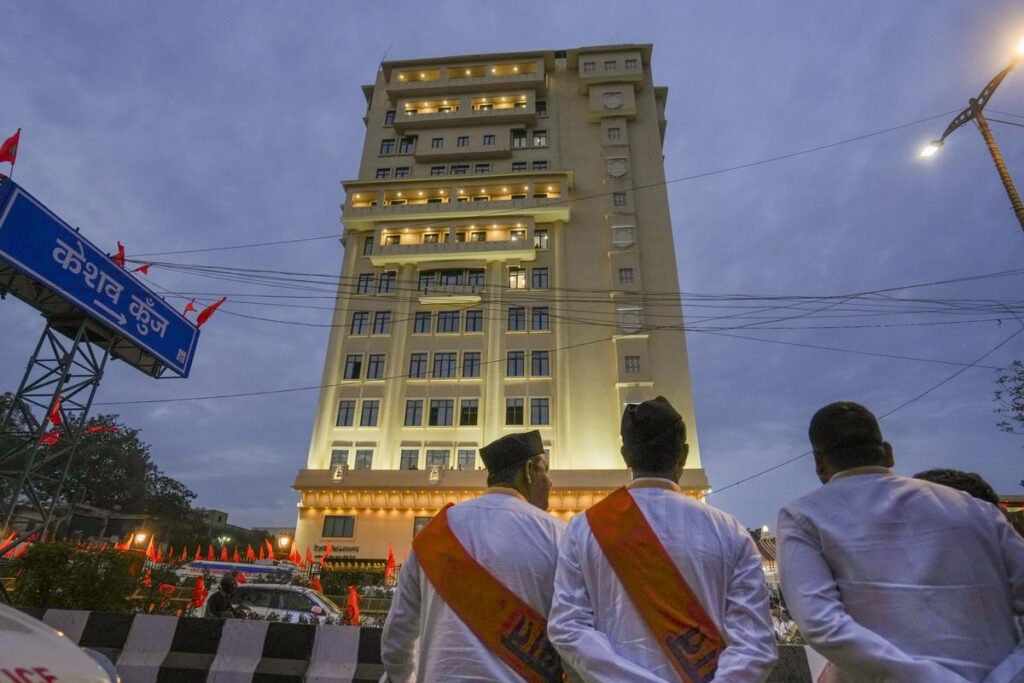
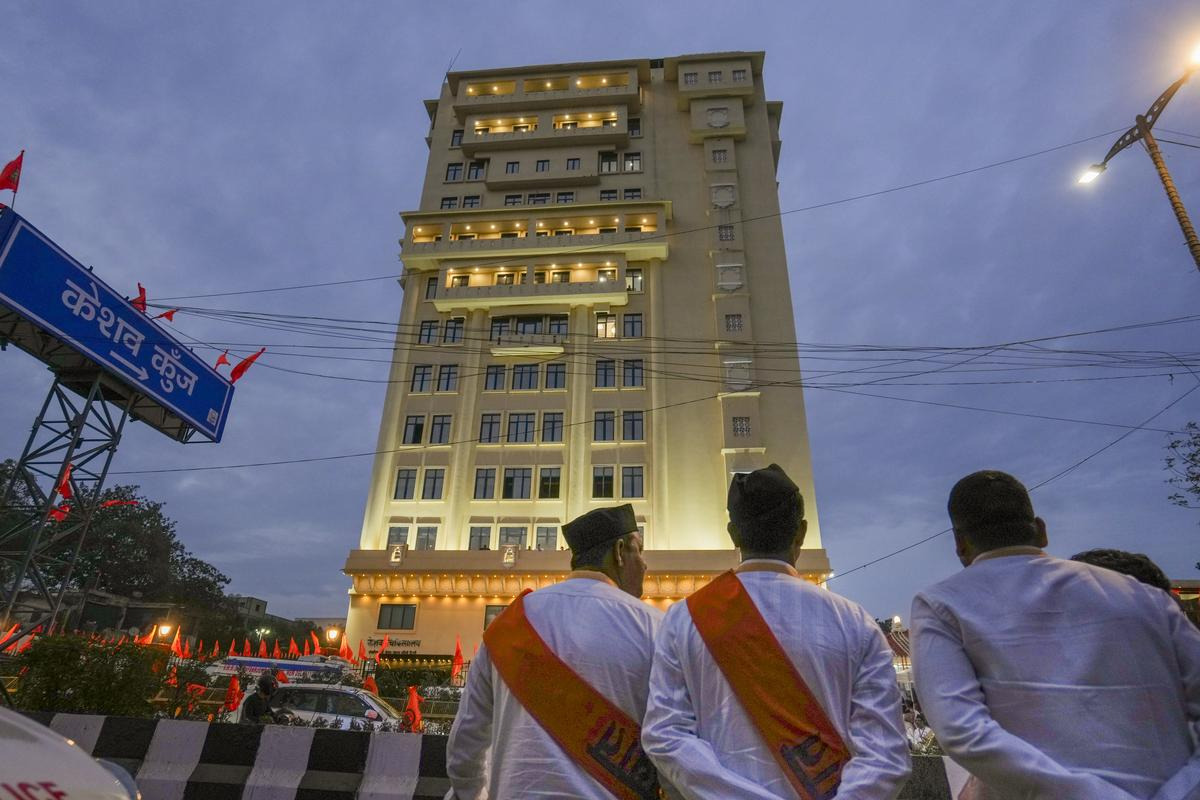
स्वतंत्रता के पूर्व स्थापित कई प्रमुख मुस्लिम शैक्षणिक, धार्मिक और राजनीतिक संस्थाओं ने ब्रिटिश सरकार द्वारा बनाए गए सोसाइटीज रजिस्ट्रेशन एक्ट 1860 अथवा ट्रस्टों से संबंधित कानूनों के तहत अपना पंजीकरण करवाया। सन् 1866 में स्थापित दारुल उलूम देवबंद, 1919 में स्थापित जमीयत उलेमा-ए-हिंद और 1894 में गठित दारुल उलूम नदवतुल उलमा – ये सभी पंजीकृत शैक्षणिक एवं धार्मिक संस्थाएं थीं, जिनका एक सुस्पष्ट संगठनात्मक ढांचा था और जिन्हें कानूनी मान्यता हासिल थी।नई दिल्ली के झंडेवालान में करीब 150 करोड़ रुपए की लागत से बनी राष्ट्रीय स्वयंसेवक संघ के नए कार्यालय की तस्वीर
जमात-ए-इस्लामी हिंद, जिसकी स्थापना 1941 में हुई थी और जिसे स्वाधीनता के बाद पुनर्गठित किया गया था, एक सामाजिक-राजनीतिक संगठन है। इसका भी पंजीकरण है। ऑल इंडिया मुस्लिम लीग (स्थापना वर्ष 1906) तो एक विशुद्ध राजनीतिक संस्था थी, मगर वह भी औपनिवेशिक राजनीतिक व्यवस्था की हदों के भीतर काम करती थी। कुल मिलाकर, कई प्रमुख मुस्लिम संगठनों और संस्थाओं ने कानूनी ढांचे और पंजीकरण नियमों का पालन किया और अपनी संस्थागत जवाबदेही सुनिश्चित की। वे कानूनों की जद से बाहर नहीं थीं।
स्वातंत्र्य-पूर्व भारत में मुख्यधारा की ईसाई शैक्षणिक, धार्मिक और गैर-सरकारी संस्थाओं ने भी सोसाइटीज रजिस्ट्रेशन एक्ट 1860 अथवा ट्रस्टों से संबंधित कानूनों के तहत बाकायदा अपना पंजीकरण करवाया। स्वतंत्रता के बाद राष्ट्रीय स्तर के चर्चों के संगठनों ने भी संबंधित कानूनों के तहत अपना पंजीकरण करवाया। कैथोलिक बिशप्स कांफ्रेंस ऑफ़ इंडिया का 1944 में संस्था के रूप में पंजीकरण करवाया गया। चर्च ऑफ़ साउथ इंडिया का पंजीकरण 1947 में हुआ, प्रेसबिटिरियन चर्च ऑफ़ इंडिया का 1924 में, चर्च ऑफ़ नार्थ इंडिया का 1924 में, मेथोडिस्ट चर्च इन इंडिया का 1981 में, इंडियन इवैंजेलिकल लुथेरन चर्च का 1958 में, यूनाइटेड इवैंजेलिकल लुथेरन चर्चेस इन इंडिया का 1975 में और कौंसिल ऑफ़ बैप्टिस्ट चर्चेस इन नार्थईस्ट इंडिया का पंजीकरण 1950 में हुआ।
मलंकरा ऑर्थोडॉक्स सीरियन चर्च 1934 में निर्मित अपने संविधान के तहत काम करता है, मगर उसके द्वारा संचालित ट्रस्ट पंजीकृत हैं। इसी तरह, सन् 1889 में अपने पुनर्गठन के समय से ही मारथोमा सीरियन चर्च अपने पंजीकृत ट्रस्टों के ज़रिए काम करता आ रहा है। जैकोबाईट सीरियन क्रिश्चियन चर्च का कोई एकीकृत राष्ट्रीय पंजीकरण नहीं है, मगर उसके धर्मप्रांत और उससे संबद्ध संस्थाएं पंजीकृत हैं। इसी तरह, बैप्टिस्ट चर्च ऑफ़ मिजोरम, राज्य के कानूनों के तहत पंजीकृत अपनी संस्थाओं के ज़रिए काम करता है।
जहां तक साईरो-मलाबार कैथोलिक चर्च और साईरो-मलान्कारा कैथोलिक चर्च सहित रोमन कैथोलिक चर्च का संबंध है, वे राष्ट्रीय स्तर पर अलग से पंजीकृत नहीं हैं, लेकिन उनके सभी धर्मप्रांत, महाधर्मप्रांत एवं उनके द्वारा संचालित शैक्षणिक व परोपकारी संस्थाएं और ट्रस्ट, भारतीय कानूनों के तहत संबंधित कार्यालयों में पंजीकृत हैं। इनमें से अधिकांश चर्च और संस्थान, सोसाइटीज रजिस्ट्रेशन एक्ट 1860 के तहत पंजीकृत हैं और उसी के तहत अपना काम करते हैं। यह अधिनियम चर्चों, मिशनों, स्कूलों, अस्पतालों और गैर-सरकारी संस्थाओं के संचालन से संबंधित नियमों को निर्धारण करता है।
जातिगत कारणों से आरएसएस अपवाद बना हुआ है
आरएसएस का गठन हुए 100 साल से ज्यादा बीत चुके हैं। लेकिन क्या कारण हैं कि न तो केंद्र और न ही किसी भी राज्य सरकार ने कभी उसकी कानूनी और वित्तीय जवाबदेही पर प्रश्न नहीं उठाए और न ही कभी आरएसएस से कहा कि वह अपने वित्तीय लेखें प्रस्तुत करे। कानून के राज से जुड़ा यह मूलभूत प्रश्न कभी किसी प्रधानमंत्री या मुख्यमंत्री ने नहीं पूछा। अब, इतने साल बाद, कर्नाटक के युवा गृहमंत्री और दलित नेता प्रियंक खड़गे ने इस बारे में आरएसएस के मुखिया मोहन भागवत को ठीक यही प्रश्न उठाते हुए एक पत्र लिखा है।
आरएसएस पर कभी कोई प्रश्न नहीं उठाए जाने के पीछे हमारी जाति व्यवस्था है। आरएसएस की स्थापना ब्राह्मणवादियों द्वारा ब्राह्मणवादियों के हितों की रक्षा के लिए की गई थी। एक ब्राह्मण नाथूराम गोडसे द्वारा महात्मा गांधी की हत्या के बाद आरएसएस पर कुछ समय के लिए प्रतिबंध लगाया गया। बाद में आरएसएस ने गांधी की जाति बनिया, जो भारत की प्रमुख व्यवसायी जाति है, से दोस्ताना संबंध बना लिये।
आरएसएस के नेतृत्व को यह अहसास हो गया कि बनियों के धन के बिना आरएसएस बहुत लंबे समय तक जीवित नहीं रह सकेगा। धीरे-धीरे बनिया व्यवसायी, आरएसएस की आर्थिक रीढ़ बन गए। इसी ब्राह्मण-बनिया गठजोड़ के कारण कोई सरकार या नेता – चाहे वे किसी भी पार्टी के क्यों न रहे हों – कभी आरएसएस के कानूनी दर्जे पर प्रश्नचिह्न नहीं लगा सके। यह इसलिए और भी आसान हो गया क्योंकि सत्ता पर इन्हीं दोनों जाति समूहों का कब्ज़ा था।
भारत में आज भी कई अपंजीकृत संस्थाएं और पार्टियां हैं, जिनमें नक्सली शामिल हैं। मगर वे खुल्लम-खुल्ला काम नहीं करते। वे भूमिगत हैं। और ऐसे समूहों और संस्थाओं का सभी पार्टियों की सरकारें दमन करती आईं हैं। अब तो आरएसएस-भाजपा के लोग जश्न मना रहे हैं कि उन्होंने नक्सलियों को करीब-करीब पूरी तरह से कुचल दिया है।
लेकिन आरएसएस सत्ता का केंद्र और स्रोत बना हुआ है। केंद्र और देश के कई राज्यों की सरकारें उसके नियंत्रण में हैं। मगर आरएसएस न तो पंजीकृत है, न किसी भी बैंक में उसका खाता है और कथित तौर पर विदेशों से धन प्राप्त करने के बाद भी उसका एफसीआरए (विदेशी अंशदान विनियमन अधिनियम) के तहत पंजीकरण नहीं है। क्या यह बहुत अजीब नहीं है?
बिना जवाबदेही की सत्ता
आरएसएस का दावा है कि वह एक गैर-सरकारी संस्था (एनजीओ) है। तो फिर अन्य एनजीओ की तरह वह पंजीकृत क्यों नहीं है? वह आयकर रिटर्न दाखिल क्यों नहीं करता? और अगर उसे विदेशों से धन प्राप्त होता है तो वह एफ़सीआरए के अंतर्गत पंजीकृत क्यों नहीं है?
भाजपा सरकार मनमाने ढंग से एनजीओ के एफ़सीआरए लाइसेंस रद्द कर रही है और उनके खातों को फ्रीज कर रही है। लेकिन अगर आरएसएस या उससे संबद्ध संस्थाओं को विदेशी स्रोतों से चंदा मिलता है तो उसकी तहकीकात क्यों नहीं हो रही है?
क्या पूर्व प्रधानमंत्री मनमोहन सिंह और उनकी सरकार में वित्त मंत्री पी. चिदंबरम (जो कुछ समय तक गृहमंत्री भी थे) को यह सब पता नहीं था? क्या कारण है कि चिदंबरम ने वे प्रश्न कभी नहीं उठाए जो आज खड़गे उठा रहे हैं? ज्ञातव्य है कि विदेशों से मिलने वाले चंदे के नियमन संबंधी कानून इंदिरा गांधी के प्रधानमंत्रित्व काल में बने थे।
चिदंबरम ने वित्त मंत्री बतौर यह नियम बनवाया था कि हर संस्था के एफ़सीआरए प्रमाणीकरण की हर पांच साल में समीक्षा होनी चाहिए। मगर उनकी सरकार ने कभी आरएसएस से यह नहीं पूछा की वह पंजीकृत क्यों नहीं है या भारत में या अन्य देशों के साथ उसका आर्थिक लेन-देन क्या है? यहां तक कि आपातकाल में – जब आरएसएस के कई नेताओं और कार्यकर्ताओं को जेल में डाल दिया था – भी संघ की गतिविधियों के इस पक्ष की अनदेखी की गई।
कम्युनिस्ट पार्टियों ने पश्चिम बंगाल, केरल और त्रिपुरा पर दशकों तक राज किया। लेकिन वे भी आरएसएस के मामले में चुप रहीं। ममता बेनर्जी ने पश्चिम बंगाल में अपने 15 साल के शासनकाल में इस मामले में क्या किया? समाजवादी पार्टी, बहुजन समाज पार्टी (उत्तर प्रदेश) और राष्ट्रीय जनता दल (बिहार) क्या अपने राज में आरएसएस से कुछ पूछताछ कर सके? आरएसएस इन सभी राज्यों में सक्रिय था और अब एक-एक करके उनके ऊपर कब्ज़ा जमा रहा है।
मोहन भागवत का कहना है कि “हिंदू धर्म की तरह, आरएसएस को भी पंजीकरण करवाने की ज़रूरत नहीं है?” अगर धार्मिक संस्थाओं को पंजीकरण करवाने और बैंक खाते खोलने की ज़रूरत नहीं है तो फिर आरएसएस-भाजपा सरकारें, ईसाई धार्मिक संस्थाओं से कानूनी और आर्थिक जवाबदेही की अपेक्षा क्यों रख रही हैं? आरएसएस यह तो चाहता है की इडी, सीबीआई और आयकर विभाग कांग्रेस और क्षेत्रीय पार्टियों के नेताओं के घरों और दफ्तरों पर छापे मारें, मगर वह अपने काम करने के तरीके और आर्थिक लेन-देन की कोई पड़ताल नहीं चाहता।
कीमत चुका रहे हैं बहुजन
अब तो यह साफ़ है कि आरएसएस संविधान और कानून के राज का तनिक भी सम्मान नहीं करता। और यही शूद्र, दलित और आदिवासी जनता के लिए सबसे बड़ा खतरा हैं। ये वर्ग भारत के बहुसंख्यक हैं। वे हिंदुओं में भी बहुसंख्यक हैं। मगर आरएसएस की नीतियों के निर्धारण में उनकी कोई भूमिका नहीं है। पिछले 100 सालों में कभी भी उन्हें आरएसएस का नेतृत्व करने का मौका नहीं मिला।
बहुजनों ने वर्णधर्म – जिसके अंतर्गत ब्राह्मण पंडितों की कही बात को पत्थर की लकीर माना जाता है – के चलते घोर कष्ट भोगे। और अब भागवत भी उसी व्यवस्था का समर्थन कर रहे हैं। आरएसएस का रहस्यपूर्ण चरित्र, चाल और चेहरा; शूद्रों, दलितों और आदिवासियों के लिए धार्मिक अल्पसंख्यकों की तुलना में अधिक बड़ा खतरा है। कारण यह कि धार्मिक अल्पसंख्यकों के बचाव के लिए आध्यात्मिक रूप से संगठित राष्ट्रीय और अंतर्राष्ट्रीय ढांचे हैं। मगर शूद्र, दलित और आदिवासी तो ब्राह्मणवादी ताकतों के संपूर्ण नियंत्रण में हैं। उनसे तो कहा जाता है कि वे हिंदू हैं।
आज हालत यह है कि एक संगठन, जिसका केंद्रीय और राज्य सरकारों पर जबरदस्त नियंत्रण और प्रभाव है, जो सरकारों की नीतियों के निर्धारण में महती भूमिका निभाता है, उसका कहना है कि कानून उसकी पड़ताल नहीं कर सकता। क्या भारत का संविधान और उसका लोकतंत्र ऐसे संगठन के बोलबाले के चलते सुरक्षित है?
जैसा कि आंबेडकर ने कहा था कि अनैतिक ताकतों के शासन में कोई नैतिक संविधान काम नहीं कर सकते। जाति का हर चीज़ का निर्धारक बन जाने से लोकतंत्र का अंत अवश्यंभावी है।
यह निश्चय ही प्रसन्नता का विषय है कि एक दलित – जो जाति व्यवस्था के सबसे बड़े पीड़ित समुदाय का सदस्य है – ने इस मामले में पहल की है और हिम्मत के साथ यह मुद्दा उठाया है। प्रियंक खड़गे ने इस मामले को राष्ट्रीय बहस का मुद्दा बनाकर देश का भला किया है। आरएसएस को चाहिए कि वह या तो अपना पंजीकरण करवाकर अपने संगठन और लेखों का पूरा खुलासा करे या फिर अपना काम बंद कर दे।
(यह आलेख पूर्व में अंग्रेजी में वेब पत्रिका ‘द वायर’द्वारा प्रकाशित है तथा यहां हिंदी अनुवाद लेखक की सहमति से प्रकाशित है।)
https://www.forwardpress.in/2026/07/politics-analysis-rss-priyank-kharge/
-
Author Kancha Ilaiah urges Sonam Wangchuk to end hunger strike; levels allegations against BJP, RSS and Election Commission.
-
Why Did India’s Political Parties Give the RSS a Free Pass All These Years?
Kancha Ilaiah Shepherd
In no other democracy would a shadowy organisation that has remained unregistered be in a position to run a country through its political wing.
Illustration: Pariplab Chakraborty.
The world must be wondering what kind of political system India has. The country has been ruled by members of the Rashtriya Swayamsevak Sangh (RSS) for 17 years now (i.e. from 1999-2004 and 2014 to 2026) and its influence on the Union government and multiple state governments is visible to all. Yet, the RSS is not a registered body, nor does it have a bank account.
In no other democracy would a shadowy organisation that has remained unregistered be in a position to run a country through its political wing.
Ironically, it has been allowed to function like this by the Indian National Congress which has ruled India for about 55 years directly or in coalition with others – despite the fact that the Congress saw fit to ban the RSS on no less than three occasions.
Contrast the RSS’s lack of any kind of formal registration with Hitler’s Nazi party – formally the National Socialist German Workers’ Party (NSDAP). First registered in 1920 (via an allied body, the NSDAV), the Nazis were banned following a failed coup attempt in 1923 (the Beer Hall Putsch), and then legally re-founded and registered as a political entity in Bavaria in February 1925.
What about Benito Mussolini’s Fascist party? The National Fascist Party (Partito Nazionale Fascista) was an officially registered and recognised political body in Italy. Founded by Mussolini in 1919 as a movement, it was officially recognised and registered as a formal political party in November 1921.
The record of other Hindu, Muslim and Christian bodies in India
In India, the Hindu Mahasabha, founded in 1907 and reorganised in 1915, formally registered itself under the Societies Registration Act in 1970.
Several prominent Muslim educational, religious and political organisations in pre-independence India were formally registered under colonial legal frameworks such as the Societies Registration Act of 1860 or trust laws. Institutions like the Darul Uloom Deoband (1866), Jamiat Ulema-e-Hind (1919) and Darul Uloom Nadwatul Ulama (1894) functioned as registered educational and religious bodies with defined administrative structures and legal recognition.
Even socio-political organisations such as the Jamaat-e-Islami Hind (founded 1941, reorganised post-1947) were registered after independence. Political bodies like the All India Muslim League (founded in 1906) operated within the colonial political system with recognised organisational frameworks. This demonstrates that many major Muslim organisations historically evolved within formal legal structures, registration systems, and institutional accountability mechanisms, rather than functioning outside them.
so read: RSS Claims to be Apolitical. Priyank Kharge’s Letter Seeks to Expose the Lie.
Mainline Christian educational, religious and non-governmental organisations in pre-independence India were formally registered under legal frameworks such as the Societies Registration Act, 1860 or various trust laws. Following independence, many national church bodies also obtained legal registration under applicable laws. The Catholic Bishops’ Conference of India was registered as a society in 1944; the Church of South India in 1947; the Presbyterian Church of India in 1924; the Church of North India in 1970; the Methodist Church in India in 1981; the India Evangelical Lutheran Church in 1958; the United Evangelical Lutheran Churches in India in 1975; and the Council of Baptist Churches in Northeast India in 1950.
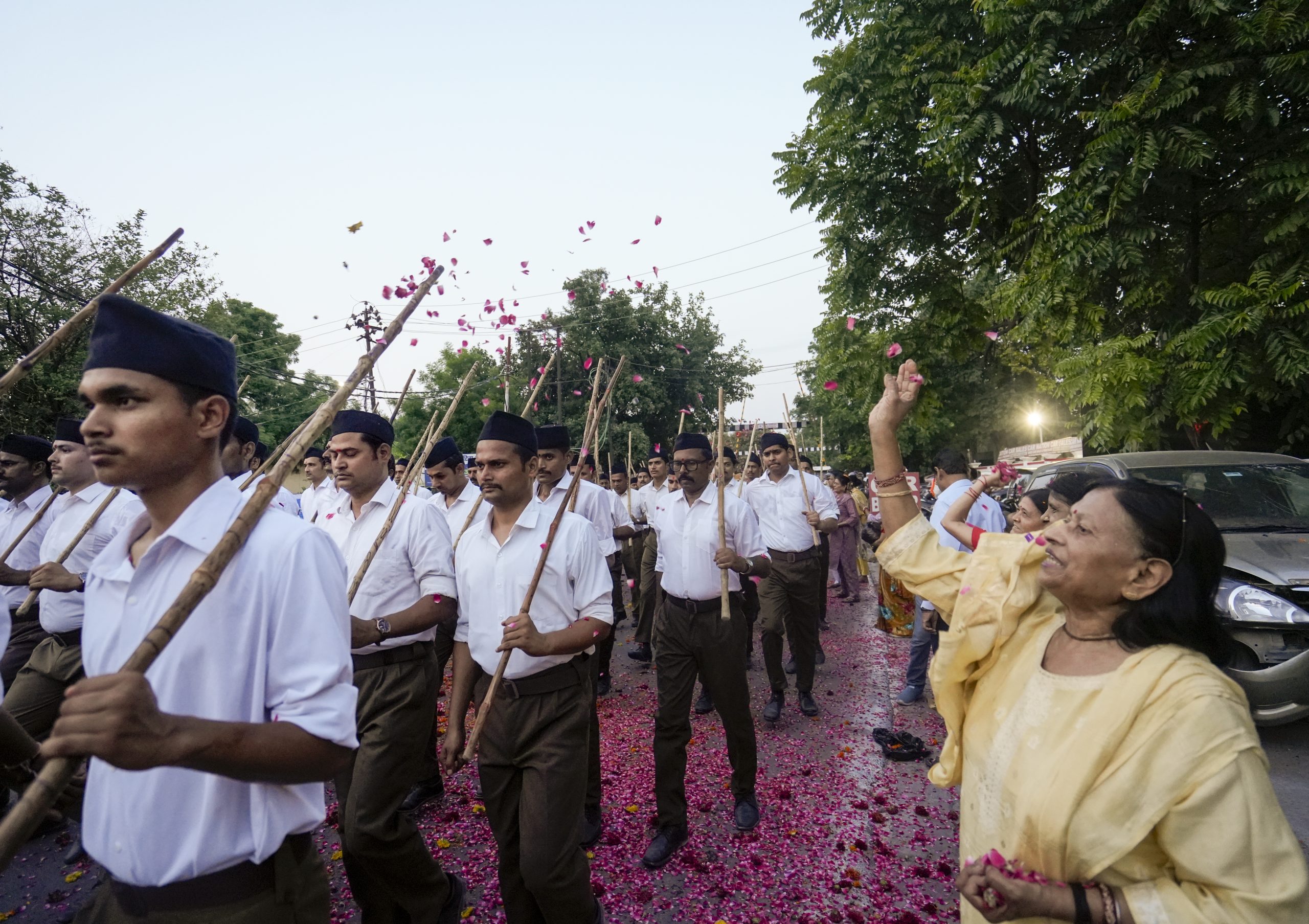
Rashtriya Swayamsevak Sangh (RSS) members take part in a path sanchalan, route march, in Lucknow on June 4, 2026. Photo: PTI/Nand Kumar.
The Malankara Orthodox Syrian Church functions under its 1934 Church Constitution, with its trusts registered separately, while the Mar Thoma Syrian Church has operated through registered trust bodies since its reorganisation in 1889. Similarly, the Jacobite Syrian Christian Church has no single national registration, with its dioceses and affiliated institutions registered independently. Likewise, the Baptist Church of Mizoram operates through entities registered under the laws of Mizoram.
In the case of the Roman Catholic Church, including the Syro-Malabar Catholic Church and the Syro-Malankara Catholic Church, there is no single all-India legal registration, as each diocese, archdiocese, educational institution, charitable society, or trust is registered separately with the relevant civil authorities under the applicable provisions of Indian law. Most of these churches and organisations are registered and operate under the Societies Registration Act, 1860, which provides the legal framework for churches, missions, schools, hospitals, and non-governmental organisations in India.
Caste power as source of RSS exceptionalism
In the existing 100-year history of RSS, why has neither the Union government nor any state government raised the issue of its legal and financial accountability or demanded that it produce its accounts? This fundamental rule-of-law question remained unasked by any prime minister or chief minister until a young Dalit home minister of Karnataka, Priyank Kharge, wrote a legally framed letter to Mohan Bhagwat, head of the RSS.
The answer lies in the caste system. The RSS was formed by Brahmins with the initial aim of preserving Brahminical interests. After Mahatma Gandhi’s murder by Nathuram Godse, a Brahmin, the RSS was banned for a short time. Later, it befriended the Baniyas – the caste group Gandhi belonged to – who are the main business caste of India.
Also read: The RSS Takes Foreign Money Too. Why Doesn’t the Government Question It?
The RSS leadership realised that without the support of the Baniya business economy, it could not survive for long. In subsequent years, the Baniya business community became its financial backbone. It is this Brahmin – Baniya alignment which ensured that no government or leader – irrespective of the party in power – ever raised the question of the RSS’s legal status. Of course, it helped that the same caste forces controlled the state structures.
In India today, there are other unregistered organisations and parties – the various Naxalite groups come to mind – but they function as underground networks. Such networks are suppressed by all parties, and the RSS/BJP are celebrating how they have almost crushed them.
However, the RSS itself remains a source of power that runs many wings of India’s administration without having registered itself, without having a bank account, and without FCRA certification, while allegedly receiving money from foreign sources. Is it not strange?
Power without accountability
In its defence, the RSS claims that it is a non-governmental organisation. Even then, it is surely obliged, like other NGOS are, are to register and file income tax returns. If it receives foreign funds, it should have FCRA certification.
The BJP government is cancelling the FCRA licenses of NGOs at will and freezing their funds. Why does the RSS not face similar scrutiny if its affiliated bodies receive foreign contributions?
Did Manmohan Singh and his finance minister P. Chidambaram – who was also home minister for some time – not know about the status of the RSS? Why did Chidambaram not raise the question that Priyank Kharge raised? It was Indira Gandhi who introduced the FCRA system.
Also read: ‘Shun the Arrogance, Follow the Law’: Kharge Hits Back at Bhagwat, Calls Out RSS-BJP Link
And Chidambaram brought in the rule that the FCRA certification of every organisation must be reviewed once every five years. But they never asked the RSS about its registration or financial transactions within India or abroad. Even during the Emergency, this aspect of the RSS was ignored, though some of its leaders and cadre were imprisoned.
What did the erstwhile Communist party run governments in West Bengal, Kerala and Tripura do when they ruled those states for decades? What did Mamata Banerjee do for 15 years? What did the leaders of the Samajwadi Party, Bahujan Samaj Party (BSP) and Rashtriya Janata Dal (RJD) do about this fundamental question when they were in power? The RSS was operating in those states and is now capturing them one by one.
Mohan Bhagwat is now saying the “RSS is like the Hindu religion. It does not have to register”. If religious bodies do not need registration and bank accounts, why is the RSS/BJP government demanding legal and financial accountability from Christian religious organisations? The same RSS wants ED, CBI, and income tax raids on Congress and regional party networks but avoids any scrutiny of its functioning and finances.
Bahujans paying a big price
It is very clear now that the RSS has no respect for the constitution and rule of law and this is where the real threat to the Shudra/Dalit/Adiavsis masses lies. The latter comprise the real majority of India – and the real majority of Hindus – but they have had no role in formulating the RSS’s policies. Nor could they ever head this organisation during these past 100 years.
The Bahujans suffered under the system of Varna dharma which treated what Brahmin pandits declared as law. Mohan Bhagwat is doing the same. The shadowy status of the RSS is more harmful to Shudra/Dalit/Adivasis than even to the minorities, who at least have their spiritually organised national and international structures to defend them. But Shudra/Dalit/Adivasis are under the control of the same Brahminic forces in the name of ‘you too are Hindu’.
Also read: In the Name of Ram: How the RSS-VHP Led the Cartelisation of the Trust and Divided Ayodhya’s Seers
The country now faces a situation where an organisation that wields massive influence on Union and state government structures and policies is saying its legal status cannot be questioned. Can India’s democracy – and constitution – survive the supervision of such an organisation?
As Ambedkar said, when immoral forces rule, no moral constitution functions. When caste rules with total control, democracy dies a natural death.
I am glad that a Dalit – i.e. someone from the group which has suffered the most because of the caste system – has shown leadership on this question and raised the issue with courage and intellectual clarity.
Kharge has initiated a national debate in the interest of the nation. The RSS should either register itself and make a full disclosure of its structure and accounts, or else it should stop functioning.
Kancha Ilaiah Shepherd is a political theorist, social activist and author. His latest book is The Shudra Rebellion.
-
Kancha Ilaiah’s Advocacy for Dalitization of Indian Society
February 21, 2026
When it comes to challenging the deepest foundations of Indian social order, few contemporary thinkers have been as direct, as consequential, or as controversial as Kancha Ilaiah Shepherd. A political theorist, writer, and anti-caste activist, Ilaiah has spent decades arguing that India cannot achieve genuine equality without a wholesale cultural and ideological transformation – one he calls the “Dalitization” of Indian society. This is not a call for marginal reform. It is a demand to replace the organizing values of Indian civilization itself: from caste hierarchy and Brahmanical privilegeto labor dignity, communal equality, and Dalit-Bahujan knowledge systems.
Table of Contents
- Who is Kancha Ilaiah?
- The concept of Dalitization
- Critique of Hindu fundamentalism and Brahmanical culture
- Dalit-Bahujan ideology as an alternative
- Dignity of labor: a philosophical cornerstone
- Buffalo nationalism vs. cow nationalism
- Education, language, and access to power
- Legacy, controversy, and continued relevance
Who is Kancha Ilaiah? 🔗
Kancha Ilaiah Shepherd, born on October 5, 1952, in Papaiahpet village of Warangal district in present-day Telangana, belongs to the Kuruma shepherd caste – a community of herders classified as Other Backward Class (OBC). His upbringing in an agrarian household shaped his political consciousness early. He credits his mother, Kancha Kattamma, as a pivotal influence – a woman who stood at the forefront of her community’s resistance against discriminatory practices and police brutality. This lived experience of marginalization became the raw material for Ilaiah’s entire philosophical project.
He went on to become a professor of political science at Osmania University, Hyderabad, and later served as Director of the Centre for the Study of Social Exclusion and Inclusive Policy at Maulana Azad National Urdu University. Though often identified as a Dalit himself, Ilaiah is technically an OBC – but his scholarship and activism have been entirely devoted to the Dalit-Bahujan cause, making him one of the most significant Ambedkarite voices of the contemporary era. In May 2016, he formally added “Shepherd” to his name as a symbolic protest against Brahmanical cultural hegemony, reclaiming his community’s labor identity as a mark of pride rather than shame.
The concept of Dalitization 🔗
“Dalitization” is the central concept in Ilaiah’s philosophical framework, and it is far more radical than simple social reform. As Ilaiah articulates it, the eating of beef, exercising the right to free speech, and living as a human being free of caste politics are not merely identity issues – they are equality issues, issues of Indian democracy maturing. The concept challenges the dominant process of what sociologists have traditionally called “Sanskritization” – the tendency of lower castes to adopt upper-caste practices and values as a route to social mobility. Ilaiah counters this with an opposite trajectory: Dalitization requires the whole of Indian society to learn from Dalitwaadas (Dalit settlements), not the other way around.
At its core, Dalitization means restructuring Indian society around Dalit-Bahujan values rather than absorbing Dalit communities into an existing Brahmanical framework. It insists that Indian civilization cannot progress by continuing to devalue those who produce its food, make its goods, build its roads, and tend its animals. This process is a movement away from identity assertion and toward societal transformation – an affirmation of the dignity of labor at the structural level.
Critique of Hindu fundamentalism and Brahmanical culture 🔗
Ilaiah’s critique of Hindu fundamentalism is both philosophical and political. He argues that what is routinely presented as “Hindu culture” is, in reality, Brahmanical culture – a specific set of values, rituals, and hierarchies that has been universalized and imposed on all Indians regardless of their actual traditions. In his landmark 1996 book Why I Am Not a Hindu: A Sudra Critique of Hindutva Philosophy, Culture and Political Economy, he systematically examines how Dalitbahujan communities have been continuously “otherized” by Hindutva politics since ancient times. He argues that Sudras and Ati-Sudras possess an original religious, economic, political, and cultural philosophy entirely distinct from Brahminical Hinduism – and that they neither need to be incorporated into nor absorbed by it.
The book constructs a Dalit-Bahujan identitythat stands in sharp contrast to Brahminical Hinduism’s self-image as a transcendental, universal faith. Brahminical Hinduism, Ilaiah argues, enshrines elite forms of knowledge – priesthood, statesmanship, Sanskrit learning – while treating the earthbound, productive, community-oriented lives of Dalit-Bahujan communities as spiritually inferior. He specifically challenges the divine iconography of Brahminical religion, pointing out that its gods are repeatedly depicted as agents of violence against those coded as Dalit or Dravida.
His later book Post-Hindu India: A Discourse in Dalit-Bahujan Socio-Spiritual and Scientific Revolution (SAGE, 2009) extends this critique further – challenging Hinduism’s interpretation of history and arguing that its anti-scientific and anti-productive orientation has actively suppressed the scientific and productive potential of Dalit-Bahujan communities. He condemns the concept of varnadharma – the idea that one’s spiritual and social duty is determined by birth – as rooted in spiritual inequality rather than any meaningful conception of justice.
Dalit-Bahujan ideology as an alternative 🔗
Central to Ilaiah’s project is the articulation of a Dalit-Bahujan ideology – a positive, constructive alternative to Brahmanical values rather than simply a negation of them. As Ilaiah argues, Dalit philosophy prizes productivity over personal pleasure, and values the collective grace of community over the elevation of any particular group at the expense of others. He draws a fundamental distinction between two modes of social existence in India: one defined by productive labor, communal sharing, and practical knowledge, and the other defined by ritual consumption, hierarchical purity, and the extraction of surplus from those who do the actual work.
Ilaiah maintains that the caste system positions upper castes as non-productive exploiters who shun physical labor in favor of ritualism, priesthood, and trade manipulation, while Shudras and Dalits sustain society through farming, animal husbandry, leatherwork, pottery, and artisanal skills. In contrast, Dalit-Bahujan economies historically emphasized communal sharing, mutual fairness, and practical innovations like seed selection, soil knowledge, and herbal medicine – all largely free from gender barriers in labor participation. This is not poverty romanticized; it is a different civilizational ethic, one that Ilaiah believes India desperately needs to adopt if it is to become a genuinely egalitarian society.
The Dalit-Bahujan ideology also reclaims the Buddhist philosophical legacy. In his analysis, when the Buddha articulated the concept of bahujan hitaya, bahujan sukhaya (welfare of the many, happiness of the many), he was explicitly referring to all those who gathered food, produced food, or performed manual labor in various forms – the very communities that Brahminical society would later marginalize. This Buddhist foundation gives Dalit-Bahujan ideology a deep historical grounding that extends well beyond modern anti-caste movements.
Dignity of labor: a philosophical cornerstone 🔗
One of the most philosophically significant dimensions of Ilaiah’s thought is his insistence on the dignity of labor as a foundational social value. Traditional Brahmanical thought inverts this: intellectual and ritual work is elevated while manual and productive labor is degraded. Those who farm, tan leather, weave cloth, and clean streets are treated as spiritually polluting – precisely because their work is most essential to society’s survival.
Ilaiah’s co-authored book Turning the Pot, Tilling the Land: Dignity of Labour in Our Times (2007)addresses this directly, examining the productive knowledge systems embedded in Dalit-Bahujan craft and agrarian traditions. He argues that Hinduism failed in constructing the dignity of labor and repeatedly attacked the productive values and energies of Dalitbahujan masses – damaging not just those communities but India’s civilizational development as a whole. An economy that devalues its most productive members cannot develop justly or sustainably.
This argument has direct political implications. Ilaiah connects the degradation of labor to the continued immiseration of Dalit-Bahujan communities – their low wages, poor access to education, limited political representation, and systematic exclusion from the professions. The solution is not charity or reservation alone, but a cultural revolution in how Indian society understands the relationship between work and worth.
Buffalo nationalism vs. cow nationalism 🔗
In his book Buffalo Nationalism: A Critique of Spiritual Fascism (2004), Ilaiah introduces one of his most striking conceptual distinctions. He contrasts “cow nationalism” – the nationalism of the upper castes, which he argues is implemented in a culturally authoritarian manner – with “buffalo nationalism,” which represents the productive, working majority of India. He compares the plight of Dalitbahujan communities to that of the buffalo: an animal that gives more milk than the cow, performs harder labor, and yet holds no sacred status in civil society and no constitutional protection. This analogy captures precisely the social condition Ilaiah identifies – indispensable yet invisible, essential yet disposable.
For Ilaiah, India can be understood in two ways: as a civilization built from the soil by the labor of Adivasis, Dalits, and backward classes – or as a civilization defined by the shastras, the temples, and the philosophical moorings of Brahminical tradition. His entire project is to make the first definition legible, legitimate, and politically empowered.
Education, language, and access to power 🔗
Ilaiah extends his critique into the domains of education and language. He has consistently advocated for English proficiency among Dalit communities, arguing that access to English allows Dalits to engage intellectually with the global world without having non-Dalits speak “for them.” This is not an abandonment of Indian languages but a recognition that language access is power access – that Brahmanical control over Sanskrit learning historically operated as a mechanism of intellectual exclusion, and that English offers a potential equalizer in contemporary India.
He also argues that India’s education system perpetuates caste hierarchies by privileging certain types of knowledge – abstract, textual, ritual – while marginalizing the practical, empirical, productive knowledge that Dalit-Bahujan communities have developed over centuries. Ambedkar’s discourse on social and political democracy was complemented by Ilaiah’s concept of spiritual democracy – the right to equal spiritual citizenship, including the right to become a priest regardless of caste background. Had spiritual democracy existed, he argues, it would have translated into social, economic, and political democracy as well.
Legacy, controversy, and continued relevance 🔗
Ilaiah’s work has had significant institutional impact. Why I Am Not a Hindu has been a consistent bestseller, reaching a third edition and sixteen reprints – remarkable for a work of academic political theory. His books have been included in and then removed from university syllabi, a pattern that reveals precisely the kind of intellectual gatekeeping he has spent his career critiquing. In 2017, his book on the Vysya trading community led to threats on his life, a parliamentary call for his hanging, and a period of self-imposed house arrest – demonstrating that his ideas remain genuinely threatening to entrenched power structures.
His critics argue that his work is polemical rather than scholarly, that it essentializes both Brahminical and Dalit-Bahujan identities, and that it occasionally sacrifices historical nuance for rhetorical force. Yet as the Los Angeles Review of Books notes, his analysis shares a deep kinship with Frantz Fanon’s anti-colonial philosophy – a comparison that underscores both the global significance and the structural seriousness of his project. A combination of Ambedkar’s theoretical deconstruction of caste and Ilaiah’s grounding in Dalit-Bahujan lived realities is increasingly seen as essential to any credible post-Ambedkarite anti-caste movement.
In an India where constitutional equality coexists with pervasive caste discrimination, where reservations are contested and Dalit students are still driven to despair in elite institutions, Ilaiah’s call for Dalitization is not a relic of radical politics. It is a live philosophical demand – that Indian society stop treating the contributions of its most productive members as invisible, and stop measuring human worth by the accident of birth.
What do you think? If “Dalitization” means reorienting all of Indian society around the values of its most productive communities, what would that transformation look like in practice – in schools, workplaces, and public institutions? And can a civilization genuinely change its foundational values, or does structural change always need to precede cultural change?
References
- https://en.wikipedia.org/wiki/Kancha_Ilaiah
- https://academicjournals.org/journal/IJSA/article-full-text-pdf/C25901E59025
- http://mainstreamweekly.net/article12116.html
- https://jarssc.com/attachments/In-todays-India-the-Caste-System-Dalitization-and-its-Ramifications-Bushra-Fatima.pdf
- https://www.allaboutambedkaronline.com/post/how-brahminism-ostracizes-the-dalitbahujan-community-a-review-of-ilaiah-s-why-i-am-not-a-hindu
- https://lareviewofbooks.org/short-takes/another-look-indias-books-kancha-ilaiah-shepherds-not-hindu/
- https://us.sagepub.com/en-us/nam/node/52535/print
- https://en-academic.com/dic.nsf/enwiki/1102570
- https://grokipedia.com/page/Kancha_Ilaiah
- https://www.islamicity.org/1785/dalit-mobilization-interview-with-dr-kancha-ilaiah/
- https://www.goodreads.com/work/quotes/1219279
- https://www.forwardpress.in/2018/12/why-oppose-kancha-ilaiahs-books/
-
Why Revanth Reddy’s Hitler remark poses a challenge for Congress
Kancha llaiah Shepherd
The Telangana CM’s comments on HYDRAA and Hitler have reignited the debate over his ideological roots, political trajectory, and implications for Congress
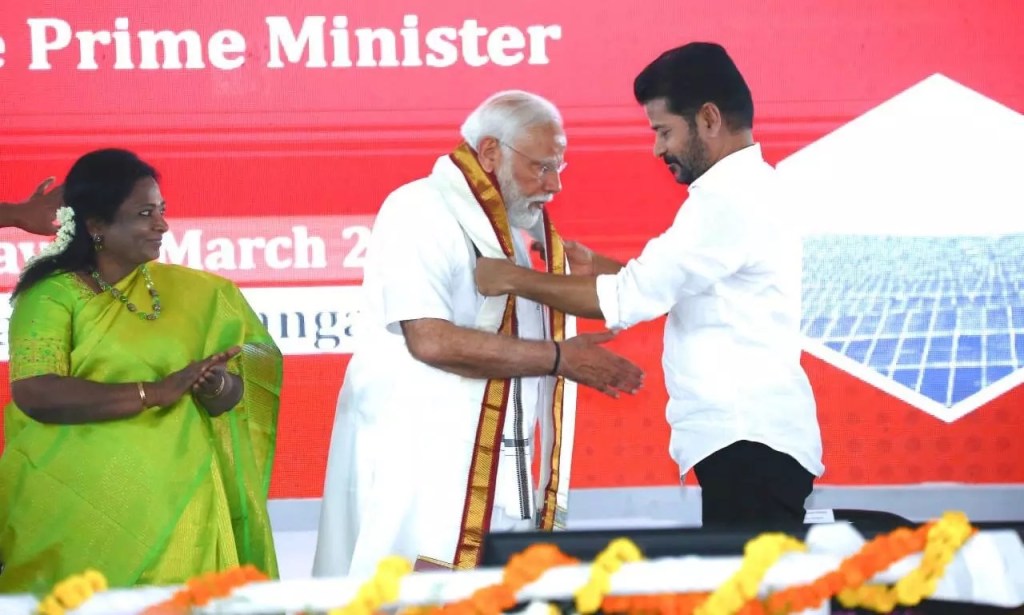
Though there has been no consistency in Revanths ideological proclamations in the recent past, his relationship with N Chandrababu Naidu and Narendra Modi has changed significantly. | File photo At a time when the BJP has managed to break yet another Opposition party-the Trinamool Congress in Bengal-and the Congress’s Meenakshi Natarajan has lost her Rajya Sabha nomination because of a controversial decision, Telangana Chief Minister Anumula Revanth Reddy’s declared admiration for Adolf Hitler has cast fresh doubts on where his loyalties lie.
Revanth’s admission, which came during an interview to N Ram, former editor of The Hindu, shocked many. The Congress chief minister of Telangana was talking about the HYDRAA (Hyderabad Disaster Management and Asset Management Agency), an administrative wing of his government that has sparked many a controversy by demolishing structures belonging to the rich and the poor alike.
The HYDRAA has been ruthless, allegedly not even bothering to serve notices to lower-middle-class Hyderabadis before tearing down their structures. Of course, it has managed to protect government property, such as lakes and other waterbodies, by demolishing unauthorized occupations, but it has also left middle-class Hyderabadis in terror.
Does that ring a bell-of the so-called “bulldozer justice” in BJP-ruled states?
Revanth Reddy’s evolutionary history
However, what made things worse is that Revanth told N Ram during the interview that he named the wing HYDRAA inspired by the German dictator. While the Congress high command did not make any public remark on Revanth’s open declaration of inspiration from a fascist leader, the million-dollar question is why-and how-a Congress chief minister can say that his inspiration came from Hitler.
This brings another incident to mind. Revanth once joked that he was “schooled in Akhil Bharatiya Vidyarthi Parishad (ABVP, the student wing of the RSS), studied in Telugu Desam College (trained by TDP), and is now working in Rahul Gandhi’s University”
Possibly nobody took Revanth’s evolutionary history seriously at that time. But his admission of drawing inspiration from Hitler raises doubts in observers’ minds whether his ABVP schooling left a permanent mark on him. After all, the RSS has historically had a very adoring view of Hitler.
MS Golwalkar, the RSS’s second chief, expressed strong admiration for Hitler and Nazi Germany in his 1939 book, We or Our Nationhood Defined. He praised Hitler’s efforts to maintain the “purity of the nation” through the persecution of Jews, presenting it as a lesson for India regarding its own minorities.
RSS’s understanding of Hitler
Revanth must have recalled his “school-day” lessons on Golwalkar as he was talking to N Ram. But for a chief minister to make such a remark should be worrisome for the Congress. The party made him the PCC chief and later chief minister of the state with the hope he would remain committed to its ideology – particularly that of Rahul Gandhi in the present context.
The Congress, as the oldest ruling party, has a very formulated understanding of Hitler, in the writings of Mahatma Gandhi and Jawaharlal Nehru. Gandhi viewed Hitler as a “monster” and unequivocally condemned his militarism as an “act degrading humanity”. Gandhi wrote two letters to Hitler (in 1939 and 1940), urging the dictator to renounce war and abandon the path of violence.
Nehru viewed Hitler and Nazism as a brutal, fascist threat to global democracy and peace.
He explicitly condemned Hitler’s anti-Semitism, suppression of Left-wing movements, and violent authoritarianism, famously refusing personal invitations to meet the dictator while traveling through Europe in the 1930s.
Nehru recorded his assessments and historical perspectives of the Nazi regime in his famous work, Glimpses of World History, a collection of letters originally written to his daughter Indira from prison.
Is Revanth becoming a challenge to Congress?
Revanth Reddy may or may not be a calculating leader, but he knows who and what Hitler was. Yet, why did he make such a statement? The doubt becomes deeper since he was schooled in RSS politics in youth. That arouses the suspicion: Is he going the Himanta Biswa Sarma and Suvendu Adhikari way and moving away from the Congress way and moving away from the Congress and its ideology?
This question certainly bothers one given the political environment in the country. Though there is no consistency in Revanth’s ideological proclamations, his relationship with N Chandrababu Naidu and Narendra Modi has significantly changed in the recent past. His body language in Modi’s presence is an indicator of that change.
Creating more trouble for the Congress, he inaugurated NT Rama Rao’s statue in Hyderabad and praised him to the sky, sparking anger among the Telangana people, who consider Rama Rao an “anti-Telangana” Kamma leader. During his time as chief minister of the undivided Andhra Pradesh (1983-1989 and 1994-1995), rich migrants from what is today Andhra exploited to the hilt the region that later became the Telangana state. That was the main reason for the second phase of Telangana agitation and the bifurcation of Andhra Pradesh in 2014.
What’s on Revanth’s mind?
In such circumstances, Revanth’s act might help Telangana’s BRS party headed by K Chandrashekhar Rao. And he seems to be doing these particularly to annoy the Congress high command.
Some of these strategic moves by Revanth are taking place in a highly politically disturbed environment. The BJP has broken the Trinamool Congress with a master plan of mustering a two-third majority of the rebel faction in parliament. On the other hand, Meenakshi Natarajan lost her Rajya Sabha nomination with the deceptive passing on of information from the Telangana Congress that she did not disclose a court case against her. Who did this, how, and why?
Only a detailed clarification from Revanth Reddy can calm down the fears.
About the Author
Kancha Ilaiah Shepherd is a political theorist, social activist and author. His latest book is The Clash of Cultures – Hindutva – Mullah Conflicting Ethics.
-
Judgment and Bill, Back-to-Back: The Legal Architecture of Exclusion
Kancha Ilaiah Shepherd
Taken together, the Supreme Court’s Dalit Christian ruling and the Modi government’s FCRA amendment threaten both the rights and the institutional lifeline of one of India’s most marginalised communities.
Representational image: People from the Christian community take part in a Good Friday procession in Amritsar on April 18, 2025. Photo: PTI.
It is no coincidence that the Supreme Court’s judgment on Dalit Christians in India and the introduction of the Foreign Contribution (Regulation) Amendment Bill (FCRA Amendment Bill) in parliament came back-to-back during this Budget Session. The judgment declares that Dalits who convert to Christianity are not eligible to invoke the SC/ST (Prevention of Atrocities) Act, nor are they entitled to reservation in education and employment.
This ruling does not confine itself to Scheduled Caste reservations alone. Its logic is likely to be extended to Dalit converts currently availing reservation under the OBC category.
In states such as Telangana and Andhra Pradesh, converted Dalit Christians have a one percent reservation under the OBC category. That, too, may now be at risk, since the court’s reasoning rests on the claim that conversion to Christianity renders a person casteless.
For a long time, these states have treated Dalit converts to Christianity as a Backward Class within India’s caste framework. The OBC category, even constitutionally, is not caste-free. It requires a caste certificate specifying the individual’s caste; only those castes listed as backward qualify for reservation in education and employment.
Similarly, those applying under the BC “C” category (meant for converted Dalit Christians) must produce a certificate showing that they converted from a Dalit background.
There is a view that this category lies in a grey area, since the court did not directly address the OBC status of Dalit Christians. But if this issue is litigated, the same reasoning – that conversion erases caste – may well be applied, putting this limited reservation in Andhra Pradesh and Telangana in jeopardy.
lso read: Hate Crimes in Odisha: India’s Best Kept Secret
It is arguable that an OBC convert to Christianity is already treated as a general category candidate. Until now, however, the legal system showed some recognition of the historical injustice of untouchability. This judgment marks a departure from that approach, aligning instead with the argument advanced by RSS/BJP legal advocates that Christianity is a foreign religion.
Dr B.R. Ambedkar, in his search for a religion that could offer dignity to the untouchables, considered Christianity before embracing Buddhism. He recognised that Christianity offered freedom, equality and fraternity, and could serve as an engine of progress. Yet he feared that in India it might not fully dismantle caste, and that converts could be viewed as denationalised. In 1956, he embraced Buddhism along with five lakh Dalits, partly in response to this concern – even though, at the time, Dalit Buddhists were not eligible for reservation under the 1950 Presidential Order. That recognition came only in 1990.
Ambedkar had anticipated that Christians might one day be targeted on grounds of nationalism. Under the present RSS/BJP regime, that apprehension appears to be borne out.
Telangana–Andhra model
In Telangana and Andhra Pradesh, the administrative understanding was that conversion removed untouchability but not caste location. In practice, untouchability often persisted even within church spaces, though its form evolved over time.
The model adopted in undivided Andhra Pradesh treated Dalit Christians as part of the OBC framework – a middle-ground approach that acknowledged both religious change and social continuity. That middle ground is now under strain.
The Supreme Court’s judgment departs from this understanding. By treating Christianity as entirely caste-free, it effectively forecloses caste-based claims by Christians, including those rooted in lived social realities.
Why is caste now considered ‘Hindu’?
This understanding does not arise from the constitution, but reflects the position taken by the RSS/BJP-led central government in court. Judges, like others, operate within broader currents of public discourse. When secularism and democracy shaped that discourse, judicial reasoning reflected those values to some degree.
Over the past decade, however, a shift in ideological dominance has altered that landscape. The view that Christianity is a foreign religion – an anxiety Ambedkar himself weighed while choosing Buddhism – has gained ground.
The constitution does not distinguish between “Indian” and “foreign” religions. Yet repeated assertions in media and public debate inevitably shape institutional thinking, including within the judiciary.
Notably, this two-judge bench ruling arrives even as a constitutional bench has, for decades, been seized of the broader question of Dalit Christian rights.
During the Mandal moment of the 1990s, many within the RSS/BJP intellectual ecosystem argued that caste was a product of Islam and Christianity. The judiciary, albeit cautiously, upheld OBC reservations despite the hierarchical order embedded in Hindu texts.
Today, the argument has flipped: caste is now acknowledged as fundamentally Hindu. This is no small shift. As Ambedkar argued, caste-bound Hinduism is structurally resistant to reform. By that logic, this admission may ultimately pose a deeper challenge than earlier denials.
The larger objective
The immediate effect of the judgment is to narrow Dalit Christians’ access to higher education and public employment. The FCRA Amendment Bill, meanwhile, threatens the institutional base – schools, colleges and hospitals – on which many depend.
These institutions, often built with foreign philanthropic support since the colonial period, provide employment to Hindus, Christians, Sikhs including Dalit and Adivasi Christians and non-Christians. While many Dalit Christians remain agrarian labourers, a section has relied on these institutions for mobility.
The Bill envisages a designated authority with powers that could extend to taking control of such institutions and transferring them to the state or private actors. In the absence of large Christian-owned corporate houses, and given the dominance of upper-caste Hindu-owned business groups – many aligned with the ruling ecosystem – there is a real possibility of asset transfer in that direction.
Also read: Rubio Leaves Indian Christians Very Disappointed
Institutions such as the Christian Medical College in Vellore, and colleges like Loyola, St Xavier’s, St Thomas, St Joseph’s and St Stephen’s, have long produced high-quality graduates. Even where their student base has been socially mixed or upper-caste dominant, their management structures have provided employment to Christians. Their takeover would disrupt that ecosystem.
Even historic churches built with foreign charity – such as the Medak Church in Telangana – could come under similar pressure. Across urban India, Christian properties occupy valuable land and sustain livelihoods. Their loss would have far-reaching consequences.
The cumulative effect is a tightening legal and institutional squeeze on Christianity’s social presence.
Do Shudras, Dalits and Adivasis benefit?
A persistent campaign claims that minorities – especially Muslims and Christians – have appropriated resources that should have gone to SC/ST/OBC communities. Amplified by sections of media and intellectuals aligned with the RSS/BJP, this narrative has gained traction.
Yet over more than a decade of rule, there is little evidence that OBCs or SC/STs have proportionately benefited. The primary gains appear to have accrued to upper-caste groups. Many of the most visible proponents of anti-minority arguments come from socially privileged backgrounds.
The idealised vision of a pre-colonial “Sanatan” order obscures the fact that Shudras, Dalits and Adivasis were historically denied education and confined to labour within rigid hierarchies.
Taken together, the Supreme Court judgment and the FCRA Bill signal a troubling direction. After Christians, similar legal strategies could be deployed against other marginalised groups, placing even existing reservation frameworks at risk.
Kancha Ilaiah Shepherd is a political theorist, social activist and author. His latest book is The Shudra Rebellion.
https://thewire.in/caste/judgment-and-bill-back-to-back-the-legal-architecture-of-exclusion
-
Joseph Vijay and His New Tamil Nationalism
Kancha Ilaiah Shepherd | 16 May 2026
TVK’s Ambedkar, Periyar, Kamaraj social justice combination, along with two women icons, constructs a new nationalist vision that is totally opposite to RSS-BJP’s nationalist vision sans women.
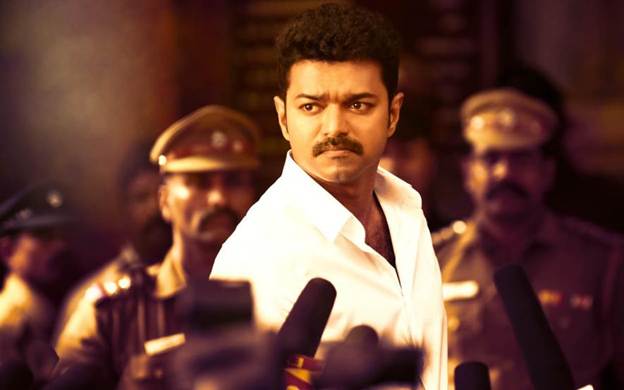
In the thick of the RSS-BJP (Rashtriya Swayamsevak Sangh, Bharatiya Janata Party) North Indian normalisation of Hindu Rashtra from Gujarat to West Bengal, a challenge emerged from the South—Tamil Nadu. Joseph Vijay’s victory definitely has a new message to the whole nation and the RSS-BJP forces in particular.
Joseph, the very name is unacceptable to the RSS ideology from its birth. But Joseph Vijay quite proudly took oath as Ninth Chief Minister of Tamil Nadu, without any hesitation by using his first name that has an established Biblical history. Joseph was Mary’s husband and foster father of Jesus Christ, who saved his life in his childhood and taught him how to read Torah and trained him to be a carpenter.
Joseph Vijay came to power in Tamil Nadu at a time when Christianity as a religion is on trial with several anti-conversion laws in different states ruled by the RSS-BJP, the amendment Bill on the Foreign Currency Regulation Act or FCRA is on the table of the BJP government to declare Christians almost as anti-nationals. They are presumed to survive with foreign money, buy souls into the fold of Jesus and build properties that deserve to be taken over through “Hindutva legal” means. I am using the phrase “Hindutva Legal” means consciously, because many laws that the BJP government passes bypass the constitutional moral framework. They are meant to suit their Hindutva ideological agendas. The anti-conversion laws and FCRA amendment Bill are part of that “Hindutva legal” means.
For Joseph’s ideological campaign, he used five figures which cannot be accepted by the RSS-BJP forces. In the Tamil context, Periyar Ramasamy Naikar, B.R Ambedkar, Kamaraj Nadar, Queen Velu Nachiyar and Anjali Ammal, have a different nationalist ideological message. While three great male icons—Ambedkar, Periyar and Kamaraj — are well known, the women icons add a new metaphor to his ideology of gender justice.
Queen Velu Nachiyar, an 18th-century queen of Sivaganga, was one of the first Indian monarchs to wage war against the British. And Anjalai Ammal, a freedom fighter from Cuddalore, is known for her active role in the Indian Independence movement, often called the “Jhansi Rani of South India”.
Joseph Vijay’s party, the Tamilaga Vettri Kazhagam (TVK), used these two women icons as its female representatives during the election campaign. This female nationalist symbolism played its role among women voters of Tamil Nadu.
WHAT THIS COMBINATION MEANS?
The Ambedkar, Periyar and Kamaraj Combination constructs a new nationalist vision that is totally opposite to the RSS’s nationalist vision of Savarkar, Hedgewar and Golwalkar. They do not recognise any woman nationalist icon because in their vision women are not even part of the sky, in a world where women are considered to be the half of the sky.
The new combination of Ambedkar, Periyar and Kamaraj, who have three different backgrounds with a common thread of inbuilt ideology and practice of social justice is certainly creative. While Ambedkar and Periyar are extensively discussed thinkers, with a lot of literature thought discourse about their life, writings and organisational activities Kamaraj is not so much in the national memory. Even the Congress did not promote him much.
Kamaraj was a Congress leader, known as king maker, with competitive energy that could challenge Chakravarthy Rajagopalachari, who led the Brahmin lobby of India. Popularly known as Rajaji, he wrote commentaries on Ramayana and Mahabharata, became a close follower of Mahatma Gandhi and finally his daughter was married to Gandhi’s son.
Though Rajaji and Kamaraj were rivals, they remained within the Congress party all their lives. Both of them ruled as state Chief Ministers. However, Kamaraj was the first OBC (other Backward Classes) leader who laid the foundation for a welfare state, particularly by beginning pro-poor education policies. He was the one who introduced the mid-day meal system for poor school children in India. He was kept outside the Dravidian pages of history, though he himself was one of the most respected lowest of the low caste political icons.
Joseph Vijay gave him the place that Kamaraj deserves. Interestingly most Nadars, who were once untouchables, are Christians in Tamil Nadu and Joseph must have found a loving place among them.
THE NEW MESSAGE
This combination of these five outstanding social justice icons of India sends a new message to the RSS-BJP nationalist ideology that works around the single point agenda of opposing Muslims and Christians of India.
Ambedkar as anti-caste philosopher and the father of Indian Constitution, with a comprehensive philosophical vision of India, is a challenge to the RSS-BJP ideology, though they pretend to own him.
Periyar is not just a thorn in their ideological bed but a thinker, social reformer and nationalist, who is gaining more acceptability even in North India after the RSS-BJP political forces captured Delhi in 2014.
They could attack Jawaharlal Nehru in Parliament and outside but they cannot attack Periyar even in their electoral campaign, though he was a strong atheist, because his moral and ethical stature is high enough for the Hindutva forces to be cautious.
Periyar’s image among the entire Dravidian society, and more particularly among women, is un-matched. Tamil nationalism is deeply embedded in his long ideological Dravida Kazhagam movement and all political parties, including BJP, could not openly attack him in Tamil Nadu.
Joseph Vijay owning him, having come from a Dalit-Christian family, background sends a different message while including him in his team of icons with a caveat (unlike Periyar, he believes in God.) That is a clever message.
JOSEPH AND DALITS
The Dalits of Tamil Nadu were very unhappy with the long rule of the DMK and AIADMK because the Dalit population is about 20% and were neglected. This is the estimate of the 2011 Census. It could be a bit more now. Such a vast population, with a well-educated middle class, was neglected by DMK and AIADMK all these years.
Thol Tirumavalavan’s Viduthalai Chiruthaigal Katchi or VCK has been working among Dalits quite for some time, but it could not galvanise non-Dalit voters into its fold across the state, therefore it remained a small success in very few regions. Joseph Vijay has crossed that barrier and galvanised masses who voted him voluntarily.
Vijay could convince the Dalits by adopting Ambedkar as his icon and setting up a welfare agenda that gives hope to them. His semi-Dalit blood lineage must have also helped him.
Periyar’s symbolism must have convinced the Dravidian ideological constituency that Joseph Vijay will carve out a new political niche. In any case, the victory of Joseph, with that Christian name at a time when Christians across India are facing persecution, financial difficulties with new strategies like the FCRA Bill by the RSS-BJP government in Delhi to starve them of any foreign assistance to run their medical, educational and orphanage institutions are getting squeezed, is a relief for them too.
Christian service outside their religious fold, cutting across caste, creed, seems to have worked in favour of young Joseph, apart from his film stardom. Let us wait and see how his administration works.
The writer is a political theorist, social activist and author. His latest book is ‘The Shudra Rebellion’. The views are personal.
https://www.newsclick.in/joseph-vijay-and-his-new-tamil-nationalism
-
Does English-Medium Education Hold Key to Power & Wealth?
Kancha Ilaiah Shepherd | 06 May 2026
The Telangana Socio, Economic Education, Employment, Political and Caste survey shows the role of English-medium education in upper caste power and wealth control.
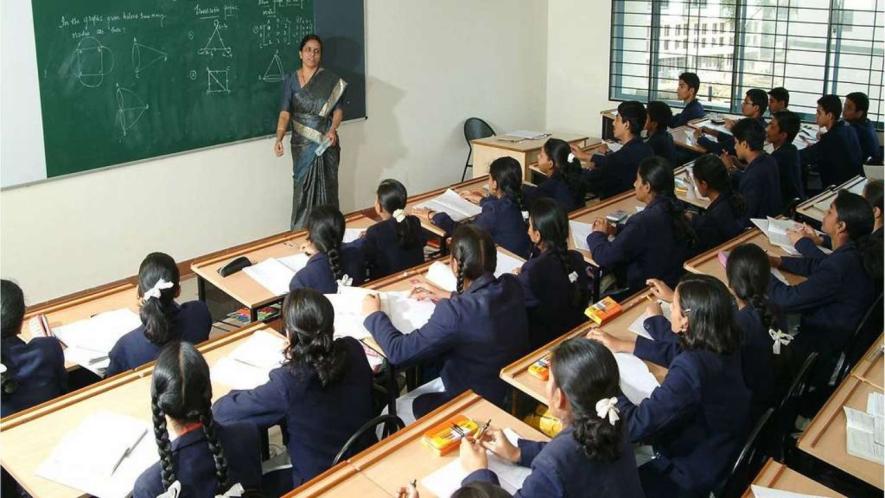
Representational image. Image Courtesy: PICRYL
The Telangana Socio, Economic Education, Employment, Political and Caste (SEEEPC) survey report has shown the real picture of the role of English-medium education and upper caste power and wealth control.
The Independent Working Expert Group studied the role of English medium across the spectrum of 56 castes. The left-hand column of the chart below shows that Brahmins, Komatis (Vysyas) Kammas, Velamas, Rajus, Reddys (all General Castes) are in the top layer of English-medium educated people of the state. The only BC community that ranked next to these six castes are BC-C, SC Christians. They all are above 75% English-medium educated and mostly in the private sector school education.
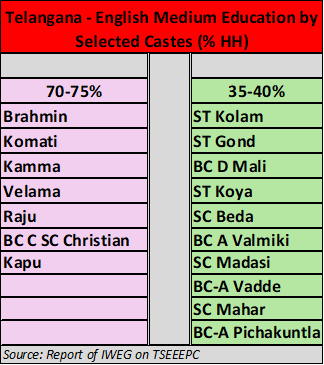
One common character of these seven highly English-medium educated caste groups is that they are small in number and highly urbanised.
LEAST ENGLISH EDUCATION
The least English-medium educated is shown on the right-hand column in the chart. The top 10 castes that never seem to have got into English-medium education are ST Kolam, ST Gond, BC-D Mali, ST Koya, SC Beda, BC-A Valmiki, SC Madasi, BC-A Vadde, SC Mahar, and BC-A Pichakuntla. All other castes have only marginal English-medium education. Their urban migration levels are very much linked to English-medium education of the youth from those castes.
In all other 42 parameters that the IWEG has computed to rank the Comprehensive Backwardness Index (CBI) of the six highly English educated social groups shows that they are in a very good socio-economic position in many other parameters. For example, 0.9% Brahmins of Telangana own 16.4% cars that run on the state roads. In owning three-bedroom houses, refrigerators, less loan from money lending market, employment in government and private sector, the data shows that they are on the top.
Of course, Dalit Christians do not match the Hindu top five upper castes in several other parameters. But they do well in overall living standards when compared to Hindu Dalits and also many other OBC (Other Backward Classes) castes that live in the agrarian economy.
One of the major differences between the Dalit Christians and Hindu English-educated upper castes is that the Hindu upper caste do not take up jobs like nursing, small paramedical operations, safai karamchari (sanitation) work and so on. But Dalit Christian women and men take up any work that pays without bothering about indignity and low social respect consideration. Because they are converts to Christianity from most labouring Dalit castes like Madiga, Mala, Relli, Dekkali and so on, they do not carry the cultural baggage of indignity of labour. Any wage-earning job for them is good enough. Perhaps the church also remains a constant educator to them about the value of work and dignified life.
Many OBC castes that suffer poverty and unemployment would not like to take up nursing jobs in government or private hospitals. We find the other five well-educated English castes prefer to be doctors, engineers, civil servants, teachers and politicians.
In the Hyderabad software and hardware industry, the five English educated castes work as CEOs, other high officials and, in fact, they own many industrial units. But at the same time, though they own a substantial amount of land as family units, their family members are not in the labouring tasks. For example, in MGNREGA (rural job guarantee scheme) work among these five castes is almost non-existent.
Most start-up companies are started by these sections, as they have bureaucratic connections in the government, both Central and state. They also manage bank loans very easily because of their caste and class connections with bank managers. In all these dealings, English language plays a key role. The overall CBI score of these five highly English educated upper castes is Brahmin (22), Velama (19), Komati (25), Kamma (19) Raju (17) Reddy (28) BC-C Christians (23). This CBI score must be seen alongside the last most backward caste CBI score of SC Dakkala at 116.
GOVERNMENT ENGLISH MEDIUM SCHOOLS
Even though the Telangana government has adopted English as a medium of teaching in government school education without undermining Telugu language teaching from class one, the private school system, mostly in the hands of the same highly English educated upper castes, is trying to pressure the state government to push for Telugu medium in government schools. If the Telangana government yields to their pressure, it will be a major setback. Private schools have seen a sharp drop in student intake, particularly in small towns, where they were drawing mostly middle farmer and artisan OBC caste English education aspirants from neighbouring villages.
There is also a concerted campaign by some intellectuals from the very same castes that English-medium education in government schools would not help in acquiring cognitive skills, as teaching in the mother tongue (Telugu in this caste) helps.
The same message comes from the Delhi rulers, such as Home Minister Amit Shah, packaged as nationalism. English-medium education is being projected as colonial but the upper castes get to retain their hegemony over the system through the same English medium education. They know that the SC/ST/OBCs living in rural areas cannot get it.
In the English-medium education chart, we can see just above these seven castes, the OC Kapus and Jains are more English educated. Jains run several English-medium schools. Most of the Jains live in Hyderabad and are very recent migrants.
What the Telangana SEEEPC survey lays bare is that English-medium education is the silk route to prosperity and human quality. The only way to provide every child in the country the opportunity to compete on an equal basis in life is to provide the same medium of education—English- in government schools.
The writer is a political theorist, social activist and author. His latest book is ‘The Shudra Rebellion’. The views are personal.
https://www.newsclick.in/does-english-medium-education-hold-key-power-wealth



You must be logged in to post a comment.