-
What BJP cannot do in the Telugu states: Kancha Ilaiah Shepherd writes

Courtesy: PTIhttps://babadd5a786dfbb2dc6c8c03527685e8.safeframe.googlesyndication.com/safeframe/1-0-38/html/container.html?n=0
In both the Telugu states, the Bharatiya Janata Party is trying to expand its base among the Backward Classes. It is trying to admit and promote anyone who comes out of the ruling regional parties and trying to give an impression that they want to bring the backward leaders to power. This has been their aspiration in the united Andhra Pradesh and in the divided two states. The recent trapping of Eatela Rajender and admitting him into the Hindutva party is part of that strategy.https://babadd5a786dfbb2dc6c8c03527685e8.safeframe.googlesyndication.com/safeframe/1-0-38/html/container.html?n=0
The BJP adopted this strategy in West Bengal where a regional Trinamool Party headed by Mamata Banerjee, a Brahmin woman leader, is in power. It first promoted Dilip Ghosh, a Sadgop backward leader, as the party president. Sadgops are historically shepherds and cattle herders in Bengal who were treated as disrespectable people by Brahmins, Kayasthas and Vaidhyas. These three castes also are known as Bhadralok with common cultural status. These three castes are highly English educated by starving the Shudras and Namashudras (Dalits) of that language. They did not even implement reservation in that state keeping the productive castes completely marginalised. This was the worst casteist legacy that the left Bhadralok leaders handed over to the masses.
Ever since independence in 1947, only Brahmins and Kayasthas have ruled that state. Modi and Amit Shah thought that the BJP can come to power only with Shudra and Dalit votes as they do not get Muslim and English educated Bhadralok votes in that state. In the 2021 elections, the BJP purely organised on caste lines and became an opposition party.https://babadd5a786dfbb2dc6c8c03527685e8.safeframe.googlesyndication.com/safeframe/1-0-38/html/container.html?n=0
In north India — particularly in Uttar Pradesh and Haryana where the backward class leaders were in power — they brought in leaders like Adityanath, a Ksatriya; Monohar Khattar, a Khatri; to power. They are trying to work caste-based calculations more carefully than the Congress at the national level and at the regional level.
But in the south, there is a different situation. The Brahmin, English-educated leaders went out of power a long time back. Mostly Shudra regional leaders are in power as they weakened the Congress step by step. The implementation of reservations in the south Indian state universities and government services are done according to the rule book. Tamil Nadu took the lead in the reservation ideology and implementation process.https://cdm.connatix.com/amp-embed/index.html?playerId=d8bdd770-c07c-42b5-9793-4354b40292db&url=https%3A%2F%2Fwww.thenewsminute.com%2Farticle%2Fwhat-bjp-cannot-do-telugu-states-kancha-ilaiah-shepherd-writes-151008%3Famp%23webview%3D1%26cap%3Dswipe
Even in the north Indian states like Gujarat and Madhya Pradesh, where the BJP was in power for a long time, the pro-poor welfare schemes were minimal. In these states, the education system is very backward and English medium education is weakest. They are in fact opposed to English medium education as part of their ‘Hindu, Hindi and Hindustan’ ideology. They only allow private sector English medium schools and colleges if they are run by monopoly companies that support them financially.
In Telangana and Andhra Pradesh, even if the BJP makes BC leaders Chief Ministers, the problem is that their welfare agenda is not in the hands of the state units of that party. The welfare economy of Andhra Pradesh, Telangana, Tamil Nadu and Kerala is several fold higher than any BJP-ruled state in the country. Take for example the old age pension. In AP and Telangana, people get Rs 2000 per month for those who are above 60 years. This scheme is not there in BJP-ruled states. No BJP-ruled state has residential schools for SCs, STs and OBCs. The SC/ST/BC budget is not comparable to any south Indian state where the regional parties are in power versus the north Indian states where the BJP is in power.
The main drive in the BJP-ruled states is not economic and educational development but religious issues. Even the Chief Ministers are given direction by the RSS on how the government should focus around religion and temples by constantly opposing Muslims and other minorities. Madhya Pradesh, Uttar Pradesh and Gujarat are good examples where the backward classes are sent on pilgrimages with government expenditure and constantly made to live in superstition without allowing them to improve their educational standards.
In AP as of now, the biggest welfare agenda is around education. In Telangana, it is the Rythu Bandhu. There is no doubt that the Rythu Bandhu programme is putting more money in the accounts of those who own more than 10 acres, which is not a good thing. That money should have been shifted into school and college education and employment. If the BJP comes to power with a BC leader as the Chief Minister, for such leader, spending on quality education and farmer welfare will not be possible because the BJP is not a region centred party. It is a national party that will not accept anything but a religious agenda. No Chief Minister can go out of that agenda.
The first Chief Minister while working from a national party like Congress to raise the bar of welfare in the state was YS Rajasekhara Reddy. But for that, he needed a big status of a mass leader to get votes on his own and put the central agenda in check. He did that. No BJP Chief Minister, including Modi, evolved such welfare schemes independent of his national party agenda. He was more robust in implementing their anti-Muslim agenda, but not SC/ST/OBC welfare agenda.
In Telangana, the Congress state unit failed in evolving a better welfare agenda than the TRS, which itself does not have a very good welfare agenda. The Congress state units also heavily depend on their national agenda, which does not allow very effective welfare schemes. The BJP is a more rigid national party than the Congress, which hardly has democratic vision. The BJP did not accept Modi’s sabka saath, sabka vikas agenda in his second term hence it has drawn him into very anti-Muslim issues like Kashmir, CAA and Delhi riots.
The most effective welfare agenda that BJP cannot think of accepting is AP’s English medium from KG to higher education, and the financial backup for the family of students. Once the SC/ST/BC masses realise that the effectiveness of English medium education with a strong financial back up like Amma Vodi and fee reimbursement, they will not get into the BJP fold. In Telangana also, either the ruling party or an alternative regional party could implement similar English medium school, college education, and strong fee reimbursement and parental financial assistance programmes. People do not vote for the BJP because it promises to make a BC leader the Chief Minister.
Since the regional parties can decide for themselves how to spend their budget, the only course left to the regional parties is to go for a stronger dose of welfare and education as against the bulldozing methods of the BJP from Delhi.
Kancha Ilaiah Shepherd is a political theorist, social activist and author of Why I am Not a Hindu — A Sudra critique of Hindutva Philosophy, culture and political economy. Views expressed are the author’s own.
-
As India struggles with Covid-19, can the RSS escape responsibility for the crisis?
The ruling party’s parent organisation failed to gauge the enormity of the medical crisis and to direct the BJP to act appropriately.

RSS head Mohan Bhagwat. | Twitter/@Rssorg 
Is Prime Minister Narendra Modi primarily responsible for India’s current Covid-19 tragedy? On May 15, Rashtriya Swayamsevak Sangh chief Mohan Bhagwat declared that the government, the administration and India’s people had become complacent after the first wave of Covid-19 ebbed. The the Opposition and the media were quick to note that the head of the Bharatiya Janata Party’s parent organisation had included Modi in its list of those responsible for the tsunami of deaths.
But what about the responsibility of the RSS itself? After all, the RSS, despite maintaining that it is non-political, does everything in its power to ensure that the Bharatiya Janata Party comes to power – and stays there.
Bhagwat has previously claimed that the organisation that he commands could be readied to fight India’s enemies at the borders at only a few day’s notice. How did this powerful organisation fail to gauge the enormity of the medical crisis correctly and direct the BJP and its prime minister to deal with it appropriately?
Moving forward
As is well known, Modi spent decades as a full-time RSS worker. After the 2002 Gujarat riots that occurred when Modi was the state’s chief minister, the RSS and Modi seized the moment to strengthen the narrative of Hindu victimhood and move forward to New Delhi. They shared an ideology of “I use you and you use me.”
Modi and Mohan Bhagwat know this well. They used each other even as their common enemy – Muslims – remained constant. Neither had an agenda to develop India on all fronts, ensuring faith in democracy and human equality. They have never believed in the core principle of democracy – liberty, equality and fraternity.
It is clear that Mohan Bhagwat is the most powerful RSS sarsanchalak since the organisation was created in 1925. No other head of the Sangh has had such an influence on the Indian state and civil society – particularly the Hindu civil society – as Bhagwat does.
This is because before Modi won the elections 2014, the RSS-BJP had never been in control of Delhi and so many states. Even Vajpyee’s tenure from 1999 to 2004 was limited by a coalition in Delhi, with only a few states in BJP control. As a consequence, KS Sudarshan, the RSS head for nine years from 2000, was less influential than Mohan Bhagwat is today.Narendra Modi in RSS uniform.
In March 2020, when the pandemic first came to attention, the RSS-BJP pushed the theory that members of the Tablighi Jammaat Muslim group were responsible for spreading the virus because they had gathered for a religious conference – even though it had started before lockdown was announced.
As it turns out, the RSS is even more responsible for spreading the coronavirus this year. Isn’t the RSS responsible for the Kumbh Mela that the Uttaranchal and Uttar Pradesh governments organised? Who should be held responsible for the spread of the virus from the Kumbh to villages around the country and mass deaths around the sacred river Ganga?
At the same time, when elections were taking place in five states, the RSS was involved in mobilising vast numbers of people for public meetings for Modi and other leaders. Didn’t the virus travel along with RSS activists from house to house, village to village, city to city?
There was news during the election campaign that Bhagwat had contracted the coronavirus disease and had to be hospitalised. Even then, he did not openly suggest that the elections should be postponed. He clearly did not get cured by the cow urine and dung therapies that some Hindutva supporters are pushing. Despite this, he has not come out to criticise this pseudo-science.
Caste drives power
Mohan Bhagwat and Modi have grown in the same organisation. Until Modi became prime minister, he had no control over the all-India networks of the RSS and its vast network of organisations. Given the caste cultural control in the Sangh, Bhagwat was a very powerful man in the RSS when Modi – a member of the Other Backward Classes – was nothing. Before 2002, Modi took his orders from Mohan Bhagwat in the RSS and another Maharashrian Brahmin, Promod Mahajan, in the BJP. Caste has always driven power in the RSS-BJP structures.
The only thing that worked in Modi’s favour was his Gujarati background which gave him strong links to business networks. Once he became Gujarat’s chief minister, a position he seemed to win almost accidentally, he used his networks well to propel him further. It is certainly unthinkable that Mohan Bhagwat accepts Modi as a leader of greater stature even now. After all, Kautilya never accepted that Chandragupta Maurya was superior to him.
How can India believe that Mohan Bhagwat and the organisation that he heads has no role in bringing the nation to its present crisis? They must own up to their role in this devastation. Escapism is not nationalism.
Kancha Ilaiah Shepherd is a political theorist, social activist and author. His latest book is The Shudras – Vision For a New Path, co-edited with Karthik Raja Karuppusamy.
-
A team that never was a hope provider for the poor
Mohan Bhagwat, Jaggi Vasudev and Sri Sri Ravi Shankar to “create hope” amidst Coronavirus pandemic
Kancha Ilaiah Shepherd18 May 2021
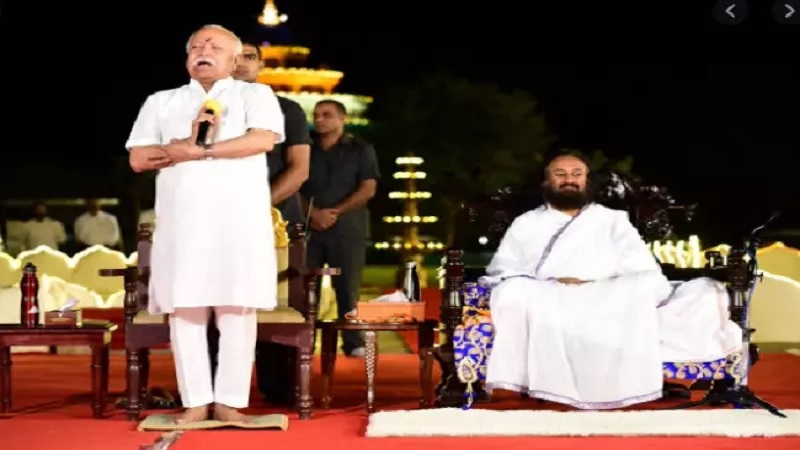
Image Courtesy:newsroompost.com
Just a few days ago, I saw an interesting news item on my mobile phone. The Rashtriya Swayamsevak Sangh’s (RSS) top leader Mohan Bhagawat and his friends: Jaggi Vasudev, and Sri Sri Ravi Shankar, will address the nation to create hope in times of Corona dance of death. One does not know what networks they will use to do that? According to the news item, they will create an opinion of ‘positivity’ in an atmosphere of ‘negativity’. Obviously, the negativity refers to opposition to the RSS/BJP central Government all over the world and India.
The news of these three great saintly men creating hope is being propagated by the RSS cadres. I wish they would have included all the Shankaracharyas of different pittas in the country. Of course, another Yogi–Adithyanath, who also heads a pitta, apart from the Uttar Pradesh Government where mass cremations are happening like a Kumbh, should have been part of the team.
The Prime Minister himself, who now looks like a saint not a ruler, will anyway address the nation from time to time.
However, the declared team consists of a Saraswat Brahmin from Maharashtra, a Tamil Brahmin who mostly lives abroad and educated in English medium at St. Joseph college of Bengaluru. The third is a Dwija educated at Mysore university-that too in English literature with a chequered life and final guruhood of international institutional base. The Indian diaspora and native upper middle-class swings and waves as they speak but the vast masses of food producers do not know what their guruship is. It is this productive nation that needs hope. For the whole nation should get hope from the central Government not from saints and sanyasis.
The RSS wants to use Ravi Shankar and Vasudev to add Hindu international networking. But the question is why this team did not find a Hindu Guru born in Shudra farmer family and a Dalit family. Is it because they are less Hindu, as they belong to the fourth varna and also no varna (Dalits are known as avarnas)? In the teaching of these three socio-spiritual leaders is there a single sentence that: ‘All Hindus Are Created Equal by Hindu God’. Is there a caste-free God they visualised for protection of all Hindus, leave alone Muslims, Christians and Sikhs of India?
Even assuming that they do not want to save the atheists and seculars, worldwide who were said to have worked for the advanced medical science, how many rural hospitals these gurus established in our poverty-stricken rural India? Ravi Shankar has a network in Geneva where there is a lot of oxygen to breathe in open air as well as in hospitals. But none in the Dandakaranya tribal belt where malnutrition is making their breathing more difficult than in any other part of the world. Why not that be his international base?
Jaggi Vasudev has networks across the United States including the wealthiest California state, but none in the Koraput tribal belt of Orissa. They learnt English in a manner that every English-speaking Asian, American, European, Australian would understand. But they never learnt a single tribal language of India. Their divinity flows in sweet English to promote ‘Hindu, Hindi, Hindustani’ and the RSS loves this nationalism.
Whom are they teaching their methods of pranayama (Isha foundation specialization)? Ravi Shankar is supposed to be an expert on rhythmic breathing. India is now dying without pranavayu, and no breathing–leave alone rhythmic. What scientific advancement they achieved and handed over to the nation? How many good hospitals that RSS and these foundations established to save the poor from lack of pranavayu in the villages and tribal areas?
Even before this deadly disease attacked Indian people in villages and urban slums were dying for want of enough oxygen in the atmosphere. What did they do? Why do they go to teach the Americans and Europeans who have everything–enough pranavayu, prana padarthas to eat along with plenty of cars and planes to travel? Why Hindu God is sending these gurus there not to tribal areas or even to African countries where there is nothing to eat and hardly any energy to breathe? They go to the US and Europe to acquire dollars, Euros and Pounds. How is that nationalism loved by the RSS?
In 1900, Ida Scudder reached the Vellore region to give life to lifeless and started a medical centre, which later became a trend setting hospital. What kind of guruship she initiated and what kind of guruship these Indian Dwijas established? The RSS leaders attack the Christian missionaries on an everyday basis. Did they establish a single hospital in the country that could match the Christian Medical College Hospital in their long life of 95 years? Did they ever look at what that hospital has done to the nation in subsequent years? That was the first hospital that started open heart surgeries in the 1960s itself, when no other hospital in India knew that science. Did any Hindu Pitta, or Foundation or organisation including the RSS did such constructive humanitarian work? Why accuse such Christians as anti-national?
The RSS and the gurus like Jaggi Vasudev, Ravi Shankar, who work around them as great Hindu nationalists must know the caste culture is causing more harm than corona to the spiritual will of the nation. Why are they so silent about it? In Uttar Pradesh where a Yogi rules, dead bodies are being discriminated against. Which culture is responsible for that? Where is a call from these gurus to not to do that?
Most organised religions in the world with strong notion monolith of faith are Hinduism and Islam, though they differ in caste cultural practices. In Hinduism these saints are in control and in Islam the Mullahs are in control. Why could vaccine science not develop in countries of those nations where they play a dominant role? Why does the secular world produce more vaccines and life-saving drugs? Why India of these pranavayu giving gurus begging for oxygen from secular nations? Why did the ‘Art of Living Foundation’, which is said to be a great teacher of breathing exercise, establish a vaccine producing industry and also an oxygen production centre? Do these gugus want to tell us those who breathed according to their methods are not attacked by Corona? We assume that Mohan Bhagwat follows them with a discipline of RSS but was attacked by Corona and treated in a modern medical system developed in Europe and America, not in the Art of Living breathing.
What kind of nationalism in Ravi Shankar and Vasudev the RSS found who established the Art of Living and art of pranayama in America and Europe but not in Indian Tribal Areas? Should Hindu nationalism be taught from California and Geneva to the farmers who are producing food for all Indian to survive and the safai sainiks who are cleaning the roads in the times of this deadly disease?
The RSS leaders must know that the nation is watching them when they are in the driving seat of the national power. There is enough intellectual base among the productive masses that can see through these English-speaking gurus, what they speak and do in their typical saintly attire here, and what they speak and do in America and Europe? The farmers, workers, shepherds, artisans and so on are already on ‘hope production’ jobs. They do not have to listen to these gurus to protect themselves from Corona. They are on the job of killing coronavirus in the fields by producing protein and raw material for medicines.
*Views expressed are the author’s own.
(Kancha Ilaiah Shepherd is a political theorist and social activist. His latest book is The Shudras–Vision for a New Parth co-edited with Karthik Raja Karuppusamy)
Other articles by Kancha Ilaiah Shepherd:
Disease distancing, not social distancing during Covid-19
Babu and Bhasha: The Game may end with this
Remembering Usaa: The greatest revolutionary barber after Upali
https://sabrangindia.in/article/team-never-was-hope-provider-poor
-
Why it’s Stalin and Pinarayi’s ideology and not Mamata’s that India needs
For the BJP/RSS, Tamil Nadu and Kerala were more ideological battlegrounds than West Bengal, as Bengal politics was operating very much within the Dwija control.

VOICES OPINION FRIDAY, MAY 14, 2021 – 15:03Kancha Ilaiah Shepherd
Stalin was a Russian ruler who did not believe in god. He shaped the post World War II world. He died on March 5, 1953. Karunanidhi, the famous Dravidian leader, while mourning his death in a meeting declared that his just born son (born on March 1, 1953) would be named Stalin. In 1953, Karunanidhi was with the DMK . He was an atheist like his mentors Anna and Periyar.
That son of Karunanidhi’s told the nation recently that Tamil Nadu is a Dravidian land that would not allow the BJP/RSS to take it back to the varna-caste system — which has been hugely weakened by the Dravidian party’s victory in the 2021 state Assembly elections. He defeated the AIADMK and BJP combine, and became the Chief Minister of the state at 68. Stalin’s ancestors were barber-musicians around temples, and his father became a famous writer, politician and five-time CM of Tamil Nadu.
In the south, the RSS is known as an Aryan organisation with a vision of putting the varna order into the proper Vedic form again in the country. If there is any movement that disturbed that order by giving marching orders to Aryan Brahmanism, it was the DK movement. The DMK is its political successor. Annadurai, Karunanidhi and now Stalin are its flag bearers. MGR and Jayalalithaa were actually trojan horses, and perhaps Jayalalithaa would be the last Brahmin to rule the state.
The BJP/RSS entered that state through the backdoor by using Jayalalithaa’s silent support to Hindutva expansion. Jayalalithaa played a double edged role in the state — Dravidian in form, but Brahmin in content.
The BJP/RSS could not threaten Stalin as much as they did Mamata Benerjee in West Bengal, who also started running around temples and claiming that she was Bengali Brahmin beti. Granted, the atheist Stalin too had to pick up the Vel in his hand to counter accusations of being anti-Hindu. But the two are not comparable because one inherits a Dravidian cultural history and the other inherits the Brahminic history.
The BJP/RSS, by using Shudra-Namashudra (Dalit) mobilisation, made the Bengali Bhadralok (Brahmin, Kayastha and Baidhyas) give up their secular-communist claims. The CPI(M) closed ranks in Bengal as it refused to see the existence of casteism among the Bhadralok. The BJP/RSS used the Shudra/OBC and Dalit aspiration to come to power in a state of Bhadralok unending hegemony and control after 1947. No Shudra or Namashudra or Muslim (Muslims constitute 27% of the state’s population) could become the Chief Minister of that state. The Kerala communist movement however went in the opposite direction — and hence, it survived. The productive Shudra (they call avarna) and Dalits captured the communist movement after EMS Namboodripad’s era ended.
The BJP/RSS could not play their tricks in Kerala, the land of Narayana Guru and Ayyankali. Pinarayi Vijayan, who came from Guru’s Ezhava community and became the commander of communist party, showed the door to Modi and Shah. He became the first communist leader to come to power for a second consecutive time.
Both Tamil Nadu and Kerala have made south India proud by telling the BJP/RSS that the south has a strong Dravidian-Shudra heritage. West Bengal on the other hand operated in the domain of Aryan Hindu casteist cultural heritage, without allowing the Shudra-Namasudra identities to come to the fore. In fact, the Bengali renaissance of Raja Rammohun Roy and Bankim Chandra Chatterjee, operated on the same Aryan Brahmin control pad. Whereas the southern renaissance initiated by Mahatma Phule (1827-1890), Iyothidasa (1845-1912), Narayana Guru (1856-1928) and carried forward by Periyar, brought about an anti- caste cultural revolution. Abolition of caste or weakening caste never were agendas of Maharastrian and Bengali Brahmanism. Whereas the Dravidian social justice ideology influenced the anti-caste and human equality movements across the country
Stalin and Pinarayi Vijayan represent that ethos. If the Kerala communists do not realise that, they too will go the way Bengal communists went, in future. It was the anti-caste movements that saved the communist ideology in Kerala.
Tamil Nadu has shown a post-colonial path for Shudra/OBC reservation as Ambedkar’s Mahar movement has shown a path for Dalit reservation in colonial times. Stalin has to carry that struggle forward.
Kerala has shown socialist democratic welfarism with an anti-caste implementation of those welfare policies. Such egalitarian welfarism proved to be a better model than Modi’s Gujarat model in every respect. Its Muslim and Christian minorities felt safe in Pinarayi’s hands than in Congress’s hands.
The Congress’s stand on Sabarimala women’s equality proved to be disastrous. Shashi Tharoor’s unending claim that he is a better Hindu than Mohan Bhagwat and Modi by writing book after book on ‘why he is a Hindu’ proved to be untrustworthy. He was trying to hide his Shudra (Nair) background and behaving like a Namboodiri himself. Such Congressism was disliked by all OBCs/Dalits and women of Kerala. After a massive anti-women’s equality mobilisation of the Congress and BJP in Kerala, Vijayan’s winning is a game changer.
In Tamil Nadu the BJP/RSS played many tricks. They wanted a coalition of AIADMK and BJP to come to power and break the back of Dravidian political history. But Stalin has shown them the door. For the BJP/RSS, Tamil Nadu and Kerala were more ideological battlegrounds than West Bengal, as Bengal politics was operating very much within the Dwija control. Mohan Bhagwat did not hate Mamata as much as he hated Stalin and Pinarayi.
The next three years will be significant for India. With BJP/RSS’s failure to stop the dance of death of corona with an army of superstition, that it built over 95 years by foregrounding myth and negating science, what will India do? There is an increased opposition to the BJP/RSS even in the northern states. If the south escapes with lesser deaths in the corona crisis, the whole north will also tilt towards science and medicine by moving away from myth. That depends on what kind of administration Stalin and Pinarayi provide in future.
(Kancha Ilaiah Shepherd is a political theorist, social activist. His latest book is ‘The Shudras — Vision For a New Path’, co-edited with Karthik Raja Karuppusamy.)
-
The Hindutva Cow Urine Cultural Nationalism And The Corona Crisis
in COVID19 India — by Kancha Ilaiah Shepherd
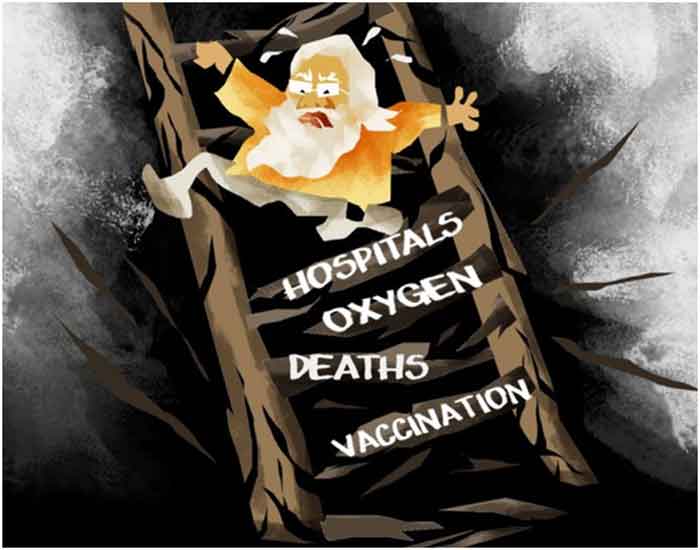
Ever Since the Rastriya Swayamsevak Sangh (RSS) and the Bharatiya Janata Party (BJP) combine came to power in 2014 the deepest crisis it is facing is the Covid-19 dance of death. As of the end of April 2021 India has become the most Covid infected nation in the world and the prediction is that India will suffer the biggest human loss in the pandemic. Its vaccination programme is the slowest in the world. Given the human numbers (1.35 billion people) by the time the vaccination reaches all vulnerable people the disease will kill a massive number of people. Scientific predictions are available that India will be the epicentre of the pandemic. But the present RSS/BJP Central Government does not believe in scientific prediction. They mainly believe in panchangam (astronomy) and Sadhu and Sanyasi opinions.
Prime Minister Modi seems to be the most pro-science man among the RSS/BJP forces, but even his life time training was in cow urine therapy as a cure for every disease. There is a deep Hindutva anti-science culture in their upbringing and also in the being. This therapy was taught to them in every Shakha (organizational gathering). That shakha training has gone into every member’s mind and of his/her family. Even the small kids are trained in the shakhas that cow urine would cure every disease on the planet–existing and also future diseases. Their mind is full of that theory right from an early age and taught in the nation for more than 95 years. This line of thinking destroyed the scientific spirit in the nation. Even doctors and scientists got influenced by this cow urine theory. Even after the RSS/BJP coming to power at Delhi when its members propagated cow urine therapy the central Government did not object.
The urines of both animals and humans have certain chemicals that are useful for one thing or the other. Even human urine has certain health use elements that was the reason why a typical Brahmin Prime Minister of India, Morarji Desai, drank it everyday and lived for nearly 100 years on this planet. This kind of unique practice did not emerge out of scientific experiments that could be verified. They are aberrations. The cow urine therapy is the most unscientific aberration of Indian brahminism. This aberration propagated by the Hindutva Dwijas as medicinal destroyed the core principle of medical science. They have been testing the Shudra followers’ mental degradation level within their organization and in civil society by making them accept this kind myth. Unfortunately though no Shudra has written anything about the greatness of the cow urine therapy, many Shudras have become victims of this theory along with many other anti-human theories they constructed. The secular Dwijas have never opposed such theories. There is a caste cultural vested interest in promoting it by the Hindutva Dwijas and the secular dwijas silently allowing it. All of them have nothing to do with the animal economy and life process. Only Shudra/Dalit/Adivasi creative, productive and scientific thinking can negate this most destructive theory. In the long life of the Shudra agrarian experience it is well established that all animal urines improve the land fertility. This is verified, tested and proved. Cow urine is part of that use value but not human medicinal value. The Shudra/Dalit/Adivasis must be doubly careful with such theories than corona virus. The corona virus could be defeated with globally worked out scientific vaccines but cow urine theory is Indian Brahminic and the world does not bother about it. Such theories of the Hindutva dwijas must be fought when they are ruling India and when people are dying because of their unscientific cow urine cultural nationalism. Science is a secular domain. If secularism is killed science will also die. All religions have shown limitations in promoting science–particularly Hinduism and Islam have shown many limitations in promoting sience in general and medical science in particular.
The Dwija children read their literature and see their parents worshipping cows in their family pooja rooms. Over a period of time the Shudra parents also get this theory from the poojaris, peer groups and friends. Though most Dwija children do not see their parents taking care of the cow in its day today’s needs and survival they see the cow getting brought on a new house warming day and making it a Goddess in the new home. They otherwise see cows roaming on the roads in urban centres. Some of them may keep a dog or cat at home but never a cow for feeding and nurturing. The Dwija children were made to hate crop fields and cattle meadows. They were made to love gurukulas, now IITs, IIMS, Central Universities and private universities like Ashoka, O.P Jindal Global University. Cow urine theory, Ashoka. O.P Jindal kind private anti-reservation ( in essence anti-Shudra/OBC/Dalit and Adivasi) university nationalism, are quite amazing combinations. In this situation came Corona and hit the nation. Burning bodies everywhere has become the symbol of Hindutva nationalism. This has become the yardstick of merit.
The RSS is a deep down Brahminic organization with a belief that ‘Science is Shudra’ and ‘Belief is Brahmin’. This organization has drawn thousands of Shudra/OBC youth out of their Science tradition and trained them in belief tradition. They became an army of cow urine therapy propagandists. This has done a lot of damage to our scientific and medicinal thinking. Even during the Congress and coalitional rule before the RSS/BJP came to power the RSS forces were threatening the ruling forces from streets and communal vantage points to implement their theories. And also within the Congress and other regional parties there were cow urine therapists and they were in league with them.
Apart from this pure vegetarianism as spiritual and social pure food of Bharat has made India weakest in the world. Added to this they made the nation believe modern medicine is ‘English Medicine’. A kind of medical superstition was built all over India. Notwithstanding the limitations of pure vegetarianism in curing diseases and also its non-availability to vast rural masses, the Hindutva pure vegetarianism has done an added damage. They made the nation almost sick now.
Our health levels should be compared to that of China which has an equal number of people and is facing the same crisis of Covid-19 as India is. But see the difference in the number of Covid contracts and deaths in India and China. The RSS/BJP claim that they are the most nationalists but how does a nation’s health could be saved by cow urine as medicine? Their cultural nationalism that worked around cow urine, Kumbha Melas, vegetarianism, anti-agriculturalism has now brought the nation where it is. They did that not just after they came to power in 2014. All through the Congress and coalition rule before 2014 they held the cultural campaign fort. There were many such cow urine therapy believers, kumbh and pure vegetarian minds in the Congress and other regional parties, not just personal food taste but they want that nation should become pure vegetarian.
The leaders of these theories came from Dwija castes–Brahmins, Banias, Kayasthas, Khatris and Ksatriyas. They all had a vested interest in retaining power and want to control the nation. The Shudras, Dalits and Adivasis unfortunately became the mass followers of these Dwija forces.
Quite interestingly no authors of this theory came from the Shudra/Dalit/Adivasis who grazed cow for millennia. The theory came from the Dwija pandits who never had an animal grazing experience and long time interaction with the animal life– its organs and products and byproducts. The Shudra farmers on the other hand had a huge animal interaction, experience and a lot of scientific observation about its birth, growth and death. But they never wrote a theory of cow urine medicinal therapy. They have developed several plant medicines to cure human and animal diseases. Though the Shudras work in the Hindutva organizations they are not accepted as theoreticians. They also simply follow what the Dwija intellectuals tell them. From Hedgewar to Mohan Bhagwat they became the directors and Shudras became the following actors. The drama has destroyed the nation with serious health consequences.
Unfortunately the Indian agrarian masses gradually fell into the trap of Dwija Hindutva theories and voted them to power. Though the Modi Government got an Indian vaccine made by Bharat Biotech but their cadres keep on promoting cow urine cure theory as a matter of their ideological agenda. For last 95 years (as the RSS was formed in 1925) the Dwija Hindutva theoreticians made the rural and urban Shudra/Dalit/Adivasi masses sufficiently superstitious by making them attend their Kumbha melas, ritual mobilizations, talking about only Vedic, puranic and mythological books as the national civilizational source and putting cow in the centrality of the national discourse. They never spoke about the science of agriculture, medicine, engineering and so on. This anti-science propaganda has gone deep down the national psyche.
The Hindutva forces have a great strategy to push the Shudra/Dalit/Adivasis to a medieval status by allowing only Dwija children to learn English, eat good food and travel all over the world and survive by modern medicine. As they never looked after cows in their day to day life but projected cows as a divine animals they never cared for regional language education but tell the Shudra/Dalit/Adivasis that they should study only regional languages. The Indian communists also believed this diabolical language sub-nationalism and propagated. While Hindutva theoreticians push the cow urine therapy into the Shudra/Dalit/Adivasi masses who have only some regional language education they beleive it. Now people are dying for want of oxygen not cow urine. The Shudra/Dalit/Adivasis are being told that English language and English medicine are anti-national and they believe. Who discovered that oxygen can be produced in a factory and preserved whenever human beings need it ?
The Shudras were sent into the streets to campaign for cow urine, campaign against love marriages, and modern medicine . The strategy is to keep English medium global education and global cuture away from the Shudra/Dalit/Adivasis. If English language education reaches them modern medicine also will reach them. Let us build a nation that practices science survives but the one that believes in myth dies.
The author is a political theorist. His new book The Shudras–Vision for a New Path co-edited with Karthik Raja Karuppusamy Penguin
-
Supreme Court’s flawed verdict on Maratha quota shows why factoring caste history is crucial
Caste and varna abolition is now in the hands of RSS/BJP, which claims to represent all Indian Hindus, not just Dwijas, the upper castes.
KANCHA ILAIAH SHEPHERD8 May, 2021 12:44 pm ISThttps://www.facebook.com/plugins/like.php?href=https://theprint.in/opinion/marathas-lack-the-power-of-written-word-supreme-court-cant-ignore-it-like-communists-did/654482/&layout=button_count&show_faces=false&width=105&action=like&colorscheme=light&height=21
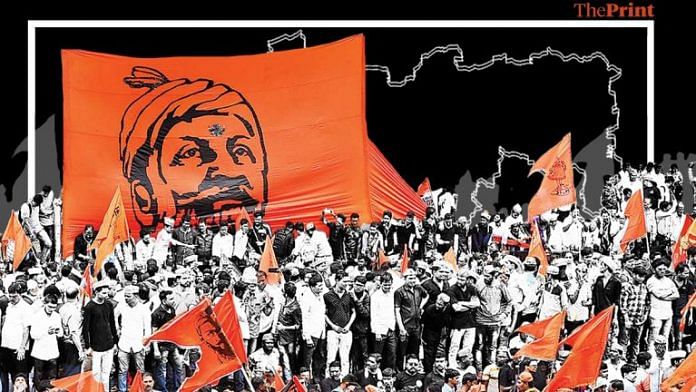
Illustration by Soham Sen | ThePrint TeamText Size: A- A+
Marathas are a large agrarian Shudra community in Maharashtra, constituting nearly 30 per cent of the state’s population. Maharashtra’s economic development, to a large extent, depends on the well-being of this community, along with other Shudra agrarian communities. The five-judge bench of the Supreme Court while striking down the 16 per cent reservation given by the state government has said that the latter had not cited any extraordinary conditions before allowing this reservation over and above the 50 per cent quota stipulated in the Mandal judgment of 1992. The court did not take into account the caste-varna system, which still functions against the idea of equality even in the case of a major agrarian community such as the Marathas.
The Marathas seem to have realised that despite the Bharatiya Janata Party (BJP), whose ideological parent is the Rashtriya Swayamsevak Sangh (RSS), being in power since 2014, the community is still confined to the varna inequities. They could not compete with the Dwijas (the non-Shudra upper castes) in all-India services or in state services, one of the avenues available to them for their socio-economic upliftment.https://77d3c7d2725566da49f55c8f58415b28.safeframe.googlesyndication.com/safeframe/1-0-38/html/container.html
Many agrarian Shudra communities in India, like Marathas, Jats, Gujjars, Patels, Reddys, Kamms, Nairs among others, did not opt to be included in the Backward Class list in 1992. But some of them now realise that they cannot compete with the Dwijas (Brahmins, Banias, Kayasthas, Khatris and Ksatriyas) who had the historical resource of education in Sanskrit, Persian and English for a long time.
Also read: New backward class lists to be drawn, 50% ceiling stays — what SC Maratha quota verdict means
The leadership vacuum
Having played a mass-mobilisation role in the Hindutva movement in Maharashtra, the Marathas aspired to get their share in Delhi’s power pie if the RSS/BJP combine formed the government. But that clearly did not happen — the Marathas seem to have realised that they are nowhere in Delhi and their power influence is limited to Maharashtra. Not just the Marathas but many other agrarian Shudra communities who remained outside the Mandal list have a similar realisation.

https://imasdk.googleapis.com/js/core/bridge3.458.0_en.html#goog_498172181
From the same state of Bombay, before its division into Maharashtra and Gujarat, Brahmins and Baniyas emerged as national leaders, top bureaucrats, scientists and intellectuals. But the Marathas did not get to share the Delhi power. Though among the Shudras, Sardar Patel did emerge as a national leader from the Patidar community, no Maratha could. The Marathas now feel that such a top man/woman was not allowed to emerge during the freedom struggle and even later, till now by the Dwijas. The RSS structure has shown them that control. Though many Brahmin Maharashtrians headed the RSS, not a single Maratha was allowed to reach at the top. They were confined to agrarian production, agribusiness and local power with a new definition of unified Hindu. Marathas were used mostly as muscle power against the minorities by the RSS.
After the exception of Mahatma Phule, who emerged as an early intellectual from the Kumbi Maratha community, India saw a stream of Brahmin leaders and intellectuals in the subsequent years from the Bombay province. While Mahadev Govind Ranade, Gopal Krishna Gokhale, Bal Gangadhar Tilak and Mahatma Gandhi (of Bania background) emerged from one stream, V.D. Savarkar, K.B. Hedgewar, M.S. Golwalkar and now Mohan Bhagwat came from the Hindutva stream — all Maharashtrian Brahmins and powerful national leaders.
The Marathas have not produced English-educated top national leaders and high intellectuals. This proves they were/are educationally backward. The Shudras, historically, were not supposed to learn, read or write Sanskrit. This historical limitation got carried to Persian learning as well during the Muslim rule. Even the modern English medium education eluded the Marathas — true of all the regional Shudra communities, except the Nairs of Kerala.
Also read: MVA-BJP blame game begins after SC Maratha quota order, Uddhav nudges PM for ‘speedy decision’
The historical gap
The Supreme Court must consider the history of caste while formulating the idea of equality. How else could one explain the inability of the Shudra upper layer castes, who outnumber the Dwijas, in competing in the all India services. This is a limitation that history has placed on all Shudra communities — they are rural and have agrarian and artisanal backgrounds. How does the highest court not take this historical factor into account?
One must know that the Marathas were spread over vast rural productive land. It was the Brahmins, Baniyas and Kayasthas (who had limited presence in the province), who became early urban settlers in the Bombay province. This was also true of Calcutta and Madras provinces. English medium education was an urban phenomenon. The Dwija castes benefited from that urbanised English education life. Even the early Christian institutional English medium education benefitted only the Dwijas. This is very clear from their overwhelming presence in all national and international English-speaking platforms, and from the near absence of the Shudras.https://77d3c7d2725566da49f55c8f58415b28.safeframe.googlesyndication.com/safeframe/1-0-38/html/container.html
The judiciary should not commit the same mistake that the Indian Communist theoreticians did. They looked only at the land ownership and not the power of the written word. The Shudras of India owned some land and labour but not the power of the written word. Apart from the power of written word, the Brahmins of Maharashtra, particularly Desais and Sirdesais, had control over land resources. In parts of British India, Brahmin zamindars and jagirdars controlled the whole life — spiritual, social, economic and political — of the Shudra masses.
The idea of reservation is to distribute the power of the written word. All Shudra castes, including the Marathas, lack in this area, particularly English and the English-medium education. In all central services, judicial services and media, the power of written word placed Dwijas in advantageous position.
This is why it is important to relook at the 50 per cent ceiling of reservation in central and state services, and education. The debate on this limit should continue until caste and varna differences are abolished. Their abolition is now into the hands of the RSS-BJP, who claim to represent all Indian Hindus, and not just the Dwijas. Granting spiritual and social justice to all Shudras and Dalits is their duty. But they are not working towards that goal. This is the biggest worry of the Shudras.
The Supreme Court gives many legally enforceable judgments but does not ask for caste census. Why? The caste census gives a clear direction about every caste’s representation in every institution.
The court’s power is also located in the written word. And that power must also be distributed among all communities. Else both social and natural justice will suffer.
Kancha Ilaiah Shepherd is a political theorist and social activist. His latest book is The Shudras — Vision For a New Path, co-edited with Karthik Raja Karuppusamy. Views are personal.
(Edited by Anurag Chaubey)
-
What YS Sharmila’s leadership could mean for Telangana: Kancha Ilaiah writes | The News Minute
What YS Sharmila’s leadership could mean for Telangana: Kancha Ilaiah writes
In some respects, YS Sharmila’s upcoming political party is the first of its kind in south India.

IMAGE: YS SHARMILA REDDY

In south India so far, a woman leader has not started a major party on her own and influenced the political scene of a state. Jayalalithaa ruled Tamil Nadu but she inherited MGR’s AIADMK because of her relationship with him. In East India, Mamata Banerjee conducted that experiment successfully. YS Sharmila’s upcoming political party in Telangana would be the first of its kind in south India.null
So far, the Telangana region has been ruled by only one woman — Rudramadevi — of the 13th century in known history. Historical evidence shows that she ruled the region from 1263-1289. Now suddenly, from an unexpected corner, YS Sharmila, the daughter of YS Rajasekhara Reddy and Vijayamma, seems to have a serious chance at claiming that place. Historically, Reddys are also Shudras just like the Kakatiya rulers.
The Kakatiya dynasty witnessed many ups and downs when they ruled this region. The Kakatiyas rulers were known for their love of agrarian economics. The Ramappa and Pakal lakes as well as the plough and bull symbols that they adopted clearly show their agenda was influenced by agricultural development. During this time, a major tank and agricultural well-irrigation system also came into operation in the dry region.Featured Videos from TNM
Though they built few Shiva temples, agriculture was their main focus. Those who visit Ramappa and Pakal lakes, which still irrigate thousands of acres of lands, are a clear indication. As someone who has drunk the water from Pakal Lake and eaten the rice produced in my area, including in my own village, it offers definitive clues to their vision of irrigation technology and development. After Rudramadevi was killed by her Kayastha senadhipathi, Ambadeva, in 1289, no woman became a ruler after her. https://f5ac434928683c91e8637d4eef21e4a4.safeframe.googlesyndication.com/safeframe/1-0-38/html/container.html
Adivasi rulers Sammakka-Sarakka, who ruled within the Koya forest belt, were martyred by Rudramadevi’s grandson, Pratarpudra. They were great women symbols of Telangana, and the Sammakka-Sarakka jatara, which symbolises the duos’ significance, is worshipped and celebrated by Adivasis.
Sharmila, even before launching her party, has made an impact. The sight of her torn jacket at the April 15 dharna became a showcase of her fighting shoulder for police culpability. The more such mistakes the TRS commits, the more she will pick up the dust.
She has shown confidence of a leader by telling the Telangana people that someday, ‘I am going to be the CM of Telangana’. But it all depends on what kind of welfare agenda that she will evolve, which could put the TRS welfare schemes in poor light.null
The Congress and BJP as national parties cannot evolve regionally transformative welfare schemes which their Delhi masters do not accept. One such major welfare agenda in Telangana that Sharmila should project is the need to convert all government schools into English medium education, while promising the mothers that their accounts will get what I call Badi Bandu (school friend) scheme to the tune of Rs 15,000 to 20,000 per year.
Additionally, there could be full reimbursement of college fees and implementation of Arogyasree as her father did. The government schools that the TRS has left dilapidated should be turned into modern institutions.
The existing Rytu Bandhu has helped high-end rich farmers rather than small, medium and tenant farmers. A creative and workable restructuring is needed. Some water schemes have been implemented, no doubt, but a more pruned irrigation scheme has to be worked out. This is where existing schemes need to be assessed for their good parts and bad. And the new aspects, which the Congress and BJP parties cannot promise, need to be considered.
School, college and university systems of Telangana also need to be rehauled. As of now, that whole sector has been deliberately killed to suit Telangana’s old feudal vision — more serious education, more emergence of quality citizenry that opposes feudal practice and lifestyle at every level. Hence, KCR has killed education systematically. More English educated graduates are demanding good jobs. Killing the school, college and university education systems guarantees more power for his English-educated son and daughter, KTR and Kavitha. Incidentally, Sharmila communicates as a leader in English and Telugu as Ayyachaatu (father promoted) son-daughter leaders can do. Sharmila is an Ayyaleni (daughter of deceased YSR) bidda and is establishing a party on her own.
She has also moved deep into Telangana during her padayatra after the tragic death of her father, more so than the present Bathukamma-playing daughter and Chirragone (rural cricket)-playing son. She entered the game by playing politics, not Bathukamma or Chirragone. That is a powerful message for those Telangana Vaadis, who have managed to buy their Innova cars and leave their motorbikes behind within just seven years.
KCR knows that the people around him have not made any sacrifices for Telanagna, except make money and even still, he promoted them. Like a British monarch, he appears once in a while in public meetings or press conferences and withdraws into the newly-built government palace (Pragati Bhavan), not working on a daily basis as CM from the office. Sharmila has to evolve a different culture of ‘I love my activists as I love myself’, a moral principle that feudal casteism hates. She has to work constantly on the political chessboard.https://f5ac434928683c91e8637d4eef21e4a4.safeframe.googlesyndication.com/safeframe/1-0-38/html/container.html
It should be taken for granted that she has an uphill task ahead of her. But given her family history, she could be able to climb that hill. What is required is tenacity, fighting spirit and an emotional attachment to the welfare of the Telangana people. It does not matter which hospital she was born in — Telangana or Andhra or Delhi or even in New York — once she has the right to vote here.
Kancha Ilaiah Shepherd is a political theorist and social activist. His latest book is The Shudras — Vision For a New Path, co-edited with Karthik Raja Karuppusamy. Views expressed are the author’s own.
-
The Shudras at the Heart of Tikait
A new way to fight Dwija hegemony
Rakesh Tikait holding The Shudras—Vision for a New Path book with his two hands at his heart shows a new shift in the Indian and more particularly in the North Indian agrarian caste sociopolitical consciousness.
North Indian Shudras more particularly the Jats, Gujjars, Patels became the backbone of the right wing human muscle and vote power in the post Mandal political churning. The Mandal Commission Report defined all Shudras, including Jats, Gujjars, Patels, Marathas and so on, as the Other Backward Classes, by shifting the historical category of Shudra into a constitutional category.
But the top agrarian castes, particularly Jats and Gujjars who are all around Delhi, opted out of being in the OBC category as it was seen as moving downwards but not up.
The rural intellectuals of the agrarian communities in the early 1990s wanted to claim Kshatriya status, as Skatriyas were the historical rulers.
They did not understand the role of reservations in producing an intellectual class from each Shudra caste. What university and college education—that too English medium education—and bureaucratic power produce could have come into the hands of substantial numbers of Gujjars and Jats. The newly English educated class in each caste plays a key role in running not only the Delhi system, it would have changed their attitude towards Dalits and other minorities.
Jats thought that their dominant agrarian base would give them power, knowledge and they could claim Skatriya status. They thought it would automatically give them national political power too. This proved to be totally wrong.
All the unreserved Shudra castes like Jats, Gujjars could have produced intellectuals that could play a critical role in central universities and research institutions. They have not so far produced political leaders with a national and international vision. This is because unlike the Dwijas the Jats and Gujjars never produced English educated intellectuals who see through the Dwija leadership.
Now there is a new awakening, as the right wing forces are running the Delhi administrative structures without much Jat, Gujjar or other Shudra agrarian castes within the power structures. Quite tragically even in the central universities run by Muslim minorities like Aligarh and Jamia Millia Islamia the presence of Shudra faculty members is minimal.
They were used for their anti-minority agendas but there few available intellectuals were not allowed to share power in national structures. And once in power the Shudras were further sidelined.
The Dwijas as defined in The Shudras—Vision for a New Path constitute Brahmins, Banias, Kayasthas, Khatris and Ksatriyas, who have no role in food or other agrarian production.
The Jats of UP, Punjab and Haryana were the main agents of the Green Revolution. But they could not become industrialists. Most Shudra castes in the country have not benefited in the massively grown industrial economy as is made very clear by the Shudra Team’s study in the book, in the chapter ‘Caste and Political Economy’. Jats and Gujjars around Delhi which runs the national power structures realise that at the Delhi high tables they have no share because of a lack of organised and modern educational efforts. Jats have no adequate representation in central universities like JNU and Delhi University.
In this situation the Shudra identity will give them a new way to fight the Dwija hegemony. Tikait seems to have realised the importance of the book.
Jats are the most active fighters against the new farm laws. Tikait seems to have realised the massive privatisation agenda is meant to de-reserve the jobs that OBCs, Dalits and Adivasis are benefiting from in a marginal way. Jats have been asking for inclusion of their caste in the reservation list. Whereas the dominant right wing is undercutting the reservation system.
The boook has initiated a conversation around all Shudras. They must assert their Shudra roots with dignity and respect. Tikait holding the book at his heart indicates the new mood of North Indian Shudras.
Kancha Ilaiah Shepherd is a political theorist, social activist and editor of The Shudras: Vision for a New Path along with Karthik Raja Kuruppusamyhttps://www.thecitizen.in/index.php/en/NewsDetail/index/14/20235/The-Shudras-at-the-Heart-of-Tikait
-
Shudras And The Central Universities
in Annihilate Caste — by Kancha Ilaiah Shepherd
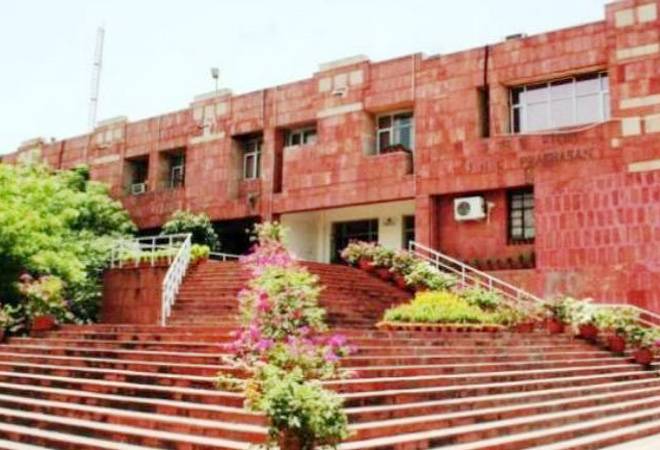
A well-known Dalit scholar Gopal Guru, presently editor of the Economic and Political Weekly, once wrote that “Indian Social Science represents a pernicious divide between theoretical Brahmins and empirical Shudras’ (2002). But Shudras did not get much attention in his, otherwise useful article. He immediately shifted his argument to the question of Dalits. Nowhere he elaborated his understanding of the Shudra question in a historical sense. Maybe this was a conscious forbearance. Since he worked in a high end central university of India JNU (Jawaharlal Nehru University) he consciously used double edged language. Because social science discourses of JNU and also the Delhi University, which were known as the best in India, were more receptive for Western theoretical formulations but sidestepped a serious engagement with ancient, medieval Indian thought processes. They operated under a broad rubric of secularism, liberalism, Marxism, pluralism, modernism, postmodernism and so on. In the 1980s and 90s they deployed a language of Michel Foucault and Jaques Derrida, two French philosophers of post-structuralism and deconstruction, whose language is like Indian Sanskrit that could be understood only by Brahminic Gods but not by people around. Many Indian professors have become like poojaris reciting those theories and that helped the present Hindutva school to characterize them as anti-national very easily.
If we characterize that phase as the post-colonial left-liberal and in that phase the Shudra/Dalit/Adivasi youth could hardly get jobs in the high end Indian universities as they could not satisfy the Western educated left liberals. The Indian educated also did not evolve a theoretical discourse around the historical production and humanitarian cultural ethic of Shudra/Dalit/Adivsi masses of India.
Huge number of reserved posts were kept unfilled by the same forces in central universities and institutes by brandishing the Shudra/Dalit/Adivasis qualified candidates as non-meritorious. Most selection committees headed by left-liberals concluded in their selection committee meetings by submitting reports as “Not found Suitable” in almost every department, as the OBC/Dalit/Adivasi candidates with Ph.D degrees of even best Indian universities in hand went home to join the labour teams in Mahatma Gandhi Employment Guarantee Scheme in their respective villages. Their hard work to earn degrees even at the JNU and Delhi universities was proved to be of no use in MGNREGA labour university. The Dwija youth got well paid jobs in private and public institutes because they were born with merit, and many of them got degrees from foreign universities, while the children of the farmers, who are protesting on Delhi borders, are meant to drive only tractors in the fields.
The Dwija pandits never accepted that Dalitism, Shudraism, and Brahminism could also be deployed as social science categories in studying the Indian socio-spiritual and political ideas and institutions of ancient and modern times. The category Shudras was in existence from Rig Vedic times, but they never thought that Indian society could be analyzed with the help of the indigenous concepts.
The left-liberal intellectual phase officially ended from 2014 general elections. Now India is living in post left-liberal phase of intellectual discourse. In this phase the Sanskrit Vedism will dominate and the same Dwija youth (Brahmin, Bania, Kayastha, Khatri and Kshatriya) will get jobs in all those universities and institutions, both public and private. The agrarian youth’s historical knowledge would not get academic recognition in this phase also. That is the reason why even in JNU and Delhi University, Jat, Gujjar, Kurmi, Yadav and other Dalit/OBC youth did not get teaching positions — whether they came under reservation or not. In all newly established private universities like Ashoka, OP Jindal and so on a mixed intellectual environment will operate. Since there is no reservation there, they still work with Harvard ideology with a Hindutva stamp. The Hinduva forces will allow that because the children of ‘Vishva Hindu’ network that operates from Dwija homes will study there both for global and Indian employment markets. The Shudras farmers around Delhi also never suspected their nationalism and challenged them.
For a long time in the post-colonial India, the liberal and left Dwija intellectuals were quite comfortable with Brahminism and avoided any socio-spiritual and theoretical contending categories of ancient India, both in writing and teaching in the high end universities. They refused to teach even Gautama Buddha as a political thinker in Colleges and university courses. They too were comfortable with Vedas, Upanishads and the philosophies of Manu and Kautilya, with a total silence on caste and theoretical concepts that have been considered to be the root ideas. They have never examined historical conflicts between Shudras and Brahminism in the historical sense, for example, with an opposite ideological engagement with nature and production. Except opposing Hindutva communalism they were as anti-Shudra and anti-Dalits in intellectual discourse as the present Hindutva school is.
No Shudra intellectual emerged from these universities to challenge them. Though Ambedkar wrote a book — Who Were The Shudras? – way back in 1946, later intellectuals often failed to see the connection between Dalit liberation and the Shudras getting free from the feet born status that the Rigveda tied them down. Those Shudras who were working in the Rastriya Swayamsevak Sangh (RSS) and the Bharatiya Janata Party (BJP) were no exception to the feet born status. They too need to be liberated for the establishment of an egalitarian society.
Hardly any section of social scientists understood that without invoking the category ‘shudras’ as an ideological instrument of pro-production along with the hegemony of Brahminism, the pre-Buddhist ancient society does not provide a framework to examine the production relations during the Vedic, Epic and Puranic times. The entire Brahminic Sanskrit literature did not engage with production at all, as production was seen as a polluting domain that’s proper only to Shudras . That literature talks about only Brahmin saints and Kshatriya kings. The Shudra food producers were completely absent. The Shudras built the pre-Rigvedic Harappan civilization and were responsible for putting India on a much bigger civilizational pedestal than China, Egypt, Israel and Greece. There was no caste/varna system in Harappan civilization.
There was no ideological battle around human untouchability in the pre-Buddhist India as Ambedkar himself admits that untouchability as a major social system was institutionalized in the process of elimination of Buddhism from India. According to Ambedkar, all former Buddhists were rendered untouchable in the battle against Brahminism. Shudras were slaves, oppressed and brutalized for a thousand years before human untouchability came into being. The Shudra producers suffered the Vedic and post Vedic ignominies for a longer time and once untouchability was constructed they seemed to have felt that they had a superior status than untouchables. Even the contemporary caste/varna system shows that Shudra/Dalit slavery and oppression continues as parallel systems.
The idea of God/Goddess in Vedism was anti-production. The idea of God/Goddess amongst Shudras was pro-production and an integral part of productive ethic and spiritual culture. If the Shudras were to live with a life of the same anti-production spiritual ideology and did not involve in production as against the Brahmanic anti-production ethic, the Indian nation would not have survived. The agrarian and artisanal production would have been completely abandoned. Even the Charvaka and Lokayata schools do not reflect the Shudra ideological, socio-spiritual and political ideas. In Charvaka and Lokayata schools also there was not much discourse around production. The communist scholars coming from the Dwija background examined the theist and atheist conflict between Vedic and Charvaka schools, but they were never concerned about the Shudra production and Vedic anti-production conflict. Nations are built with production systems and the cultures that emerged out of production process but not otherwise.
What many political thinkers who studied in India or in the Western universities did not realize is that in pre-vedic times between building of Harappan urban civilization and vedic-pastoralism there was a time gap of about 1500 years. It was almost the present Shudra/Dalit/Adivasis who were existing as indigenous people (Mulanivasis), who were actually Indo-Africans with some racial mutations. They were condemned as Shudras by Aryan Brahmins in Vedic times. The Aryan Brahminism constructed the four varna theory dividing the sub-continental society- Shudra, Vaisya, Ksatriya and Brahmin– in Rigveda. In pre-Rigvedic times there was no anti-production or anti-agrarian school in the Indian sub-continent. All were engaged in hunting, fishing and also agriculture. They built several villages and cities like Harappa, Mohenjo-Daro, Dholavira and so on much before China could reach such a stage. The development of such an advanced city construction in India with very advanced ancient technologies than that of contemporary ancient China, Israel, Egypt, Greece and so on, would not have been possible without advanced agriculture and village economic systems all around the cities. The Indian cities were never isolated ones, like ancient Greek cities from villages. They were always an extension of villages as we see today all over India. The builders of that pre-Aryan and pre-Vedic civilization definitely were the descendants of the present Shudra/Dalit/Adivasi Harappans.
In Indian university teaching ancient Greek city states and the master-slave relations occupied primacy than studying ancient Indian Shudra-Brahmin civilizational conflict and building of Harappan civilization prior to that. In the garb of political philosophy, more ancient Europe was taught than ancient India because a serious engagement with ancient India would involve serious research on the origins of the caste system and the Shudra slave question.
Now the BJP Government as part of its cultural nationalist package wants to deploy Vedic, Purnic and Epic history a serious focus on the pre-Vedic Harappan civilization is called for.
In the Hindutva history only Brahmins and Kshatriya kings, who worked under the mentorship of Brahmin rishis and writers would be shown as nation builders. The Shudra producers and Vaishya agrarian supervisors and commodity exchanges in pre-Buddhist times do not find place. The Indian nation will be shown as a country of mythological evolution. The Indian food producing farmers, artisans, Dalits and Adivasis will be invisibilized as non-existent social mass.
They not only completely discount the Muslim and Chritian history in India but they completely erase the Shudra/Dalit/Adivasi history. The Dwija left and liberal intellectuals do not find any problem with the Shudra/Dalit/Adivasi history not being in the teaching courses but they will talk more about minority history as that gives an international rights status. Particularly the non-existence of Shudra/OBCs does not become an issue because they are characterized ‘Caste Hindu’ and the Dwija existence in history is seen as living history of India.
The Shudra/Dalit/Adivasi question has no international recognition as of now. The Dalit question has some visibility in the global stage since numerous studies were taken up and also it is rooted in most inhuman practice of untouchability And this forces the Indian State to feel loss of face on international intellectual forums. They try to support Dalit reservation but they never acknowledge the Shudra slavery at any time in Indian history. As of now the Shudra question is no issue intellectually, because Shudras themselves have not acquired modern English educational intellectual energy to challenge the Dwija hegemony in any field. When this was so when the liberal and left intellectuals were in control of the institutions of knowledge, the Hindutva intellectuals will undermine the Shudra question more systematically but they can be seen as white snakes in green grass. However, since Hindutva forces are in power the very intellectual environment in the educational institutions–particularly in the universities anti-Shudra intellectuality will be strengthened through ‘cultural nationalist’ paradigm. In this paradigm the Dwija history will be shown as Indian history. The entire food production and the Shudra civilizational heritage would have no value at all.
While the control of Brahmin over the Hindu temple was consistent from the days of writing of Rigveda to 21st century, the control of Brahmin over the State by becoming the Prime Minister of the state and chief priest of the State started with Kautilya becoming the Prime Minister and the head priest of Mauryan state. Chandragupta Maurya, though was a Shudra, was given a Kshatriya status and in the process of coronation by separating him from the rest of the Shudra productive masses. From then on to 1947 that system continued whether the state was small or big under Brahminism.
Even during the British period there were number of princely states under the control of Brahmin Prime Ministers and head priests while the rulers being Shudras. But they were given Ksatriyahood in a brahminic ritual. Baroda Maharaj who though sent Ambedkar to higher studies could not give him a house within Baroda city after he returned to take up a job in 1917. Likewise, Mysore king, Kolhapur king, Shahu Maharaj (grandson of Chatrapati Shivaji) had to follow the Brahmin priestly authority even though they were against Brahmins. Even the rulers from Shudra communities did not assert their spiritual autonomy against Brahmin priests. This process arrested the Shudra consciousness.
This kind of spiritual slavery kept them as slaves and subordinates to Brahmins all along. In crucial ways, a ruler of state was a slave of a Brahmin. That did not allow the Shudra rulers to get education and enlightenment. Even now the fear of Brahmin among Shudras is the most difficult knot of the Indian history. All Shudra Chief Ministers and ministers live under the spiritual control of Brahmin priest. Why a Shudra could not emerge as a spiritually independent being? How and why Hindu Gods stopped that change.
From Kautilya to Jawaharlal Nehru the Brahmin Prime Minister position remained unchanged. Sardar Vallabai Patel, a Shudra, could not become the first Prime Minister of India because only a Brahmin should be the head of an Independent Indian state. That principle was an insult to the entire food producers of India. Thus, the Hindu temple and the State became Brahmin property. Shudras never developed a rebellious consciousness against this tradition. No Shudra ruler asked a fundamental question: why a Shudra cannot head a temple as a priest where a Brahmin is part of? Why should a Brhamin not till the land and produce food? It was this question that would have resolved all other issues of Shudra slavery and subordination.
The issue of Shudra slavery is very much linked with the Dalit question. Once Shudra were to get priesthood rights, the authority to run the state on his own would have been realized. Once such questions were resolved abolition of untouchability would have become automatically a major question. Once the spiritual system gets democratized many fundamental questions of human inequality and untouchability would have got resolved.
Till today the Brahmin is avoiding the fundamental question of spiritual democracy within the Hindu order and the Shudra has no self-respect and no critical thinking to assert oneself. This relationship has its implication to modern education of the Shudras. A typical Shudra is afraid of English education like she/he was afraid of Sanskrit education. This is the fundamental reason why even the relatively better off Shudra castes like Jats, Yadavs, Gujjars, Patels, Marathas and so on cannot be found in high end central universities and institutions.
Philosophy of written word has become a fearsome issue for a Shudra. This is what Brahmin did after writing Rigveda. Till today that fear is haunting them. It is time that the Shudras gatecrash the central universities. They must get into teaching positions in all departments and acquire skills to run them efficiently. Let the Dwija youth drive tractors and produce food in the fields. Only this change will resolve the question that Indian courts are repeatedly asking: how many generations should the reservations continue? A simple counter question is for how many generations only the Shudras, Dalits and Adivasis should till the land and produce food? Let the roles change between Shudras and Dwijas and reservations can also end.
Kancha Ilaiah Shepherd is a political theorist and social activist. His latest book is The Shudras–Vision For a New Path co-edited with Karthik Raja Karuppusamy
https://countercurrents.org/2021/03/shudras-and-the-central-universities/
-
G. Sampath reviews The Shudras: Vision for a New Path, edited by Kancha Ilaiah Shepherd & Karthik Raja Karuppasamy – The Hindu
Review
This anthology brings the spotlight on challenges facing a people who form not only the majority of India’s population but also the majority among Hindus
The term ‘Other Backward Classes’, or OBCs, is an administrative category. It is typically deployed in the context of public policy and academic research. Is it advisable to construe the hundreds of sub-castes in the OBC category as a singular political community? Kancha Ilaiah Shepherd and Karthik Raja Karupusamy, political theorists and the editors of The Shudras: Vision for a New Path, seem to think so. While they acknowledge it could be problematic to see the Shudras/OBCs as a “monolithic unit,” it is this conceptual framing that informs the essays in this volume.null
Enforcers of an ideology
The narrative argument that emerges from this anthology can be summarised as follows: Majority of Indians are Shudras. Over millennia, it was the Shudras who performed the labour involved in the production of food and material goods. But they were denied the prestige and wealth that accrues from productive work. Thanks to their social and spiritual slavery under Hinduism’s varnashrama dharma, the non-productive, minority Dwija (twice-born) elite comprising the Brahmins, Kshatriyas, and Vaishyas exploited them for centuries. When colonial modernity and democracy enabled social mobility for the Shudras, the Dwijas came up with Hindutva. Funded by Brahmin-Bania monopoly capital, Hindutva politics is about tightening the Dwijas’ grip over every node of power that has a bearing on education, employment and political representation. Paradoxically, it is the Shudras who are the biggest enforcers of an ideology whose biggest beneficiaries are their oppressors.
This narrative raises two questions: What explains this “Shudra conundrum,” of turkeys voting for Christmas, as it were? And how do the Shudras forge a coherent politics of social transformation?
On the first question, the contributors do a fine job of delineating why Hindutva — which appears to target only non-Hindus — cannot possibly end well for Shudras and Dalits. But there is no convincing explanation for why something that’s so obvious to these writers makes no impression on the millions of Shudras who are in thrall to an ideology that sanctions their degradation. Ilaiah suggests this is due to the Shudras’ intellectual backwardness and spiritual slavery — both rooted in the ritual denial of access to learning and resources by their Dwija oppressors.
While this is certainly a major factor, it doesn’t explain why even the relatively ‘advanced’ OBC communities, who have had avenues of learning open to them for quite some time, are seemingly keen to embrace their own “socio-spiritual slavery” by supporting Hindutva. Putting all the blame on the Dwijas alone is a theoretical dead end — the byproduct of treating Shudras as a unitary group abstracted from socio-historical context. In trying to circumvent this dead end, the anthology raises more questions than it answers.
Objecting to a tag
For starters, how to build a politics around ‘Shudra’ identity when influential Shudra communities think of themselves as Kshatriyas and would object to the ‘Shudra’ tag?
It is undeniable that historically, oppressed communities have had to ‘ethnicise’ and reinvent their identity as a precursor to emancipation. That’s what the Dravidian movement did, and it’s why the ‘Untouchables’ became ‘Dalits’. And yet, would self-identification as ‘Shudras’ sharpen or bridge the already violent fissures between Shudras and Dalits?
Further, given Hindutva’s proven capability to capture power by using ‘Hindu’ identity as a lever to both transcend caste and offer status elevation within the caste order, it is no longer obvious to the OBCs that supporting a Hindutva party is against their self-interest. From a Shudra perspective, the suggestion that they should support one Brahminical national party instead of another Brahminical national party because the former is ‘secular’ and the latter is not, makes little sense.
While neither party would be progressive from a Shudra perspective, there is a case to be made for supporting the one that’s more likely to offer the marginal rewards of representation simply because it’s more likely to win. In today’s India, this would make the BJP the national party of choice for many Shudras, and so it has.
Alternative to Ram Rajya
The Breitbart doctrine holds that “politics is downstream from culture”, and to change a people’s politics, you must change their culture first.
The rightwing knows this, which is why it’s displacing India’s plural traditions with Hindutva. The authors in this volume recognise it too. Therefore, they contend that Hindutva cannot be stopped unless Shudras are de-brahminised. They believe Shudra de-brahminisation requires them to rediscover and embrace autonomous Shudra traditions.
Drawing on the work of Jyotirao Phule, they see an alternative to Ram Rajya in the kingdom of Baliraja, a deity of Maharashtra’s peasantry. Shudras in other regions have their own versions of Baliraja, which brings us to the final contradiction: Should the regionally fragmented Shudras take on a homogenising national force by building an alternative homogenous politics around ‘Shudra’ identity? Or does it make better sense to fight an oppressive homogeneity with a renewed and fiercely federated pluralism?
Notwithstanding the analytical problems attending the ‘Shudra’ category, this anthology brings the spotlight on the challenges facing a people who form not only the majority of India’s population but also the majority among Hindus. The Shudras is a timely intervention that ought to be read by anyone exercised by the paradoxical status of OBC communities in a country facing Hindutva hegemony.
The Shudras: Vision for a New Path; Edited by Kancha Ilaiah Shepherd & Karthik Raja Karuppasamy, Penguin Random House, ₹699.
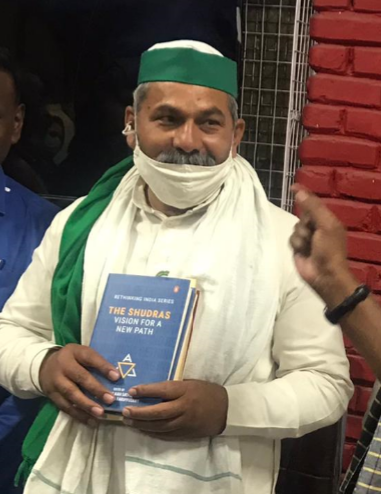
 Kancha Ilaiah Shepherd
You must be logged in to post a comment.