-
BJP’s OBC line has silenced RSS Brahmins. But Shudras key to anti-Muslim battles
The RSS knows that Shudra agrarian communities across India are re-assessing their status in all spheres of life — spiritual, social, educational and economic.
KANCHA ILAIAH SHEPHERD17 August, 2021 11:25 am IST
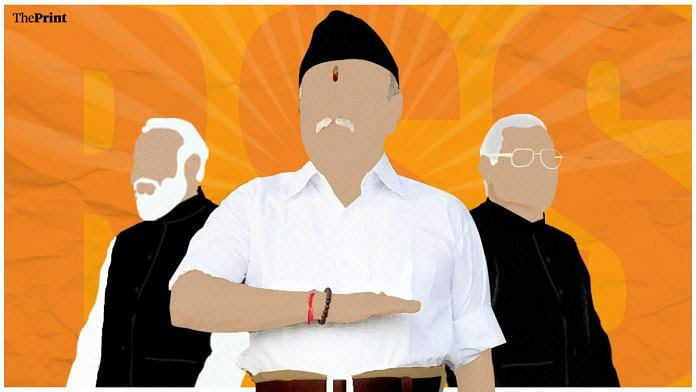
Illustration by Ramandeep Kaur | ThePrint
Just a day before the Indian Parliament passed the Constitution (One Hundred and Twenty-Seventh Amendment) Bill on the question of Other Backward Class reservation, the general secretary of the Rashtriya Swayamsevak Sangh, Dattatreya Hosabale, gave an unusual statement, given the history of his organisation. He said that reservation is a historical necessity for India, it should continue as long as there is inequality being experienced by a particular section of society. He also said that “the history of India would be ‘incomplete’ without the history of Dalits”.
The statement of its new general secretary goes against the repeated statements that Mohan Bhagwat, the Sarsanghchalak of the Rashtriya Swayamsevak Sangh (RSS), has given against reservations. On 10 August 2021, the OBC reservation Bill, which is meant to uphold the Maratha and other state-level caste reservations, was passed unanimously with a two-thirds majority in Parliament at a time when the Parliament did not do any other useful work by Narendra Modi’s BJP government.
This Bill put the Congress in a fix, because when it was in power, it never took such a significant step.
The RSS knows that the Shudra agrarian communities across the country now are in a mood to reassess their status in all spheres of life — spiritual, social, educational, and economic.
The Tamil Nadu government’s decision to appoint trained archakas (priests) from all Shudra/Dalit castes also goes against the very traditional (in the garb of nationalist) idea of Hinduism of the RSS. It never openly stood against the practice of only Brahmins getting priesthood in the temples. But now it cannot go against such a move because it knows that to remain in political power in Delhi and also in other states, the Shudra/OBC votes are critical.
It also knows that all its anti-Muslim battles were physically fought by the Shudra/OBCs with the hope that they will get equal rights in Hinduism with the support of RSS. If they do not get equality when they are in power, the Shudra/OBCs will rebel against the RSS’ Brahminism. This is why the strongest anti-OBC reservation forces in that network are grudgingly silent.
The issue of caste census
Another very contentious issue in the organisation is the caste census. Since the Vajpayee-Advani days (1999-2004), the RSS has been resisting the demand for a caste census. But the statement by Dharmendra Pradhan, the current education minister, who is an OBC himself, shows a serious intent that has otherwise been missing all these years. He said during a debate in the Rajya Sabha, “caste-based census is a revolutionary process.” At an ideological level, the Shudra/OBC demands of extending reservations in education and jobs, access to temples, priesthood to all Shudra/Dalits who accept themselves as Hindu, and caste census, have existed irrespective of parties. There are more such people in the Bharatiya Janta Party and RSS than in any other group as of now.
These issues are not that of the RSS. The sangh parivar’s issues were the Ram temple, abrogation of Article 370, the Uniform Civil Code, and so on, which have implications for the Muslim community. The theory of RSS came from the Brahmins, but in practice, the anti-Islamic muscle power came from the Shudra/OBCs. Ever since Narendra Modi claimed that he was an OBC, just before the 2014 election, the Shudra/OBC forces felt that the future government would be theirs. In the latest cabinet reshuffle, Modi has included more OBC/Dalit/Adivasis than ever before.
This kind of caste-identity issue was not anticipated by the RSS theoreticians who officially owned Manusmriti as their great ancient constitution. K. B. Hedgewar, M. S. Golwalkar, even and later Sarsanghchalaks were not at all convinced by the present Constitution, which could empower the Shudras, OBCs, and Dalits in Delhi and other states, and even shift the power base. The Congress also resisted such a shift in power, which some liberal intellectuals lament as a ‘total shift in power elite.’ While the Shudras/OBCs/Dalits do not understand the Euro-American jargon, they do now know the power of caste and numbers. The Left-liberals, coming from the dvija social background, think the Modi era has disempowered the so-called well-educated power elite.
Ideological opposition in BJP and RSS
An ideological opposition to Modi and Dharmendra Pradhan kind of OBC practice can be seen in the recent writings of Ram Madhav. Madhav, who is a Brahmin from Andhra Pradesh, came from the RSS to the BJP after Modi became prime minister and went back to the RSS with definite ideological differences. In many of his recent articles talking about the dangers of ‘elected authoritarianism dictatorships’, it is easy to understand who he is referring to. He bemoans how a democratic government cannot be run by elected representatives alone. Perhaps he wanted to be a Pramod Mahajan in the Modi government but was not allowed to. In his recent book, Because India Comes First: Reflections on Nationalism, Identity and Culture (2020), Ram Madhav upholds Manusmriti in the same ideological reverence as Hedgewar when speaking about Manu’s laws.
As I have written in The Shudras: Vision for New Path, Hedgewar, the founder of the RSS, praised Manu’s laws as greater than those written by Lycurgus and Solon and says, “In our constitution, there is no mention of the unique constitutional developments in ancient Bharat. Manu’s laws were written long before Lycurgus of Sparta or Solon of Persia…. But to our Constitutional pundits, that (Manu’s laws) mean nothing.” (Introduction XXV) He had no respect for the Constitution that Ambedkar instituted.
However, it is the same Constitution that enabled an OBC, Narendra Modi, to become the Prime Minister of the nation in 2014. Since Modi is still the Prime Minister, Ram Madhav in the very introduction of his book, says “Through its living history of over five millennia, India has offered invaluable gems of wisdom enriching all of mankind…This wisdom was proclaimed in Manusmriti, one of the oldest constitutions of India.” He further quotes a Sanskrit sloka from the Manusmriti to say “Men all over the world would come to beseech lessons in character through the lives of the great men born in this country”. No Shudra/OBC/Dalit man or woman can accept this view of Manu even if they are from the RSS/BJP fold. In one of his articles in the Indian Express Madhav says, “this pandemic has become an excuse for some leaders to usurp more powers and become more authoritarian”. In his book, he develops this line of argument further.
In a 2014 internal RSS meeting, Bhagwat also said that “the Sangh should not get into eradicating or opposing caste. Caste is a system (though now perverted) that exists in society. It would remain until the society believes in it.” Hosabale’s view of caste and reservation is opposite of this view of Bhagwat.
We know that Brahmin intellectuals working with all parties and institutions share similar sentiments about Manu, Kautilya and the caste system, but no Shudra/OBC/Dalit who has studied them and experienced caste oppression can agree with that view.
The opposition to reservation and caste census comes from such Brahmanism and its support from Shudra/OBC/Dalits comes from their socio-spiritual and historically oppressed status. The Shudra/OBC/Dalits working in the RSS/BJP have more serious reasons to ask for equality in every sphere because they have invested their energies and resources in anti-Muslim campaigns. Modi’s location as a ‘claimed OBC’ and Ram Madhav’s location as a Brahmin ideologue of the RSS seem to clash on such issues.
However, one can see there are two strong opposing ideological positions in the RSS and BJP. Let’s wait and see what happens in the future.
Kancha Ilaiah Shepherd is a political theorist and social activist. He is the author of The Shudras: Vision For a New Path, co-edited with Karthik Raja Karuppusamy. Views are personal.
(Edited by Srinjoy Dey)
-
Is low job creation the reason for quota fixation? | IndiaToday
-
Modi: Lincoln or Bush?
May 27, 2014, 7:52 am IST
First time in Indian history, a PM declared that he hailed from a lower caste

India’s 15th Prime Minister Narendra Modi (Photo: PTI/File)
“The coming decade is of dalits and other weaker sections.”
Narendra Modi, March 2, 2014
Narendra Modi’s spectacular win across India packs in massive implications for our polity, civil society and the Hindu spiritual system. The Bharatiya Janata Party has not only won a clear majority on its own steam, but it has wiped off the Congress Party’s presence from several states. There is a sizeable vote that the BJP bagged because of Mr Modi alone, and not because of its sister organisations, for example the other backward classes’ vote. The party and its sister organisations provided the logistics, but Mr Modi’s appeal travelled beyond that. What this means for the Hindutva forces needs to be examined, as they might use this vote base for further expansion.For the first time in Indian history, a prime ministerial candidate declared that he hailed from a lower caste and that he had been oppressed and humiliated by the upper castes. None of our Prime Ministers — from Jawaharlal Nehru to Manmohan Singh — could talk about their social background because they all belonged to the “oppressor” class. Mr Modi rallied the weaker sections on his own accord, promising that “the coming decade will be of dalits and other weaker sections”. The hopes of the weaker sections of India have risen.
Mr Modi’s win, and swearing-in on Monday, has another social dimension. He was trained at khaki shorts camps of the Rashtriya Swayamsevak Sangh. This organisation, along with its affiliates, provoked several communal riots. The biggest riots took place in Gujarat in 2002 under Mr Modi’s nose. Both Muslims and Christians have reason to harbour fear as he is seen as the person who aided and abetted the Gujarat riots. Globally, he was targetted more than L.K. Advani, a father figure of the hate campaign against Muslims and Christians. Nobody campaigned for Mr Advani’s visa rejection by any foreign government though Congress Party chief Sonia Gandhi described Mr Advani as “The Merchant of Hatred” in the 2009 election campaign when he was the BJP’s prime ministerial candidate.
In contrast, Mr Modi was projected as India’s Hitler in upper caste households. There was a caste bias in constructing that image of Mr Modi. For example, Mr Advani was India’s home minister during the 2002 Gujarat riots and also other riots. But there was no such massive international or national campaign against
Mr Advani. But Mr Modi was projected as the villain of India.Mr Modi turned this villainous image into that of a hero. He exploited his lower caste background and chaiwala status to his advantage. Many BJP upper caste leaders may be upset with Mr Modi for opening up the caste discourse across the country.
But with the Prime Minister of India himself letting the world know that he is an OBC, because of which his family and caste suffered for generations, the caste discourse enters a different stage. The humiliation and backwardness of the lower castes was because of the same Hindu religion that the Sangh Parivar does not want to reform. Unless the Hindu spiritual system is reformed, cultural relations will not change. This is one of the main reasons for religious conversions in India. This problem cannot be solved with economic development alone.
Mr Modi’s development cannot be for the high-profile, monopoly companies and the affluent, upper castes alone. Development has to reach the scheduled castes, the scheduled tribes and the other backward classes, who constitute the real poor of India. And economic development has to go hand-in-hand with educational and cultural development.
No Prime Minister can serve the interests of the rich when the poor, with whom he identifies and who voted him to power with the hope of change, get no returns. If they could be disillusioned with the Congress — a party that gave them many welfare schemes and spent much on their well-being — they can get disillusioned with Mr Modi as well, and in a much shorter time span.
When the American blacks found a sympathetic President in Abraham Lincoln, they rebelled against their white masters. At a time when the most violent Ku Klux Clan was targeting the blacks, Lincoln who got elected as President from the right-wing Republican Party, turned the black-white issue into a civil war to preserve the integrity of the nation. He also initiated the legal process to abolish slavery.
Mr Modi, who has accepted that “neech jaati” life is humiliating and unacceptable, should initiate steps for the abolition of untouchability and caste inequality.
A section of the RSS and the BJP might oppose such social reforms, but only a fight like Lincoln’s will help him secure a special place in history.Mr Modi should know that it was because of the reform agenda that Lincoln lost his life, but he is also remembered as the greatest President of America. We also have the example of George W. Bush Jr, who went after Muslims while claiming to export democracy and American values to the Arab world. He attacked Iraq and in the process weakened America and buried his own history. No one celebrates his role even after his two-term presidency.
Mr Modi can go after minorities in India and think of establishing Akhand Bharat by annexing Pakistan and Bangladesh as part of his cultural training in khaki shorts. But such an attempt will destroy India and also his image. The huge non-resident Indian community that sees him as unworthy of becoming the Prime Minister, both because of his low caste background and non-Western English education, will move against him.
However good an orator Mr Modi may be — even better than Atal Behari Vajpayee — he is not seen as an enlightened leader. The notion of enlightenment in India still hinges around English education and foreign degrees. And, of course, one’s caste.
Mr Modi should know that New Delhi is not Gandhinagar. The poor people who voted for him across the country will be happy only if their children are able to study in English-medium and if their schools are at par with those of the rich children. They should get good jobs, good food and live in good houses. Otherwise the disillusionment will turn into something we are unable to foresee, or even fathom.
The writer is director, Centre for the Study of Social Exclusion and Inclusive Policy, Maulana Azad National Urdu University, Hyderabadhttps://www.deccanchronicle.com/amp/140527/commentary-columnists/article/modi-lincoln-or-bush
-
World-class private universities and Hindu-Hindi public universities
Opposing the use of the English language as the medium of teaching and learning in public institutions and allowing it to flourish in private institutions is a dangerous method that over a period of time will lead to Indian English becoming the new Sanskrit – a preserve of the few, writes Kancha Ilaiah ShepherdBY
KANCHA ILAIAH SHEPHERD कांचा इलैया शेपर्ड ON JULY 19, 2021 NO COMMENTSइस लेख को हिंदी में पढ़ें
The Hindutva school of thought has been completely in control of the nation from 2014 onwards. Narendra Modi and Amit Shah in Delhi and Mohan Bhagwat and Dattatreya Hosabale and other Rashtriya Swayamsevak Sangh (RSS) leaders in Nagpur have been executing a strange ideology of nationalism after they came to power. Theoretically, the Hindutva school of thought has propagated “Hindu, Hindi and Hindustan” as the short form for its religious, linguistic and nationalist goals. The Hindu, Hindi and Hindustan goal appears as an all-inclusive nationalist goal. The projection has been that it does not exclude historically excluded castes and communities from the spiritual system and educational structures in terms of language and of course from the national resources if they are Hindus. It has always treated Muslims and Christians as the other.
The Hindutva ideological forces came to power with the support of big industries and big business houses, which have been entering into the education business – school, college and university – in a big way from the mid-1990s liberalization onwards. A decade later, in Sonipat, Haryana, the state government purchased a massive amount of land to be allocated for the private educational sector. It was named as Rajiv Gandhi Education City. It is here that the costliest private English-medium universities, touted as offering world-class higher education, came up. Now, the so-called best liberal arts and basic science universities, Ashoka University and O.P. Jindal Global University, have made it their home. These universities do not implement the reservations that the public universities are Constitutionally mandated to implement.
The character of these universities is very different from the likes of Jawaharlal Nehru University, Delhi University, Hyderabad Central University and Aligarh Muslim University, which are required to implement central educational laws and norms.
The private universities evolve their own syllabus and teach in more sophisticated, British-American English so that students of these universities will be able to compete in the global market. The teachers and students live in an anglicized environment on the campuses. The first generation of educated poor Dalits, Adivasis and OBCs, taught in a regional language, cannot even enter those campuses.
The universities like JNU, Delhi University and Hyderabad University provided quality education in an environment where the first-generation regional-language-educated youth also gradually picked up that quality education and English language. There is no such atmosphere in the private universities. We must understand that the Indian civil society that produces the student mass is not the USA or UK. India should more reasonably compare itself with China, though China’s political system is different. If we weaken the best government universities and promote private higher education the poor will get frustrated sooner than later. In the central public universities, the Hindutva nationalists are pushing for more and more Hindi and also their “pure-nation-centred” Hindutva syllabus. The pliable academicians appointed as vice-chancellors appointed by the central government are bound to appease the central government by imposing its ideological agenda on the central universities.
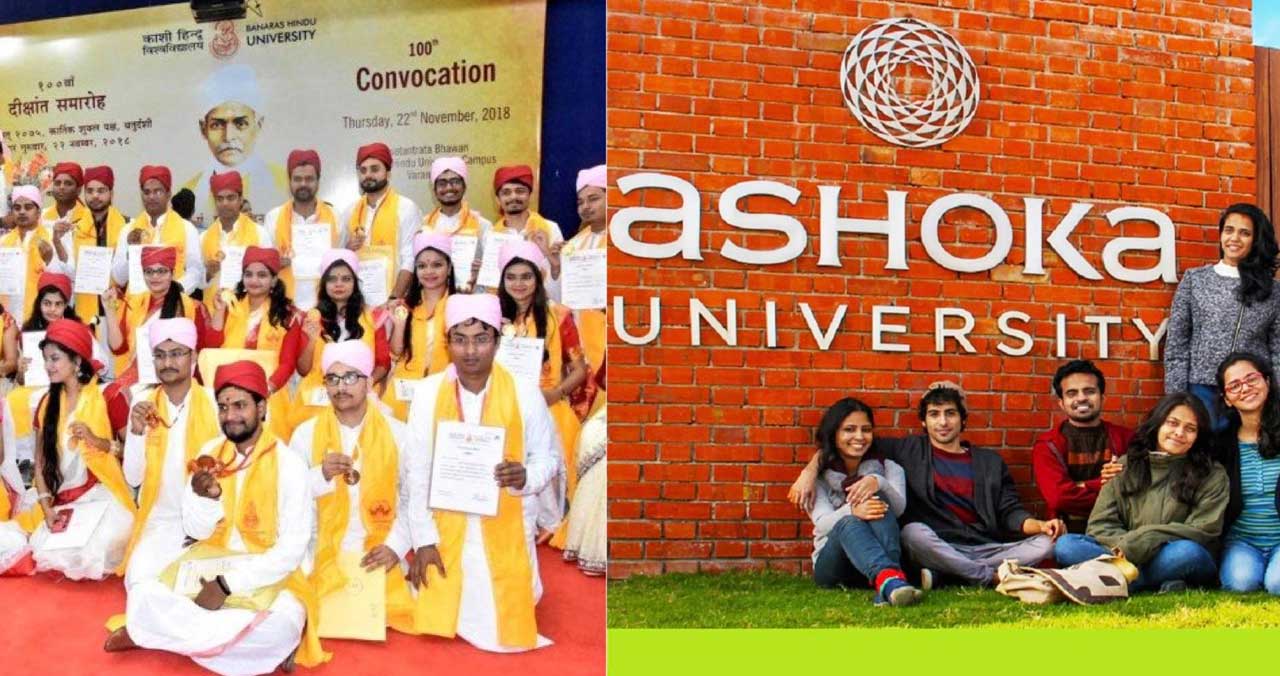
(Left) The 2018 Convocation at Banaras Hindu University; Students at Ashoka University
Weakening the government-owned educational institutions and encouraging the private institutions to educate the rich for foreign markets is not nationalism. India is not a nation of a single non-English national language like China or Japan. Hindi is not like Mandarin or Japanese. Opposing the use of the English language as the medium of teaching and learning in public institutions and allowing it to flourish in private institutions is a dangerous method that over a period of time will lead to Indian English becoming the new Sanskrit – a preserve of the few. The Shudra, Dalit and Adivasi intelligentia is not in a position to see the danger of this politics over the medium of instruction and syllabus by the Hindutva forces. There is no resistance from the academic bodies.
Banaras Hindu University, the Hindutva school’s brainchild, now has classes mostly in Hindi and allows both post-graduate and undergraduate students to take their exams in Hindi and English. But most students take their exam in Hindi and also write their dissertations in Hindi. This university, in the past 30-40 years, has not produced many intellectuals who could influence our education system. On the contrary, JNU, Delhi University and Hyderabad University have produced scholars, civil servants and politicians of visible stature. If the present trend of de-standardizing them continues they will turn into ordinary so-called nationalist universities.
Interestingly, the Hindutva school of thought is for massive privatization in industry, agriculture and education. Their push for privatization in the industrial economy is well known. They have also decided to privatize agriculture through new laws, against which the farmers have been fighting. Their policy on higher education has significant bearing on the future. The Ministry of Human Resource Development and the University Grants Commission are operating in two opposite directions. The private educational institutions are being allowed to be globalist (not nationalist) and the government-owned universities are being pushed into substandard “pure nationalist” ways. In a globalized world, such a regionalized education system would again make the poor Dalits, Adivasis and OBCs immobile and cause them to remain substandard.
In all of the central public universities, the Indian government controls the syllabus, language and organization. Global standards or competitiveness is not the focus there. The focus of Hindu nationalism is ancient Hindu (not Indian) knowledge and its goal is to do away with the English medium of instruction and learning. For example, while teaching Political Thought, there is an attempt to reduce the European Thought component and to let Indian Vedic, Upanishadic, Thought take its place. Exclusion of Buddhist Thought is quite conspicuous.
Even in universities like JNU and Delhi University the focus is not on improving the English-speaking and English-writing skills of students and helping them acquire globally competitive knowledge. Rather, it is on confining them to Hindi and Hindutva ideology. Even China is not so narrow-minded in its attitude to education.
The recent incident of Pratap Bhanu Mehta’s resignation and the subsequent debate that followed in Ashoka University also showed how teachers who have academic visibility have left the central universities like JNU and Delhi University and joined private universities confident that their global approach to education will be safe there. But all socially concerned academicians who are leaving the top government institutions and joining private universities must think again. Private universities, without representation of students and teachers from the poor sections, middle classes and historically oppressed castes, do not serve the mass cause in India. Just teaching the rich who can pay has no intellectual stimulation, at least in my view.
-
Why Modi’s Cabinet reshuffle doesn’t really benefit SCs, STs and OBCs
As long as there are foreign-educated, dominant-caste ministers who find a Cabinet position via Rajya Sabha, SCs, STs and OBCs will continue to lose out.
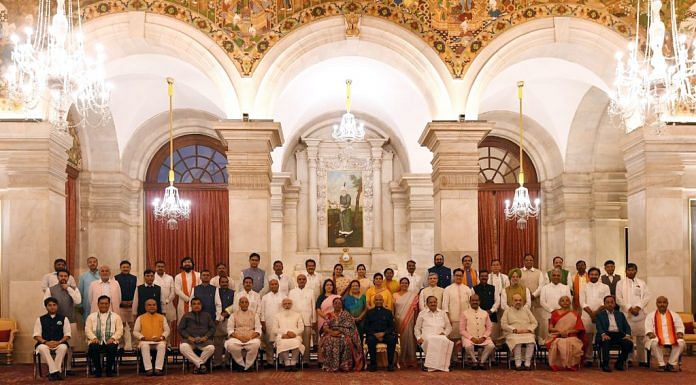
Prime Minister Narendra Modi in a group photograph with ministers during the swearing-in ceremony as part of Union Cabinet expansion, at Rashtrapati Bhavan in New Delhi today | ANIText Size: A- A+
After the recent Cabinet reshuffle of the Narendra Modi government, there are now 27 Other Backward Class, 12 Dalit, and 8 Adivasi ministers for the first time in our parliamentary democracy history. In all, Cabinet membership of OBCs, SCs and STs has reached 47. I do not know whether this number includes the prime minister himself.
However, the media highlighted the new number of OBC/SC/STs in the Cabinet, covering it over and over again. At the same time, it mourned the resignations of Ravi Shankar Prasad, Prakash Javadekar and Harsh Vardhan. For the national media, it was unthinkable that they could be dropped from the Cabinet.null
Now, while talking about OBC/SC/ST members and leaders, their caste becomes an identifiable marker. But the media not once mentioned, as it never does, the caste background of the so-called “meritorious” ministers who were dropped — Ravi Shankar Prasad is a Kayastha, Prakash Javadekar is a Brahmin, and Harsh Vardhan is a Bania with a Goel family name. Both Prasad and Javadekar have never won an election and entered the government only through Rajya Sabha membership.
Generally, the national media includes Shudra communities like Jat, Gujjar, Patel, Maratha, Reddy (G. Kishan Reddy from Telangana is the only Reddy in the Cabinet), Kamma, Kapu, Lingayat, Vokkaliga, Nair and Naikars, Mahisya (from Bengal) and many others in the OBC category. Let us not forget that the Shudra OBCs (both reserved and unreserved), SCs and STs together constitute about 77 per cent of India’s population — 52.2 per cent OBCs (as per the 1980 Mandal Commission report), 16.2 per cent SCs and 8.2 per cent STs (according to 2001 Census). If more than half of the council of ministers’ pool is from such a large population, why does it still become negative news?
Dwijas’ cushion
In our caste-cultural democracy, after Rajiv Gandhi came to power, those in the Congress and the BJP who are foreign-educated — the Oxford, Harvard, Cambridge walas — but could never win an election, became the ‘face’ of the government through Rajya Sabha. The national media always falsely projected only these people as the ‘real’ representatives of democracy. But the cornerstone of democracy is the elections on the ground. If the members of Rajya Sabha are made ineligible to become ministers at the Centre, the Dwija caste representation in the ministerial list will go down drastically. This is what the Mandal movement sought to do.
The OBCs who were part of the BJP when the V.P.Singh government implemented the Mandal Commission report in 1990, including Modi himself, thought that it was an anti-national agenda. But it created a massive power consciousness among the rural agrarian and artisanal communities, which Modi, with the OBC card, utilised to become the prime minister. But gaining power via Rajya Sabha has continued where the OBCs, Dalits and Adivasis have hardly any scope because it is a route of manipulation.
Manmohan Singh remained in Parliament for more than 20 years, serving as both finance minister and prime minister. So did P. Chidambaram (though he sometimes won elections), Jairam Ramesh, and others with a so-called “intellectual aura.” Ravi Shankar Prasad and Prakash Javadekar are also Rajya Sabha heroes, apart from Nirmala Sitharaman and S. Jaishankar who still are holding top ministries — finance and external affairs — in the Modi government. The friends of the English press — Arun Jaitley, Pramod Mahajan and Arun Shourie from the BJP camp also never won elections. They became famous leaders in top ministers via Rajya Sabha.
Shudra, Dalit and Adivasi leaders have hardly ever had this cushion. One good thing about these 47 OBC/SC/ST leaders is that, largely, they won elections at the ground level. Running the central government via Rajya Sabha with “proxy-intellectualism” is not a democratic method regardless of the BJP or Congress rule.
Bring the new intellectuals
There was a latent subtext in the media coverage — the inclusion of SC/ST/OBC ministers comes at the cost of the ‘merciless dropping’ of Ravi Shankar Prasad and Prakash Javadekar. It is seen as an ‘injustice to meritocracy.’https://1322ee43c91da0e0e1d18c4000cc230b.safeframe.googlesyndication.com/safeframe/1-0-38/html/container.html
If democracy means English-speaking intellectualism but denying it to the Shudra, SC and STs in the government schools, where a large population of children from these communities study, then it’s better to just abolish the electoral system itself.
We now live in an age of identities where different groups are asserting their right to be part of democratic governance with a vision and efficiency of their own. “Efficiency” has different meanings for different sections in this regard. Community identities are always laid on the power negotiation table in our governance. The Congress, the BJP, and the Communists have long tried to sweep caste and community identities under the carpet. But it does not work for the future. The Communist parties are dying because they do not recognise caste as an identifiable marker.
The only way to strengthen Indian democracy is by giving representation to those communities that have been relegated to the margins of Delhi’s power corridors all these years.
In a country where casteism is a key social organiser, the notion of secular-liberalism has been misused to control power by the Dwija English-educated elite.
The RSS and the BJP have now realised that the oppressed castes are conscious of the power of their votes. They will turn the other way if their representatives are not seen in the power structure. The Congress, meanwhile, has never attempted a deeper caste analysis because its powers rest within the hands of imported intellectuals.
This is not to suggest that ignorant individuals be brought into governing structures just to be inclusive of caste identities. Ambedkar also strongly opposed mere symbolic “slave-Dalit” representation in governance. The post-Mandal era has produced a number of well-educated Dalit, Adivasi, and OBC leaders and intellectuals who deserve their chance, for the future does not hold stead only for the former ‘greats’ but young voices destined to bring change.
Kancha Ilaiah Shepherd is a political theorist and social activist. His latest book is The Shudras — Vision for a New Path co-edited with Karthik Raja Karuppusamy. Views are personal.
(Edited by Srinjoy Dey)
-
St Stan Swamy – declared a saint by the Adivasis, Dalits and Shudras
Stan Swamy has saved India by his death. The world has come to know how the Indian regime could crucify one who worked for the most oppressed. Our constitutional democracy obviously has not changed the hearts of those who don’t love the Tribals and Dalits as fellow human beings, writes Kancha Ilaiah Shepherd
By Kancha Ilaiah Shepherd On July 8, 2021
Father Stan Swamy (Stanislaus Lourdusamy) who was systematically sent away to heaven, certainly not to hell as they wanted, from a Mumbai private hospital by the Indian government agencies on 5 July 2021, is in my view the greatest saint in the Catholic history of India. Normally, sainthood is conferred upon a great Catholic by the Vatican through an elaborate process. But Fr Stan Swamy’s sainthood is bestowed on him by WE THE PEOPLE OF INDIA – the Adivasis, Dalits and Shudras. From the time he started work in Ranchi, Jharkhand, the 84-year-old worked tirelessly for the poor, exploited and oppressed masses. He was persecuted for standing up for the human rights of the Adivasis to the point that despite limited judicial intervention, he was allowed to die from criminal neglect.Cruelty of this kind on an old and infirm priest is unparalleled. The Rashtriya Swayamsevak Sangh (RSS) and the Bharatiya Janata Party (BJP) central government has shown its contempt for his selfless service to the Tribals of India. This is not what the Indian civilization and culture stands for. The productive mass civilization of India salutes Stan Swamy for the sacrifice he made for its people.
St Thomas, one of Jesus’ original 12 disciples, was martyred in today’s Tamil Nadu in the first century of the Christian Era. St Thomas travelled all the way from Palestine (Israel) and planted the message of Jesus Christ so that it could take root in Indian soil, which it did. That was not an era of nationalism. It was an era of Jesus’s death and resurrection for all of humanity’s liberation from sin, slavery, ignorance and superstition. India needed such a messenger from outside at that time because of the brutal varna dharma that the brahmanical ancestors of the present Hindutva forces inflicted on the productive masses of India who built this civilization from Harappan civilization onwards.
They destroyed the human soul in this land of great Harappan civilization by creating caste and untouchability. All the food producers and artisans, those who worked with their hands, were rendered soulless by their brahmanical teachings and practices. They needed somebody from outside to instil a soul among them. St Thomas lit that flame and was martyred in our land.
Centuries after St Thomas, Mother Teresa who came from Albania spent most of her life ministering to the poorest of the poor – Dalits, Adivasis and Shudras – in India and also those who were suffering with leprosy and other serious diseases. For their services, shortly after her death, the Vatican declared her a saint. However, during her life of service, she encountered several insults from the same Hindutva forces. At a time when she was serving leprosy patients no RSS activist or Hindu saint was touching such Indians, let alone serving them. Their nationalism was working around the rich and healthy.
Stan Swamy was never a believer in violence. He went from his native Tamil Nadu to the central Indian tribal regions to educate them through various legal institutions. Since colonial times, Christian educational institutions and hospitals have worked to improve the life of such oppressed masses. One does not know how the central government and its National Investigation Agency (NIA) came to the conclusion that this frail, old man supposedly conspired against the Indian State. This is unprecedented!

Father Stan Swamy
Furthermore, it is hypocritical. Most of the English-medium-educated ruling class of India – including many top leaders of the BJP – studied in Christian educational institutions and even have been treated for serious ailments in their hospitals. Even today schools and colleges run by the Jesuits of India are among the most preferred by the Indian elite. Stan Swamy was associated with many such institutions. He was Director of the Indian Social Institute, Bangalore in the 1970s and 1980s with a great reputation for social work. Such a man, that too in his 80s, was accused of being a Maoist and arrested under the draconian law – the Unlawful Activities (Prevention) Act, which virtually declares you guilty until proven innocent.
Stan Swamy has saved India by his death. The world has come to know how the Indian regime could crucify one who worked for most oppressed. Our constitutional democracy obviously has not changed the hearts of those who don’t love the Tribals and Dalits as fellow human beings. The ruler’s heart hangs around the wealthy who have no moral value of sharing the wealth with the poor even when they are dying in a pandemic. Their spiritualism hangs around brahmanical saints who establish institutions in the West and accumulate wealth but not around those like Stan Swamy who left a comfortable life in Tamil Nadu and lived among Adivasis for decades to give them human dignity and self-respect.
They saw in St Stan a moral house that was accommodating these homeless masses. Burning that house was their cultural nationalism. St Stan is not dead. That burnt house will not become ash. He resurrects and rebuilds many houses for the Tribals, Dalits, Shudras and the poor to live as proud Indians. St Stan’s love for all was deeply rooted in his nationalism as he lived among the Adivasis who are the actual inheritors of the great Harappan civilization.
-
Jagan Reddy is giving Andhra Pradesh children something better than gold — English education
The Andhra Pradesh model of education under CM Jagan Reddy is breaking barriers for children. He’s equalising language.
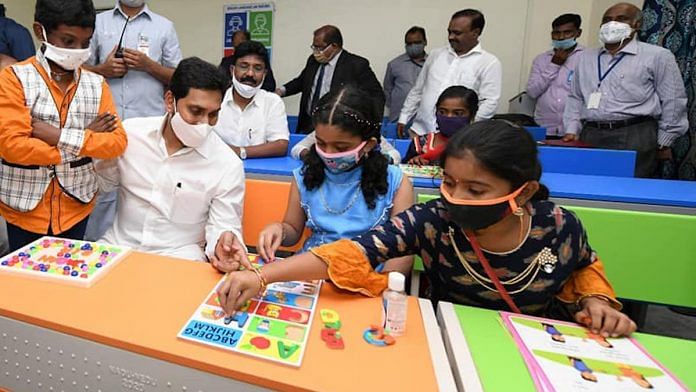
File photo of Andhra Pradesh CM YS Jagan Mohan Reddy at a school | Facebook/ysjaganText Size: A- A+
The Andhra Pradesh government is doing an unusual experiment in the education sector. In 2019, it introduced English as the medium in government schools from class I to VI — a move stuck in legal trouble. Now the government has made English the medium of teaching in all UG colleges. The state’s young and ambitious chief minister Y.S. Jagan Mohan Reddy had to fight several battles to do so.
The hypocrite intelligentsia of the state, who educate their own children in costly private English-medium schools, opposed the move and made it a huge ‘mother tongue’ issue. They shouted ‘mother tongue is like mother’s milk’. When the shouting did not cow down Jagan, they went to court.null
The Andhra chief minister launched a counter-attack by exposing their hypocrisy and deployed his young cadre and leaders to counter their street and media fight. The Telugu Desam Party, the Bharatiya Janata Party, and the Left forces opposed him and said he was anti-Telugu. But Jagan stood his ground because English medium education was part of his navaratnalu (nine jewels) programme and a promise in his election manifesto.
Jagan also made one Telugu subject compulsory in private and government schools, and ordered all textbooks to be printed in bilingual mode. The same lesson will have the English version on one page and the Telugu version on the other for all subjects. His critics had no option but to keep quiet because this also pushed their own children into learning two languages, even in private schools. Many private English medium schools till then were not allowing Telugu learning at all.
Also read: No more Telugu medium in Andhra — Why Jagan govt wants English in all schools, colleges
Jagan’s education overhaul
Jagan Mohan Reddy got the support of the people because most rural, farmer, and middle-class parents prefer English medium education in government schools. No court can go against a child’s right to education in preferred medium, a principle the Supreme Court of India upheld in many judgments.
The right to English-medium education cannot be confined only to the private sector. Child is a child; their right is right whichever school they study in — private or government.
Jagan backed his English medium agenda with the Amma Vodi (mother’s lap) scheme, which gives a school-going child’s mother Rs 15,000 per year for educational expenditure along with total fee reimbursement for college education. Added to this, under Nadu-Nedu (earlier and today) scheme, he is investing huge amounts in changing the school infrastructure all across the state. This scheme is more concrete and qualitative than Arvind Kejriwal’s programme in Delhi. Andhra Pradesh is also a bigger state.
The chief minister also has clubbed the anganwadis with primary schools from this academic year, and increased the staff and school facilities. The government gives quality mid-day meals with a fixed menu for each day. The quality of food is better than in most states. A few days back, Jagan announced that there will be a primary school within one kilometre of every child’s house, a high school within three kilometres, and twojunior colleges within seven-eight kilometres. All these institutions will be English medium, with a strong Telugu component in one subject.null
The Andhra Pradesh government also launched a massive teacher-training programme to enable teachers to teach both in English and Telugu.
No leader focuses so much on education. Jagan Reddy is young a man of just 48. He has a long political life left. In fact, he is the youngest chief minister with his own regional party running the government in the country. If he continues this education agenda, he will leave a major mark on the nation’s public educational policy.null
Also read: Karnataka upset as Andhra makes English the ‘medium of instruction’ in its schools
A model for equality
It is well known that education is the most durable property in one’s life. It is better than gold. English education for Dalits, Adivasis and Shudrasworks like a gold mine in one’s own travel bag. This has been proved time and again.
But the post-Independence Indian rulers denied equal medium education by establishing two separate sectors—public regional language and private English language. The food producers and other labouring masses are starved for English language education in the garb of regional and national sentimentalism. The formation of linguistic states abetted that sentiment and worked in the interest of the English-educated elite.
Jagan Mohan Reddy is breaking that sentimental chain. He regularly reviews his education projects. No other chief minister is known for such a focus on education. His education budget allocation is fairly good. It appears that he also uses other resources for his education schemes.
Although the Narendra Modi government’s New Education Policy worked out a somewhat improved model of education, its language policy does not help provide globally competitive education to the rural and poor masses who cannot afford private English-medium schools. A new contradiction is emerging in the education sector during the BJP era. On the one hand, it is rigid about regional language school education in state government schools, on the other, it allows a huge number of private schools, colleges and universities to continue in English medium.
The Andhra Pradesh model of school education is the only option to provide quality and equal medium education to all children in schools. Since there is no scope to abolish private sector education where only the rich can study, bringing all schools to a level playing field is the only way out.
Kancha Ilaiah Shepherd is a political theorist, social activist. He is the author of From Shepherd Boy to An Intellectual-My Memoirs.
-
What BJP cannot do in the Telugu states: Kancha Ilaiah Shepherd writes

Courtesy: PTIhttps://babadd5a786dfbb2dc6c8c03527685e8.safeframe.googlesyndication.com/safeframe/1-0-38/html/container.html?n=0
In both the Telugu states, the Bharatiya Janata Party is trying to expand its base among the Backward Classes. It is trying to admit and promote anyone who comes out of the ruling regional parties and trying to give an impression that they want to bring the backward leaders to power. This has been their aspiration in the united Andhra Pradesh and in the divided two states. The recent trapping of Eatela Rajender and admitting him into the Hindutva party is part of that strategy.https://babadd5a786dfbb2dc6c8c03527685e8.safeframe.googlesyndication.com/safeframe/1-0-38/html/container.html?n=0
The BJP adopted this strategy in West Bengal where a regional Trinamool Party headed by Mamata Banerjee, a Brahmin woman leader, is in power. It first promoted Dilip Ghosh, a Sadgop backward leader, as the party president. Sadgops are historically shepherds and cattle herders in Bengal who were treated as disrespectable people by Brahmins, Kayasthas and Vaidhyas. These three castes also are known as Bhadralok with common cultural status. These three castes are highly English educated by starving the Shudras and Namashudras (Dalits) of that language. They did not even implement reservation in that state keeping the productive castes completely marginalised. This was the worst casteist legacy that the left Bhadralok leaders handed over to the masses.
Ever since independence in 1947, only Brahmins and Kayasthas have ruled that state. Modi and Amit Shah thought that the BJP can come to power only with Shudra and Dalit votes as they do not get Muslim and English educated Bhadralok votes in that state. In the 2021 elections, the BJP purely organised on caste lines and became an opposition party.https://babadd5a786dfbb2dc6c8c03527685e8.safeframe.googlesyndication.com/safeframe/1-0-38/html/container.html?n=0
In north India — particularly in Uttar Pradesh and Haryana where the backward class leaders were in power — they brought in leaders like Adityanath, a Ksatriya; Monohar Khattar, a Khatri; to power. They are trying to work caste-based calculations more carefully than the Congress at the national level and at the regional level.
But in the south, there is a different situation. The Brahmin, English-educated leaders went out of power a long time back. Mostly Shudra regional leaders are in power as they weakened the Congress step by step. The implementation of reservations in the south Indian state universities and government services are done according to the rule book. Tamil Nadu took the lead in the reservation ideology and implementation process.https://cdm.connatix.com/amp-embed/index.html?playerId=d8bdd770-c07c-42b5-9793-4354b40292db&url=https%3A%2F%2Fwww.thenewsminute.com%2Farticle%2Fwhat-bjp-cannot-do-telugu-states-kancha-ilaiah-shepherd-writes-151008%3Famp%23webview%3D1%26cap%3Dswipe
Even in the north Indian states like Gujarat and Madhya Pradesh, where the BJP was in power for a long time, the pro-poor welfare schemes were minimal. In these states, the education system is very backward and English medium education is weakest. They are in fact opposed to English medium education as part of their ‘Hindu, Hindi and Hindustan’ ideology. They only allow private sector English medium schools and colleges if they are run by monopoly companies that support them financially.
In Telangana and Andhra Pradesh, even if the BJP makes BC leaders Chief Ministers, the problem is that their welfare agenda is not in the hands of the state units of that party. The welfare economy of Andhra Pradesh, Telangana, Tamil Nadu and Kerala is several fold higher than any BJP-ruled state in the country. Take for example the old age pension. In AP and Telangana, people get Rs 2000 per month for those who are above 60 years. This scheme is not there in BJP-ruled states. No BJP-ruled state has residential schools for SCs, STs and OBCs. The SC/ST/BC budget is not comparable to any south Indian state where the regional parties are in power versus the north Indian states where the BJP is in power.
The main drive in the BJP-ruled states is not economic and educational development but religious issues. Even the Chief Ministers are given direction by the RSS on how the government should focus around religion and temples by constantly opposing Muslims and other minorities. Madhya Pradesh, Uttar Pradesh and Gujarat are good examples where the backward classes are sent on pilgrimages with government expenditure and constantly made to live in superstition without allowing them to improve their educational standards.
In AP as of now, the biggest welfare agenda is around education. In Telangana, it is the Rythu Bandhu. There is no doubt that the Rythu Bandhu programme is putting more money in the accounts of those who own more than 10 acres, which is not a good thing. That money should have been shifted into school and college education and employment. If the BJP comes to power with a BC leader as the Chief Minister, for such leader, spending on quality education and farmer welfare will not be possible because the BJP is not a region centred party. It is a national party that will not accept anything but a religious agenda. No Chief Minister can go out of that agenda.
The first Chief Minister while working from a national party like Congress to raise the bar of welfare in the state was YS Rajasekhara Reddy. But for that, he needed a big status of a mass leader to get votes on his own and put the central agenda in check. He did that. No BJP Chief Minister, including Modi, evolved such welfare schemes independent of his national party agenda. He was more robust in implementing their anti-Muslim agenda, but not SC/ST/OBC welfare agenda.
In Telangana, the Congress state unit failed in evolving a better welfare agenda than the TRS, which itself does not have a very good welfare agenda. The Congress state units also heavily depend on their national agenda, which does not allow very effective welfare schemes. The BJP is a more rigid national party than the Congress, which hardly has democratic vision. The BJP did not accept Modi’s sabka saath, sabka vikas agenda in his second term hence it has drawn him into very anti-Muslim issues like Kashmir, CAA and Delhi riots.
The most effective welfare agenda that BJP cannot think of accepting is AP’s English medium from KG to higher education, and the financial backup for the family of students. Once the SC/ST/BC masses realise that the effectiveness of English medium education with a strong financial back up like Amma Vodi and fee reimbursement, they will not get into the BJP fold. In Telangana also, either the ruling party or an alternative regional party could implement similar English medium school, college education, and strong fee reimbursement and parental financial assistance programmes. People do not vote for the BJP because it promises to make a BC leader the Chief Minister.
Since the regional parties can decide for themselves how to spend their budget, the only course left to the regional parties is to go for a stronger dose of welfare and education as against the bulldozing methods of the BJP from Delhi.
Kancha Ilaiah Shepherd is a political theorist, social activist and author of Why I am Not a Hindu — A Sudra critique of Hindutva Philosophy, culture and political economy. Views expressed are the author’s own.
-
As India struggles with Covid-19, can the RSS escape responsibility for the crisis?
The ruling party’s parent organisation failed to gauge the enormity of the medical crisis and to direct the BJP to act appropriately.

RSS head Mohan Bhagwat. | Twitter/@Rssorg 
Is Prime Minister Narendra Modi primarily responsible for India’s current Covid-19 tragedy? On May 15, Rashtriya Swayamsevak Sangh chief Mohan Bhagwat declared that the government, the administration and India’s people had become complacent after the first wave of Covid-19 ebbed. The the Opposition and the media were quick to note that the head of the Bharatiya Janata Party’s parent organisation had included Modi in its list of those responsible for the tsunami of deaths.
But what about the responsibility of the RSS itself? After all, the RSS, despite maintaining that it is non-political, does everything in its power to ensure that the Bharatiya Janata Party comes to power – and stays there.
Bhagwat has previously claimed that the organisation that he commands could be readied to fight India’s enemies at the borders at only a few day’s notice. How did this powerful organisation fail to gauge the enormity of the medical crisis correctly and direct the BJP and its prime minister to deal with it appropriately?
Moving forward
As is well known, Modi spent decades as a full-time RSS worker. After the 2002 Gujarat riots that occurred when Modi was the state’s chief minister, the RSS and Modi seized the moment to strengthen the narrative of Hindu victimhood and move forward to New Delhi. They shared an ideology of “I use you and you use me.”
Modi and Mohan Bhagwat know this well. They used each other even as their common enemy – Muslims – remained constant. Neither had an agenda to develop India on all fronts, ensuring faith in democracy and human equality. They have never believed in the core principle of democracy – liberty, equality and fraternity.
It is clear that Mohan Bhagwat is the most powerful RSS sarsanchalak since the organisation was created in 1925. No other head of the Sangh has had such an influence on the Indian state and civil society – particularly the Hindu civil society – as Bhagwat does.
This is because before Modi won the elections 2014, the RSS-BJP had never been in control of Delhi and so many states. Even Vajpyee’s tenure from 1999 to 2004 was limited by a coalition in Delhi, with only a few states in BJP control. As a consequence, KS Sudarshan, the RSS head for nine years from 2000, was less influential than Mohan Bhagwat is today.Narendra Modi in RSS uniform.
In March 2020, when the pandemic first came to attention, the RSS-BJP pushed the theory that members of the Tablighi Jammaat Muslim group were responsible for spreading the virus because they had gathered for a religious conference – even though it had started before lockdown was announced.
As it turns out, the RSS is even more responsible for spreading the coronavirus this year. Isn’t the RSS responsible for the Kumbh Mela that the Uttaranchal and Uttar Pradesh governments organised? Who should be held responsible for the spread of the virus from the Kumbh to villages around the country and mass deaths around the sacred river Ganga?
At the same time, when elections were taking place in five states, the RSS was involved in mobilising vast numbers of people for public meetings for Modi and other leaders. Didn’t the virus travel along with RSS activists from house to house, village to village, city to city?
There was news during the election campaign that Bhagwat had contracted the coronavirus disease and had to be hospitalised. Even then, he did not openly suggest that the elections should be postponed. He clearly did not get cured by the cow urine and dung therapies that some Hindutva supporters are pushing. Despite this, he has not come out to criticise this pseudo-science.
Caste drives power
Mohan Bhagwat and Modi have grown in the same organisation. Until Modi became prime minister, he had no control over the all-India networks of the RSS and its vast network of organisations. Given the caste cultural control in the Sangh, Bhagwat was a very powerful man in the RSS when Modi – a member of the Other Backward Classes – was nothing. Before 2002, Modi took his orders from Mohan Bhagwat in the RSS and another Maharashrian Brahmin, Promod Mahajan, in the BJP. Caste has always driven power in the RSS-BJP structures.
The only thing that worked in Modi’s favour was his Gujarati background which gave him strong links to business networks. Once he became Gujarat’s chief minister, a position he seemed to win almost accidentally, he used his networks well to propel him further. It is certainly unthinkable that Mohan Bhagwat accepts Modi as a leader of greater stature even now. After all, Kautilya never accepted that Chandragupta Maurya was superior to him.
How can India believe that Mohan Bhagwat and the organisation that he heads has no role in bringing the nation to its present crisis? They must own up to their role in this devastation. Escapism is not nationalism.
Kancha Ilaiah Shepherd is a political theorist, social activist and author. His latest book is The Shudras – Vision For a New Path, co-edited with Karthik Raja Karuppusamy.
-
A team that never was a hope provider for the poor
Mohan Bhagwat, Jaggi Vasudev and Sri Sri Ravi Shankar to “create hope” amidst Coronavirus pandemic
Kancha Ilaiah Shepherd18 May 2021
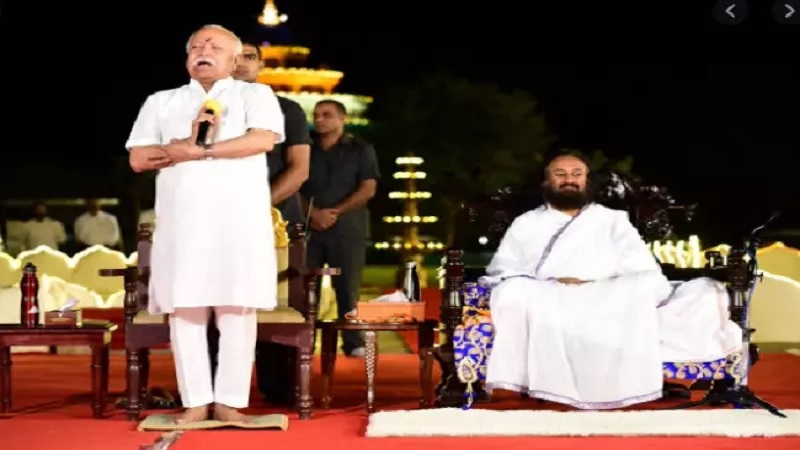
Image Courtesy:newsroompost.com
Just a few days ago, I saw an interesting news item on my mobile phone. The Rashtriya Swayamsevak Sangh’s (RSS) top leader Mohan Bhagawat and his friends: Jaggi Vasudev, and Sri Sri Ravi Shankar, will address the nation to create hope in times of Corona dance of death. One does not know what networks they will use to do that? According to the news item, they will create an opinion of ‘positivity’ in an atmosphere of ‘negativity’. Obviously, the negativity refers to opposition to the RSS/BJP central Government all over the world and India.
The news of these three great saintly men creating hope is being propagated by the RSS cadres. I wish they would have included all the Shankaracharyas of different pittas in the country. Of course, another Yogi–Adithyanath, who also heads a pitta, apart from the Uttar Pradesh Government where mass cremations are happening like a Kumbh, should have been part of the team.
The Prime Minister himself, who now looks like a saint not a ruler, will anyway address the nation from time to time.
However, the declared team consists of a Saraswat Brahmin from Maharashtra, a Tamil Brahmin who mostly lives abroad and educated in English medium at St. Joseph college of Bengaluru. The third is a Dwija educated at Mysore university-that too in English literature with a chequered life and final guruhood of international institutional base. The Indian diaspora and native upper middle-class swings and waves as they speak but the vast masses of food producers do not know what their guruship is. It is this productive nation that needs hope. For the whole nation should get hope from the central Government not from saints and sanyasis.
The RSS wants to use Ravi Shankar and Vasudev to add Hindu international networking. But the question is why this team did not find a Hindu Guru born in Shudra farmer family and a Dalit family. Is it because they are less Hindu, as they belong to the fourth varna and also no varna (Dalits are known as avarnas)? In the teaching of these three socio-spiritual leaders is there a single sentence that: ‘All Hindus Are Created Equal by Hindu God’. Is there a caste-free God they visualised for protection of all Hindus, leave alone Muslims, Christians and Sikhs of India?
Even assuming that they do not want to save the atheists and seculars, worldwide who were said to have worked for the advanced medical science, how many rural hospitals these gurus established in our poverty-stricken rural India? Ravi Shankar has a network in Geneva where there is a lot of oxygen to breathe in open air as well as in hospitals. But none in the Dandakaranya tribal belt where malnutrition is making their breathing more difficult than in any other part of the world. Why not that be his international base?
Jaggi Vasudev has networks across the United States including the wealthiest California state, but none in the Koraput tribal belt of Orissa. They learnt English in a manner that every English-speaking Asian, American, European, Australian would understand. But they never learnt a single tribal language of India. Their divinity flows in sweet English to promote ‘Hindu, Hindi, Hindustani’ and the RSS loves this nationalism.
Whom are they teaching their methods of pranayama (Isha foundation specialization)? Ravi Shankar is supposed to be an expert on rhythmic breathing. India is now dying without pranavayu, and no breathing–leave alone rhythmic. What scientific advancement they achieved and handed over to the nation? How many good hospitals that RSS and these foundations established to save the poor from lack of pranavayu in the villages and tribal areas?
Even before this deadly disease attacked Indian people in villages and urban slums were dying for want of enough oxygen in the atmosphere. What did they do? Why do they go to teach the Americans and Europeans who have everything–enough pranavayu, prana padarthas to eat along with plenty of cars and planes to travel? Why Hindu God is sending these gurus there not to tribal areas or even to African countries where there is nothing to eat and hardly any energy to breathe? They go to the US and Europe to acquire dollars, Euros and Pounds. How is that nationalism loved by the RSS?
In 1900, Ida Scudder reached the Vellore region to give life to lifeless and started a medical centre, which later became a trend setting hospital. What kind of guruship she initiated and what kind of guruship these Indian Dwijas established? The RSS leaders attack the Christian missionaries on an everyday basis. Did they establish a single hospital in the country that could match the Christian Medical College Hospital in their long life of 95 years? Did they ever look at what that hospital has done to the nation in subsequent years? That was the first hospital that started open heart surgeries in the 1960s itself, when no other hospital in India knew that science. Did any Hindu Pitta, or Foundation or organisation including the RSS did such constructive humanitarian work? Why accuse such Christians as anti-national?
The RSS and the gurus like Jaggi Vasudev, Ravi Shankar, who work around them as great Hindu nationalists must know the caste culture is causing more harm than corona to the spiritual will of the nation. Why are they so silent about it? In Uttar Pradesh where a Yogi rules, dead bodies are being discriminated against. Which culture is responsible for that? Where is a call from these gurus to not to do that?
Most organised religions in the world with strong notion monolith of faith are Hinduism and Islam, though they differ in caste cultural practices. In Hinduism these saints are in control and in Islam the Mullahs are in control. Why could vaccine science not develop in countries of those nations where they play a dominant role? Why does the secular world produce more vaccines and life-saving drugs? Why India of these pranavayu giving gurus begging for oxygen from secular nations? Why did the ‘Art of Living Foundation’, which is said to be a great teacher of breathing exercise, establish a vaccine producing industry and also an oxygen production centre? Do these gugus want to tell us those who breathed according to their methods are not attacked by Corona? We assume that Mohan Bhagwat follows them with a discipline of RSS but was attacked by Corona and treated in a modern medical system developed in Europe and America, not in the Art of Living breathing.
What kind of nationalism in Ravi Shankar and Vasudev the RSS found who established the Art of Living and art of pranayama in America and Europe but not in Indian Tribal Areas? Should Hindu nationalism be taught from California and Geneva to the farmers who are producing food for all Indian to survive and the safai sainiks who are cleaning the roads in the times of this deadly disease?
The RSS leaders must know that the nation is watching them when they are in the driving seat of the national power. There is enough intellectual base among the productive masses that can see through these English-speaking gurus, what they speak and do in their typical saintly attire here, and what they speak and do in America and Europe? The farmers, workers, shepherds, artisans and so on are already on ‘hope production’ jobs. They do not have to listen to these gurus to protect themselves from Corona. They are on the job of killing coronavirus in the fields by producing protein and raw material for medicines.
*Views expressed are the author’s own.
(Kancha Ilaiah Shepherd is a political theorist and social activist. His latest book is The Shudras–Vision for a New Parth co-edited with Karthik Raja Karuppusamy)
Other articles by Kancha Ilaiah Shepherd:
Disease distancing, not social distancing during Covid-19
Babu and Bhasha: The Game may end with this
Remembering Usaa: The greatest revolutionary barber after Upali
https://sabrangindia.in/article/team-never-was-hope-provider-poor


You must be logged in to post a comment.