-
Art Through the Mists of Time in Kancha Ilaiah’s Book Harappa
in Book Review


In 2015, I wrote an article titled ‘One Pound Capitalism, a Pinch of Democracy, and the Not-So-Holy Buffalo’. At the time, I was designing recipes as part of my discomfort food art/essay series, and the recipe ‘Buffalo Jumbo Pav (BJP) #1 hypocrisy kebab bonda pav’ which accompanied the article was inspired by Professor Kancha Ilaiah Shepherd’s response to the Indian state of Maharashtra, which had extended a ban on cow slaughter to include bulls and bullocks but not buffalo. He had said of the ban, “It’s racism and casteism. It’s racial because the buffalo is black. Why is black bad? They want to kill it like the white Americans did. The Aryan racist idea came into that. They drink the milk because it is white. So, dark buffalo gives white milk but she doesn’t qualify as sacred?”
About seven years later, I was thrilled beyond words when Prof. Ilaiah approached me to illustrate his important novel HARAPPA: God’s City of Civilization, which was published by Unbound Scriptin July this year. His text flooded my mind’s eye with vivid imagery. I clearly had a lot to work with.
HARAPPA is a work of fiction, but not of fantasy. Prof. Ilaiah kept his story within the bounds of what is known about the place and time in which it is set. I too had to be sure that my illustrations would be consistent with what scholars have learned after researching the Harappa Civilization for more than a century. Most of all, I wanted the imagery to reinforce the deeper messages that one finds in every page of Prof. Ilaiah’s text.
The People
The story focuses on the people of a village that will eventually play a pivotal role in the birth of the Harappa Civilization. In the illustrations, I represented those characters in accord with what we know of their ancestry. Their family tree traced back to two populations. One consisted of hunter-gatherers who had migrated out of Africa tens of thousands of years earlier and eventually settled in what today is northeastern Pakistan. The other ancestral group, also African immigrants, followed a more westerly route into Asia, ending up in what today is western Iran; there, they took up agriculture and then, much later, migrated to the same region of Pakistan. By the time Prof. Ilaiah picks up the story, at about 5,500 years before the present, the two groups have been coexisting and commingling for millennia. They have thus become one people.
In the book’s images, I portrayed the villagers in ways consistent with their African ancestry, given with what’s known from archeology, genetics, and the communities of indigenous South Asians (Adivasis) who still live in places across the subcontinent. As one guide to their general appearance, I took into account the way Harappans portrayed their own people in the artifacts they left behind at archeological sites. Thus, I gave most of the men black hair braided in rows running tight, crosswise, across the top of the scalp and arranged in two buns, one above the other, in back. The women wear their hair in thick, long braids pinned up and across in back (yes, they had hairpins).
The “winter festival” scene in Chapter III features two stars of Harappa’s archeological remains. The most famous, the 4-inch-tall “Dancing Girl” of Mohenjo-daro, with her sassy, strikingly modern pose, has captivated scholars for almost a century; in the book’s festival scene, I have her cheekily turned her back to us. For another of the foreground figures, I “reconstructed” a badly broken Harappan artifact, a small sculpture of a male dancerwhose body language suggests gender fluidity. Yet another festival-goer blows an egg-shaped whistle, examples of which have been unearthed by archeologists.
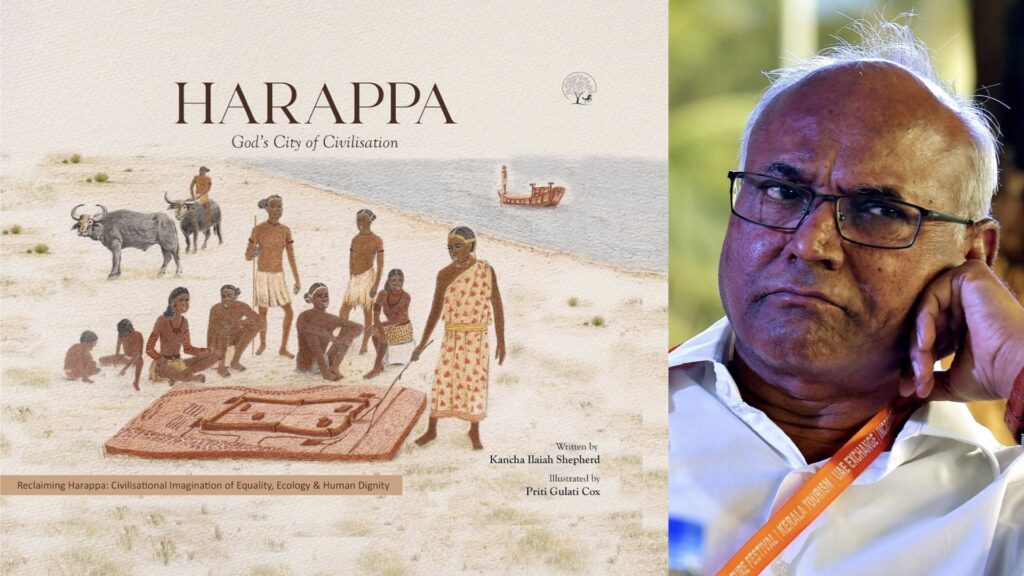
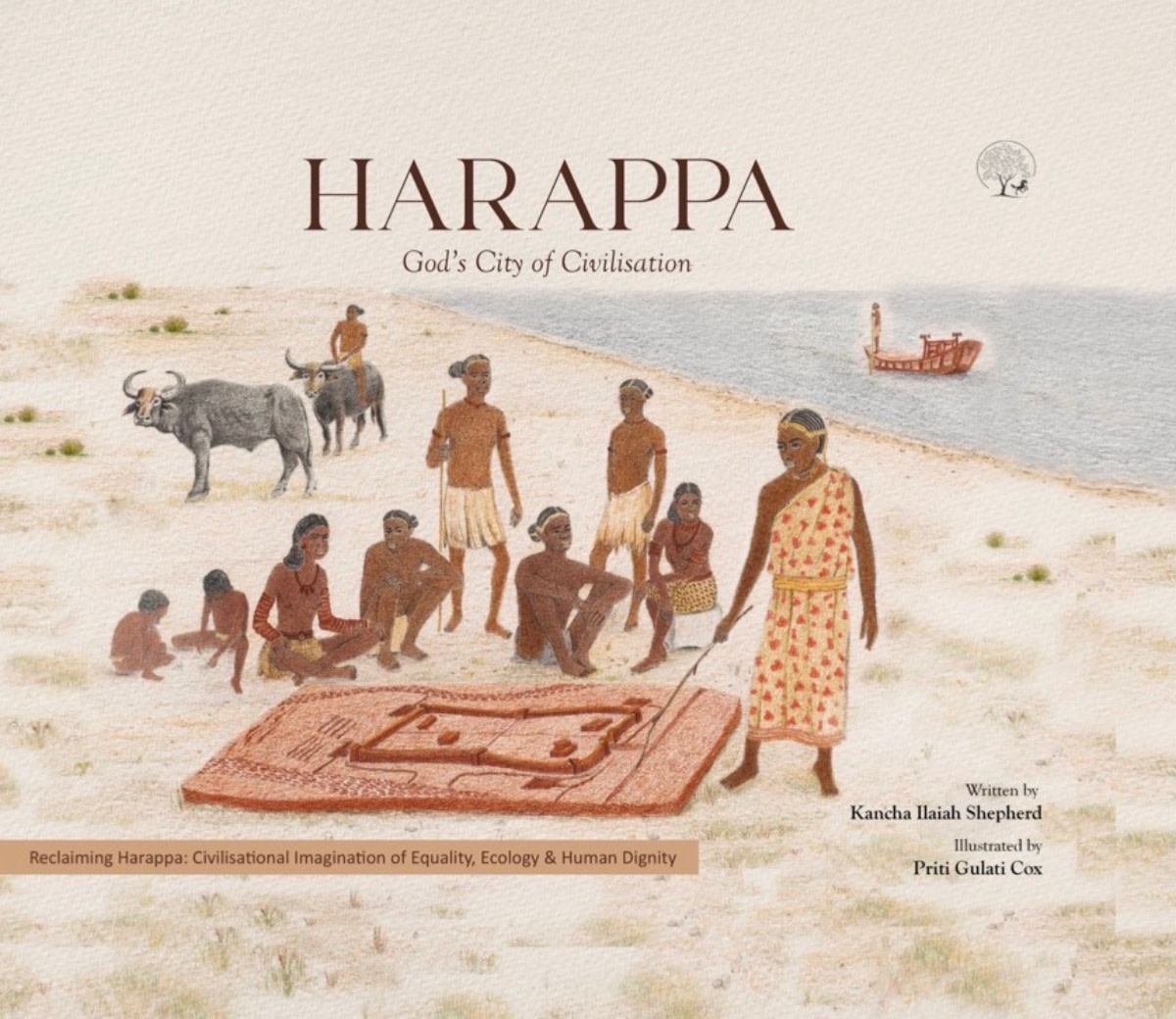
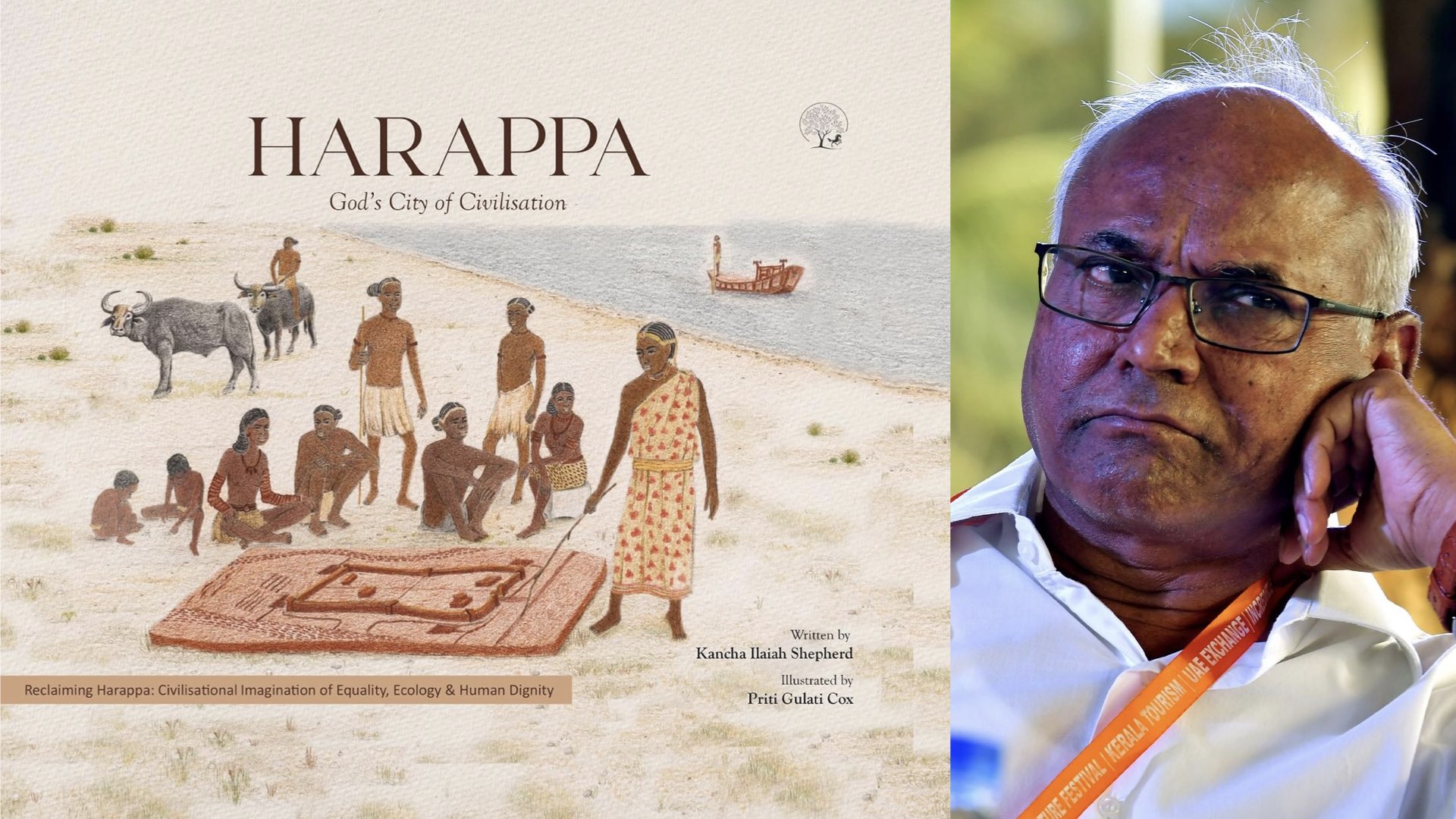
In the book’s cover image, I used still other Harappan sculptures as models for the sitting or squatting postures of people as they watch the main character, named Harappa, explain a clay model of the city that they will go on to build together. These resting postures remain common throughout rural South Asia today. The depictions of children in this and other of the images come from my observation of children at play in villages of south-central India.
For the scene in which a pottery-maker has sculpted an image of Harappa and offers it to him, I used as a model one of that civilization’s most well-known artifacts: the sculpture of a handsome, bearded man with the double-bun hairstyle known today as the “Priest-King.” (In the story, Harappa rejects the gift, saying, “I am not God. Take it away. We … must be above human worship.”)
A new character bursts onto the scene in the book’s closing chapters. Adidevudu (roughly, “first god”) is sort of a wandering philosopher. As Prof. Ilaiah describes him, “His lower body was covered with a lion’s skin, though it had several holes. Three harmless snakes were … coiling around his neck … He was the same color as Harappa. His hair was knotted on the top of his head.” He held a stick that had “three dried-up branches” on top.
Adidevudu is clearly meant to embody an indigenous South-Asian version of the god Shiva—centuries before Hindu gods were conceived of. Prof. Ilaiah clearly modeled him after several Harappan artifacts that are widely considered to be depictions of a “proto-Shiva.” These include several figures sitting in Shiva’s cross-legged yogic pose, as well as the aforementioned dancing-man sculpture, whose pose appears to presage that of the Nataraja or “Dancing Shiva.” Therefore, in the book’s five images of Adidevudu, a character who becomes crucial toward the end of the story, I portrayed him as a dark-skinned, somewhat eccentric version of Shiva.
Animal Domestication
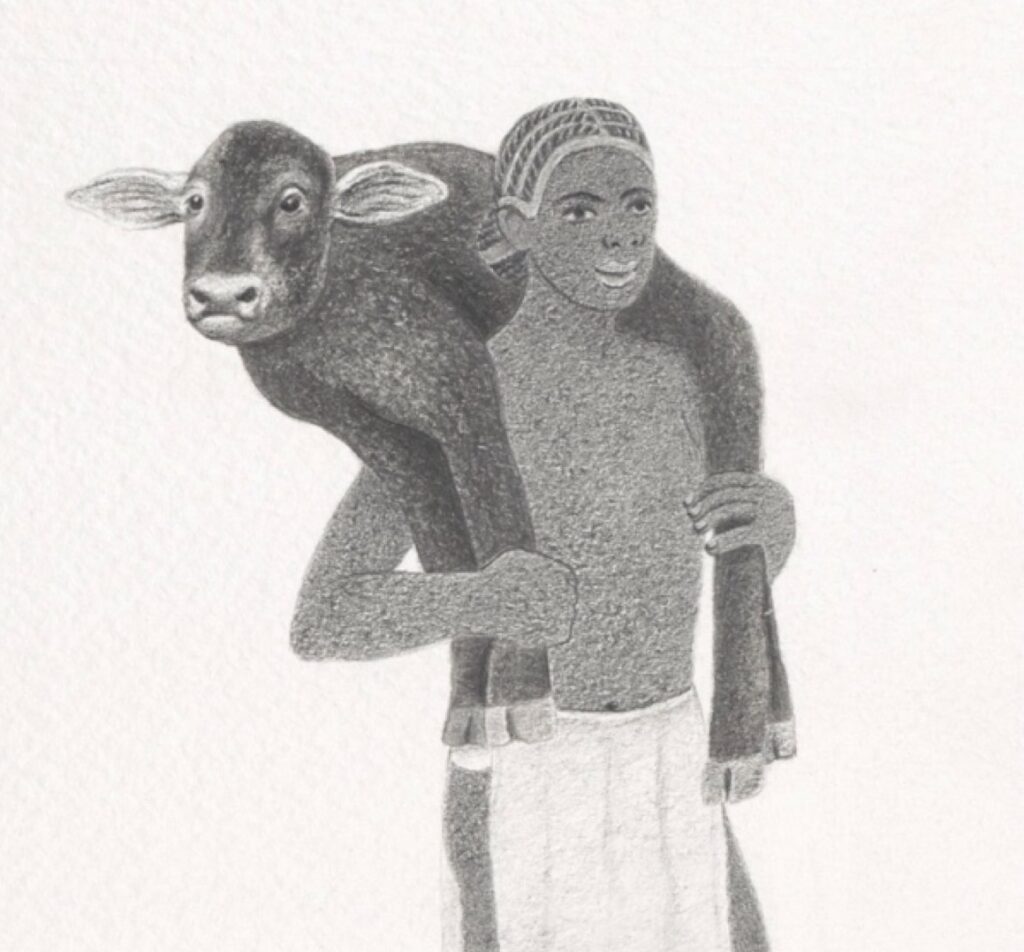
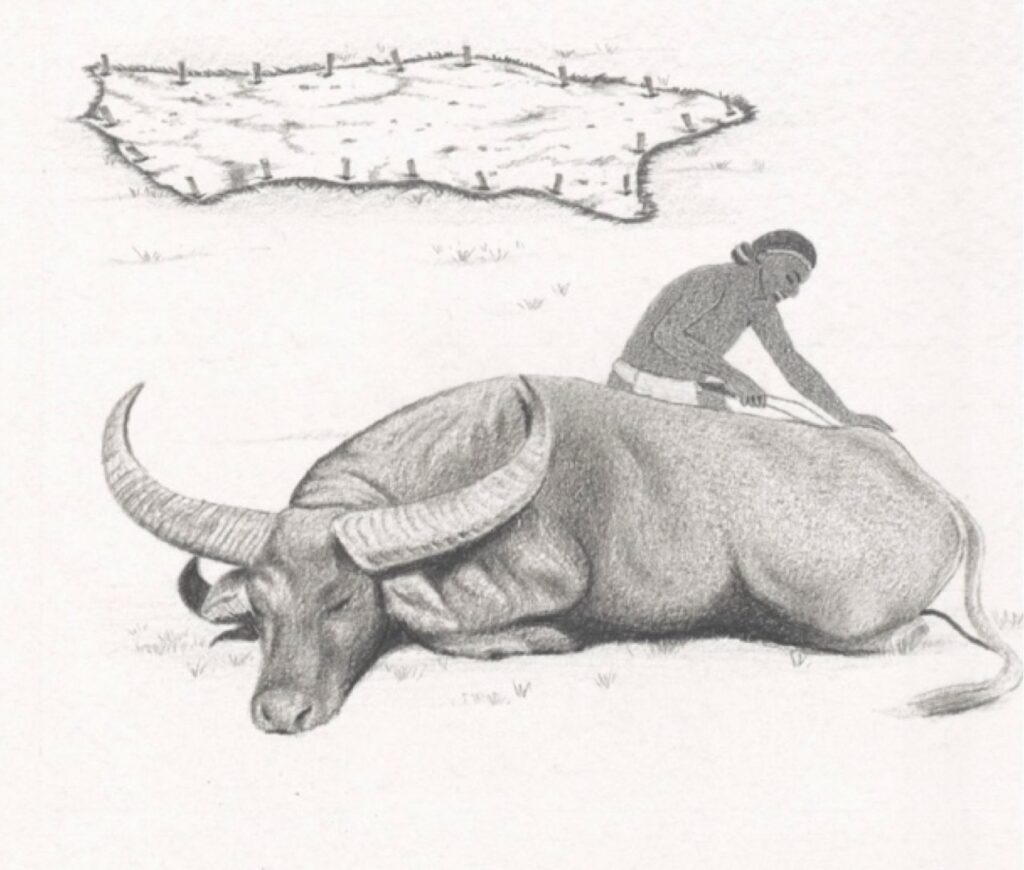
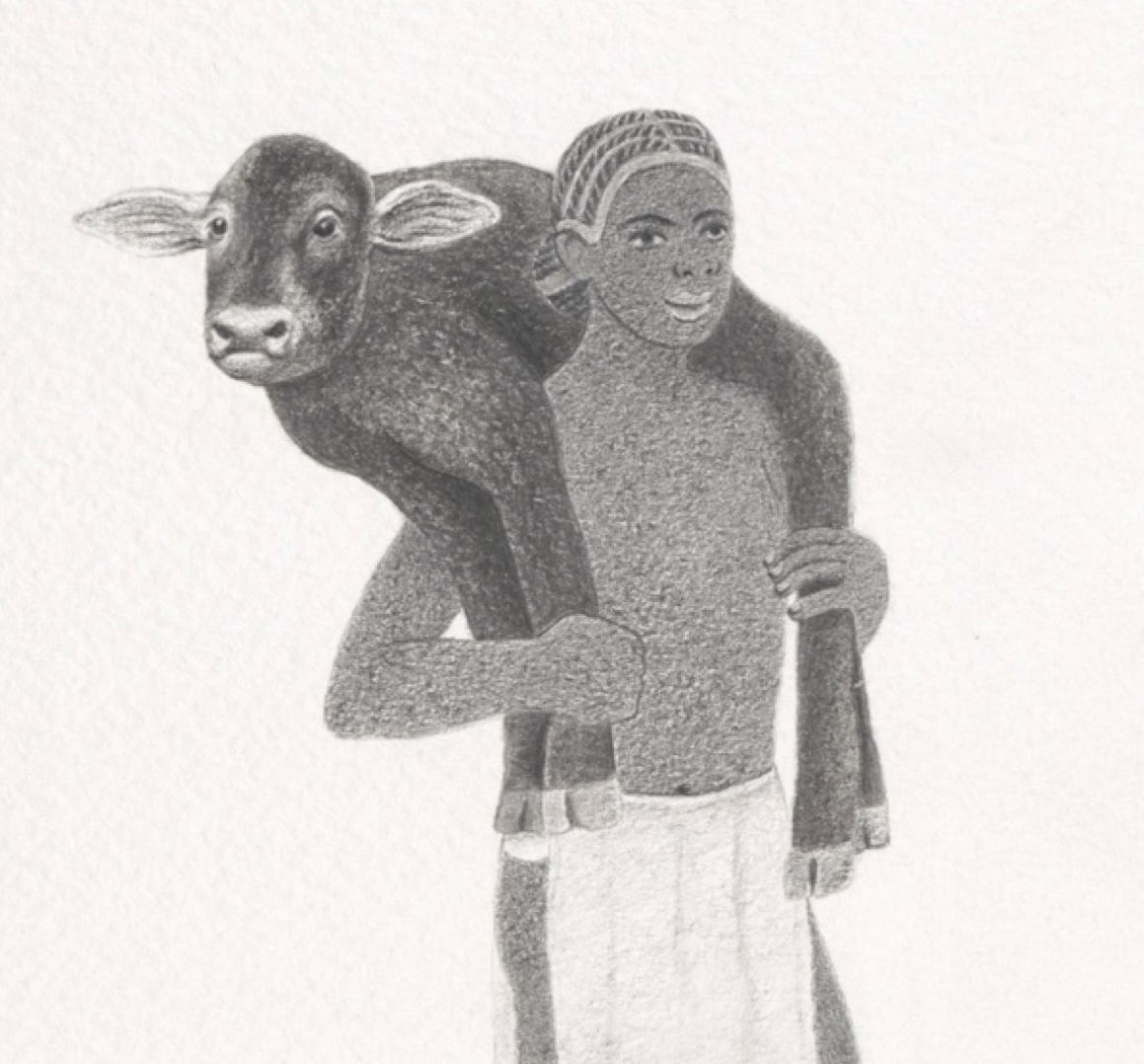
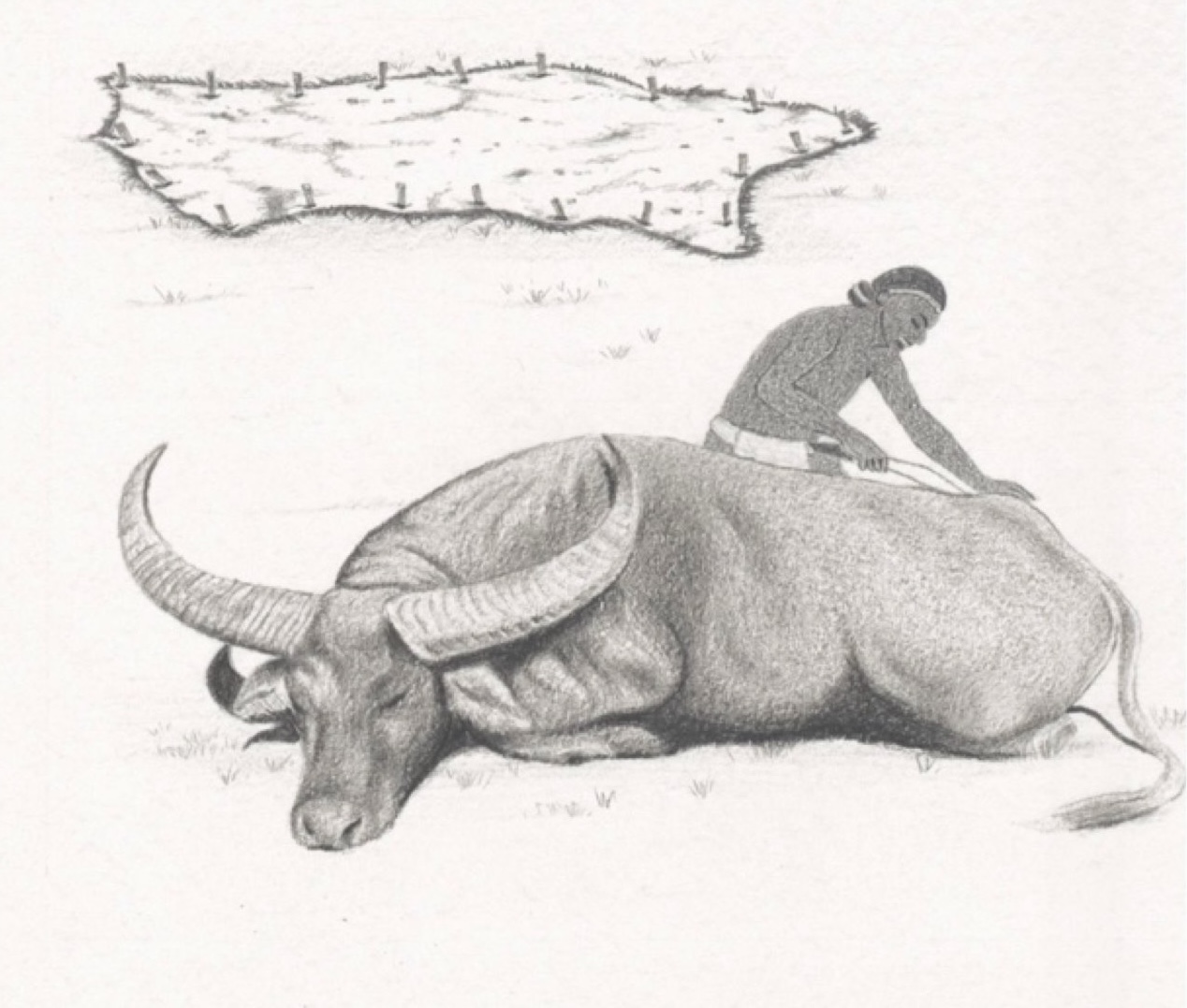
Animals, both wild and domestic, played a central role in the society that would become Harappa, and the book highlights animal domestication as an essential step in the civilization’s development. Several illustrations follow the book’s descriptions of how the people at the root of the Harappan Civilization herded sheep and goats and initiated the domestication of jungle fowl—progenitors of today’s chickens. They also hunted buffalo and deer for meat; therefore, I included images of men killing buffalo with large ornamental spears. I based these images on ritual artifacts depicting buffalo sacrifice that were found at Harappan sites. The book also describes Harappa, as a young man, taming a baby buffalo, feeding it on sheep and goat milk as a first step in developing a full-blown buffalo economy.
At this initial stage of domestication, the above animals were visually indistinguishable from their wild progenitors, and I portrayed all of them as such. The Harappans are also reported to have at least partially domesticated the dog, elephant, and camel, but they are absent from the book; nevertheless, I included a drawing of an Indian pariah dog. An animal that is featured on many Harappan seals and other artifacts, probably more than any other, is a creature that never existed: a unicorn with the body of a water buffalo.
Water
The Harappa Civilization evolved in a low-rainfall region of South Asia, and the archeological sites include a variety of sophisticated systems for waterstorage, distribution, and use, as well as wastewater management. Prof. Ilaiah’s story credits the origins of these systems to the efforts of a young woman named Maisamma, who begins by creating mud-walled reservoirs and canals to convey stored water to the village and surrounding fields. I included images of both.
Prof. Ilaiah includes a character named Neetiman who launches Harappa’s boatbuilding industry. The Harappans designed their boats for travel and trade, not only through the region’s river systems but also on the sea to locations as distant as present-day Oman. (Yes, they were shipping through the Strait of Hormuz more than 4,000 years ago.) None of the vessels survive, except as imageson tablets and seals, which I used as reference for illustration. Similar (though less lavishly ornamented) flat-bottomed boats are still used for crossing the Indus River in the Mohenjo-Daro area.
Food and Agriculture
Agriculture was fundamental to the founding of South Asian civilization. A plowed field uncovered in the 1980s in the southeastern part of the Harappa region dates back 4,800 years, to the very early Harappa period, and is regarded as the world’s earliest evidence of a row-cultivated plot of land. In the book, I depict that field as part of a composite image arranged in an Indian rangoli pattern, along with some of the crop plants grown in those days: wheat and barley (their staple grains), sesame, and mustard. Also included are a typical Harappan solid-wheeled cartfor hauling grain; a young farmer holding her sickle, her pose based on a photo I took of a harvester in south-central India; images of round grain-threshing platforms made of bricks (modeled on remainsthat were unearthed in Harappa intact) and of men pounding bundles of plants on such platforms to knock out the grain (based on my observation of present-day threshing methods on small farms in India).
The pipal (aka peepul or bo) tree, Ficus religiosa) has been revered in South Asia for millennia, including during the Harappa period. Its leaves are used for myriad purposes to this day in South India. I included pipal trees in two of the book’s scenes; in one, Harappa, as a young man, has climbed the tree to escape a charging mother buffalo.
Another rangoli collage, at the start of Chapter V, highlights more uses of plants by the characters of Prof. Ilaiah’s story. It includes the weaving of fabric from jute and the making of plant-based dyes. Then there’s an image of the plant Ephedra gerardiana, a gymnosperm considered to be the most likely source of soma, a stimulant that plays an important role in the most ancient Hindu texts.
Soma is believed to have held spiritual significance for the Harappan civilization. For instance, in artifacts, the fantastical unicorn is almost always portrayed as facing toward a hard-to-identify, seemingly ritual object. The most plausible answer to the question, “What is that thing?” is that it was a device was used to distill and filter soma. (Near the end of the book, I included an image of this device in a sepia-toned rangoli pattern that reprises many images from throughout the book.) I also feature soma in the book’s winter festival scene. Prof. Ilaiah writes that there was ample soma on hand at the party, and it was served in pipal-leaf cups. I depict the cups, along with tall clay urns in which the soma was stored.
The Rest Is History
Illustrations early in the book are rendered in shades of gray, with the images of people, plants, and animals appearing as though viewed through the mists of deep time. Partway through Chapter III, I start adding a little color here and there, starting with a peacock and then, in the party scene, adding color to the Dancing Girl’s bangles, wood fires, roasted buffalo and deer meat, and some laddoos—small buns made with ground wheat and barley grain. Then, toward the book’s end, around the time the proto-Shiva figure Adidevudu shows up, the images take on full, often garish color.
Soon, Prof. Ilaiah introduces four new characters: pale-skinned, cattle-herding, beef-eating Aryans who’ve wandered on horseback out of Central Asia and descended on the Harappa region. At this point, where the plot starts turning some unexpected corners, my images become more explicitly symbolic. At the book’s beginning and again near the end, for example, I placed composite images modeled on the southernmost petals of the mythological lotus-shaped map of India known as the Jambhu-Dwipa (“Plum-tree Continent”). In chapter I, the center of Jambhu-Dwipa, and petals radiating from it contain gray-toned scenes from Harappa when it was still a village. By chapter VIII, those scenes have been replaced by Mt. Meru in the center, and in the petals, scenes from the Vedic culture that would soon be migrating to Jambhu-Dwipa, stealing and claiming ownership over everything Indigenous.
In the bottommost petal of the second Jambhu-Dwipa image, I scatter a few specimens of Amanita muscarita across the landscape as a portent of things to come. Some scholars have suggested that A. muscarita (known as the fly agaric mushroom, bright red in color with white spots), not E. gerardiana, provided the active ingredient in soma. According to K.T. Achaya in his book Indian Food, those mushrooms exert “hallucinogenic effects of the kind described in the Vedas… Much of the poetic if rather cryptic imagery of the texts seems to fit the mushroom.”
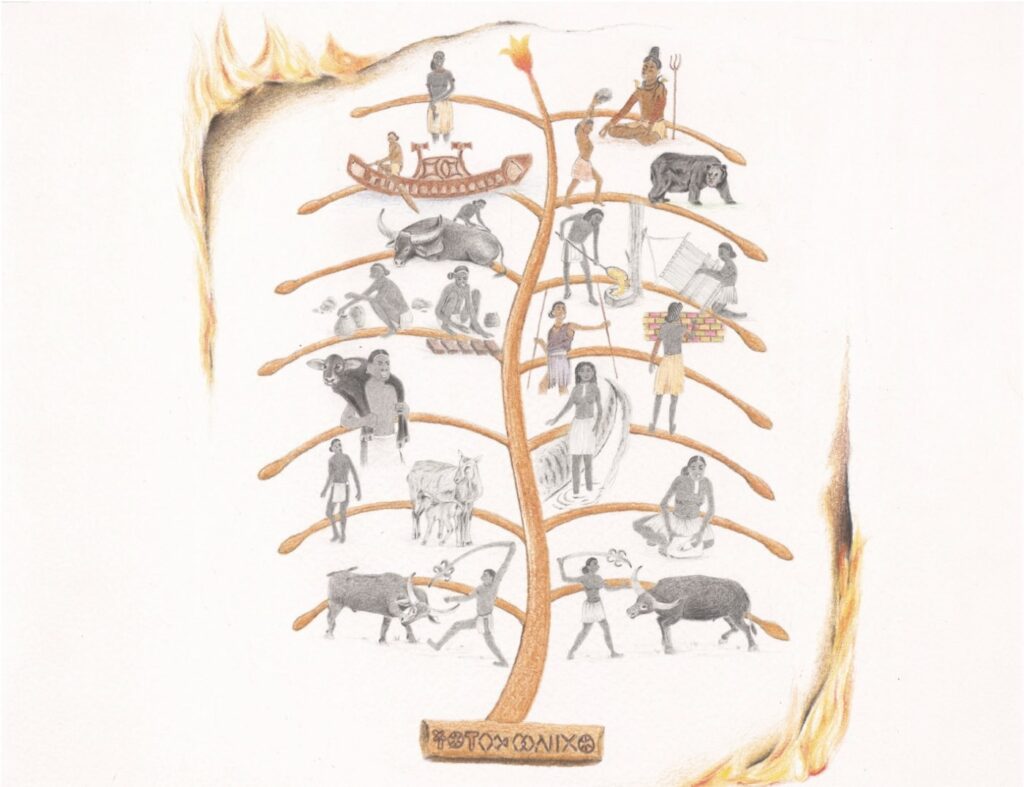
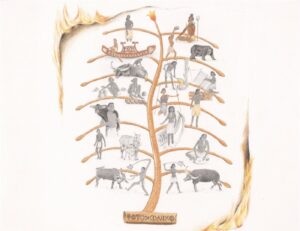
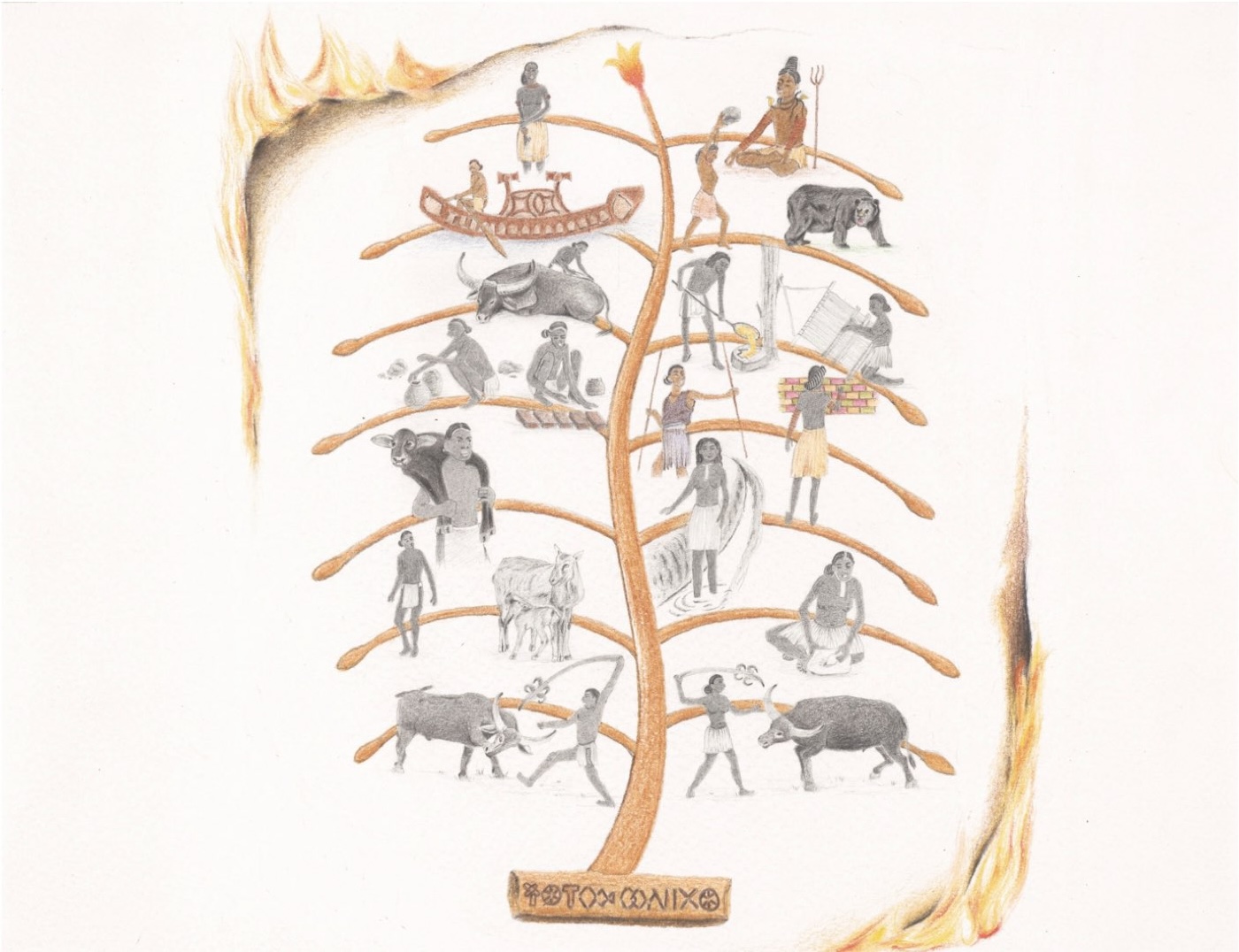
As a final sad farewell, I added a second pair of images. Each features a lively treerendered on a terra-cotta tablet. It’s one of the most well-known artifacts from Harappa. At the end of Chapter VIII, I depict the tree with its leaves replaced by thumbnail versions of images we’ve seen earlier in the book, most of them depicting Harappan technologies and practices: water travel, leather-working, metallurgy, precision brickmaking, animal breeding, painting, weaving, and more. I place the same image at the end of the story, with one change: the edges of the paper on which it’s drawn are now going up in flames, a portent of the Harappa Civilization’s demise.
Prof. Ilaiah ends his book with the four Aryan wanderers gazing out over Harappa City for the first time, leaving us to consult nonfictional history for the rest of the story. Of course, the historical, archeological, and biological records show that as the itinerant Aryan pastoralists migrated to and settled in the Indus and Ganges basins, they usurped and exploited Harappan agricultural methods, technologies, sacred and artistic practices, and approaches to designing and constructing visually impressive, highly functional, city-states. They seized political and cultural power and, after a few centuries, consolidated that power through imposition of the caste system. And the rest, as they say, is history.
Priti Gulati Cox, (@PritiGCox), is an artist and writer. Her work has appeared in Countercurrents, CounterPunch, Salon, Truthout, Common Dreams, the Nation, AlterNet, and more. To see her art please visit https://resistancembroidery.com/
https://countercurrents.org/2026/09/art-through-the-mists-of-time-in-kancha-ilaiahs-book-harappa/
-
दलित-पिछड़ों आंख कान खोलकर सुन लो प्रोफेसर कांचा
इलैया की ये बात?
-
Book review: Kancha Ilaiah’s autobiography is a lesson on dissent
The activist’s book “A Shudra Life” examines, in his own words, the life he led, the experiences that shaped him and who he became – written with honesty.

Dr Mahnoor Sahrash| Published: 14th September 2026 4:28 pm IST
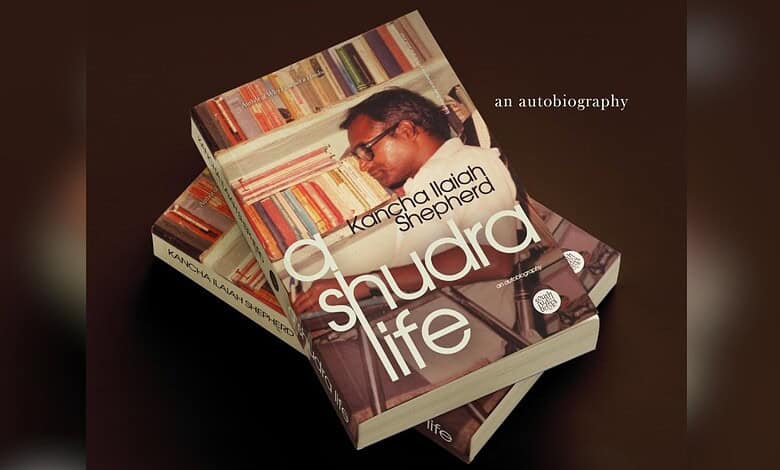
Kancha Illaiah, in his book “A Shudra Life,” examines, in his own words, the life he led, the experiences that shaped him and who he became.


“In the school, I became a being with a name that was written on a paper with a future of my own.”
Kancha Ilaiah Shepherd is one of the most prolific writers and activists from Hyderabad, with a style of writing and speaking not just unique, but filled with the kind of courage that is possible only when one has fully understood one’s own roots.
While he is known for being the voice of the marginalised and has written countless articles and books on issues related to the caste system, his book “A Shudra Life” examines, in his own words, the life he led, the experiences that shaped him and who he became – written with an honesty and clarity of thought typical of Ilaiah.
As someone who grew up reading his op-eds in Deccan Chronicle in the late 90s and the early 2000s, Ilaiah was one those rare writers in my repertoire of reading that spoke about caste and the social-cultural, political and ideological issues surrounding it. For urban readers growing up in that era, unless one was a student activist on the university campus, caste and its issues were news items reported and discussed without the insight and nuance it deserved. It is in such a space that Ilaiah’s writing and activism became so important.
A Shudra Life traces his childhood, with food and the local customs shaping a young man’s worldview, be it gender roles, the importance of community and most importantly, the importance of an education. Kancha Ilaiah in his study.
The book details the history of his family and the community it built, the role his grandmother and mother played in the family and the larger community, cementing in Ilaiah a lifelong admiration and respect for women.
His early experiences with school are quite delightful, especially since he went on to do his PhD and his post-doctorate and was a popular professor at the university, as he didn’t particularly take to schooling initially, with its rules and discipline. For a boy used to functioning among his beloved cattle and sheep and following the natural rhythm of nature, school proved to be a prison that expected him to go against his natural grain.
Over time, however, education became a major part of his life, especially when he realised its significance for the development of his community.Writer and activist Kancha Ilaiah Shepherd.
First encounter with caste
The book details his first tryst with caste supremacy, when at the end of a the funeral rituals for his mother, the priest expected his brother and him to touch his feet. Defiant, Ilaiah refused to do so, cementing his lifelong commitment to upholding his dignity and raising his voice against the perceived supremacy of certain groups over others. Another notable observation during the same time, that of the lack of pay parity in the groups who did the various rituals on the basis of caste, influenced him deeply.
These experiences cemented his resolve to study harder, since he increasingly understood the role his education was playing in enabling his sense of justice and fairness.
His tryst with Hyderabad, from his early days as a student pursuing MA in Political Science, to his professorship are detailed with interesting anecdotes, replete with caste and gender experiences, alongside his tryst with communist ideology and its after-effects in a constantly evolving political landscape, both in India and abroad. Kancha Ilaiah Shepherd’s mother, Kattamma.
Research on Buddha expanded scope of political scholarship
His doctoral research on the Buddha as an ideologue was unique and became a point of discussion in various groups that Ilaiah was a part of. Some criticised it, some found it intriguing. But what is important to note is that Ilaiah became one of the first humanities scholars to explore beyond standard political thinkers and opened up research possibilities that involved political activists and ideologues across different castes as well as religion.
As a teacher, he detailed, quite simply, the discrimination he faced, from colleagues criticising his research and activism to students refusing to sit in his class because of his caste. Against this backdrop, it is amazing how Ilaiah was able to rise above it all, keep speaking his mind and keep finding renewed purpose.
Involvement with feminism
Beyond caste, quite interesting to me, was his involvement with feminism ideology, being labeled “A male sister of the feminist movement in India,” by activist Susie Tharu. Perhaps the role his mother played in ensuring his education, the women scholars who treated him with respect and the women who shared his ideology and purpose, developed in him the kind of warm respect and admiration so rarely seen in men.
While he remains active and in good health and continues to write, his influence goes beyond borders and he continues to remain the voice of courage and reason – in a world where it is becoming increasingly difficult to find one.
Dr Mahnoor Sahrash
Dr Mahnoor Sahrash is a professor and researcher, currently heading the Department of Management Studies at St Francis College for Women, Hyderabad. A resident of Hyderabad, she holds a PhD in Business Management. Dr Sahrash has a deep interest in various issues that affect society at large.
-
Prof Kancha Ilaiah Podcast: God’s City of Civilization: From Harappa to Ramappa | A Shudra
Ramayana Has No Shudras: Kancha Ilaiah on God’s City of Civilization | From Harappa to Ramappa | M #kanchailaiah #god #harappa #ramappa #ramayan #shudras #life #city #mictvnews
Prof Kancha Ilaiah Podcast: God’s City of Civilization: From Harappa to Ramappa
-
God’s City of Civilisation
Prof. Kancha Ilaiah Exclusive
Mic Tv News
#kanchailaiah #godscityofcivilisation #harappa
#history #buchannamuchata #mictvnews.
-
वर्चस्ववादी विमर्शों के खिलाफ प्रति-विमर्श बयान करता एक लघु उपन्यास
‘हड़प्पा: गॉड्स सिटी ऑफ़ सिविलाईजेशन’ – कांचा आइलैय्या शेपर्ड का कथा साहित्य के क्षेत्र में प्रवेश एक साहसिक कदम है। यह एक उद्घोषणा है कि दमितों को भी यह अधिकार है कि वे अपनी सभ्यतागत विरासत की पड़ताल कर सकें, उसका बयान कर सकें और उस पर अपना दावा कर सकें। बता रहे हैं सत्य सागर
सत्य सागर August 28, 2026
Share on FacebookShare on Like on FacebookShare on X (Twitter)Share on WhatsAppShare on Telegram
प्रो. कांचा आइलैय्या शेपर्ड ने भारतीय इतिहास और समाज की वैचारिक नींव को जिस निरंतरता और निर्ममता से चुनौती दी है, वैसा भारत में सार्वजनिक जीवन में सक्रिय बहुत कम बुद्धिजीवियों ने किया है। वे करीब तीन दशकों से इसी दिशा में काम करते आ रहे हैं। इसकी शुरुआत उनकी युगांतकारी पुस्तक ‘व्हाई आई एम नॉट ए हिंदू’ से हुई थी। इसके बाद उन्होंने ‘बफेलो नेशनलिज्म’ व ‘पोस्ट-हिंदू इंडिया’ जैसी पुस्तकें लिखीं, जो प्रभावी साबित हुई हैं। प्रो. शेपर्ड शुरू से ही यह कहते आ रहे हैं कि देश के बौद्धिक और सभ्यतागत विकास की कहानी से देश के उत्पादक वर्गों – शूद्रों, दलितों एवं आदिवासियों – को बाहर धकेल कर दिया गया है।
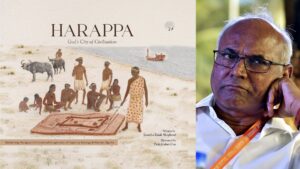
हाल ही में प्रकाशित उनकी कृति ‘हड़प्पाः गॉड्स सिटी ऑफ़ सिविलाईजेशन’ उनकी बौद्धिक प्रयास की अगली कड़ी है। मगर उन्होंने इस बार अपनी बात कहने के लिए एक अनपेक्षित विधा को चुना है। यह पुस्तक सभ्यता की विकास यात्रा को चित्रों के साथ कहानी के रूप में सुनाती है।समीक्षित पुस्तक का आवरण व प्रो. कांचा आइलैय्या शेपर्ड
प्रो. शेपर्ड का लेखन वर्चस्ववादी नजरिए को चुनौती देने तक सीमित नहीं रहा है। उन्होंने इन नजरियों को सिर के बल खड़ा कर दिया है। ‘हड़प्पाः गॉड्स सिटी ऑफ़ सिविलाईजेशन’ एक साहसपूर्ण साहित्यिक और बौद्धिक पहल है, जो वैदिक पुराकथाशास्त्र के बरक्स सिंधु घाटी सभ्यता को खड़ा करती है। प्रो. शेपर्ड कहते हैं कि सिंधु घाटी की सभ्यता का निर्माण बलि और अनुष्ठानों से खुश होने वाले देवों, जो अपने भक्तों को दिव्य पुरस्कारों से नवाजते हैं, ने नहीं, बल्कि साधारण मनुष्यों ने किया था, जिनकी महानता यह थी कि उन्होंने जानवरों को पालतू बनाया, फसलें उगाईं, नई तकनीकों का आविष्कार किया, नगर बसाए और मनुष्य की प्रगति की भौतिक नींव तैयार की।
एकबारगी ऐसा लगता है कि यह किताब बच्चों के लिए लिखी गई है। इसकी शुरुआत में हमारा परिचय कथम्मा नामक एक पात्र से करवाया जाता है जो गांव का किस्सागो और वैद्य है। वह सिंधु घाटी की प्राचीन सभ्यता के अवशेषों के नज़दीक रहने वाले बच्चों के एक जिज्ञासु समूह को हड़प्पा के भुला दिए गए अतीत से परिचित करवाता है। इस आसान से तरीके से प्रो. शेपर्ड एक कठिन लक्ष्य हासिल कर लेते हैं। मिथकों, समाज की सामूहिक स्मृति और किस्सागोई के ज़रिए वे सभ्यता के विकास का एक वैकल्पिक मॉडल प्रस्तुत करते हैं, जिसमें किसान, चरवाहे, शिकारी, महिलाएं, शिल्पकार और पशुपालक इतिहास के असली निर्माता हैं।
उनकी कृति का नायक न तो कई पराक्रमी राजा है और न ही कोई दिव्य साधु। वह हड़प्पा नाम का एक युवा पशुपालक है। दूसरे राज्यों पर सैन्य विजय या आध्यात्मिक रहस्योद्घाटन उसकी उपलब्धियां नहीं हैं। वह तो पशुओं के व्यवहार पर ध्यान देता है, वह प्रकृति से सीखता है, बिना हिचकिचाए प्रयोग करता है और भेड़ों, बकरियों, भैंसों और मुर्गियों को पालतू बनाकार अपने समुदाय की अर्थ-व्यवस्था को बदल कर रख देता है।
जंगल में अपनी भेड़ें चराने के दौरान उसे भैंस की एक पाड़ी नज़र आती है। वह उसे घर ले आता है और उसकी मदद से अपने गांव की अर्थ-व्यवस्था को और समृद्ध कर देता है। जब वह कुछ बड़ा होता है तो उसकी मुलाकात मैसम्मा से होती है – जो उसी की तरह जिज्ञासु प्रवृत्ति की लड़की है। वह पानी को संरक्षित करने के उपाय ढूंढ़ रही है, जिसमें उसे सफलता मिल जाती है। यह सभ्यता के विकास में एक महत्वपूर्ण कदम है। पशुओं की खाल से चमड़ा तैयार करने और फिर उससे विभिन्न उत्पाद बनाने को भारत में आज तुच्छ काम माना जाता है। मगर प्रो. शेपर्ड की समझ में यह एक बहुत महत्वपूर्ण काम है। चाहे वह मानव सभ्यता का कांस्य युग में प्रवेश हो या मनुष्यों की आराधना से तौबा – ये सब क्यों हुआ, इसका ठोस कारण वे अपने पाठकों के समक्ष प्रस्तुत करते हैं। लेकिन इसके साथ ही वे पाठक में और जानने-समझने की जिज्ञासा भी उत्पन्न करते हैं। यही एक अच्छी किताब की ताकत होती है।
प्रो. शेपर्ड के हड़प्पा में सभ्यता का विकास दिव्य ज्ञान से नहीं, बल्कि श्रम से होता है। पुरोहितों के अनुष्ठान नहीं, बल्कि आम श्रमजीवियों की खोजें सभ्यता के विकास का आधार बनतीं हैं। यह उलटबांसी इस पुस्तक का सबसे क्रांतिकारी पक्ष है। पीढ़ी-दर-पीढ़ी हमारी पाठ्यपुस्तकें और लोक-संस्कृति राजाओं, साधु-संतों और विजेताओं को महिमामंडित और उत्पादक श्रमिक वर्ग को नज़रअंदाज़ करती आईं हैं। प्रो. शेपर्ड विद्वानों द्वारा निर्धारित इस पदक्रम को पलट देते हैं। पशुपालन विज्ञान बन जाता है और बकरी का दूध निकालना तकनीकी नवोन्मेष। महिलाएं दूध खौला कर तथा उसे फाड़कर दही, मक्खन और घी बनाने के तरीके खोजती हैं, ताकि दूध का इस्तेमाल अधिक से अधिक दिनों तक किया जा सके और भोजन पकाने और मिट्टी के बर्तन बनाने की प्रक्रिया के साथ प्रयोग करती हैं। हर व्यावहारिक सफलता, सभ्यता की इमारत में एक नई ईंट जोड़ती जाती है और इतिहास की परिभाषा बदलती चलती है।
जो पाठक प्रो. शेपर्ड की पुरानी कृतियों से वाकिफ हैं, उन्हें तुरंत यह अहसास हो जाएगा कि हालिया प्रकाशित इस पुस्तक से उनके तार जुड़ते हैं। ‘बफैलो नेशनलिज्म’ में वे भैंस को भारत के उत्पादक वर्ग का प्रतीक बताते हुए उसे पवित्र गाय से उच्च दर्जा देते हैं। उनकी इस पुस्तक में भी भैंस कथानक के केंद्र में है। लेकिन वह केवल अनुष्ठानिक प्रतीक नहीं है। वह आर्थिक और सामाजिक क्रांति की नींव है। भैंस को पालतू बनाने को केवल कृषि के क्षेत्र में बड़ी सफलता नहीं बताया गया है, बल्कि उसे मानवता की अहम् उपलब्धि के रूप में निरुपित किया गया है। प्रो. शेपर्ड की सोच को मुख्यधारा के सांस्कृतिक राष्ट्रवाद से जो अलग करता है, वह यह है कि वे श्रम, उत्पादकता और भौतिक जीवन को उच्च दर्जा देते हैं, उनका उत्सव मनाते हैं।
प्रो. शेपर्ड के दृष्टिकोण में महिलाएं भी बदलाव की अगुआ हैं। सिंध और मैसम्मा जैसे पात्र केवल पुरुषों की सहचरी नहीं हैं। वे भी अन्वेषक और अविष्कारक हैं। वे नए भोज्य पदार्थ खोजती हैं, दुग्ध उत्पादों के साथ प्रयोग करती हैं, पानी का प्रबंधन करती हैं और इस प्रकार समाज को ज़रूरी तकनीकी ज्ञान उपलब्ध करवाती हैं। प्रो. शेपर्ड की कहानी की महिला किरदार, सभ्यता के विकास की पारंपरिक कहानियों के पितृसत्तात्मक आधार को ध्वस्त करती हैं और उसकी जगह यह स्थापित करने का प्रयास करती हैं कि सभ्यता का निर्माण सामूहिक रचनात्मकता से हुआ।
कुछ पाठक निश्चित रूप से कह सकते हैं कि पुस्तक में जो बताया गया है वह इतिहास के तथ्यों से मेल नहीं खाता। इतिहासविदों की तरह पुरातत्वविद भी प्रमाण और अनुमान के बीच अंतर करते हैं और यह समझ में आने वाली बात है। लेकिन प्रो. शेपर्ड इतिहास की पुस्तक तो नहीं लिख रहे, बल्कि सभ्यता के विकास की कहानी के साथ अपनी कल्पना जोड़ रहे हैं। वे कथा-साहित्य लिख रहे हैं, पुरातात्विक रिपोर्ट नहीं। इस अंतर को हमें समझना होगा।
यह पुस्तक सिर्फ इसलिए अनूठी नहीं है, क्योंकि वह हड़प्पा की सभ्यता का उत्सव मनाती है। यह इसलिए लिए भी अनूठी है क्योंकि यह स्वीकार नहीं करती कि मिथक गढ़ने का हक केवल शक्तिशाली को है। प्रो. शेपर्ड जानते-बूझते एक प्रति-मिथक गढ़ते हैं। इसलिए नहीं कि उनके लिए इतिहास अप्रासंगिक है, बल्कि इसलिए कि लंबे समय से इतिहास पर उस वर्ग का कब्ज़ा रहा है जो यह दावा करता आया है कि भारत के अतीत का निर्माण उसने ही किया था। प्रभुत्वशाली परंपरा महाकाव्यों, पुराणों और तथाकथित पवित्र विमर्शों का इस्तेमाल सामाजिक ऊंच-नीच को सही ठहराने के लिए करती रही है। इसके जवाब में प्रो. शेपर्ड भी उतना ही मज़बूत प्रति-विमर्श प्रस्तुत करते हैं, जो श्रम की गरिमा और मनुष्यों के सामूहिक प्रयासों को सबसे आगे रखता है। पुस्तक का नायक हड़प्पा चीज़ें को ध्यान से देखता-समझता है और स्वभाव से जिज्ञासु है। वह किसी भी बात पर आंख मूंद कर भरोसा नहीं करता और न ही किसी दैवीय ताकत के आगे सिर झुकाता है। वह तार्किकता में विश्वास रखता है।
प्रो. शेपर्ड की इस रणनीति पर तीखी प्रतिक्रियाएं हो सकती हैं। प्रशंसक कहेंगे कि यह बौद्धिक वि-औपनिवेशीकरण है, जिसका इंतज़ार लंबे समय से था। आलोचक उसे यह कर ख़ारिज करेंगे कि यह एक विशिष्ट विचारधारा की दृष्टि से लिखा गया इतिहास है, जिसमें अनेक तथ्यात्मक गलतियां हैं। लेकिन दोनों ही असली मुद्दे को समझ नहीं पा रहे होंगे। किताब का उद्देश्य किसी पुरातात्विक वाद-विवाद पर फैसला सुनाना नहीं है। पुस्तक का उद्देश्य कल्पना के उस कैनवास को विस्तार देना है, जिसके ज़रिए भारत स्वयं को समझता-पहचानता है।
प्रीती गुलाटी कॉक्स के बनाए चित्र, पुस्तक के कथानक को सजीवता प्रदान करते हैं। वे बहुत सहजता से उस दुनिया से हमारा परिचय करवाते हैं, जिसमें मनुष्य, पशु और प्रकृति एक-दूसरे के संगी-साथी हैं। वे केवल किताब के पृष्ठों को सजाते-संवारते नहीं हैं। वे पुस्तक के इस केंद्रीय संदेश को मजबूती देते हैं कि सभ्यता का विकास प्रकृति के साथ सहभागिता से होता है, उस पर वर्चस्व स्थापित कर नहीं।
पुस्तक का कथ्य आसान भाषा में लिखा गया है – मानो कोई आपसे बातचीत कर रहा हो। यह शैली किस्सागोई की ग्रामीण परंपरा से मेल खाती है। पुस्तक में गीत हैं, लोगों के बीच संवाद हैं और वह अपने केंद्रीय संदेश की हमें बार-बार याद दिलाती है। ऐसा लगता है कि वह सर्दियों के मौसम में अलाव के आसपास बैठकर हुई चर्चाओं का पाठ है, न कि किसी विश्वविद्यालय की कक्षा में दिया गया व्याख्यान। इससे यह पुस्तक बाल साहित्य भी कही जा सकती है और राजनीतिक रूपक भी। वह एक नए सामाजिक दर्शन का प्रतिपादन भी करती है और भारतीय के रूप में हमारी पहचान से जुड़े समकालीन विमर्श में एक सशक्त हस्तक्षेप भी है।
‘हड़प्पाः गॉड्स सिटी ऑफ़ सिविलाईजेशन’ को पढ़ा जाना चाहिए। पुरातत्व पर एक पाठ्यपुस्तक के रूप में नहीं, बल्कि भारत की सामूहिक स्मृति, पहचान और इतिहास में एक साहसिक हस्तक्षेप के रूप में। यह प्रशंसा अर्जित कर सकती है, आपको असहज कर सकती है और तीखी बहस को जन्म दे सकती है। और ठीक यही उसकी उपलब्धि है। यह पुस्तक एक उद्घोषणा है कि दमितों को भी यह अधिकार है कि वे अपनी सभ्यतागत विरासत की पड़ताल कर सकें, उसका बयान कर सकें और उस पर अपना दावा कर सकें।
पुस्तक के बारे में
शीर्षक : हड़प्पाः गॉड्स सिटी ऑफ़ सिविलाईजेशन
लेखक : प्रो. कांचा आइलैय्या शेपर्ड
रेखांकन : प्रीती गुलाटी कॉक्स
प्रकाशक : अनबाउंड स्क्रिप्ट
स्वरूप : सजिल्द
पृष्ठ : 80
मूल्य : 349 रुपए/ 18 अमरीकी डॉलर
(मूल अंग्रेजी से अनुवाद : अमरीश हरदेनिया, संपादन : नवल/अनिल)
फारवर्ड प्रेस वेब पोर्टल के अतिरिक्त बहुजन मुद्दों की पुस्तकों का प्रकाशक भी है। एफपी बुक्स के नाम से जारी होने वाली ये किताबें बहुजन (दलित, ओबीसी, आदिवासी, घुमंतु, पसमांदा समुदाय) तबकों के साहित्य, संस्कृति व सामाजिक-राजनीति की व्यापक समस्याओं के साथ-साथ इसके सूक्ष्म पहलुओं को भी गहराई से उजागर करती हैं। एफपी बुक्स की सूची जानने अथवा किताबें मंगवाने के लिए संपर्क करें। मोबाइल : +917827427311, ईमेल : info@forwardmagazine.in
लेखक के बारे में

सत्य सागर
सत्य सागर को प्रिंट और ब्रॉडकास्ट पत्रकार व स्वास्थ्य संप्रेषक के रूप में विश्व के विभिन्न देशों, मुख्यतः दक्षिण व दक्षिण-पूर्व एशिया, में 30 वर्ष से अधिक से काम करने का अनुभव है। उन्होंने अपने पत्रकारीय जीवन की शुरुआत द इंडियन एक्सप्रेस व इकनोमिक टाइम्स से की थी.. वे सन 1992 से लेकर 2004 तक थाईलैंड में रहे, जहाँ उन्होंने न्यू डेल्ही टेलीविज़न (द वर्ल्ड दिस वीक कार्यक्रम) के विशेष संवाददाता व एशिया टाइम्स के बैंकाक ब्यूरो चीफ, इंटर प्रेस सर्विस के थाईलैंड संवाददाता व यूनाइटेड नेशनस इकोनोमिक एंड सोशल कमीशन फॉर एशिया एंड द पेसिफिक के कम्युनिकेशन्स व सोशल डेवलपमेंट ऑफिसर बतौर काम किया।
-
What does a caste census actually tell us about inequality?
In this episode, Swathi examines the Telangana SEEEPC Survey and the Independent Expert Working Group’s analysis of its findings. The survey goes far beyond simply counting caste populations. With 75 socioeconomic, political and asset-related parameters, it attempts to measure how different caste communities experience deprivation, wealth, education, employment and social mobility.
The conversation explores what the data reveals about backwardness across BC, SC, ST
and OC communities, how wealth and land remain concentrated, why some communities
have greater access to professional and private-sector employment, and how caste
continues to shape opportunity in contemporary Telangana.The episode also examines Muslim communities within the caste framework, the
significance of the “No Caste” category, the role of political and institutional power, and the
larger question: if we now have the data, what should we do with it?The central argument is simple: caste cannot be understood only as identity. It has to
be understood through the distribution of power, assets, opportunity and
deprivation.Download the official SEEEPC Independent Expert Working Group Report:
Topics Covered
Introduction & IEWG Composition: The creation and scope of the 9-member Independent Expert Working Group led by Justice B. Sudershan Reddy and Prof. Kancha Ilaiah, with inputs from Thomas Piketty and Jean Drèze.
The Census Methodology: How over 1,00,000 state enumerators surveyed 1.12 crore households over two months, creating a new gold standard for national demographic exercises.
The Composite Backwardness Index (CBI) Architecture: A breakdown of the 42 parameters across Social Discrimination, Education, Occupation, Income, Land, Living Conditions, and Finance.
The Caste Hierarchy of Deprivation: Analysis of the extreme ends of the index—from SC Dakkal (CBI 116) and SC Beda (CBI 113) to the least backward OC Kapu (CBI 12).
The Land Ownership Paradox: Why high dry-land ownership among Scheduled Tribes (58.1%) fails to translate into developmental mobility, contrasted with the highly concentrated, irrigated land buffers of OC Reddys (13.5% of total land with a 4.8% population share).
The Gatekeeper of Mobility: The critical transition from land centrality to education centrality, highlighting English-medium and private schooling access as the modern “birth lottery” borders.
Socio-Economic Gaps of Pasmanda Muslims: Granular data exposing the intense marginalization of BC-E Muslim sub-groups (Dhobi, Shaik, Qureshi) and the compounding impact of gender constraints.
Deconstructing “No Caste”: Why the 1.2 million “casteless” cohort represents an urban elite, and the paradox of 43.3% of this group retaining official caste certificates.
The “Casteless Poverty” Refutation: Empirical proof that poverty does not equalize the caste experience; SC/ST poor remain significantly more deprived across living standards than General Caste poor.
The Rural-Urban Continuum: Proof that caste hierarchies remain statistically identical across rural and urban geographies, with extreme urban-rural backwardness gaps in pastoral and working groups.
Welfare Leakage & Precision Targeting: Analyzing why 30% of state welfare goes to castes less backward than the average, and the proposal to move to a “Social Justice Tap”.
Socio-Cultural Modernization: A closing call for scientific literacy, rationalism, sharing domestic labor, and an Ambedkarite approach to the annihilation of caste.Timestamps
About The Conscious Republic
The Conscious Republic is a long-term political project exploring politics, religion, identity,
democracy, caste, nationalism, ethics, and public life through dialogue and reflective inquiry.If these conversations matter to you, do consider:
Watching patiently
Reflecting critically
Participating respectfully
Sharing thoughtfully
Because democracy is sustained by deeper conversations and meaningful public action. Also, do
write to us at: adialoguewithswathi@gmail.com -
Review: Kancha Ilaiah Shepherd’s ‘Harappa: God’s City of Civilisation’
Kancha Ilaiah Shepherd’s first foray into fiction is a courageous declaration that the oppressed, too, have the right to imagine, narrate and reclaim their own civilizational inheritance, writes Satya Sagar
Satya Sagar August 24, 2026
Few Indian public intellectuals have challenged the ideological foundations of Indian history and society as relentlessly as Kancha Ilaiah Shepherd. For more than three decades, beginning with his landmark book Why I Am Not a Hindu, followed by influential works such as Buffalo Nationalism and Post-Hindu India, Prof Ilaiah has consistently argued that India’s productive castes, the Shudras, Dalits and Adivasis, have been written out of the nation’s intellectual and civilizational story.
His latest work, Harappa: God’s City of Civilisation, extends that lifelong intellectual project into an unexpected genre: the illustrated civilizational fable.
Prof Shepherd has never been content merely to challenge dominant narratives, he overturns them. Harappa: God’s City of Civilisation is an audacious act of literary and intellectual imagination that reclaims the Indus Valley Civilization from the long shadow of Vedic mythology. Instead of gods obsessed with sacrifice, ritual and heavenly rewards, Prof Ilaiah presents a civilization built by ordinary people whose greatness lay in domesticating animals, cultivating crops, discovering new technologies, building towns and creating the material foundations of human progress.
At first glance, the book appears to be a children’s story. It begins with Kathamma, a village storyteller and healer, who narrates the forgotten history of Harappa to an eager group of children living near the ruins of the ancient civilization. But this deceptively simple narrative device allows Prof Ilaiah to accomplish something far more ambitious. Through myth, memory and storytelling, he reconstructs an alternative civilizational imagination. One in which shepherds, hunters, women, artisans and animal keepers become the true makers of history.
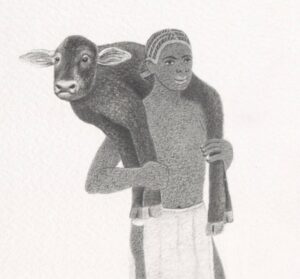
The hero of the story is not a warrior king or divine sage but a young pastoralist named Harappa. His greatest achievements are neither military conquest nor spiritual revelation. Instead, he observes animals patiently, learns from nature, experiments fearlessly and transforms the economy of his community through the domestication of sheep, goats, buffaloes and chickens.
When the young Harappa goes to graze his sheep in the forest, he encounters a baby buffalo and manages to bring it home, turning around the village economy. As he comes of age, he meets a curious girl, Maisamma, who is experimenting with ways to conserve water and even succeeds – an important step in the development of a civilization. The so-called lowly works of leathercrafting and tanning in present India are given their due placein Prof Ilaiah’s imagination. Be it the stepping into the Bronze Age or the shunning of human-worship, the reader is given sound reasoning, while still being left to inquire further. That is the power of a well-written book.
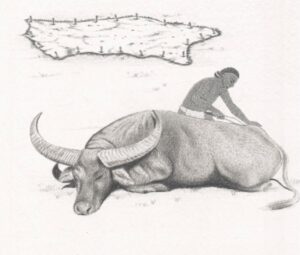
In Harappa’s world, civilization emerges not from revelation but from labour; not from rituals performed by priests but from discoveries made by ordinary working people. This inversion is the book’s most radical intervention. For generations, school textbooks and popular culture have celebrated kings, sages and conquerors while treating productive labour as socially invisible. Prof Ilaiah reverses that hierarchy. Herding animals becomes scientific inquiry. Milking goats becomes technological innovation. Women discover fermentation, develop methods of preserving milk, and experiment with cooking and pottery. Each practical breakthrough adds another brick to the edifice of civilization. The cumulative effect is to redefine what counts as history itself.
Readers familiar with Prof Ilaiah’s earlier writings will immediately recognize recurring themes. In Buffalo Nationalism, he famously elevated the buffalo over the sacred cow as a symbol of India’s productive classes. Here too, the buffalo occupies centre stage. Rather than being reduced to a ritual symbol, it becomes the foundation of an entire economic and social revolution. Domestication of the buffalo is portrayed not merely as an agricultural breakthrough but as one of humanity’s defining achievements. This celebration of labour, productivity and material life has always distinguished Prof Ilaiah’s scholarship from mainstream cultural nationalism.
Women occupy an equally transformative place in the narrative. Characters like Sindh and Maisamma are innovators rather than passive companions. They discover new food practices, experiment with milk products, manage water, and contribute essential technological knowledge to society. In doing so, Prof Ilaiah quietly dismantles patriarchal assumptions embedded within many traditional origin stories, replacing them with a vision of civilization built through collective creativity.
Some readers may question the historical liberties the book takes. Archaeologists understandably distinguish carefully between evidence and speculation. Prof Ilaiah, however, is not writing conventional history. He openly inhabits the territory of civilizational imagination. His Harappa is a literary reconstruction rather than an archaeological report. That distinction is crucial.
What makes this book remarkable is not simply its celebration of Harappan civilization, but its refusal to accept that only the powerful have the privilege of myth-making. Ilaiah deliberately fashions a counter-myth. Not because history is irrelevant, but because history itself has long been colonized by those who claimed exclusive ownership of India’s past. If dominant traditions have employed epics, Puranas and sacred narratives to legitimize social hierarchy, Prof Ilaiah responds by creating an equally compelling narrative rooted in the dignity of labour and collective human endeavour. Harappa, an ardent observer and a keen inquirer, does not instantly believe in or bow down to any mystical deity, but displays a rational temperament instead.
This strategy is likely to provoke strong reactions. Admirers will celebrate it as an overdue act of intellectual decolonization. Critics may dismiss it as ideological counter-history, marred by factual inaccuracies. Yet both responses miss the point. The book’s purpose is less to settle archaeological debates than to expand the imaginative possibilities through which India understands itself.
The illustrations by Priti Gulati Cox strengthen this vision spectacularly. Rendered with warmth and simplicity, they evoke a world where humans, animals and landscapes exist in intimate relationship. Rather than merely decorating the pages, the illustrations reinforce the text’s central philosophical message that civilization grows from cooperation with nature rather than domination over it.
The prose itself is accessible, almost oral in rhythm, reflecting the traditions of village storytelling. Songs, conversations and repeated motifs give the narrative the feel of an epic told around evening fires rather than inside university classrooms. This accessibility allows the book to function on multiple levels: as children’s literature, political allegory, social philosophy and intervention in contemporary debates about Indian identity.
Harappa: God’s City of Civilisationdeserves to be read not as an archaeological textbook but as a bold intervention in India’s ongoing struggle over memory, identity and history. It invites praise, discomfort and fierce debate in equal measure, and that is precisely its achievement. It is a courageous declaration that the oppressed, too, have the right to imagine, narrate and reclaim their own civilizational inheritance.
Details of the Book
Title: Harappa: God’s City of Civilisation
Author: Kancha Ilaiah Shepherd
Illustrator: Priti Gulati Cox
Publisher: Unbound Script
Format: Hardcover
Book Length: 80 pages
Price: Rs 349 or $18 -
Harappa: Now That Was a Civilization!
Kancha Ilaiah Shepherd’s new book portrays the Indus Valley Civilization as cooperative and egalitarian—and challenges nationalist myths about India’s origins.
STAN COX AUG 19, 2026
Kancha Ilaiah Shepherd has a way of getting under Hindu supremacists’ skin. And the latest book by this political theorist, social activist, and former Osmania University professor—titled Harappa: God’s City of Civilization—is almost certain to elicit frenzied howls of outrage. This 90-page work of fiction, illustrated by Priti Gulati Cox (full disclosure: I’m married to the artist), is set about 4,500 years ago in a small village along a tributary of the Indus River. Over generations, its residents, working with people from neighboring villages, create in their home territory the city of Harappa, the likes of which have never been seen in South Asia—one that will become a nucleus for their region’s first (possibly the world’s first) great civilization.
There is much that we do not know about the lives of the people who were there at the dawn of Harappa. However, thanks to extensive archeological, anthropological, ecological, and genetic research, there is much we do know.
We know that the people living in Prof. Ilaiah’s fictional village would have been descended from the mixing of two populations: First Indians—that is, modern humans who traveled out of Africa into Asia tens of thousands of years ago, with some of them eventually making their way to the Indus Valley—and an agricultural people who migrated to the Indus Valley from the Zagros region of present-day Iran.
We also know that, at the time Prof. Ilaiah’s story begins, the Indus Valley people were farming and had learned how to domesticate animals, including sheep, goats, chickens, and water buffalo. And we know they would go on to create a written language and striking art, while developing highly effective structures for water management, sanitation, land and water transportation, urban housing, and public services.
Harappan cities came to be scattered across a vast region one-third the size of present-day India. Archaeologists and historians have marveled at the highly functional and attractive layout of Harappan cities and their high-quality construction. They clearly were the product of well-thought-out urban planning; even the height-width-length ratio of the bricks used in construction throughout the region was standardized (at 1:2:4), as were weights and measures. But, in contrast to the ruins of other ancient civilizations, Harappa’s ruins contain no remains of grand, monumental structures. Their cities, full of home foundations that do not vary greatly in size, modest public buildings, and other utilitarian features, do not suggest wide class disparities. Accordingly, the book Harappaportrays a relatively egalitarian, cooperative, hard-working society.
Evidence points to a civilization built on the collective labor of its own people. That would stand in stark contrast to most other “great civilizations” of ancient and modern times, which usually achieved that status through conquest, territorial expansion, imposition of power over other peoples, grandiose architecture, and amassment of great wealth, with some intellectual and artistic accomplishments thrown in. Most importantly, in achieving all those things, those other civilizations depended heavily on labor provided by underclasses of their own people, or by those they conquered, or both. No such exploitation is evident in Harappa—neither in the village of Prof. Ilaiah’s book nor in the archeological remains of Harappan cities.
That first Indian civilization had quite a good run, from about 4,600 to 3,700 years ago. Its demise is attributed primarily to the drying-up of the rainfed rivers on which it depended. That drought brought down other Bronze Age civilizations as well. But research based on ancient DNA samples shows that Harappa’s people didn’t just die off; they emigrated, some venturing east to the Ganges basin, others to southern regions of the subcontinent. In both the north and the south, over centuries, they blended with local First Indian populations and kept on contributing to India’s development and culture.
Unfortunately, the next civilization to arise in northwestern India would, over the centuries, evolve in the opposite direction, toward inequality and injustice.
The Aryan Immigrants
A century of research and scholarship has established beyond all doubt that the Harappan Civilization was the Indian subcontinent’s first. But Hindu supremacists, whose political and cultural power has been increasing steadily over the past three decades, continue to insist that India’s first civilization was launched by a people who composed the Vedas, India’s oldest religious texts. In the first of these works, they identified themselves as the Arya. (Millennia, later, Western scholars would dub them the “Aryans”.)
There are big holes, though, in the claim that the Arya were the fount of Indian civilization. First is the timing. They didn’t start composing the first of their foundational works, a set of prose and poetry known as the Rigveda (which was originally transmitted orally and eventually written down in Sanskrit) until less than 4,000 years ago—at a time when India had already been hosting one of the world’s great ancient civilizations—Harappa—for centuries. On top of that, the Arya weren’t even ancestral Indians. In fact, at the time they composed the Rigveda, they were newcomers to the subcontinent—or may not have even arrived yet.
Nomadic cattle herders known as Arya migrated out of the steppes of present-day Kazakhstan around 4,000 years ago. They spread south through Central Asia and present-day Afghanistan, to finally end up, about 3,500 years ago, in a part or northern India that would become the Hindu homeland.
Hindu fundamentalists have long insisted on a wholly different history: that the Arya had always lived in what is now northern India and had founded a Vedic civilization more than 5,000 or even 10,000 years ago. At least one claim has them in India, working on the Rigveda, as early as 25,000 years ago (which might have had them mingling with the original immigrants who’d come from Africa). Still others claim that the Arya have been living in India since the beginning of time! Much of the “evidence” supporting these wild “estimates” is gleaned from tortured “analysis” of the Vedic texts themselves—a circular argument if there ever was one.
Meanwhile, Hindu supremacist claims regarding their origin are easily disproven. DNA samples collected from ancient human remains at archeological sites, from Africa to India to Iran to the steppes of Eurasia—particularly samples analyzed in the past decade or so—show
- that the Vedic Arya were recent immigrants from the Central Asian steppe who settled in northern India in the second millennium B.C.E. and
- the people who built the Harappa civilization, India’s first, carried DNA from First Indians and Iranian farmers and none from Central Asian populations.

The Downgrading of Labor
In contrast to Harappa, Arya-dominated civilization evolved in a severely hierarchical direction. They didn’t bring caste with them to India, and they mentioned no caste-like hierarchies in the early Vedas. Centuries later, as they were consolidating their power through imposition of the caste system, their rationale was based on economics much more than ethnic origin. By then, there were few or no “pure” Arya or “pure” Harappans or “pure” local First Indians living in the newly adopted Arya “homeland.” Each person’s genome most likely carried DNA from either two or all three of those populations, in various proportions. India had become a genetic melting pot of sorts. The evolving caste system was a socioeconomic hierarchy.
The caste system was designed by those claiming membership in the Vedic Arya elite, their goal being to consolidate their power over society. The system downgraded the types of labor that had created and sustained the Harappan Civilization while elevating the kind of abstract thinking and pursuit of conquest and power that had characterized most other ancient civilizations. (To be sure, most societies around the world have done likewise ever since; caste isn’t the only means to exploitation and oppression.)
To the extent that the word civilizationhas positive connotations for us, I expect that many of us who read Harappa: God’s City of Civilization’s text, view its images, and ponder the way of life, labor, and leisure portrayed, will close the book and think to ourselves, “That wasn’t just a village that would one day launch a civilization. That was a civilization! And a damn good one, too.”

Stan Cox is the author of seven books, including The Green New Deal and Beyond: Ending the Climate Emergency While We Still Can and Losing Our Cool: Uncomfortable Truths About Our Air-Conditioned World. His latest book is Anthropause: The Beauty of Degrowth. He writes from Dearborn, Michigan.
-
30 Anniversary of Prof Kancha Ilaiah Shepherd’s Book “Why I am not a Hindu?



You must be logged in to post a comment.