-
Irony of FCRA regulation: Foreign funds in Christian orgs benefited elites the most
If one calculates the Brahmins and Baniyas who benefited from free education and healthcare at Christian institutions, funded by Western donors for mission charity, they would outnumber all other castes.
Written by : Kancha Ilaiah Shepherd
Published:23rd Oct, 2026 at 4:53 PM
The anti-Christian agenda of the RSS and BJP Government, by adopting various measures like the FCRA Bill, anti-conversion laws, and other forms of systemic attacks, is to ensure that the Dalit, Adivasi, and Shudra communities do not get education and global connectivity on par with the Brahmin, Bania, and other upper castes.
The RSS and BJP assessment is that earlier only the Brahmin, Bania and other upper caste youth benefited from Christian education and health institutions, though built and run with the help of foreign money. But now they have their own private English-medium educational institutions and private hospitals. Even in earlier regimes headed by the Congress, they only benefited from the best Christian education and health institutions. The Christian institutions also ignored the role of the caste system in denying SC/ST/OBCs access to their top institutions, as they did not adopt any caste-based reservation policy.
In the early modern period India did not have great non-Christian medical institutes like Christian Medical College and Hospital (CMCH, established in 1900) and St. Stephen’s College of Delhi, established in 1881. Even in the early days of Independence for best modern English-medium education and allopathic health treatment the upper castes depended on the Christian institutions.
Delhi University was established only in 1922. The All India Institute of Medical Sciences, Delhi was established only in 1956. The rich upper castes depended on these world-class private Christian missionary institutions. They too were willing to serve them. Though they were collecting fees, it was never like the present upper caste owned private institutions. Even now there is a difference between the Christian and non-Christian fee structures in private education and health institutions. That was because they were/are subsidising the income from foreign donations through FCRA, and before FCRA was enacted, they were governed by the Indian tax laws. But the money was coming very much legally.
However, for a long time, the Indian Christians—particularly Catholics—served the same upper castes who became anti-Christian now, not the poor lower castes. Only in the recent past did they diversify their educational and health services. For example, colleges like St. Stephens and CMC Vellore did not implement reservation for SC/ST/OBCs. They only gave some seats to privileged Christians.
If only one could calculate the sheer number of Brahmins and Baniyas who studied in Christian institutions and got treatment in their hospitals, almost free of cost, they would outnumber any other caste persons. The point is that this was made possible because of foreign money coming to these institutions to subsidise education and health from Christian Western governments, churches, and individual families thinking that it is a mission charity to serve in a poor country like India.
The conversion question
Why are they saying only the poor get converted by force using FCRA-related money? The rich and privileged were also vulnerable to forced conversion in Christian schools, colleges, and hospitals. What would have happened if conversion were made a precondition to study in a Christian institution or get treated in our hospitals?
Though Islam existed in India for about a thousand years, the rulers had maintained great fraternal relations with the Brahmin, Bania and other savarna Hindus. Though Muslim rulers did not give them great education or health science, more upper castes got converted to Islam. They embraced the caste system and did nothing to reform the social conditions in India. During this period, neither the rulers nor the Islamic clergy established any institutions to serve the populations who have come to be listed as Dalits/OBCs/Adivasis.
Without establishing any institutions that served outside the fold of their faith, the Hindu and Muslim ruling classes served only elites. Even as both collaborated to keep the caste system alive, they also created communal conflicts in competition with each other. As the ruling Hindus and Muslims played their deadly games, the food-producing Shudra/Dalit/Adivasis suffered illiteracy and poverty. In the latest stage of this ancient game, the RSS/BJP is preparing the ground for pushing the productive communities to primitive stages. Modern English education alone can help them to overcome their historical backwardness.
Empowered SC/ST/OBCs threaten RSS/BJP
Did Indian Christians create religious and communal conflict ever since Christianity became the source of Indian education and health science? Why this RSS/BJP animosity towards Indian Christianity? The main reason behind it is that over the last few decades, Christian institutions increasingly started educating the SC/ST/OBC communities too in their English-medium schools.
The fear is that if the Christian institutions are allowed to educate Dalit, Adivasi and Shudra youth with some amount of subsidised fees, they will fight against the caste system, monopoly exploitation, and compete in all spaces, including media. Using this draconian FCRA law, the poor Dalit, Adivasi, and Shudra forces could be controlled.
As Abhijeet Dipke, Convenor of the Cockroach Janta Party, rightly said, these people are against the poor getting educated. In reality, RSS and BJP forces are against the Dalit, Adivasi, and Shudra (the poor) getting educated because they challenge the control of the Brahmin-Bania forces. They want to be more cautious after seeing Dipke’s own example of emerging as a leader of youth, being a Dalit himself.
Christianity as cultural buffer
All the Christians in the world must know that before Christianity opened schools and hospitals, the majority productive communities—Shudras, Dalits, and Adivasis—were treated worse than cows. They worshipped cows but did not even touch the Dalits.
The first secular schools in the subcontinent were opened by Christian and colonial establishments where anybody could study irrespective of their caste, gender or religion. This stress on imparting mass education was a direct consequence of the period of enlightenment in Europe and impelled Christian missionaries to establish printing presses, scientific institutions, schools, colleges and hospitals. This secular Christian education helped Muslims and Brahmins to modernise themselves. Rajaramohan Roy and Sir Sayyad Hammed are outstanding examples of such modernisation. These institutions here and in England helped many freedom fighters to understand the world through the lens of secular democracy.
Until the British established the Department of Public Instruction in 1855 and opened the gates of mass education, Hindus and Muslims ran institutions that were exclusively for elites of their own communities in Urdu and in regional languages. The ancestors Shudra/Dalit/Adivasis were not allowed to read and write till the British, by all means, with a Christian communion arrived in India. Indeed, it is only with these radical changes that the first generation of educated social and political reformers emerged from our communities.
Without caring for Brahminic values of human untouchability and the indignity of labour, they opened schools, though very few, for all Indians. Because of that, through the policy of education for all, a great couple, Jyothiba Phule and his wife, Savitribai, the first Shudras, got basic school education. They became the first slave liberators in the mid-19th century. This is the kind of secular educational path RSS is uncomfortable with. These kinds of changes are not acceptable in the Brahmanic tradition.
Now the RSS and BJP want to close down all those educational institutions and health centres, like early hospitals, including the Christian Medical College Hospital, Vellore, over a period of time with a carefully crafted legal system.
Through education and health, in fact, the Christian institutions helped more upper castes than the Dalit, Adivasi, and Shudra till recent years. Opening such public institutions for SC/ST/OBCs is slowly creating an awakening in them.
The new FCRA laws do not affect the Muslim public institutions much because they do not have any significant educational or health institutions that were established with foreign money. Importantly, they rarely have secular institutions which provide services to all communities.
These laws will not touch the Hindu institutions either. In any case, they mainly serve the upper castes by charging huge payments. There is no charity help in Ambani or Adani schools or in universities like Ashoka or any other such private universities. In Hindu private hospitals, there is no charity-based cheap treatment for the poor. But the Christian institutions did that earlier and continue to do so. This seems to be the RSS/BJP combine’s main concern, particularly in the education sector.
Kancha Ilaiah Shepherd is a Political Theorist, Social Activist and writer. His latest books are A Shudra Life – Autobiography and Harappa – God’s City of Civilisation. Views expressed are the author’s own.
-
This book highlights pivotal role of Shudras as builders of civilisation and productive communities
By Harsh Thakor
The Shudra Rebellion, authored by Kancha Ilaiah Shepherd, presents a revolutionary perspective on Indian civilisation, shedding light on the overlooked contributions of Shudra nationalism. This work redefines the historical narrative by highlighting the pivotal role of Shudras as builders of civilisation and productive communities.
At the heart of the book is the binary between the spade, symbolising labour, and the book, representing the Aryan textual tradition. Shepherd argues that while the Harappan civilisation was built on the collective labour of Shudras, Dalits, and Adivasis, Aryan culture glorified Brahminical texts and ritualism. The book critiques the Brahminical worldview that undermines the value of physical labour, portraying it as degrading, while exalting intellectual pursuits as superior.
Shepherd goes beyond conventional academic boundaries to delve into the spiritual and cognitive dimensions of Shudra identity. He examines how the servility imposed on Shudras by the hierarchical Aryan system persisted across generations, stifling their potential for self-emancipation. Despite material progress, the Shudras remain spiritually and philosophically subjugated.
The author constructs an alternative historical narrative, challenging the dominant academic discourse shaped by ‘Dwija’ intellectuals. Drawing on recent scientific works like those of Tony Joseph, Shepherd asserts that Shudras were the original founders of Indian civilisation. However, they were systematically marginalised by Brahminical agents who demeaned their “spade civilisation.”
The book reproduces significant historical references, such as the letters of Chhatrapati Shahu Maharaj, a pioneer in promoting education and reservation for backward classes, and the writings of Jyotirao Phule, who fiercely critiqued Brahminical dominance.
Shepherd explores the imposition of Hindi and the cultural hegemony of Sanskrit, linking these to the suppression of Shudra identity. He critiques how language politics has shaped public discourse and self-rule, drawing attention to the socio-political implications of English, local languages, and Sanskritic traditions.
The book critiques Hindutva for erasing Shudra contributions from history and perpetuating Brahminical dominance. It also exposes the failure of left-liberal intellectuals to address caste in their anti-Hindutva discourse, highlighting their neglect of the systemic inequalities rooted in caste.
Shepherd warns of the dangers posed to Shudras by the rise of Hindutva. He examines how constitutional democracy failed to address caste inequalities and how the RSS-BJP alliance resurrected Varnadharma ideology. The chapter on Vallabhbhai Patel critiques his inability to challenge caste hegemony within Gandhi’s vision of Hindu nationalism.
The book explores the integral role of Shudras in agriculture and their suppression by Brahminical forces, which stifled progress and experimentation. Shepherd argues that the spiritual system of Vedic texts pushed Indian civilisation backward, creating a historical disaster.
The chapter ‘Hindi for Shudras, Sanskrit for Devatas’ highlights how the imposition of Hindi suppressed Shudras, while Sanskrit remained a tool of Brahminical domination. Shepherd critiques the Hindutva agenda of promoting globalisation and privatisation in education, further marginalising rural and economically disadvantaged communities.
While the book is a treasure trove of insights, it has its limitations. Shepherd’s analysis is heavily caste-centric, often overlooking the broader socio-economic and class dynamics. By focusing solely on caste, the author sidelines the achievements and complexities of Indian civilisation and its economic history.
The Shudra Rebellion is an essential read for anyone seeking to understand the suppressed histories of Indian civilisation. It raises important questions and challenges the reader to rethink established narratives.
-
Centuries Of Brahminical Hegemony: Kancha’s “The Shudras” Explains The Problem

On the celebration of the birth anniversary of Dr. Bhim Rao Ambedkar and in the context of Shudras revolution in nations building, the Centre for Human Dignity and Development (CCHD), IMPRI Impact and Policy Research Institute, New Delhi organized on April 29, 2021, a Book Discussion on “The Shudras Vision For a New Path“.
The eminent panelists include Prof Kancha Ilaiah Shepherd, Indian Political Theorist, Prolific Writer, Dalit Rights Activist, and Dr. Arvind Kumar, Assistant Professor, Centre for the Study of Social Exclusion and Inclusive Policy (CSSIP), Jamia Milia Islamia (JMI), New Delhi as the speakers. Prof Sukhadeo Thorat, Eminent Economist; Professor Emeritus, Jawaharlal Nehru University (JNU); Chairperson, Indian Institute of Dalit Studies (IIDS) as the chair of the talk. Dr. Ajay Gudavarthy, Associate Professor, Center for Political Studies, Jawaharlal Nehru University (JNU), New Delhi and Dr. Aakash Singh Rathore, Series Editor, Rethinking India, Penguin/Vintage; Professor of Politics, Philosophy, and Law, LUISS University, Rome as the discussants of the talk.
Setting the tone for the book discussion, the speaker, Prof Kancha Ilaiah Shepherd, very briefly touched upon the caste politics of our country and gave an idea of his book. Prof Ilaiah shared very profoundly why he chose “Shudras” as the title of his book. In this context, he discussed how certain forces in our country are always coming forward to control the marginalized classes by their political power.
Upper Caste Exploitation And Discrimination
He also emphasized that since the Vedic or ancient period, the upper castes have been dominating and exploiting the lower classes especially in the context of Shudras who are mainly considered as a working and production-based class in the Varna system in Hinduism, whereas the three upper classes – Brahmin, Kshatriya & Vaishya always have behaved as the master of the Shudras. The Brahmin class is always recognized for economic-social development construction, civilizational building, and intellectual legitimacy.Kancha Ilaiah Shepherd at Kerala Literature Festival, 2018.
Prof Kancha Ilaiah Shepherd gave the economic definition of the present Shudras in Indian society. He criticized Brahmanism in many aspects and asserted that why the Shudras did not allow wearing the sacred thread “Janeu”, why did they not play the role of priest yet and why did the Shudras not get access to the power language (Sanskrit in Ancient India and English in Present India). He presented a form of linguistic formation, which also came as a barrier in the Shudras’ academic learning.
In discussion, Prof Ilaiah expressed his concern regarding the hegemonic characteristic of BJP, RSS, and other political forces, and how they all are suppressing the Shudras in every sphere of life in Indian society. He also said that it is ironic of our Indian society that till today no text has been written on the Shudras philosophy and how the Shudras became the only muscle power and vote bank for the right-wing party.
It is seen that there is no representation of the Shudras in the central government to date, only two Prime Ministers were elected from this community but only for a short period. In addition, it is also a well-known fact that in our country there is no representation of this class among the 100 industrialists and 25 monopolists. No doubt the Shudras hold 52% of the population of our country and without them the BJP, RSS cannot remain in power, but still, their concerns are not addressed very well at the national level. The Shudras are still facing the hit of Vedic deployment in the name of secularism and anti-colonialism.
Further Prof Ilaiah talked about how the Adivasis, on one hand, got recognition because of their separate location. On the other hand, the Shudras always face discrimination from the economic, political, and spiritual hegemonic groups. They were always recognized as non-intellectual, non- modernists and considered as the slave of the Brahmin priest. He said that this book also suggests how the English language is now considered property in Indian society. He criticized how caste politics also decides the leadership of our country. He gave an example of our present Prime Minister and his “baniya” economic support in his win.
Where The Book Stands
In short, Prof Ilaiah says about his book’s motive which trends a path for Shudras friendly relation establishment. He also expressed his concerns and said that the RSS brought a new form of Brahmanical functional groups in the present Indian society, which also presented a different Hindu centric approach in the form of hegemonic services of the temple, wealth, political and medicinal values (in the name of cow urine). He also expressed his concern in the context of the lack of Shudras literature; he praised the “Gulamgiri” which is the best creation in this field to date. He also appreciated his young team members who all belong to the Shudras community itself and did not conceal their identity.
The discussant of this discussion, Prof Aakash Singh Rathore, begins by saying that this book is the fifth part of the series and also gave a brief idea of the previous series of books. Further, he applauded this book and said that it is quite relevant in the present era of caste politics. This book suggests a normative platform of how to rethink our realities and imagine the political and public spheres that are very constrained now.
He emphasized that this book also gives some suggestions in the context of a new, equitable, and prosperous future for the intellectual and policymakers of modern India. This book also advocates the ideological revolution and constitutional values in nation-building and presents a new vision to rethink India in the context of the principle of graded inequality. At last, he suggested that finally, it’s time to spin the wheels to get rid of the spiritual, social, political, and economic slavery of hegemonic Brahmins and build an equitable and just nation for all.
The next discussant, Dr. Ajay Gudavarthy, came up with his strong comments on this book and considered it a very timely book. According to him, this book presents the conceptual basis of a vision of Hindu politics and Hindu Rashtra in present India. In other words, it presents an epistemic philosophy and dominant hegemony in the context of the marginalized class. This book has also identified a sociological conflict that we lost in the history of Buddhism. It is a well-known fact that Buddhism was the first revolution against Brahmanism in the dimension of social, political, and economic dominance in ancient India. He also raised some questions regarding the Shudras, why this class is always considered only for productive works in Indian society.
Further, Dr. Gudavarthy asserted that on the one hand Shudras talk about mobility and ideational work, but on the other hand, they present self-concealing contributions. For example, at the recent farmers’ protest, there was the representation of OBC only. In this sense, why did they not come up with their concerns, as it is known that the Shudras are agrarian or productive class? He presented that there is an indirect contradiction between Shudras and OBC, because of the ignorance of history. So, it is time to address this issue. He also drew attention to the myth and mythologies of caste philosophy, which is the main reason why the Shudras did not get real recognition in Indian Society.
Dr. Gudavarthy talked about the introduction part of the book which does not explain clearly in the context of upliftment of the Shudras, it only discusses the historical hegemony of the right-wing, culture logic of late capitalism, and power egalitarian things. At last, he said that this book presents symbolic appropriation which is the cause of continuous games of inclusion and exclusion in society. Therefore, this is a need of the hour to bring about the kind of equivalence and resolve the dynamic of powers in the present social theory.
The next speaker, Dr. Arvind Kumar, started his discussion with some policy concerns related to the backlog seats of the reserved category and also shared his personal experiences on the same. Dr. Kumar profoundly shared how the Shudras have faced denial and injustice since the historical period in Indian society, as they did not have the right to read and write, they were only considered as the minions of Brahmins in that period. While discussing the title of this book, he said that in our country we can see a clear politics of naming, that’s why we intentionally chose the word “Shudras” in the title, so we can address this class and its ground reality in true sense.
Representation, Methodology, And Policy
In addition, his concern was regarding the question in terms of methodology in the context of the academic literature of the backward class and depressed class. In his final note, he raised the issue of how Shudra lost, just because of the foray of social injustice by the upper class. Finally, in this sense, there should be the presentation of egalitarian empirical work.
Further, Prof Sukhadeo Thorat gave his remarks over the entire discussion. He agrees that no doubt there are various problems and issues of OBC and Shudras, but it is not yet raised properly, that’s why this problem remains. Why there is a need for three categorizations- economic, political, and ideological of Shudras in the context of definition? Why are we not considering the NSSO data to acquire true information about the socio-economic status of the Shudras and OBC? He suggested to young scholars to follow the data in their research work, to give validation/ authentication of the arguments.
He also addressed the Shudras as the cultivators of land with their history, as they didn’t get any high yielding or developed technology but they only carried or followed their traditions through the experiences. That’s why they faced other occupation and education restrictions in that period, which also brought the practices of untouchability in ancient India.
According to Manusmriti, cultivation was considered an inferior profession, that’s why Shudras were treated badly as they were wage laborers. But today the Shudras are also producers and owners of the land. No doubt graded equality also misinterpreted the problems of the Shudras. In this sense, it is needed to represent the issues of this class logically.
Prof Sukhadeo Thorat also talked clearly about the representation of the Shudras in Indian politics. He emphasized that the OBC & Shudras are majority class although they are not in power. As they hold 52% of the total population in the country, in this sense we cannot always blame the upper caste. Finally, he suggested that we should think critically about where Shudras are lacking in the contemporary world based on ideology and social education.
Then the discussion moved once again to the speaker Prof Kancha Ilaiah Shepherd and he confronted the idea of Prof Sukhadeo Thorat in many aspects and asserted that land is not the symbol of richness, knowledge should be considered as richness. He also disagreed on how we address the questions of historical and philosophical issues based on numbers.
Mr. Manikant also contributed to this book discussion and shared that we have to identify those areas where the OBC & Shudras are failing. He also emphasized that there is an urgent need for Shudras consciousness in the new normative direction of understanding the essence of Brahmin’s modernity. In the final concluding view of Prof Kancha Ilaiah Shepherd, this volume is only the beginning in the name of Shudras’ revolution, and the main objective of this book is to start the conversation on the same.
Acknowledgment: Priyanka Walter is a Research Intern at IMPRI and is currently pursuing MA (PPG) Course from Chinmaya Vishwavidyapeeth, Kochi, Kerala.
-
Why and how I wrote the novel ‘Harappa: God’s City of Civilisation’
Neither Ayodhya named in the Ramayana nor Dwaraka named in the Mahabharata have proven excavational evidence of having been ancient cities. My novel, on the other hand, draws on the world’s oldest city – Harappa – that existed around 3000 BCE in the Sindhu river basin, as proven by excavations and DNA studies, writes Kancha Ilaiah Shepherd
Kancha Ilaiah Shepherd October 15, 2026
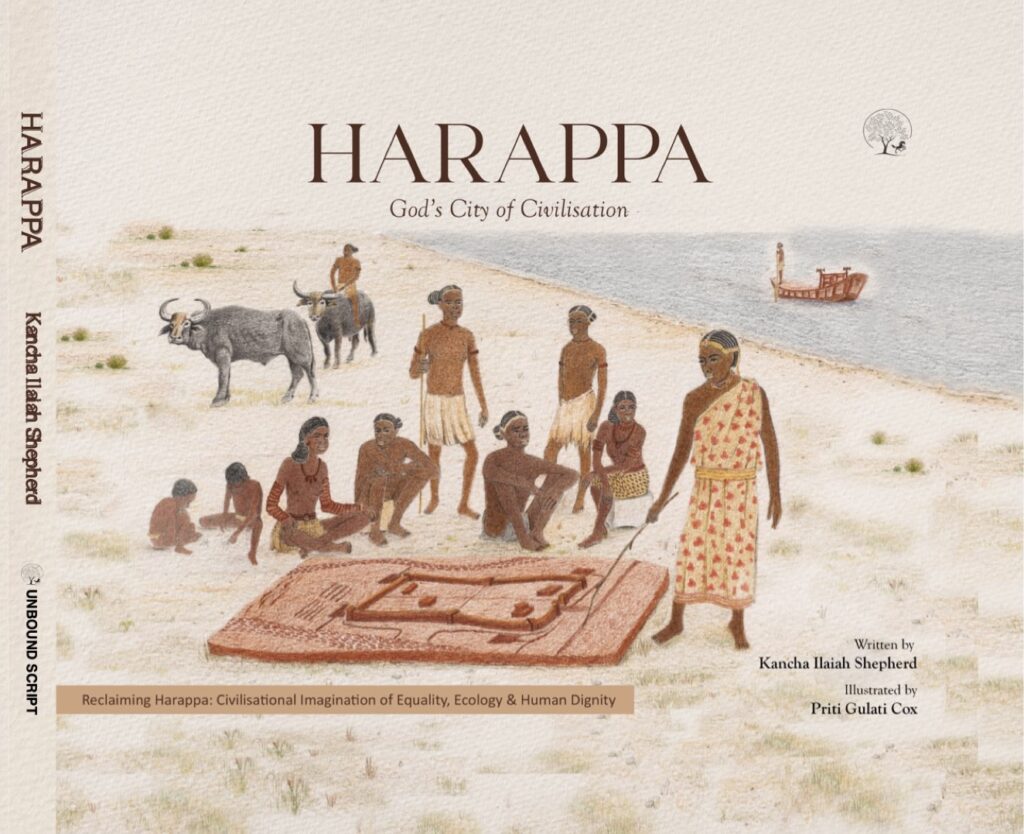
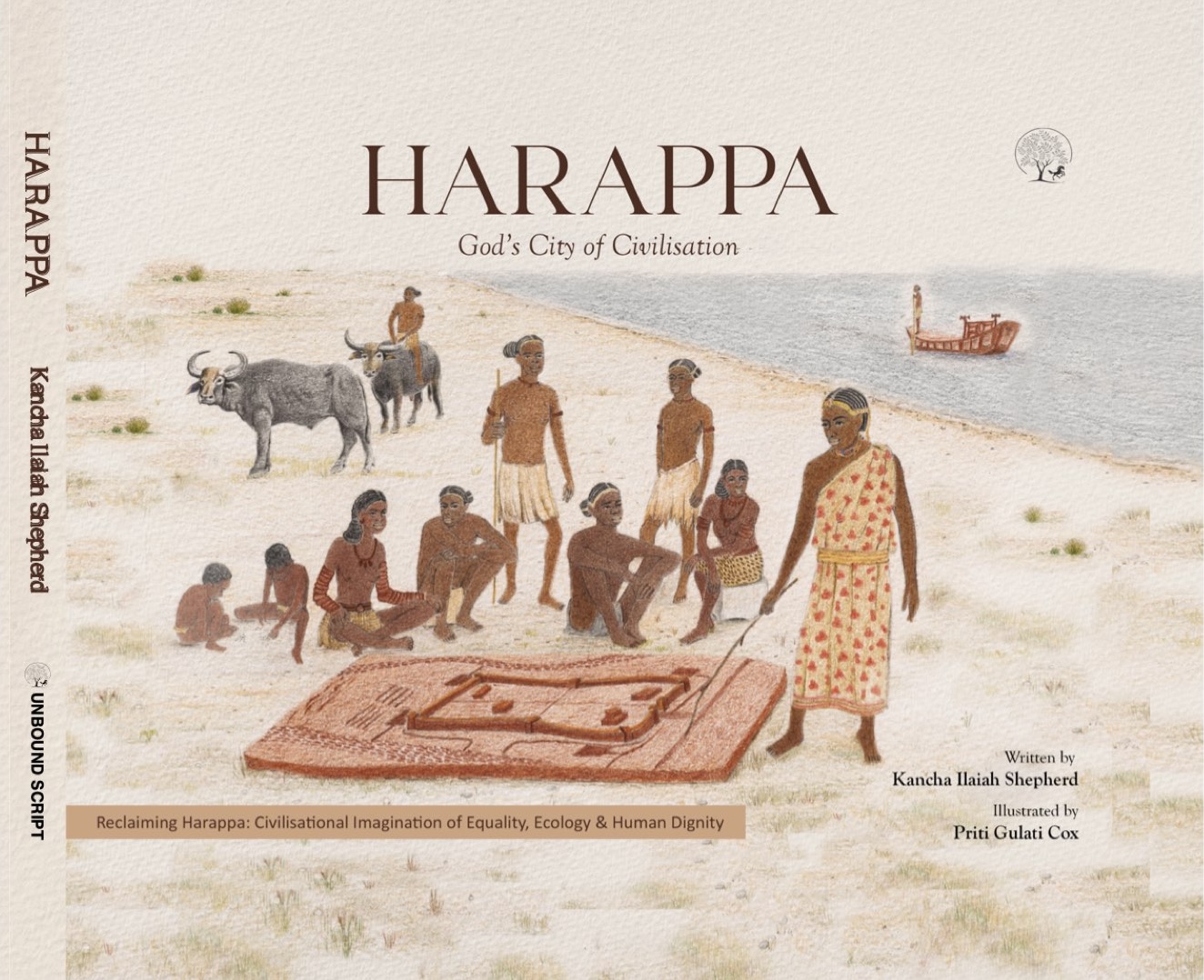
My just-released novel Harappa: God’s City of Civilisation, published by Unbound Script, New Delhi, with magnificent illustrations by Priti Gulati Cox is an unusual experiment in the literary history of India. Critic Satya Sagar described it as a counter myth and product of courageous imagination. We have in the guise of history only purely mythical Brahminic Sanskrit literature, texts starting with Rigveda followed by Ramayana, Mahabharataand so on. There is no historical source of production, animal economy and collective culture and even what they call civilization. Ramayana and Mahabharata were woven around characters of Brahmin and Kshatriya heroes, ascetics and some women.
My novel, on the other hand, draws on the world’s oldest city – Harappa – that existed around 3000 BCE in the Sindhu river basin. Excavations, DNA studies, reading and rereading of archaeological artefacts by scholars from India and abroad have proved that there was a city with this name and it had a civilizational, cultural and economic strength that was unmatched globally at the time.
India as a nation today can be proud of its civilizational roots in Harappa. The protagonist of my novel is Harappa as the one who builds the world’s greatest city of his time, with the assistance of his wife Maisamma after Harappa himself domesticates the buffalo. Maisamma builds the world’s first water tank. They gradually transform Jambhu Dwipa, a village named after Harappa’s father into a massive city Harappa. He becomes the first king of that city state. The story goes on till some foreigners arrive.
Harappa was the ancient historical city, not Ayodhya
Harappa was the first major global city. In many aspects it was different from the ancient cities of Egypt, Israel, Greece and Rome. Harappa had many special civilizational strengths that other ancient cities did not. From houses built with bricks and sustainable wood to canals, the connection with the present Indian village and town with agrarian life is apparent.
Harappa laid the foundation for the advancement of knowledge of humans and has left behind information about their living environment, animal economy, productivity, science, engineering almost 1500 years before Aryan (Brahmin, Kshatriya and Bania) migration or invasion took place. It was much later that the rest of the world reached that level of civilizational advancement.
In contrast, the town we know of as Ayodhya, the capital of Dasharatha, the father of Rama – now what the Hindutvawadis call Rama Rajya – seems to be a city of much later period. It seems that most of the so-called ancient cities and other locations that bear names from the texts of Ramayanaor Mahabharata were named after those names first appeared in those texts. Harappa, on the other hand, is the oldest historical name of a place. I am of the opinion that the city could have been named after its builder, Harappa. The practice of naming villages and cities after people has been a historical practice in India. My belief has been reinforced by the fact that there are hundreds of such names that end with the suffix “appa” in South India. Harappan troops who migrated to the south may have taken these names with them.
Ayodhya and Dwaraka
Neither Ayodhya named in the Ramayana nor Dwaraka named in the Mahabharata have proven excavational evidence of having been ancient cities. Some excavations were done in Ayodhya after a court order in the context of the Babri Masjid dispute and a report was prepared by the Archaeological Survey of India saying that there are some relics of ancient constructions in that place dating to 700-300 BCE. However, it did not have strong evidence in terms of artefacts. Not much evidence was found about Ayodhya’s economy, animals, technology and so on. Even if we go by that report, Ayodhya came into existence much later than Harappa. Obviously it was built almost 800 to 1000 years after the Aryan Brahmin migration took place. There has not been a single scholarly study on those findings from the Ayodhya excavation unlike in the case of Harappa. The descriptions of the characters, their dress codes, the palaces they lived in, the ornaments they used and the chariots they rode in Ramayana give the impression that they were very modern. How did those kings and their women get such clothes and ornaments? If that was an ancient civilizational life, how could they use such dresses, ornaments, houses and vehicles? Of course, their idea of Krita Yuga is very recent and imaginary with absolutely no evidence. Both Ramayana and Mahabharata are novels written with purely imagined figures. The Indian Shudra/Dalit/Adivasis should not trust any book written by Brahmin/Ksatriya/Vaisya writers because they wrote only about themselves. They never even recognized the existence of the productive forces of India – Shudra/Dalit/Adivasis – let alone their antecedence. This is where my novel Harappa becomes very important for the future generations of India. Even the Brahmin Brahmin/Bania/Ksatriya youth have to realize that the Sanskrit literature, which did not deal with the lives and contribution of productive masses, has no value for the nation. The Indian youth have to reconstruct the Indian past from the Harappa city civilization onwards to acquire a respectable stature in the global knowledge systems. Reading mere Brahmin/Ksatriya life as ancient parampara of the nation will lead to a clash of cultures among Indian castes. Unity among all castes becomes possible only when you go to the casteless society of Harappan times.
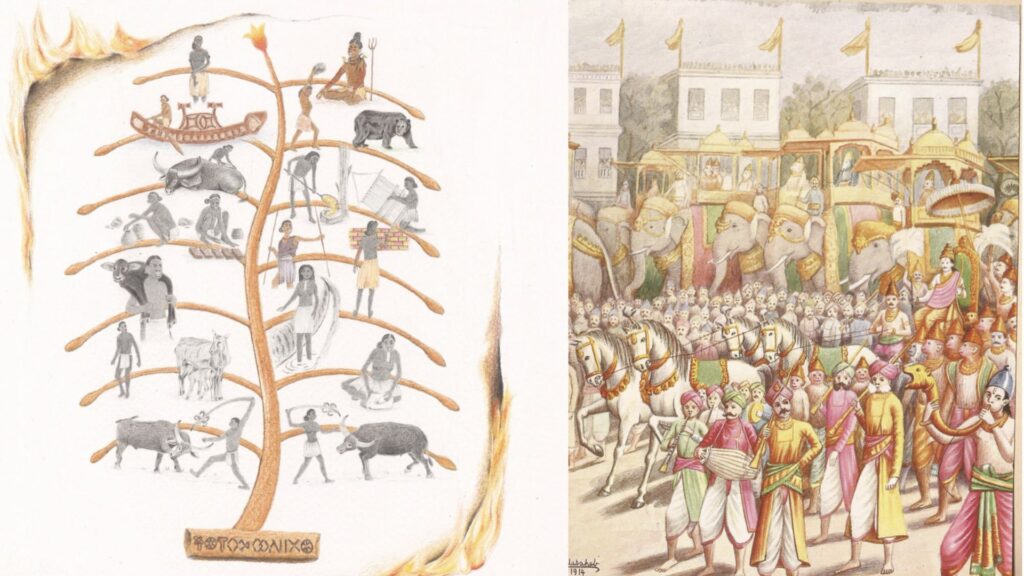
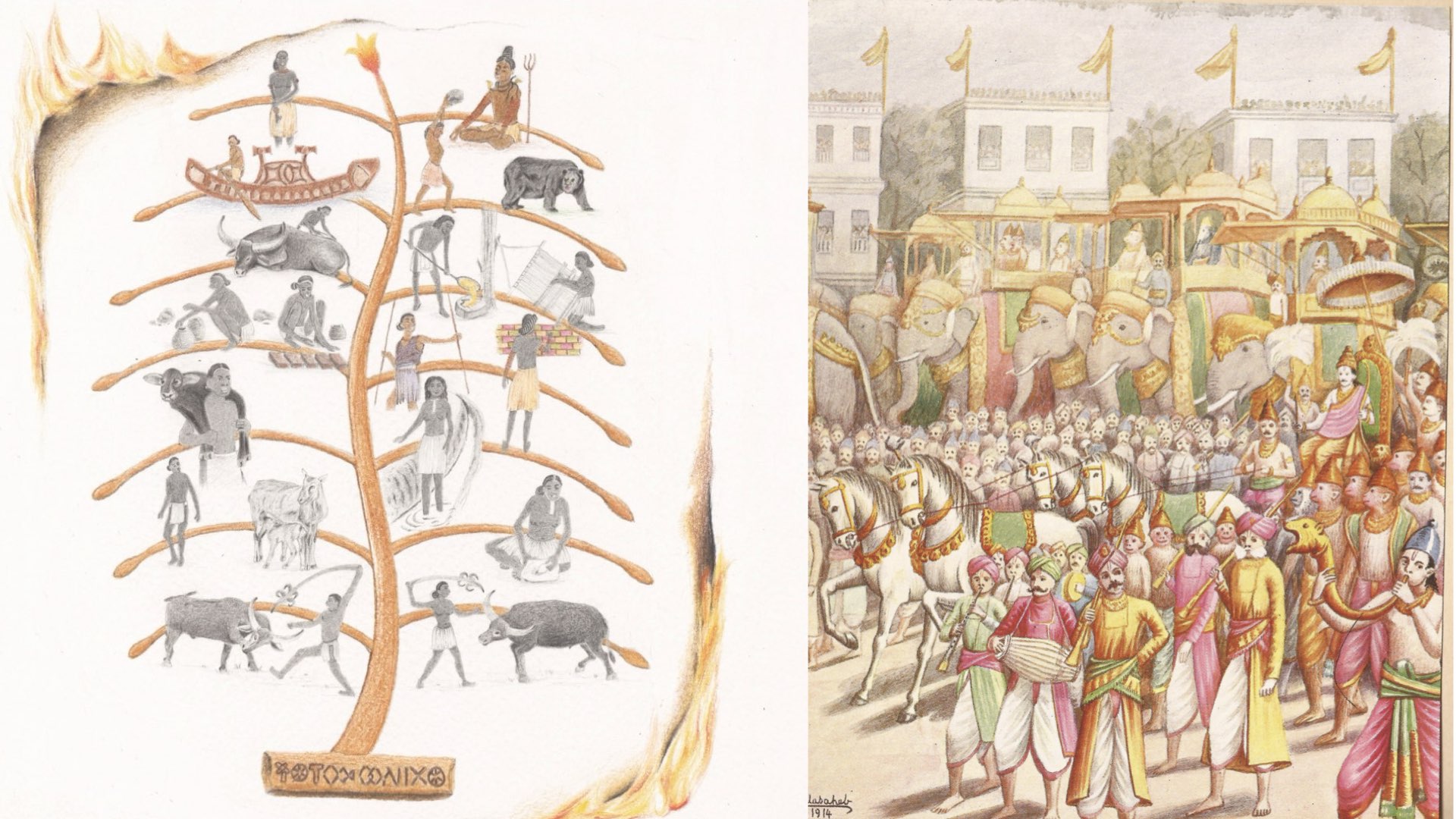
The true story of an ancient civilization and its people lies in Harappa, not in Ayodhya or Dwaraka.An illustration in ‘Harappa’ by Priti Gulati Cox; and an illustration of Ram’s return to Ayodhya by Balasaheb Pant Pratinidhi in Ramchandra Madhwa Mahishi’s ‘Chitra Ramayana’ (1916) [Source: Wikipedia)
My novel
Harappa: God’s City of Civilisationshows the evolutionary process of human society, economy, relations between humans and animals, technology and science in India’s antiquity. The book Ramayana, on the other hand, does not show the kind of animal economy the Ayodhya kingdom had starting with the rule of Dasharatha. Even a work of fiction will have to show the nature of agriculture, animals, artisan production and usage of technology in those times. The Ramayana only deals with the Ksatriya royalty and Brahmin ascetics. How did society survive without food producers at that time? Who were producing food, supplying meat and milk products to Ksatriya rulers and Brahmin ascetics? Naturally when there were Ksatriya kings and Brahmin ascetics, there would have been Shudra food producers, based on the varna-based division. In that social system, Ksatriya kings and Brahmin ascetics never got involved in food production. A story of ancient India would have to show ancient values, lifestyles, artefacts, technology. If a narrative claims to be ancient, yet features lifestyles and technologies that are more recent, the writer’s maturity will be called to question. Even a novel has to be located within a time frame. If Ramayana was written by a person called Valmiki the text has to give an indication of the time frame in which lived and the social, economic, cultural environment that existed in those times. The Ramayana does not tell us anything about the lives of the people who sustained that society. My novel tells about the masses who built this nation’s early civilization from which India of today evolved.
Harappa shows the ancient evolutionary character of society that was learning things gradually and collectively. The production process is a collective labour process. So is war. The Ramayana tells about how Vanaras helped Rama in the war against Ravana. That was a collective effort. In fact food production, house construction, making productive tools and weapons for war need a more organized long-term collective effort. The Ramayanadoes not tell anything about that fundamental process in Ayodhya or the life in nearby villages.
Any spiritual or social text will have to deal with masses of that time. They may be slaves or masters. But Ramayana and Mahabharata dealt only with the Ksatriyas and Brahmins who constituted the ruling class and the religious heads. Such books do not reflect India and the Indian people. When Ksatriya rulers are projected as gods and goddesses the very idea of religion itself gets distorted. Once the idea of God is caste-centred, that divine agency remains completely alienated from the productive masses on whom humanity depends for survival. My novel runs contrary to the narrative in the Ramayana and Mahabharata and is set hundreds of years before even their fictional time frame of Krita Yuga and Dwapara Yuga.
Domestication of animals and birds
So far no social science book or a work of fiction has dealt with the process of how human beings could domesticate sheep, goats and more importantly one of the most ferocious wild animals, the water buffalo. Nobody has given an account even of when and how the chicken was domesticated. Domestication of animals and birds was a scientific process and involved studying the psychology of animals and birds. My novel deals with this struggle of Harappa, his father Jambhav and his mother Sindh to domesticate the buffalo, sheep, goat and chicken. While Jambhav domesticated sheep and goat, Harappa himself domesticated buffalo. His mother’s efforts to domesticate chicken and how she laid the foundations of the milk and curd (yogurt) economy has been graphically explained. Generally, writers presume that these animals were around to be used by humans. But before they were domesticated humans had to hunt and eat. After animal domestication, human lifestyle underwent a sea change as the meat and milk economy became the home and village economy. Without the domestication of animals and birds, humans could not have sedentary village economies and without such economies no city could have come into existence. Harappa: God’s City of Civilisation is a creative depiction of this process. ‘Harappa: God’s City of Civilisation’, by Kancha Ilaiah Shepherd; Unbound Script, Delhi; Hardcover, 80 pages, Rs 399
How I realized that Harappa was a man’s name
Most villages and cities in India even today are named after the man or woman who played a key role in settling that village or city. It is a known fact that cities and towns are the result of expansion of villages. In ancient and medieval times, cities were never planned and built like Chandigarh in modern India. Nowhere in the world were cities a one-time building project. A city is formed by the continuous expansion of a village.
There are a number of names in South India that end with “appa”. There are also godheads like Ayyappa, Beerappa, Ramappa and so on. The Ayyappa temple of Kerala is well known. Beerappa is the god of the shepherd communities across South India, more pronouncedly in Maharashtra among the Dhangar community and among the Kuruma/Kuruba communities in Telangana, Andhra Pradesh and Karnataka. A Beerappa temple can be seen in every village where these caste communities live. The Ramappa temple is located in north Telangana, near the town of Mulugu.
There are hundreds of personal and family names suffixed with “appa” in South India – Bangarappa, Veerappa, Mallappa and so on, apart from those are named after deities like Ayyappa, Beerappa and Ramappa. There are several villages with names that end with the word “Appa”. It is this socio-anthropological cultural environment of South India that got me thinking that Harappa would have been the name of a man in ancient India, after whom the historical city was named.
The process of writing this novel began with a sociological understanding of this similarity in names as well as the discovery by archaeologists and historians that Harappa shared many similarities with South India – people’s skin colour, their agricultural tools, housing patterns and so on.
The name Harappa does not figure in any Aryan Sanskrit books or names of people of Aryan heritage even today.
A village settles and advances only when there is a well developed animal economy, agriculture and artisanal craftsmanship. The people can develop all kinds of tools in the village only when there is a reliable supply of food available and they don’t have to hunt and fish everyday for survival.
In my novel the village Jambhu Dwipa comes into existence with the domestication of sheep, goat, chicken, dog by Harappa’s father Jambhav and mother Sindh. Jambhav’s father and mother were Mahisha and Pocha. Mahisha and Pocha were the first known couple who lived depending on nature and under trees and caves, but from Jambhav and Sindh onwards animal and chicken domestication paved the way for artisanship and the settling of a village. That was great advancement.
The idea of God
The idea of God has been presented in the book as a process of new thinking and imagination. The people of Jumbhu Dwipa were also forming new ideas about life.
The idea of God was abstract at the beginning. Then some people wanted to introduce idol worship. However, Harappa strongly opposes the idea of projecting humans as gods and goddesses. But in the process, Harappa becomes the king of the city state. Then another person, Adidevudu, claims that he has some speculative, foreseeing powers and predicts aliens arriving and destroying his city state. Harappa begins to take him seriously. Adidevudu thus became the first human being to be accepted as equivalent to God.
My view is that those indigenous (Mulavasi) people of India, by the time they built the city of Harappa and that great civilization, had a well developed idea of God in two contending forms – abstract God and human God. Over a period of time the idea of human God took the form of an idol. Adidevudu represents that divine cultural stream.
This novel is in fact going to establish that mythological books like Ramayanaand Mahabharata were written to bring society under the complete control of Brahmin writers and priests with the assistance of Ksatriya rulers. Both these castes became anti-production and gradually turned against productive science, technology and advancement. Those adults and children who read Harappa: God’s City of Civilisation will realize that India’s ancient roots lie in Harappa.
Forward Press also publishes books on Bahujan issues. Forward Press Books sheds light on the widespread problems as well as the finer aspects of Bahujan (Dalit, OBC, Adivasi, Nomadic, Pasmanda) society, culture, literature and politics. Contact us for a list of FP Books’ titles and to order. Mobile: +917827427311, Email: info@forwardmagazine.in
About The Author
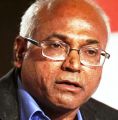
Kancha Ilaiah Shepherd
Kancha Ilaiah Shepherd is a political theorist, author and activist. He has been a professor of Political Science at Osmania University, Hyderabad and director of the Centre for the Study of Social Exclusion and Inclusive Policy at Maulana Azad National Urdu University, Hyderabad. He is the author of ‘Why I Am Not a Hindu’, ‘Buffalo Nationalism’ and ‘Post-Hindu India’
-
Unveiling of the Statue of Prof. Kancha Ilaiah Shepherd
On the auspicious occasion of the celebration of 209 years of Indian English
PACPET, Hyderabad | 4 October 2026
-
209th Indian English Day & Prof. Kancha Ilaiah Shepherd
-
Why We Need Savitribai Phule’s India: Sujana
Yadav’s Bold Speech on Equality
In this powerful and thought-provoking speech, Sujana Yadav (Founding & Core Committee Member of the Telangana People’s Front) discusses the critical role of English education in empowering women and marginalized communities in India. She challenges the current education system, calls out the imposition of majoritarian ideologies, and emphasizes the need to look up to icons like Savitribai Phule and Dr. B.R.
Ambedkar. Yadav passionately advocates for the establishment of high-quality, international-standard “Telangana Public Schools” to ensure equal rights and constitutional morality for all.
-
Indian English Day
-
Savitribai Phule: The Mother of Indian English

5th October 2025 marks the 209th Indian English Day
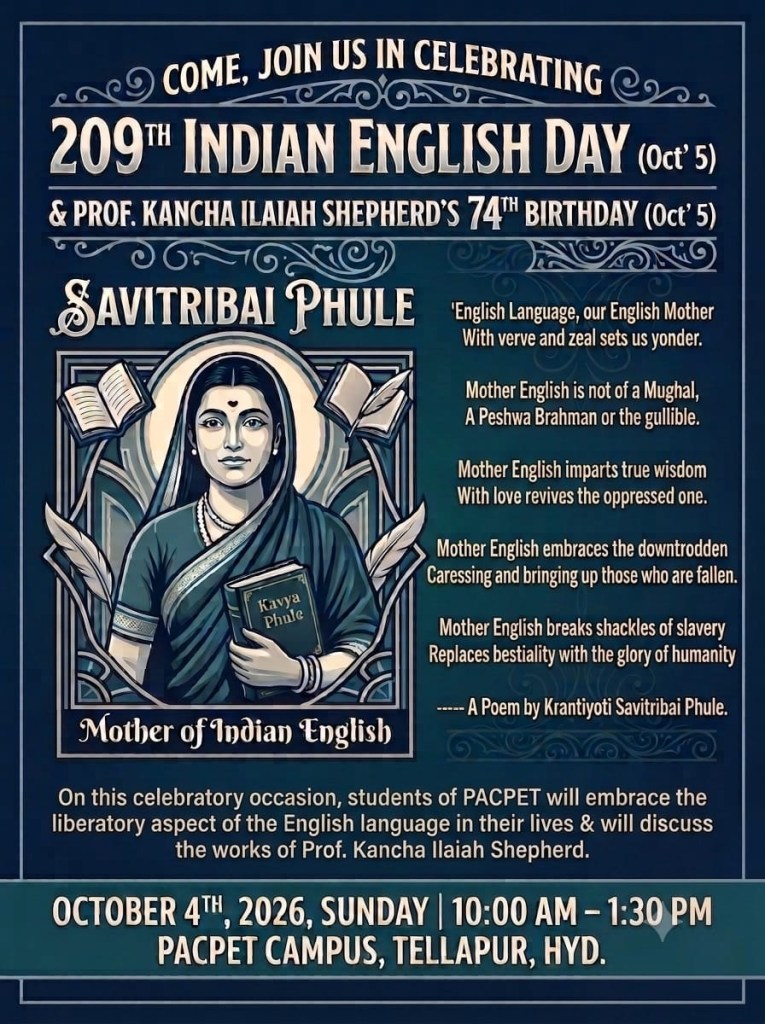
The Phule-Ambedkar Centre for Philosophy and English Training (PACPET), Tellapur, Hyderabad, will celebrate the 209th Indian English Day by declaring Savitribai Phule as the Mother of Indian English at the PACPET campus on 4th October 2026. Indian English Day falls on Monday, the 5th, but we are celebrating it on Sunday due to the availability of the participants.
The celebration of this day is to pressure the hypocritical Indian rulers in Delhi that they cannot continue with two modes of school education in India—English for the rich in private schools and regional-language education for the poor in government schools. For the last twelve years, the BJP/RSS government in Delhi has widened the gap between government and private education by allowing monopoly companies and foreign educational institutions to set up private schools, colleges and universities offering education in English for payment, while starving government educational institutions by all means.
The central and BJP-ruled state governments constantly push for de-Anglicising school, college and university education run by the government.
In Chatron Ki Goonj meetings, Rahul Gandhi has repeatedly heard students studying in government institutions explain how their opportunities in regional-language education are almost nil. The standards in government institutions are falling year by year as the governments do not recruit teachers or improve infrastructure. Regional-language textbooks are substandard compared to English-medium standards in the private sector.
This is a deliberate drive of the RSS/BJP to collapse the government education system so that the total education system can be sold to private businesses. That will automatically lead to the isolation of the masses who cannot afford private education.
Why Savitribai, and not any other woman of her time, should be the Mother of Indian English
Savitribai was the first woman to take a bold stand and write a poem about how the English language liberates oppressed lower-caste women and men more than regional-language education in India. The Phules lived just after the British ended the Peshwa Brahminic barbaric Raj in Maharashtra.
Mother English
In 1854, Savitribai published her poetry book Kavya Phule. The poem “Mother English” was part of it and was the most striking of all the other poems in the book because of the way in which she Indianised the English language 172 years ago. She was the first English-speaking woman willing to write in that language, even though she had no formal education. I do not think any other Brahmin/Bania woman was allowed to learn reading and writing in English during Savitribai’s time.
The poem was written in Marathi and later translated into English (Gail Omvedt).
Rule of Peshwa is gone
Mother English has come.
Forlorn and dark our hopelessness
Ominous fears of heaven and abyss.
In such a dismal time of ours
Come Mother English, this is your hour.
Throw off the yoke of redundant belief
Break open the door, walk out in relief.
Learn to read and write, O my dear one
Opportune times! Mother English has come.Manu’s ways are evil and mean
Poor and depressed we have all been.
They’ve cheated, befooled, looted us all
They’ve gone with English Mother’s footfall.Brahman’s rule is now in ashes
Under the English whips and lashes.
It is all for the good of the poor
Manu’s dead at English Mother’s door.Knowledge is a poor man’s refuge and shade
It’s akin to comfort mother made.
In English rule we’ve found our joy
Bad days gone, Mother English abhay!English is the inheritance of no
Persian, Brahman, Yemeni or Hun.
We have true Indian blood in our veins
Cry out aloud! And shout! Mother English is OUT!Go, Get Education
Be self-reliant, be industrious
Work-gather wisdom and riches.All gets lost without knowledge
We become animals without wisdom.
Sit idle no more, go, get education
End misery of the oppressed and forsaken.
You’ve got a golden chance to learn
So learn and break the chains of caste.
Throw away the Brahmin’s scriptures fast.Background of the poem
Though Ambedkar later wrote volumes in English, including the Constitution of India, and burnt Manusmriti, the book of Brahminical oppressive laws, as the father of the new knowledge and constitutional democracy, he too did not make such a brave statement on the role of the English language as a liberator of SC/ST/Shudra/OBCs. Though he tried to fight to declare English as the national language, he could not succeed. However, the Brahminical forces in the Constituent Assembly agreed to declare English as the Indian administrative language and Hindi as the national language. The RSS/BJP regime is trying to use that to de-Anglicise education in the government sector, gradually moving towards undoing that constitutional guarantee that English will be the administrative language.
Savitribai’s designation of the English language as “Mother English” was earth-shaking. From the state of Peshwa Brahminism and living amidst the most conservative Brahmin nationalists in Poona, who were opposing all the reforms that the Phules were fighting for, she wrote that poem and worked for the spread of the English language along with Mahatma Phule. The Brahminical upper-caste conspiracy of denying Sanskrit education to Shudra/Dalit/Adivasis from their Vedic period onwards continued to keep the agrarian and artisanal productive Indians illiterate and controlled and exploited them for millennia. Even the Muslim rulers obeyed the Brahmins by not allowing the Shudra/Dalit/Adivasi masses to learn the Persian language, leave alone Sanskrit.
We have no idea why they did not learn even reading and writing in Pali, which was a Buddhist language. Of course, Buddhist monasteries were influenced by Brahmanism in later years, and they never tried to open large numbers of schools in India.
In modern times, though the British opened the doors of education to the Shudras and Dalits, the Brahmins controlled the British education system with an iron grip. Tilak, M.K. Gandhi, and many other Brahmin-Bania Congress leaders opposed the Shudra/Dalit/Adivasis learning English during the British period too. Gandhi went on preaching for regional-language education. The Phules, from the 1840s onwards, fought against Brahmin control. Even the Bengali and Tamil Brahmins did not allow the productive castes to learn English.
Savitribai’s declaration of English as Mother and her clarion call for Shudra/Dalit/Adivasi women and men to educate themselves and learn English is a major breakthrough in the history of the English language in India.
PACPET’s ideology
PACPET has by now trained about 750 girls and 750 boys (as the admission policy is 50-50, with separate exclusive girls’ Data Science training)—i.e., 1,500 rural youth from all over India—to speak, read and write in English over a period of four and a half years. All of them read Savitribai, Phule, Ambedkar and my writings as part of the syllabus.
Savitribai is special to the Centre. There is a hidden expression in Savitribai’s “Mother English” poem that English should become the mother tongue of all Indians irrespective of caste, class and gender. In Poona, Rahul Gandhi attacked Manudharma, and the BJP/RSS leaders reacted that he was trying to oppose Sanatana Dharma of Manu. Look at what Savitri said about Manu in her poem: “Manu’s dead at English Mother’s door.” Her message has to be taken to every door in India in order to liberate our women and men from casteism and patriarchy.
By declaring Savitribai as the Mother of Indian English, PACPET throws a challenge to the RSS/BJP forces that they cannot stop the spread of English education in Indian government schools and its use as an administrative language. English is the only language that exists in every state’s school books, whatever their regional language may be. Even the most remote tribal children, whose so-called mother tongue is confined to a small group, know some English. Whether one is an Urdu-speaking Muslim boy or girl or a Gurmukhi-speaking Sikh, English is a common language between all of them. Such a presence of English among all youth enabled PACPET to train youth from about 20 states, whose mother tongues are totally different. They communicate among themselves only in English. English strengthened nationalism among them all. Hindi cannot do that now or in the future.
In Telangana and AP, English has become the medium of teaching in all government schools. Though pro-Hindutva forces like Venkaiah Naidu, Justice N.V. Ramana, and Jayaprakash Narayana tried to convince A.P. CM Chandrababu Naidu and Telangana CM Revanth Reddy to discontinue English-medium education in government schools, they did not succeed.
Celebrating Indian English Day every 5 October, adorned by a beautiful portrait of the Mother of Indian English—Savitribai Phule—the Phule-Ambedkar Centre for Philosophy and English Training wants to immortalise Savitribai’s heroic declaration in 1854 that English is the Indian mother.
Kancha Ilaiah Shepherd is a political theorist, social activist and author. His latest books are A Shudra Life—Autobiography and Harappa God’s City of Civilization (a novel).
https://countercurrents.org/subtopics/kancha-ilaiah-shepherd/
-
Art Through the Mists of Time in Kancha Ilaiah’s Book Harappa
The story focuses on the people of a village that will eventually play a pivotal role in the birth of the Harappa Civilization.
In 2015, I wrote an article titled ‘One Pound Capitalism, a Pinch of Democracy, and the Not-So-Holy Buffalo’. At the time, I was designing recipes as part of my discomfort foodart/essay series, and the recipe ‘Buffalo Jumbo Pav (BJP) #1 hypocrisy kebab bonda pav’ which accompanied the article was inspired by Professor Kancha Ilaiah Shepherd’s response to the Indian state of Maharashtra, which had extended a ban on cow slaughter to include bulls and bullocks but not buffalo. He had said of the ban, “It’s racism and casteism. It’s racial because the buffalo is black. Why is black bad? They want to kill it like the white Americans did. The Aryan racist idea came into that. They drink the milk because it is white. So, dark buffalo gives white milk but she doesn’t qualify as sacred?”
About seven years later, I was thrilled beyond words when Prof. Ilaiah approached me to illustrate his important novel HARAPPA: God’s City of Civilization, which was published by Unbound Script in July this year. His text flooded my mind’s eye with vivid imagery. I clearly had a lot to work with.
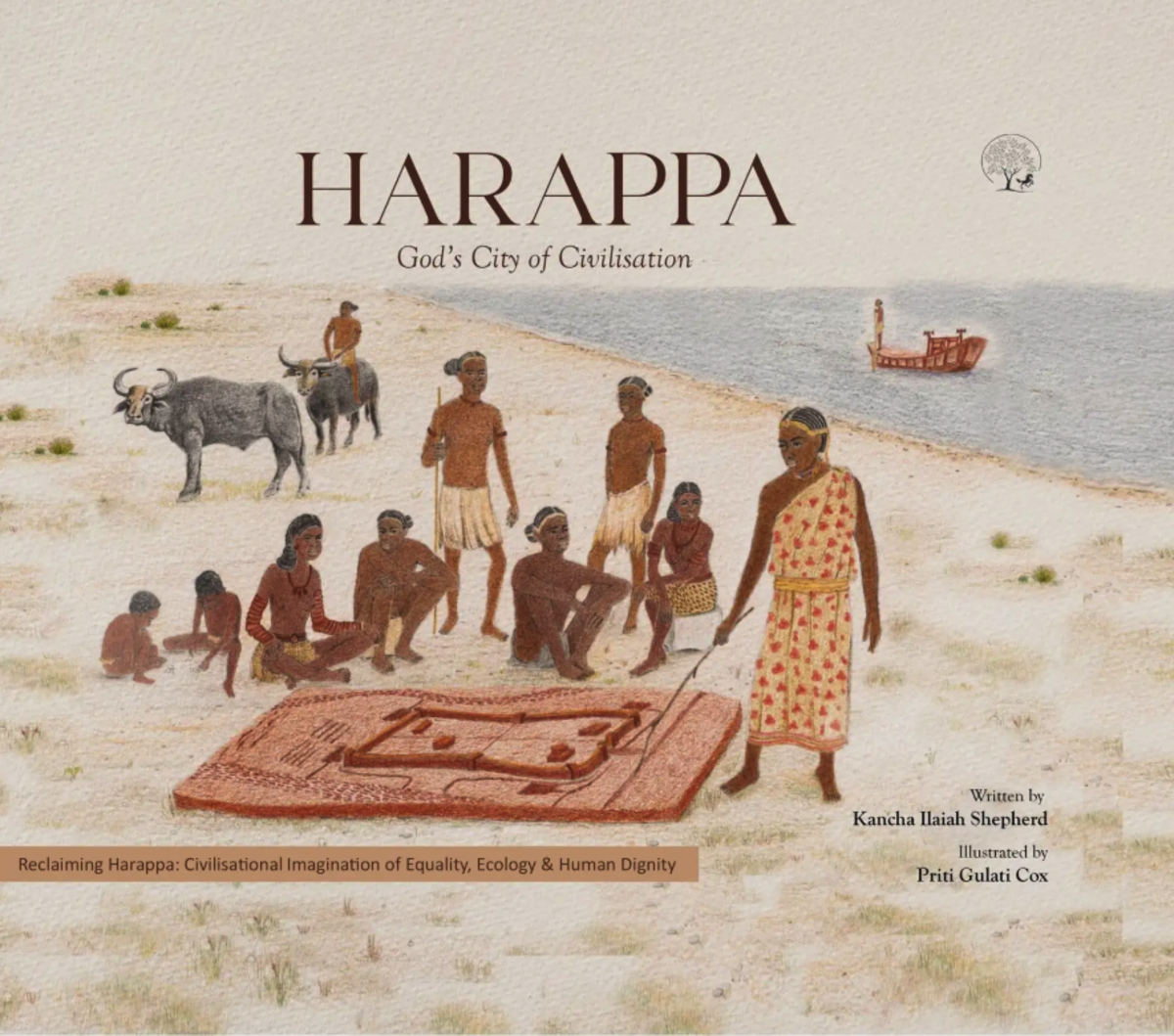
HARAPPA is a work of fiction, but not of fantasy. Prof. Ilaiah kept his story within the bounds of what is known about the place and time in which it is set. I too had to be sure that my illustrations would be consistent with what scholars have learned after researching the Harappa Civilization for more than a century. Most of all, I wanted the imagery to reinforce the deeper messages that one finds in every page of Prof. Ilaiah’s text.
The People
The story focuses on the people of a village that will eventually play a pivotal role in the birth of the Harappa Civilization. In the illustrations, I represented those characters in accord with what we know of their ancestry. Their family tree traced back to two populations. One consisted of hunter-gatherers who had migrated out of Africa tens of thousands of years earlier and eventually settled in what today is northeastern Pakistan. The other ancestral group, also African immigrants, followed a more westerly route into Asia, ending up in what today is western Iran; there, they took up agriculture and then, much later, migrated to the same region of Pakistan. By the time Prof. Ilaiah picks up the story, at about 5,500 years before the present, the two groups have been coexisting and commingling for millennia. They have thus become one people.
In the book’s images, I portrayed the villagers in ways consistent with their African ancestry, given with what’s known from archeology, genetics, and the communities of indigenous South Asians (Adivasis) who still live in places across the subcontinent. As one guide to their general appearance, I took into account the way Harappans portrayed their own people in the artifacts they left behind at archeological sites. Thus, I gave most of the men black hair braided in rows running tight, crosswise, across the top of the scalp and arranged in two buns, one above the other, in back. The women wear their hair in thick, long braids pinned up and across in back (yes, they had hairpins).
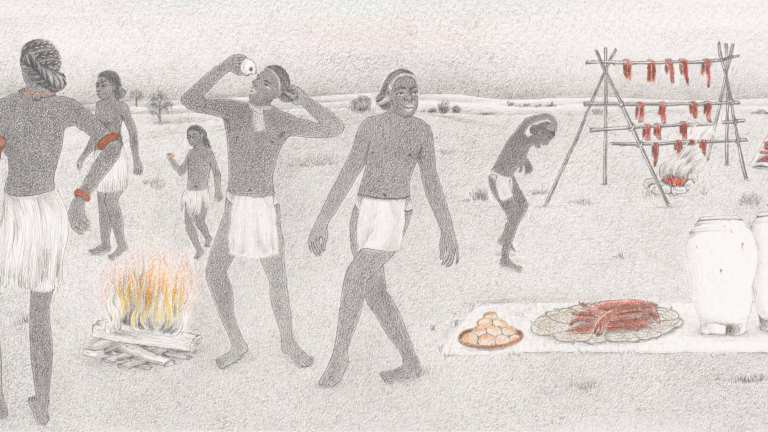
The “winter festival” scene in Chapter III features two stars of Harappa’s archeological remains. The most famous, the 4-inch-tall “Dancing Girl” of Mohenjo-daro, with her sassy, strikingly modern pose, has captivated scholars for almost a century; in the book’s festival scene, I have her cheekily turned her back to us. For another of the foreground figures, I “reconstructed” a badly broken Harappan artifact, a small sculpture of a male dancer whose body language suggests gender fluidity. Yet another festival-goer blows an egg-shaped whistle, examples of which have been unearthed by archeologists.
In the book’s cover image, I used still other Harappan sculptures as models for the sitting or squatting postures of people as they watch the main character, named Harappa, explain a clay model of the city that they will go on to build together. These resting postures remain common throughout rural South Asia today. The depictions of children in this and other of the images come from my observation of children at play in villages of south-central India.
For the scene in which a pottery-maker has sculpted an image of Harappa and offers it to him, I used as a model one of that civilization’s most well-known artifacts: the sculpture of a handsome, bearded man with the double-bun hairstyle known today as the “Priest-King.” (In the story, Harappa rejects the gift, saying, “I am not God. Take it away. We … must be above human worship.”)
A new character bursts onto the scene in the book’s closing chapters. Adidevudu (roughly, “first god”) is sort of a wandering philosopher. As Prof. Ilaiah describes him, “His lower body was covered with a lion’s skin, though it had several holes. Three harmless snakes were … coiling around his neck … He was the same color as Harappa. His hair was knotted on the top of his head.” He held a stick that had “three dried-up branches” on top.
Adidevudu is clearly meant to embody an indigenous South-Asian version of the god Shiva—centuries before Hindu gods were conceived of. Prof. Ilaiah clearly modeled him after several Harappan artifacts that are widely considered to be depictions of a “proto-Shiva.” These include several figures sitting in Shiva’s cross-legged yogic pose, as well as the aforementioned dancing-man sculpture, whose pose appears to presage that of the Nataraja or “Dancing Shiva.” Therefore, in the book’s five images of Adidevudu, a character who becomes crucial toward the end of the story, I portrayed him as a dark-skinned, somewhat eccentric version of Shiva.
Animal Domestication
Animals, both wild and domestic, played a central role in the society that would become Harappa, and the book highlights animal domestication as an essential step in the civilization’s development. Several illustrations follow the book’s descriptions of how the people at the root of the Harappan Civilization herded sheep and goats and initiated the domestication of jungle fowl—progenitors of today’s chickens. They also hunted buffalo and deer for meat; therefore, I included images of men killing buffalo with large ornamental spears. I based these images on ritual artifacts depicting buffalo sacrifice that were found at Harappan sites. The book also describes Harappa, as a young man, taming a baby buffalo, feeding it on sheep and goat milk as a first step in developing a full-blown buffalo economy.
At this initial stage of domestication, the above animals were visually indistinguishable from their wild progenitors, and I portrayed all of them as such. The Harappans are also reported to have at least partially domesticated the dog, elephant, and camel, but they are absent from the book; nevertheless, I included a drawing of an Indian pariah dog. An animal that is featured on many Harappan seals and other artifacts, probably more than any other, is a creature that never existed: a unicorn with the body of a water buffalo.
Water
The Harappa Civilization evolved in a low-rainfall region of South Asia, and the archeological sites include a variety of sophisticated systems for water storage, distribution, and use, as well as wastewater management. Prof. Ilaiah’s story credits the origins of these systems to the efforts of a young woman named Maisamma, who begins by creating mud-walled reservoirs and canals to convey stored water to the village and surrounding fields. I included images of both.
Prof. Ilaiah includes a character named Neetiman who launches Harappa’s boatbuilding industry. The Harappans designed their boats for travel and trade, not only through the region’s river systems but also on the sea to locations as distant as present-day Oman. (Yes, they were shipping through the Strait of Hormuz more than 4,000 years ago.) None of the vessels survive, except as images on tablets and seals, which I used as reference for illustration. Similar (though less lavishly ornamented) flat-bottomed boats are still used for crossing the Indus River in the Mohenjo-Daro area.
Food and Agriculture
Agriculture was fundamental to the founding of South Asian civilization. A plowed fielduncovered in the 1980s in the southeastern part of the Harappa region dates back 4,800 years, to the very early Harappa period, and is regarded as the world’s earliest evidence of a row-cultivated plot of land. In the book, I depict that field as part of a composite image arranged in an Indian rangolipattern, along with some of the crop plants grown in those days: wheat and barley (their staple grains), sesame, and mustard. Also included are a typical Harappan solid-wheeled cart for hauling grain; a young farmer holding her sickle, her pose based on a photo I took of a harvester in south-central India; images of round grain-threshing platforms made of bricks (modeled on remainsthat were unearthed in Harappa intact) and of men pounding bundles of plants on such platforms to knock out the grain (based on my observation of present-day threshing methods on small farms in India).
The pipal (aka peepul or bo) tree, Ficus religiosa) has been revered in South Asia for millennia, including during the Harappa period. Its leavesare used for myriad purposes to this day in South India. I included pipal trees in two of the book’s scenes; in one, Harappa, as a young man, has climbed the tree to escape a charging mother buffalo.
Another rangoli collage, at the start of Chapter V, highlights more uses of plants by the characters of Prof. Ilaiah’s story. It includes the weaving of fabric from jute and the making of plant-based dyes. Then there’s an image of the plant Ephedra gerardiana, a gymnosperm considered to be the most likely source of soma, a stimulant that plays an important role in the most ancient Hindu texts.
Soma is believed to have held spiritual significance for the Harappan civilization. For instance, in artifacts, the fantastical unicorn is almost always portrayed as facing toward a hard-to-identify, seemingly ritual object. The most plausible answer to the question, “What is that thing?” is that it was a device was used to distill and filter soma. (Near the end of the book, I included an image of this device in a sepia-toned rangoli pattern that reprises many images from throughout the book.) I also feature soma in the book’s winter festival scene. Prof. Ilaiah writes that there was ample soma on hand at the party, and it was served in pipal-leaf cups. I depict the cups, along with tall clay urns in which the soma was stored.
The Rest Is History
Illustrations early in the book are rendered in shades of gray, with the images of people, plants, and animals appearing as though viewed through the mists of deep time. Partway through Chapter III, I start adding a little color here and there, starting with a peacock and then, in the party scene, adding color to the Dancing Girl’s bangles, wood fires, roasted buffalo and deer meat, and some laddoos—small buns made with ground wheat and barley grain. Then, toward the book’s end, around the time the proto-Shiva figure Adidevudu shows up, the images take on full, often garish color.
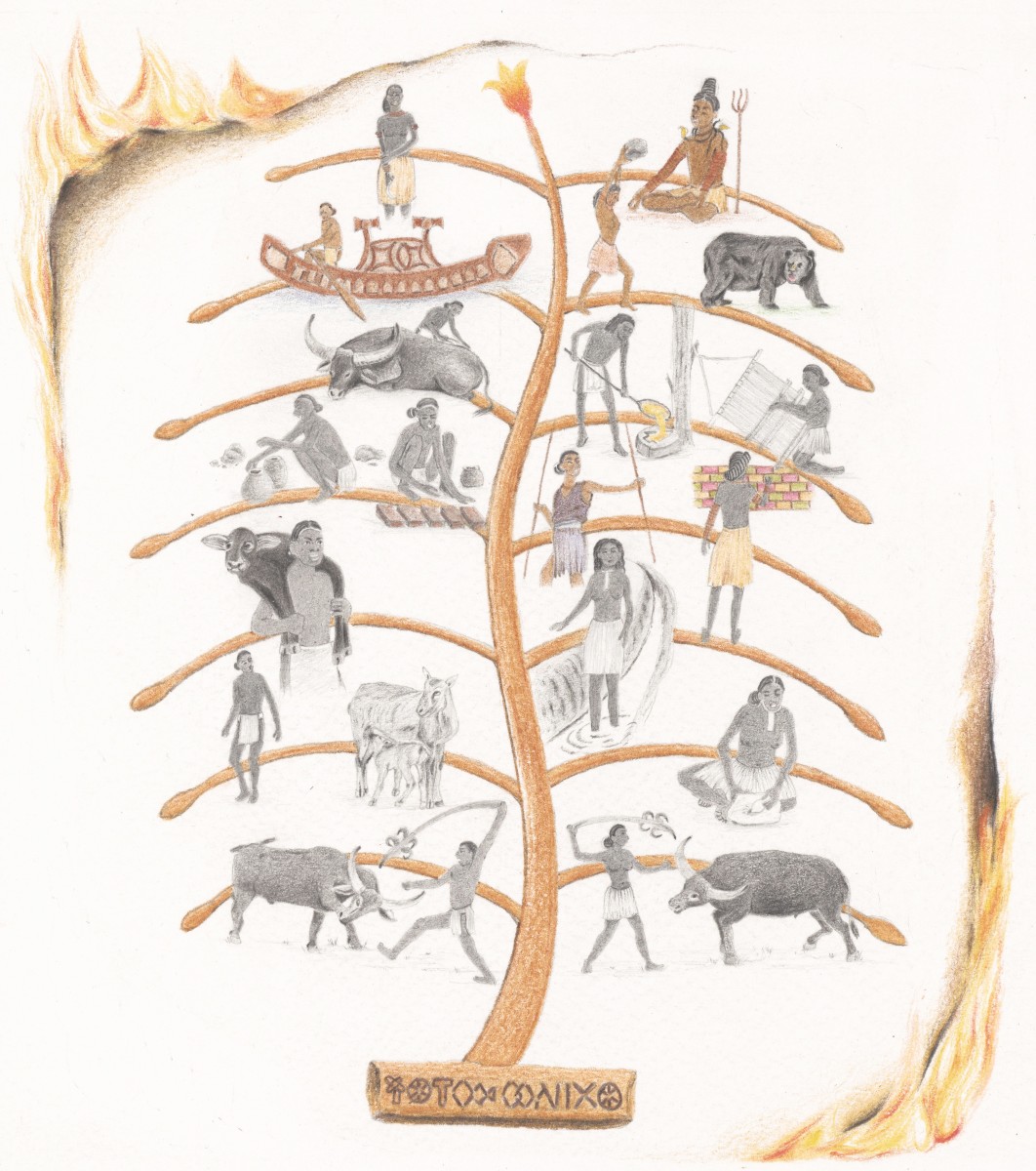
Soon, Prof. Ilaiah introduces four new characters: pale-skinned, cattle-herding, beef-eating Aryans who’ve wandered on horseback out of Central Asia and descended on the Harappa region. At this point, where the plot starts turning some unexpected corners, my images become more explicitly symbolic. At the book’s beginning and again near the end, for example, I placed composite images modeled on the southernmost petals of the mythological lotus-shaped map of India known as the Jambhu-Dwipa (“Plum-tree Continent”). In chapter I, the center of Jambhu-Dwipa, and petals radiating from it contain gray-toned scenes from Harappa when it was still a village. By chapter VIII, those scenes have been replaced by Mt. Meru in the center, and in the petals, scenes from the Vedic culture that would soon be migrating to Jambhu-Dwipa, stealing and claiming ownership over everything Indigenous.
In the bottommost petal of the second Jambhu-Dwipa image, I scatter a few specimens ofAmanita muscarita across the landscape as a portent of things to come. Some scholars have suggested that A. muscarita (known as the fly agaric mushroom, bright red in color with white spots), not E. gerardiana, provided the active ingredient in soma. According to K.T. Achaya in his book Indian Food, those mushrooms exert “hallucinogenic effects of the kind described in the Vedas… Much of the poetic if rather cryptic imagery of the texts seems to fit the mushroom.”
As a final sad farewell, I added a second pair of images. Each features a lively tree rendered on a terra-cotta tablet. It’s one of the most well-known artifacts from Harappa. At the end of Chapter VIII, I depict the tree with its leaves replaced by thumbnail versions of images we’ve seen earlier in the book, most of them depicting Harappan technologies and practices: water travel, leather-working, metallurgy, precision brickmaking, animal breeding, painting, weaving, and more. I place the same image at the end of the story, with one change: the edges of the paper on which it’s drawn are now going up in flames, a portent of the Harappa Civilization’s demise.
Prof. Ilaiah ends his book with the four Aryan wanderers gazing out over Harappa City for the first time, leaving us to consult nonfictional history for the rest of the story. Of course, the historical, archeological, and biological records show that as the itinerant Aryan pastoralists migrated to and settled in the Indus and Ganges basins, they usurped and exploited Harappan agricultural methods, technologies, sacred and artistic practices, and approaches to designing and constructing visually impressive, highly functional, city-states. They seized political and cultural power and, after a few centuries, consolidated that power through imposition of the caste system. And the rest, as they say, is history.
The opinions expressed here are solely the author’s and do not reflect the opinions or beliefs of the Hollywood Progressive.

Priti Gulati Cox (@PritiGCox) is an artist and local organizer for CODEPINK Sidewalk Gallery of Congress, a community street art space. Please go here to see her current project It’s Time. https://hollywoodprogressive.com/art/art-through-the-mists-of-time-in-kancha-ilaiahs-book-harappa


You must be logged in to post a comment.