-
Siddaramaiah: A Rational OBC Counter to Modi’s Communal OBC Politics
The time has come for Shudra-OBC leaders across the nation to unite and lead the country with positive democratic welfarism and putting a firm end to communalism in the name of OBC politics.
Kancha Ilaiah Shepherd
3 hours ago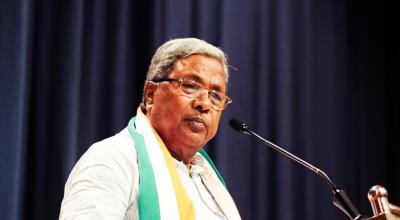
Siddaramaiah. Photo: Twitter/@INCKarnataka
A point of view has gained ground that the Congress’s victory in the Karnataka assembly elections is because of Rahul Gandhi’s Bharat Jodo Yatra. There is no doubt that the yatra played an important role, but without a strong mass leader at the state level, no national party can win assembly elections. If not for the presence of a strong mass leader like Siddaramaiah, who proved to be a good administrator and above corruption politics – which afflicted the Karnataka state BJP leadership – it would have been impossible to win in the manner that the Congress did in 2023. Though D.K. Shivakumar played an important role as the Karnataka Congress president, he does not have a significant mass base in the state. It is Siddharamaiah’s mature and unwavering secular leadership, backed up by his ability to mobilise people, that should be hailed above everything else as the reason for the Congress’s victory. The party’s nationalist leadership should see the benefit of replicating the same model in every state.
daramaiah becoming the chief minister of Karnataka for the second time is good news for India as a whole. His second term, though, poses challenges of keeping the BJP in check and running the administration to the satisfaction of the people, who delivered a defeat not just to the BJP but also to Prime Minister Narendra Modi. This was an election between Siddaramaiah’s people’s welfare politics and Modi’s ‘Jai Bajrang Bali’ communal politics. Siddaramaiah’s grassroots popularity and his consistent secular democratic strategies have made him a real mass leader. This election in Karnataka has an important lesson at a moment when the country is at a crossroads between communalism and democratic welfarism. This shift would have serious implications for the Hindutva ideological apparatus.
Karnataka is the home state of Dattatreya Hosabale, the next prospective RSS chief. He would have wanted to get a majority by using all possible resources. It is said that Hosabale was among those who pushed for Modi to be the BJP’s PM candidate in 2013. Hence, Modi also used his government’s strength, time and energy to win Karnataka, using the OBC card and sharpening communal divides. The BJP government in Karnataka has made some of its most critical anti-Muslim policies – like banning the hijab in government schools and scrapping the quota for Muslims – during Bsavaraj Bommai’s time as chief minister to appease RSS leaders like Hosabale and B.L. Santosh.
But Siddaramaiah countered all those efforts with his mass contact, his proven administrative abilities as a chief minister between 2013 and 2018. The poor, the Shudras, OBCs, Dalits and Adiavsis were eager to bring him back. Of course, the Muslims were also with him as he had a strong and vocal stand on the positive role of Tipu Sultan.
Sidda, as he is popularly known, has not come from an urban business background, big or small, or a community that has been granted OBC status for political purposes. He is from a historical Shudra shepherd family that was denied the right to education and human dignity from the days of ancient Hindu texts.
Having realised that the OBC vote is going to decide the power equation in Delhi, the RSS/BJP and affiliated forces have been minting many non-Shudra leaders as OBCs. This was because of the realisation – after having opposed the Mandal reservation at first – that without OBC votes, it was not possible for them to capture Delhi. Narendra Modi and Sushil Modi, the BJP leaders who now flaunt their OBC status, opposed the Mandal reservation and worked as leaders of the militant Kamandal movement!
Siddaramaiah was their nemesis. He was a strong leader of the Mandal movement. Having come from a shepherd family, with a family that has roots in the agrarian and animal economy, he went to school after he turned 10 and obtained BSc and LLB degrees. That was unexpected of a Kuruba boy in those days. After he completed his LLB, he started practising law while working as a social activist in the Mysore area. As a young lawyer, he caught the eye of M.D. Nanjundaswamy, a well-known leader of the farmers’ movement, in the early 1980s. It was he who gave Sidda the opportunity to contest in the assembly elections as the representative of the farmers’ organisation Karnataka Rajya Raitha Sangha. He won and walked into the state assembly in 1983. He later joined the Janata Party, emerging as a pro-poor faction leader in that khichdi party. He went on to win election after election and soon became a minister.
After the split in the Janata Dal, he joined Deve Gowda’s Janata Dal (Secular) [JD(S)] vocally pro-poor and committed OBC, SC, Adivasi representative. He had hoped to become the chief minister after Deve Gowda, as he had worked as a deputy CM in his cabinet. But Deve Gowda picked his son.
Siddaramaiah then left the JD(S) and flirted with the idea of forming a regional party to champion the cause of the AHINDAs (an acronym for Alpasankhyaka, Hindulida, Dalita). Hindulida in Kannada means backwards.
But he entered the Congress instead, bringing his strong commitment to secularism and rationalism. One can see his commitment to secularism and rationalism in all his statements after the BJP came to power in Delhi. He never compromised with saffronism. The state president D.K. Shivakumar can be seen sporting a bundle of saffron threads on his wrist, but not Sidda.
The Congress’s national leaders like Rahul Gandhi and Priyanka Gandhi also make a display of their Hindu faith by going to temples. But Siddaramaiah does not. He would quote Basava and Akka Mahadevi as his tradition of spiritual leaders.

Congress leaders, including Siddaramaiah and Shivakumar, celebrate in New Delhi. Photo: By arrangement
How is he an original OBC?
The Shudras, who in the present society constitute about 52% of the population, got divided into Other Backward Classes (OBCs) and into the general category (Jats, Patels and Marathas, Reddys, Kammas, Nairs and so on). In Karnataka, Lingayats and Vokkaligas, who are like Jats and Reddys, are upper agrarian Shudras but they have a share in the reservation scheme. They are also known as Other Backward Classes or OBCs. Siddaramaiah, having come from a Kuruba (shepherd) background has lived a life steeped in agriculture, a characteristic he shares with Lingayats and Vokkaligas. His relationship with meat and milk producers and also grain producers is deep and intimate.
Modi, who came from an urban business Mod-Ganchi community background, has often tried to cast him as anti-Lingayat. But Siddaramaiah was a true representative of OBCs, who fought for reservations for Kannada Shudras. Lingayats and Vokkaligas know that. The poor of those castes are fully with him. After Devaraj Urs, he is the only leader to command such a popular vote base in the state.
The BJP, which tactically put forth Modi, playing up his OBC status has won two national elections. I believe he can be defeated only if the Shudra agrarian OBC leaders of the nation join hands. Siddaramaiah, Pinarayi Vijayan, M.K. Stalin, K. Chandrasekhar Rao, and Jagan Mohan Reddy, all the chief ministers in South India, are from Shudra agrarian and artisanal backgrounds. In the North, Akhilesh Yadav, Tejashwi Yadav, Nitish Kumar, Bhupesh Bhagel, and Ashok Gehlot are also from Shudra agrarian backgrounds. If they power their respective parties to a majority of parliament seats in 2024, the BJP will lose. The Congress in Delhi must realise that the BJP’s urban business OBC agenda must be countered with the historical Shudra agrarian-peasant OBC agenda. Siddaramaiah’s model suits that party very well at the national level.
Once Modi as the PM used the religious slogan ‘Jai Bajrang Bali’, urging people to go to the election booths and chant it before they vote, he clearly put forth his aggressive communal positioning on the election scene. Morally, he has lost a lot of ground.
The time has come for Shudra-OBC leaders across the nation to unite and lead the country with positive democratic welfarism and putting a firm end to communalism in the name of OBC politics. Urban-communal OBC politics is a far cry from agrarian productive Shudra/OBC forces.
Articulating agriculturist nationalism and checking massively amassed crony capital mobilisation of non-OBC, Dalit, and Adivasi forces is critical. These forces have distorted the democratic capitalist path of India. Mahatma Phule, Dr B.R. Ambedkar and Periyar wanted a positive people’s democracy without involving religion in politics. Siddaramaiah has represented that ideology throughout his career. Congress intellectuals, if they know what is good for them, should study his path carefully and work out a comeback strategy at the national level.
Kancha Ilaiah Shepherd is a political theorist, social activist and writer. His recent book The Shudras: Vision for a New Path, co-edited with Karthik Raja Karuppusamy shows a possible way out from the communal OBC morass that the RSS/BJP deploy.
https://m.thewire.in/article/politics/siddaramaiah-counter-modi-communal-obc-politics
-
Why South Indian states are more developed, ahead in per capita income, fiscal health
The South Indian states of Tamil Nadu, Andhra Pradesh, Telangana, Kerala, and Karnataka have the strongest state economies in India, accounting for over 30% of India’s GDP; Tamil Nadu, with a GSDP of Rs 24.8 lakh crore at current prices, is the biggest economy in south India
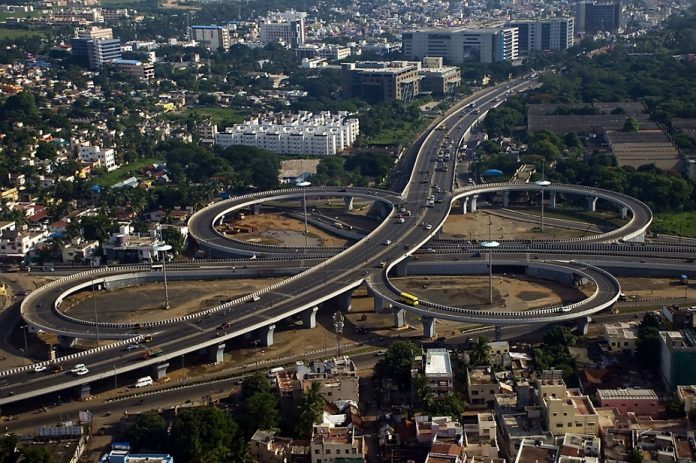
Tamil Nadu, with a GSDP of Rs 24.8 lakh crore at current prices, is the biggest economy in south India. Photo: Wikimedia Commons The five South Indian states of Tamil Nadu, Andhra Pradesh, Telangana, Kerala, and Karnataka have emerged as the strongest economies in the country, according to the recently released data analysis of the per capita income, state debt, tax revenue, interest payment ratio, and fiscal deficit
The data analysis from the media networks reveals that these five southern Indian states are among the major contributors to the nation’s economic growth, accounting for over 30 per cent share of India’s Gross Domestic Product (GDP). The data available from the Reserve Bank of India (RBI), and economic surveys of these states shows that in FY23 Tamil Nadu, with a GSDP of Rs 24.8 lakh crore at current prices, is the biggest economy in south India. Karnataka (Rs 22.4 lakh crore), Telangana (Rs 13.3 lakh crore), Andhra Pradesh (Rs 13.2 lakh crore) and Kerala (Rs 10 lakh crore) Gross State Domestic Product (GSDP) are the other five major economies in south India.
A look at the per capita income
Telangana recorded the highest per capita income of Rs 2,75,443 in FY22. Karnataka, with Rs 2,65,623, is in the second spot. It is followed by Tamil Nadu (Rs 2,41,131) and Kerala (Rs 2,30,601). Andhra Pradesh (Rs 2,07,771) has the lowest per capita income among the five major south Indian states. However, all these states have higher per capita income than the national average of Rs 1,50,007.
The debt ratio indicates the capability of the southern states to further boost their economies. The debt to GSDP ratio is a major indicator for analysing the financial health of the economy where a lower debt-to-GDP ratio indicates the stronger financial condition of that state. Among the five major south Indian states, Telangana has the lowest debt to GSDP ratio of 25.3 per cent, followed by Karnataka (27.5 per cent), Tamil Nadu (27.7 per cent), Andhra Pradesh (32.8 per cent), and Kerala with (37.2 per cent).
Welfare distribution policies
As of 2023 though, Andhra Pradesh has less GDP because of the division of the United Andhra Pradesh leaving the well-developed Hyderabad capital to Telangana. Within Hyderabad, the Andhra capital share of investment is far higher than original Telangana investors’ capital. Andhra Pradesh will certainly catch up and advance given the present education and economic policies with a strong welfarism that the present government has put in place. It is a question of time.
The distribution of state resources for the welfare of productive masses does not weaken the state’s economy. In fact, it strengthens it. The state’s welfare distribution policies channel money into both rural and urban markets, thereby improving the purchasing power of the people in the state.
However, what is more important is this: why do these South Indian states perform better than Gujarat, which has a GSDP of Rs 25.62 lakh crore, and West Bengal, which has a GSDP of Rs 17.19 lakh crore? One reason could be the right-wing Hindutva model of development that the Bharatiya Janata Party (BJP) presented as the best model of development in the 2014 General Elections has no well-packaged welfare distribution.
The second reason could be the fact that West Bengal has been ruled by the Communist bhadralok for over 34 years and, subsequently, by liberal bhadralok for about 15 years now and both of them have no good welfare system in place. In both cases, the distribution of wealth among the agrarian productive masses is far less than that in the South Indian states.
The curious case of Gujarat and Maharashtra
Why are the Southern states performing better than Maharashtra, which has the most industrial capital city, Mumbai? Maharashtra has a GDP of Rs 35.27 lakh crore, and its per capita income is Rs 2.42 lakh. Gujarat and Maharashtra are home to some of the wealthiest capitalists in the country and are listed among the world’s richest. Hundreds of top industrialists live in Western India, so their per capita income should have been much higher than that of the South Indian states. Though Gujarat per capita GDP is ₹281,804 the wealth in that state is more concentrated in the hands of industrialists and traders. There is no Tamil Nadu or Andhra Pradesh kind of robust welfare system in Gujarat.
These two states are under the grip of right-wing ideological forces, even though Mahatma Jyotirao Govindrao Phule and Bhimrao Ambedkar were born in that region. There is no visible educational welfarism in those states. The emergence of the middle-class from the Shudra/Dalit/Adivasi communities with good English medium education is not higher in those states compared to the Southern states. The Southern states are much better in generating a middle class from Dalit/OBC/Adivasis.
Stronger welfare initiatives in the South
The education and competing welfare initiatives in the South Indian states are much stronger compared to the Northern and Western states. In Tamil Nadu, due to the presence of two Dravidian regional parties, there has been a long-standing tradition of competing welfare policies. This has resulted in well-funded school education, a well-cared-for agricultural sector, and a robust healthcare system. Since 1967, Tamil Nadu has never allowed the national parties to come to power, which has allowed the state to maintain its focus on regional issues and the needs of its people.
In the united Andhra Pradesh and now in the two separate states of Telangana and Andhra Pradesh, regional parties have been in power with a focus on competing welfare policies. Though the Congress party ruled the combined AP in competition with the TDP, after YS Rajasekhara Reddy came to power in 2004, the welfare initiatives gained autonomy from the Delhi Congress.
Currently, Andhra Pradesh is leading in online transfer of welfare scheme funds into women’s accounts. This is playing a key role in the expansion of rural and urban markets. The money is being regularly ploughed back into the market, increasing the GST income for the state.
The fact that Andhra Pradesh maintains a higher rank in all economic indexes than any other Northern states itself shows that the state’s agrarian economy is more robust than any other state in the country. Even though it does not have a long-standing industrialised capital city and most of its wealthier investors are in Telangana, it still maintains its economic balance. Its potential lies in its coastal agrarian production and the better management of welfare initiatives.
With newly built school and college infrastructure, a more focused English-medium school and college education in the government sector, the state’s economy is poised for growth in the future.
Secular cultural environment
On the whole, the Southern states are known for their secular cultural environment where reduced superstitions have weakened caste controls, which in turn has helped them maintain better economic development. This is the reason why, although three out of the five Southern states (Kerala, Telangana, and Andhra Pradesh) are small in size, they constitute 30% of the national GDP.
Communal politics keep the states in a constant state of fear and insecurity, and also promote competing superstitions. In such an environment, developmental discourse in civil society is bound to be less and less. Educational institutions and the media tend to focus on communal stories rather than promoting scientific temper, which is key to economic development. The Hindutva school, which is prevalent in many Northern states, has made people compete with communal Muslim ideology, further hindering scientific and developmental discourse. Karnataka in the South is slowly getting pushed into that mode.
The role of an expanded English medium educated middle class in these states cannot be underestimated. Without a globally mobile English medium educated middle class, no state can improve its economy in the globalized world. Even Gujarat and West Bengal could not develop a good English-medium-educated Shudra/Dalit/Adivasi section of society so that they could join the vibrant middle-class of the world. To some extent, South Indian states have been able to do that.
In West Bengal and Gujarat, both the communist and Hindutva models have failed in creating a competing middle-class from the OBC/Dalit/Adivasi sections. On the other hand, the competing Ambedkarite liberalism with robust electoral competition plays a critical role in strengthening the economy of a state, with a focus on education, health and other welfare schemes.
(The Federal seeks to present views and opinions from all sides of the spectrum. The information, ideas or opinions in the articles are of the author and do not necessarily reflect the views of The Federal)
Kancha Ilaiah Shepherd is former director, Centre for the Study of Social Exclusion and Inclusive Policy, Maulana Azad National Urdu University, Hyderabad
-
Hindus opposing anti-caste Bill promote Brahmanic traditions in the USA | The News Minute
The so-called Hindu organisations give the impression that Shudras and all Other Backward Classes (OBCs) are part of them. However, none from among these castes can lead a temple or any spiritual system even in America.

TWITTER / AMBEDKAR INTERNATIONAL CENTER
VOICES CASTE WEDNESDAY, MAY 03, 2023 – 12:51
Written by Kancha Ilaiah Shepherd
On April 25, the California state’s anti-caste-discrimination Bill successfully crossed a hurdle when it was unanimously cleared by the Senate Judiciary Committee and sent to the full senate. The Bill’s introduction by Afghan American Senator Aisha Wahab had seen vehement opposition by conservative non-resident Indian (NRI) Dwijas who assume the caste-hiding religious identity of Hindus.
Dwijas include the Janeu-wearing (so-called sacred thread) Brahmins, and Banias, Kayasthas, Khatris, and Kshatriyas. Instead of forming caste organisations there, the privileged caste NRIs formed so-called religious organisations like the Hindu American Hindu Foundation (HAF) and Coalition of Hindus of North America (CoHNA).
The California Bill is not against the Hindu religion, but against caste discrimination. According to this, even discriminating against a Brahmin by a Dalit in the name of caste is a crime. Why the opposition to the Bill then?Featured Videos from TNM
Those castes that are opposing the Bill are telling the world that they should have the right to discriminate worldwide. This is a shameless approach to a major discriminatory practice.
The caste Hindus in the United States of America should know that no Christian organisation has opposed anti-race laws as a religion. For the first time in modern democratic and human rights history, a religious tag is being used by Hindu organisations to oppose anti-caste legislation. The casteist mindset behind this is more discriminatory than white racism.
On the one hand, the HAF’s website declares that Hinduism teaches that the ‘divine’ is equally present in all. It says that as all beings are connected through this shared ‘divine’ presence, prejudice and discrimination against anyone or any group violates this fundamental teaching and the moral duties of selflessness, non-injury, and truth evoked by it.
On the other hand, the HAF works to sustain the casteist, Brahmanic tradition of only Brahmins becoming priests and conducting rituals in temples, even in the USA.
More than anyone else, the Shudras must understand the Brahmanic ploy that is being played out in foreign countries as well. Brahmins never tilled land in India, nor worked in any artisanal village industry, always treating such work as untouchable. They wrote that Shudras are a fourth varna — slaves unworthy of heading temples, or reading and writing books.
Can they show one Shudra priest in any American Hindu temple? Caste Hindu NRIs import only Brahmins as temple priests, who make a lot of money and return to India. Why do they not want spiritual democracy? How does social democracy come about without there being spiritual democracy? Why are American Brahmin intellectuals not arguing that the priesthood position in that country at least should be open for all Hindus irrespective of caste? Can a Shudra, such as a Reddy, Kamma, Jat, or Maratha, become a temple priest in America?
The so-called Hindu organisations give the impression that Shudras like Reddys, Kammmas, Velamas, Lingayats, Vokkaligas, Jats, Marathas, Nairs, and all Other Backward Classes (OBCs) are part of them. For example, the Kammas and Reddys from the Telugu states lead organisations like Telugu Association of North America (TANA) and American Telugu Association (ATA). None from among these castes can lead a temple or any spiritual system even in America. Caste has not oppressed only Dalits or Adivasis. Brahmanism has historically oppressed all Shudras and OBCs as well. If the Shudras think that the anti-discriminatory laws in America are useful for only Dalits, they are wrong. The Shudras are also discriminated against by the Dwija forces worldwide because the Shudras do not have equal rights in the caste system.
Protesting before the California Senate Judiciary Committee, the members of these Hindu organisations said that the Bill will fuel hate against Hindus. The joint statement by the organisations under CoHNA said, “We fear the Bill will encourage religious profiling and stereotyping of a minority. We believe it advances baseless hateful narratives against these communities by legalising a presumption of guilt and turns a long-standing bedrock principle of American justice on its head.”
What caste do the signatories of this statement belong to? Why do they not reveal their caste background and cultural heritage?
Caste origins are rooted in the anti-dignity of labour prescribed by Brahmanism from ancient days. At no stage in Indian history have Brahmin scholars written anything positive about leather technology, nor have they spoken about agrarian tool science as positively divine. Their literature does not deal with production, as that work is assigned to Shudras and/or Dalits. They have always characterised productive communities’ lives as impure while describing the Brahmanic, anti-production life as pure.
However, there is no such pure and impure work ethic in the discourses of race. Neither does Brahmanism’s pure and impure treatment of male and female bodies exist in the language of race. Women’s life at different stages like menstruation or childbirth are treated as impure in Brahmanism. But Dwija intellectuals have not changed this narrative even while living in the West.
The world now knows that Dalits (the historical untouchables) are the worst exploited and humiliated lot in the world. They constitute about 200 million people. With modern education and globalised migration, the West – America, Canada, UK, etc. – has taken up the cause of abolition of caste relations.
The battle that Mahatma Jyotirao Phule, Savitribai Phule, and Dr BR Ambedkar started in India has reached the West now. But there too, the Dwijas are opposing human equality laws as they have done in India for a long time since the freedom struggle.
According to Manoj Mitta’s latest book Caste Pride: Battles for Equality in Hindu India, when Sardar Vallabai Patel, a Shudra leader, proposed a Bill for legalising inter caste marriages in 1918, during the British Raj, Madan Mohan Malaviya and Surendranath Banerjee opposed it quite shamelessly. It is widely known that when Ambedkar proposed a separate electorate for untouchables, MK Gandhi opposed it bitterly fearing that it would divide Hindus and turn them into a minority against the Muslims.
Now, Dwijas living in America are opposing equality laws in the name of Hindu organisations. As history repeats this shameless civilizational practice, fighting this behaviour of casteists will be one of the world’s biggest problems.
Kancha Ilaiah Shepherd is a political theorist, social activist and author. His latest book The Shudras: Vision For a New Path, co-edited with Karthik Raja Kuruppusamy, has put forth a powerful argument that without the cooperation of Shudras with Dalits and Adivasis, caste inequality and oppression cannot be changed.
-
What it took for the West to wake up and notice casteism
It’s Dalit-Buddhist organisations, not centres of South Asian studies, that raised awareness
6:30 AM, 10 April, 2023

Immigrant dwijas (Brahmins, Banias, Kshatriyas, Kayasthas, and Khatris) reportedly treat migrant Dalits/Shudras and Adivasis as lesser beings within the Indian diaspora. Representational image: iStock
Brahminism is possibly the worst philosophical school that took birth and survived among human beings. Brahminism as an ideology of casteism was constructed around 1500 BCE. The only source from which we know about its birth is the first major Brahmin spiritual book, the Rigveda.
By the 21st century, it became a source of global discrimination, inequality, and untouchability. Millions of Indians suffer from this barbaric socio-spiritual philosophy.
In India, in Hinduism, this philosophy does not allow the Dalits/Shudras/Adivasis to become temple priests and does not allow them to intermarry and inter-dine to date, as those things form a core part of caste culture. Intercaste marriages resulted in many brutal murders of young couples or one of the partners.
One of the reasons why this philosophy was constructed was because a small section of Aryans in ancient times wanted to remain outside productive labour and survive. Hence, they gave a spiritual sanction to the caste, cultural, and spiritual ideology. It destroyed the Indian social ecosystem and the positive growth of human relations, talents, and socio-spiritual character. This should have ended a long time back. Instead, what has happened?
Global spread
This philosophy, with all its negative values, has spread to the United States, Canada, Europe, and Australia. It has become a virus. The only hope is that the US has now recognised its dangers, and laws are being framed in different states, cities, and institutions to criminalise caste practices. On March 22, 2023, a Bill was introduced in the California Senate to outlaw caste practices.
Earlier, the Seattle City Council and some universities added caste — along with religion, race, gender and sexual orientation — to the anti-discrimination list.
In Canada, the Toronto Education District Board has outlawed caste practice. The laws that are being passed in the US are more radical than what the Indian Constitution did. It abolished only untouchability but not caste.
But the anti-caste laws in the US go beyond to criminalise all caste-based humiliations, discriminations, and bullying. There is a lesson here for Indian lawmakers.
The gurus who uphold this system as the most revered Hindu divine system are also migrating to the US. They spread caste-discriminatory culture from their temples and cultural institutions and finally use their practices at workplaces in those countries too. They use food, cultural practices, family names, and accents in the speech to dig out the caste background of immigrants.
The first-generation migrants inculcate the culture of caste among the second- and third-generation American or Canadian citizens. They would want to turn America gradually into New India.
Immigrant dwijas (Brahmins, Banias, Kshatriyas, Kayasthas, and Khatris) reportedly treat migrant Dalits/Shudras and Adivasis as lesser beings within the Indian diaspora.
Lack of awareness
Christians in the West did not appear to seriously study the philosophical and ideological mind of Brahminism. Though there are several South Asian Centres in the academic institutions in those countries, those centres rarely researched caste and Brahminism.
The caste-based discrimination in the US was brought into the public domain by Equality Labs headed by Thenmozhi Soundararajan and other Dalit Buddhist Organisations like the Ambedkar Association of North America (AANA), Boston Study Group (BSG), Periyar Ambedkar Study Circle (PASC), Ambedkar Buddhist Association Texas (ABAT), Ambedkar-King Study Circle (AKSC), and Ambedkar International Mission (AIM). They have conducted their own studies and surveys. The outcome is the present awareness of caste in the western world.
The question then is what have the centres of South Asian Studies done all these years? Most of the so-called top-class academics from India have been working in these centres. They have conducted millions of dollars of studies on South Asian societies and states. But until the beginning of the 21st century, by the time the Durban UN Conference on Racism, Racial Discrimination and Xenophobia took place in 2001, and the world and the Dalit organisations took the caste question there, the West remained ignorant of caste and untouchability. Why?
Most of the left-liberal scholars teaching and researching in those centres wrote tomes on India. But all that writing and teaching did not help the people who were facing caste discrimination and untouchability. Did they go to the US to live a better life there? Did they help the immigrants to the Western world live a life of equality? Caste and untouchability migrated along with Brahmins, Banias, Kayasthas, Khatris, and Kshatriyas.
The centres of South Asian studies did not organise seminars and symposia on the issues of equality by abolishing caste. They did not participate in anti-caste discourses in Indian universities till the Mandal movement arrived in the 1990s. And, even after that, they appeared to cold-shoulder Dalit/Shudra/OBC scholars.
They studied class, gender, subalternism and so on. But those studies remained abstract without giving any hope to the oppressed castes and those who have been suffering human untouchability, while producing food for the nation. They did not question the rigid caste structure in the Hindu religion, though they did myriad studies on Hinduism.
Solidarity
This whole process of fighting caste and untouchability in recent years came to the US after Dalit-Buddhist organisations there took these issues to the black women and men. They came forward to support them in several ways. Cornel West, Isabel Wilkerson, and others got fully involved in writing and speaking about the caste system in a more creative way than Indians did.
Then, women like Ksama Sawant, herself an upper-caste woman but concerned about human equality, and Aisha Wahab got involved in fighting against casteism. The Seattle Bill was introduced by Sawant. The California bill was moved by Wahab, a Democratic senator of Afghan origin. What great solidarity.
But by and large, the Dwija academia working in the US remain neutral or silent. Many among them support the theory that caste is a colonial construct and may result in Hinduphobia if such laws are passed in the US and Canada. Such casteism does not help the world. Let us take a clear stand on equality wherever humans live.
(The writer is former Director at the Centre for the Study of Social Exclusion and Inclusive Policy, a political theorist, and an author.)
https://thefederal.com/opinion/what-it-took-for-the-west-to-wake-up-and-notice-casteism/
-
Hindi Version of Toward The Hindutva Mukta India

-
Why Are Vishwagurus Opposing Vishwa Equality Laws in America and Canada?

By invoking the spectre of Hinduphobia, are the Hindutva organisations and leaders trying to say Hinduism does not stand for human equality?
Kancha Ilaiah Shepherd
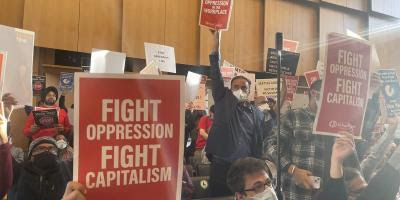
Mar 29, 2023The Seattle City Council during the vote on caste discrimination. Photo: Twitter/Kshama Sawant
California, the wealthiest state in the US and the destination for many immigrant Indians, introduced an anti-caste discrimination Bill in the state senate on March 22, 2023. If passed, it will become the first state law in the world that addresses caste in a fundamental way. The Indian constitution abolished untouchability but not caste. Members of the diaspora who support Hindutva are anxious about this major development. The Rashtriya Swayamsevak Sangh (RSS) and Bharatiya Janata Party (BJP) are also wary. But the world is beyond their power.
When the Seattle City Council and the Toronto District School Education Board passed a law prohibiting discrimination of individuals – citizens, adults or children – on the basis of caste along with race, religion, gender or sexual orientation, it was opposed by many RSS/BJP intellectuals. They condemned these laws as “Hinduphobic”.
Why should they oppose such laws if they stand for human equality in general and the equality of Indians and of Hindus wherever they live in this world?
According to an Indian Express report on March 8, 2023, the “RSS-affiliated magazine Panchjanya has called a resolution passed recently by the Seattle City Council to add caste to anti-discrimination laws as a sign that ‘Hinduphobia is being promoted in the US through the institutional route, and that there is a conspiracy to stymie the progress of Indian talent in the US’.”
A similar argument was advanced by Ram Madhav, one of the senior leaders of the RSS. He comes from a Brahmin family in Andhra Pradesh. He says in an article, again in the Indian Express, “Groups that champion this false flag of caste discrimination are generally Hinduphobic. They are using this discrimination card to malign the Hindu religion.”
He accuses civil society groups in the US, Canada and Europe which have worked for anti-caste laws and rules in the West of being “Hinduphobic”. It is clear that one’s own caste location, along with ideological position, plays a key role in the stand that one takes. So far, no RSS/BJP intellectual has written or spoken in support of these laws.
Panchajanya is an RSS-affiliated magazine of the RSS, somewhat akin to a mouthpiece. It is saying that the anti-discrimination law is a sign of Hinduphobia and a conspiracy to stymie the progress of Indian talent. But how can the practice of caste discrimination, in India or regions with significant Indian diaspora, be tackled without local laws or institutional rules? Those who discriminate would never think that such discriminatory treatment is wrong. Discriminatory behaviour becomes part of the psychological pathos of an individual or a group.
In the case of the Hindu religion, no one can serious dispute the fact that such discrimination is sanctified and justified through spiritual texts.
There have been studies which show how caste discrimination operates among Indian migrants in the US, Canada, Australia, Europe and other Western regions. They narrate the stories of discrimination and the trauma that school- and college-going children and youth undergo on an everyday basis.
For example, Thenmozhi Soundararajan’s recent book, The Trauma of Caste: A Dalit Feminist Meditation on Survivorship, Healing, and Abolition, lists innumerable incidents of discrimination among Indian migrants in the US. Her own personal experience – as a student and a working woman – of discrimination at the hands of Brahminic Americans tells a powerful story. She is a second-generation Indian-American Dalit woman.
Rita Meher, Shailaja Rao, Thenmozhi Soundararajan and others celebrate after Seattle voted to outlaw caste discrimination on February 21, 2023. Photo: By arrangement
After the Toronto rules were framed, a student in college in Canada, Trina Kumar, wrote a detailed narrative of her experience of caste discrimination. She says, “I faced a lot of caste bullying in Greater Toronto schools. I found this bullying confusing; I wondered why caste mattered so much to my fellow classmates, especially since we are all Canadian.” She adds, “I didn’t follow their upper-caste rituals, and [they] made fun of me for being a Dalit Christian.” This, in a country where Christians are the majority. Is this not “Christophobia”?
Organisations like Equality Labs, founded by Soundararajan, have created a crisis in the Western comfort zones of casteist immigrants. The casteist Indian immigrants have proved Thomas Friedman wrong. The world is not flat yet.
Ram Madhav dismisses Equality Labs’ study of caste discrimination in the US. But it is not just Equality Labs that has worked towards outlawing caste discrimination in the US and Canada. Groups like the Ambedkar Association of North America, Boston Study Group, Periyar Ambedkar Study Circle, Ambedkar Buddhist Association, Ambedkarite Buddhist Association of Texas, Ambedkar-King Study Circle and Ambedkar International Mission have also done a lot of work on behalf of oppressed caste immigrants to expose the discrimination.
What is wrong with educating the world about the caste system and its dehumanising practices? How can the RSS/BJP say they stand for democracy without standing for human equality?
The world has come a long way since 2001, when the UN Conference at Durban against Racism Racial Discrimination, Xenophobia and Related Intolerance, took place. In the conference, the caste question was not allowed to be discussed along with the race question. The UN bodies hardly had any idea about the caste system then. The Indian government, led by the BJP, was not willing to allow any discussion on caste, saying it was “an internal matter”. I was a witness to their efforts to keep caste discrimination off the table at Durban. The world has since learnt about caste and is taking measures to arrest the discrimination it fosters.
Why does the “Vishwaguru” try to derail the struggle against discrimination, inequality and xenophobia by invoking the spectre of Hinduphobia? Are they trying to say Hinduism does not stand for human equality?
Kancha Ilaiah Shepherd is a political theorist, social activist and author.
-
Agriculturalism And Hindutva
July 24, 2020
in Life/Philosophy — by Kancha Ilaiah Shepherd — July 24, 2020FacebookTwitterWhatsAppEmailShare0
In China there was a philosophical school called Agriculturism between 770 BCE and 221 BCE. The main philosopher, who represented this school with a sophisticated exposition of that philosophy, was Xu Xing (372-289 BCE). His main philosophy was that people’s propensity is based on farming than to any other thing. By the third and the fourth century BCE the Chinese society had come out of pastoralism and firmly moved into agrarian production with a back up of strong philosophy of agriculturism. In Xu Xing’s philosophical domain agriculturist was known as ‘divine farmer’. The divine farmer was treated with higher esteem than the religious preacher.
In India farmer never got such a stature. A Brahmin saint who does not know what is agriculturism was given greater place in agrarian society also. The agriculturists were designated as Shudras by Brahmin saints and they were never allowed to acquire philosophical and respectful divine status. The Shudras had evolved their own agrarian spiritual deities but those deities were shown as unworthy in the brahmin literature. Thus production itself was rendered unworthy and it was not allowed to acquire philosophical significance.
Agriculturism as a philosophical school opposed division of labour and it proposed an idea, in China, called Shennong which in essence means that people should live by an ‘agrarian, communal and egalitarian’ system.
Confucianism opposed this school and proposed for division of labour and establishment of society of classes based on functional specialization. The agriculturist school was not a dogmatic school. It promoted ‘hundreds of schools of thought’ for spreading agrarian ideas. Free debate among farmers about seasons, seeds, crop patterns, methods of sowing, weeding and harvesting to improve the productivity was part of these hundred schools of thought. It also promoted debates around human society, God and their relationship. All agrarian societies built divine deities to represent God and relate to their abstract ideas of divinity. The Chinese society for a long time believed in worshipping nature as part of its deep agriculturist civilizational growth.
It was this Chinese agriculturist philosophy that engendered positive schools of thought like Confucianism, Taoism and Legalism later and accommodated Buddhism. But it never allowed Indian type of Brahminism (Hinduism) to take root in that country. We can now see how Indian Brahminism, that emerged after the third wave of migration of Aryans to the subcontinent (Tony Joseph, 20018) destroyed the very roots of agriculturist philosophy that had its existence in Harappan civilization. My assumption is that without agriculturism during Harappan times agriculture would not have developed to a level where surplus generation could take place and city civilization could have been built.
However, the Qin Dynasty that ruled China in the second century BCE opposed the agriculturalist philosophical school of thought as it believed in Legalism and burnt many of its books. Legalism itself was more progressive than Indian Brahminism which did not believe in any law that respects human being as a human being.
Unlike the Indian ancient Shudras who were agriculturalists but did not leave any written philosophical discourse, the Chinese agriculturists were great writers and philosophers. Since there was no varna-caste system in China every one had a right to read and write from ancient days and hence writings of all occupational forces were preserved in China by rulers after the Qin dynasty was overthrown. This is where the roots of Chinese agrarian development and Indian under- development lies.
Though Qin rulers burnt many books on agriculturist philosophy, yet the literature that survived influenced the Chinese civilization forever. Unfortunately, there is no such philosophical influence of Indian Shudra agriculturists as they were not allowed to emerge as thinkers and writers by Brahmins in ancient and medieval times. Once the Brahminism constructed Shudras as slaves and forced them to remain illiterate their philosophical growth was arrested. The Brahminic Vedas, Upanishads, Ramayana, Mahabharata, Kautilya’s Arthashastra and Manu’s Dharmashastra have no discourse on agriculturism and every writer in India treated these books as a source of Indian civilization and culture. All these books have nothing to do with agriculturism.
The Chinese agriculturism influenced many other schools of China, including Confucianism, though it opposed some aspects of agriculturism, Taoism, Legalism. It also influenced Buddhism of China once Buddhism reached there from India. Since the Qin Dynasty promoted Legalism that school also took strong roots in China from the second century BC onwards.
Wikipedia mentions:
“Due to its Legalist focus, the Qin Dynasty was thorough in its purging of rival philosophical schools, including Agriculturalism. However, Agriculturalism in its heyday heavily influenced the agrarian policies of Confucianism, Legalism, and other contemporary Chinese philosophical schools, and so subsequently many concepts originally associated with the Agriculturalists continued to exist in Chinese philosophy.
The transmission and translation of Chinese philosophical texts in Europe during the 18th century had a heavy influence on the development of Agrarianism in Europe. French agrarianist philosophy, a predecessor to modern Agrarianism, of François Quesnay and the Physiocrats, are said to have been modeled after the agrarian policies of Chinese philosophy”.
One of the main problems of India is that at no stage of Indian philosophical evolution agriculturism was allowed to take root as a philosophical school.
In 18th and 19th centuries when Europe was borrowing agriculturist philosophy the Indian thinking was still under the grip of brahminism.. The Shudra farmers were not allowed to develop their own alternative thought. The first Shudra thinker who asserted the importance of agriculture and farmer was Mahatma Jotirao Phule in the late 19th century. Phule realised that the Shudras were denied of a philosophical status and were reduced to the status of gulam (slave). No slave could construct a philosophical school of his own, so long as s/he remains slave. Hence he wrote Gulamgiri putting the Shudra farmer in the central. However, his thought did not develop into full-fledged agriculturism like the Chinese school of thought because he had no historical heritage of building up a school of thought with a series of writings. Without a systematic writing no school of thought would develop.
A full-fledged philosophical school emerges only when multiple thinkers write on the same subject. The Chinese agriculturists rightly believed that ‘ hundred schools must contend’ to build a proper mature philosophical school. Based on the Chinese agriculturist school Mao Zedong who came from an agriculturist farming family developed a slogan ‘Let hundred flowers bloom and thousand thoughts contend’. His idea of peasant revolution was also based on the Chinese history of agriculturism.
In India there was an anti-agrarian brahminism in power all through its written history. The Shudra varna was the only varna which was engaged in agrarian productivity and it was not allowed to read and was denied the basic human dignity and spiritually validated existence. Though agricultural development is based on the science of cultivation it naturally evolves its own philosophy. That philosophy transits from generation to generation and age to age only when it is codified into a text. This was not allowed by Brahmin writers and ruling Ksatriyas. The Vaisyas were in between the Shudra agriculturists and Brahmins in ancient India. Only Gupta rule from 3rd to 5th century AD the Vaisyas became Dwijas with full business rights and right to education. Subsequently they too opposed the Shudra agriculturism. Though Mohandas Karamchand Gandhi wrote their nationalist philosophy but that philosophy has nothing about agriculturism. Because the Indian Banias, who became a totally business community, lost touch with agriculture, he never studied the Chinese history as he studied the European history. Later a famous Dalit (former untouchable) thinker and philosopher,Dr B.R. Ambedkar critiqued brahminism but not from agriculturism point of view but from religious morality and caste-cultural exploitation view point.
Ever since Vedic texts were written the pre-Vedic agriculturism was set aside because agriculturism esentially survives as Xi Xing emphasises on farm production, communitarianism and egalitarianism. Indian Brahminism inherantly opposed communitarianism, as communitarianism plays a key role in the advancement of agriculturism. Communitarianism would not allow the caste culture to operate in any field of life. Since Vedism brought in four fold varna (caste-class) division which is not even based on division of labour but based on spiritual and social authority over the Shudras who were the mainstay of agriculturism, that division negated progress of agriculturalism.
Brahminism from the beginning disarmed the Shudra agriculturalists by not allowing them to write their discourses into textuality. The Brahminic war centric vedisim and epic ideology and Ksatriya heroism did not allow agriculturism to develop as a philosophical school of thought because that school would have been lead by the Shudra thinkers. Not that there were no Shudra agriculturist thinkers at a time when agriculturism developed as a strong philosophical school in China. But they were crushed with an iron hand from the days of Kautilaya writing Arthashastra and more so from the days of Manu writing of Dharmashastra.
From 3rd century BC to 1st century AD when agriculturism would have developed with some kind of agrarian production Kautilya’s Arthashastra and Manu’s Dharmashastra were written by devaluing agrarian production. Farmers in India were never allowed to become divine farmer. Brahminism promoted anti-social saints and sanyasis as the ultimate model of Indian society, who have no role in production and agriculturism.
The parampara of Kautilya and Manu were continued by Savarkar and Golwalkar through their writings in modern times. The Hindutva school with an overt ideology of enmity to religions like Chritisianity, Islam and Buddhism covertly its structural ideology is anti-agricutlturism. Though constructed their ideology in terms of nationalism advancing agrarian production was never part of their discourse.
Agriculture scientifically was found based on two process– photosynthesis and decomposition. Because of this twin process renewability becomes possible. There is a spiritual view that God commanded humans to labour on the land, to which they belong to and produce from it and live a long life. This is a scientific spiritual dictum. Building agriculture science is long engaged by forming community with a philosophical discourse that land and labour re-generate similar species by multiplying themselves, which became a useful thing for human survival.
The Shudra producers of India were capable of advancing the philosophy of agriculturism with constant interaction with land, plant and animal. Still this philosophy is in oral form as the Shudra producers did not write that philosophy in detail into texts. Our agricultural universities are not structurally suitable for advancing agriculturism as a philosophy. Because they are full of brahminism.
Agriculturism is based on reason and scientific engagement with soil, seed and animal with an out of the box thinking. The Hindutva parampara is either anti-agriculturist or does not understand its fundamentals as it needs a productive mind but not destructive mind; a positive mind not a negative mind.
This is what Manu told the Shudras to do. Their work in agriculture was never seen as work.
- 123. The service of the Brahmanas alone is declared to be an excellent occupation for a Shudra; for whatever else besides this he may perform will bear no fruit.
- 129. No collection of wealth must be made by a Shudra, even though he be able to do it; for a Shudra who has acquired wealth gives pain to Brahman.
No Shudra wrote anything worthy against this barbaric statement of Manu till a Dalit law maker and philosopher, Ambedkar, came and wrote the present constitution and repudiated Manu. After the Bharatiya Janatha Party, which still follows Manu’s Dharmashastra as part of the parampara, came to power in 2014, agriculture remains most neglected area of administration, as it is not part of their philosophy.
Kancha Ilaiah Shepherd is a Political Theorist, Social Activist and Thinker
-
Lalit Modi, Nirav Modi are not OBCs. BJP calling them so is an insult to the community
BJP and RSS did nothing for OBCs but they want to show it’s Rahul Gandhi who hates the community.
28 March, 2023 07:00 am IST
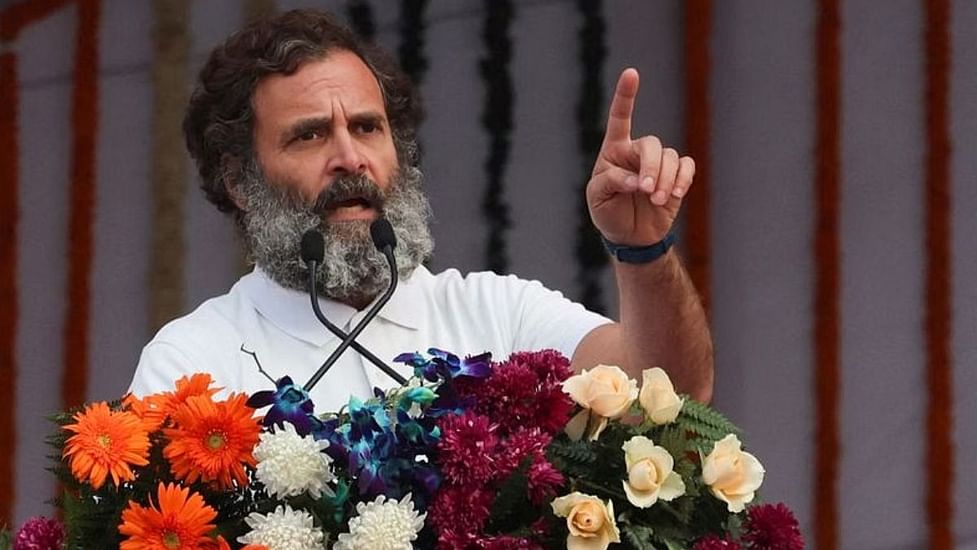
Rahul Gandhi was convicted for a 2019 speech where he mentioned the Modis. He is now a disqualified MP | ANI
Rahul Gandhi is a self-proclaimed Brahmin and Narendra Modi is a certified OBC. Nobody is denying this fact. But no court has given OBC status to fugitive businessmen Lalit Modi and Nirav Modi. So, how have they become OBC in the BJP’s harangued narrative?
Rahul Gandhi’s April 2019 speech in Kolar, Karnataka mentioned three names: Lalit Modi, Nirav Modi, and Narendra Modi. The first two stocked money through hawala in foreign countries and now live in London after fleeing India. They have huge international business networks. Do they have OBC certificates too?
From 23 March onwards, BJP leaders have been running a campaign against Rahul Gandhi on TV channels and social media platforms, calling him a habitual ‘OBC abuser’. The Congress is not known to be a die-hard OBC-loving party. It never promoted any pro-Mandal leader to top positions either in the country or within the party. But just to corner the Congress now, the BJP has turned Lalit Modi and Nirav Modi into OBCs.
I first heard this narrative from Union labour minister Bhupender Yadav, an OBC, during a news debate on 24 March. Thereafter it caught up through all layers of the party. BJP president JP Nadda, Union education minister Dharmendra Pradhan and other senior ministers started repeating it. If Lalit Modi and Nirav Modi are OBCs, then the whole OBC community should be ashamed now.
BJP’s anti-OBC history
After Narendra Modi became the Prime Minister in 2014, the BJP consciously started using the OBC card because the community, the largest vote bank in the country, can alone keep the party in power.
The anti-OBC history of BJP and RSS has not been exposed since the Mandal movement started. The BJP did not support the OBC agenda at any critical moment in the struggle for reservation. But to counter Rahul Gandhi, it is assigning the proverbial OBC certificate to everyone with the Modi surname.
Do all Modis belong to the oil-pressing Modh-Ghanchi-Teli community? Where is the evidence based on caste census, which the BJP is opposed to?
Only Akhilesh Yadav, former chief minister of Uttar Pradesh and an OBC, is calling out the BJP’s narrative by constantly talking about how Yogi Adityanath, the current chief minister of UP, had insulted his Shudra/OBC status by getting the CM bungalow sprayed with Ganga Jal after taking over the reins from Yadav. The BJP, and particularly its OBC prime minister, never objected to this inhuman and casteist practice of his party’s CM.
But today, the party is playing on this narrative that Rahul Gandhi hates the community. Perhaps it seeks to placate the community offended by the language used in Ramcharitmanas against the Shudras/OBCs?
It was in this context that RSS chief Mohan Bhagwat talked about how caste was not created by God but by priests. Bhagwat also said that the shastras (ancient Hindu texts) need to be reviewed.
Private sector quota and Modis
It is true that the Congress intellectuals never talk about caste, as if it doesn’t exist. Since the BJP and RSS are operating around the Hindu religion in opposition to the secular narrative, they have to face the caste challenge without losing power. And that is why they are imposing an OBC nationalist narrative by roping in anti-national characters like the fugitive businessmen Lalit Modi and Nirav Modi into the OBC list.
The UPA government at least proposed a caste-based reservation in the private sector and constituted a committee headed by former Karnataka CM Veerappa Moily to convince the stakeholder. All major Indian industries opposed the proposal. Not a single Modi running a big business in India showed their support or offered jobs to the OBCs. Even after the BJP had an OBC prime minister in the driver, it did not propose such a reservation.
Caste status cannot be manipulated to deceive India’s toiling masses. Most OBCs of this country constitute the Shudra agrarian and artisanal masses. There is no doubt that the oil-pressing community in pre-modern industrial times was also an artisanal community. But that status cannot be tagged to everyone with the Modi surname. It doesn’t even warrant a legal or social argument. For example, the Chaudhary surname is found in many communities in India, and not all of them belong to the same caste.
Agenda for vote bank
On the one hand, the BJP and RSS are opposing anti-caste laws in India and in countries like the United States and Canada. The RSS mouthpiece Panchjanya and the BJP’s national general secretary Ram Madhav, who is one of the main functionaries of the RSS, wrote against Seattle’s anti-caste discrimination law and movements in Canada. And on the other hand, the party is using the OBC agenda for vote purposes.
Other than the fact that Narendra Modi of OBC caste is allowed to become the prime minister of India, the BJP or RSS has not taken any concrete step to further the cause of the OBCs of India. Their stand on the issue must be questioned.
It’s not as if the Congress has any serious positive practice and stand on the OBC question. But it never used the community like the BJP and RSS are doing. If the same trend continues, it is the OBCs who will end up losing the most.
Kancha Ilaiah Shepherd is a political theorist, social activist, and writer. He has been campaigning for English medium education in rural and urban government schools of India since the last thirty years. Views are personal.
(Edited by Ratan Priya)
-
Prof Kancha Ilaiah || Teaching English To The Sheep || Lesson 4 ||@RTV T…
-
Prof Kancha Ilaiah || Teaching English To The Sheep || Lesson 3 ||@RTV T…


You must be logged in to post a comment.