-
Rahul Gandhi advocates for power-share for dalits, backward classes in the country
-
Samvidhan_Samman_Sammelan in Chandigarh witnessed renowned author and professor #Kancha_Ilaiah’s speech ridiculing Assam CM’s remarks.
Kancha took a jibe at the motor mouth Assamese BJP leader for his ridiculous insinuation that the #red book @RahulGandhi carries is a #Chinese constitution.
He pointed out the illogicality of associating anything red with #China, like tagging Sikhs with their red turbans as Chinese. This was a subtle yet effective rebuttal that highlighted the CM’s cheap rhetoric and lack of substance.
Getting the large audience, including #Rahul, to laugh at the funny rebuttal undermined the seriousness of the allegations.
It ridiculed the CM and BJP’s pet narrative of branding the opposition as anti-national in a light-hearted manner.
Rahul’s joining in the laughter endorsed Kancha’s spin that gave confidence to others present.
Ofcourse, it boosted the momentum of the conference by exposing irrational propaganda in an entertaining way. Kancha’s signature style of critique through humour added levity to an otherwise serious discussion on safeguarding democracy and Constitution.
So in sum, the repartee was a crowd-pleasing highlight that stole the show at the conference.
LokSabhaElections2024 #Elections2024 #CongressManifesto #NyayKaHaqMilneTak
-
Condolences for K.P Yohannan
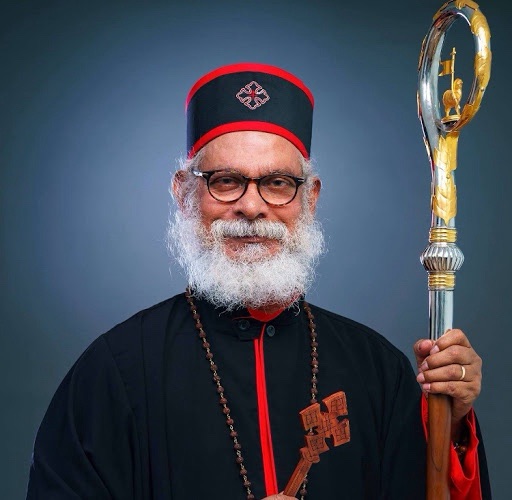
Mor Athanasius Yohan I I extend my deepest condolences on the sad and sudden passing of Mor Athanasius Yohan I, also known as K.P Yohannan, a remarkable philanthropist and educator known worldwide. His dedication to building educational institutions globally leaves a lasting legacy of hope and opportunity.
I recall my visit to his Dallas office in 2004, where I had the privilege of addressing his staff and sharing a meal graciously hosted by him and his wife. Their commitment to serving others, regardless of background, is truly inspiring.
Learning of his tragic accident in Dallas from my friend Most Rt. Rev. Dr. Joseph D’Souza, Archbishop of Good Shepherd Churches of India, was deeply shocking.
May his legacy of compassion and service live on, and may God bless the institutions he worked tirelessly to establish. Sending thoughts of comfort and strength during this difficult time.
Kancha Ilaiah Shepherd,
Hyderabad, India
-
India’s OBCs Can’t Understand Why Narendra Modi, an OBC PM, Is Against a Caste Census
The BJP has panicked after the Congress’s assurance of a caste census and an increase in caste reservation.

Illustration: Pariplab Chakraborty
The 2024 Congress election manifesto has forced the Bhartiya Janata Party leaders, mainly Prime Minister Narendra Modi, to start a defensive campaign on the entire reservation system.
The Congress manifesto has guaranteed a Samajik Nyay (social justice) pillar by saying that if it comes to power a caste census will be conducted nationwide and the 50% reservation cap imposed by the Supreme Court on caste-based reservation regime will be removed. This is causing jitters in the BJP camp.
The main force that demanded a caste census across the country is the historically oppressed majority, Shudras. This category, later, was made the Other Backward Classes (OBC) for implementation of reservations. Since the 1990 Mandal movement days, the Dwija castes were against granting reservations to the Shudras as they would have changed the Dwija hegemony in the education and employment sectors. The two national parties, the Congress and Bharatiya Janata Party, were also opposed to OBC reservation in 1990. By then they had somewhat reconciled with reservation for Scheduled Caste and Scheduled Tribes reservation, though it was hardly getting implemented. But the idea of Shudra or OBCs getting reservation was a fearsome issue for them.
But later, after the V.P. Singh government implemented 27% reservations for the OBCs, the Congress and BJP slowly reconciled themselves to the concept. The Shudras/OBCs constituted the largest vote share in the country. Some Shudra/OBC regional parties also emerged. This gradual change weakened the Congress. However, in the process the BJP picked up this segment, using the Hindutva and anti-Muslim card. The Shudra/OBCs became its anti-Muslim muscle power.
In 2014, the BJP tactfully promoted Narendra Modi as the prime ministerial candidate. He was from a listed OBC caste. For the last 10 years this OBC background of Modi’s has helped BJP remain in power with a comfortable majority. However, during these last 10 years, the BJP government headed by an OBC PM has done nothing for the OBC masses. The OBC masses are the main agrarian producers. In the education and employment sectors, OBC presence has weakened because of massive privatisation of both these sectors.
Across the country, OBCs began to realise this new method of marginalisation through the means of privatisation.
The Hindutva economists – all most all of them come from Dwija backgrounds – have been advocating for the ‘de-statisation’ of all sectors of economy including industrial, business, health, education and also cultural. The massively increasing wealth of monopoly houses, and the ‘upper’-caste, upper-middle classes has created a huge gap between the OBC/Dalit/Adivasis and Dwija ‘upper’ castes, particularly those who live with the RSS-BJP political ideology.
The OBC PM systematically implemented an anti-OBC privatisation agenda because that was his core ideology.
Rahul Gandhi
Rahul Gandhi, presumably in the course of his Bharat Jodo Yatra and Bharat Jodo Nyay Yatra, realised that the OBC demand for caste census was justified. Once the OBC population data comes out, the Supreme Court cap of 50% reservation will have to be reviewed.
His party succeeded in framing a manifesto that promised the same. The manifesto also promised to protect the state institutions from privatisation and job creation in the public sector economy.
Did Modi, who is once again being projected as the strongest leader of the RSS-BJP combine, convince his party’s Dwija leadership to come up with a pro-poor or transformative manifesto in every election? Elections for him are little more than rhetorical speeches. The Dwija intellectuals knew that he would ultimately play their game and not that of the Shudra/OBCs. Their “Modi kiguarantee” manifesto has nothing to offer to the poor or to the nation. Hence they do not even refer to their own manifesto in the campaign but constantly attack the Congress manifesto.
Crisis in the BJP vote bank
The Congress manifesto has created a crisis in the BJP’s OBC vote bank. Added to this, the Congress manifesto also talked about expanding the welfare regime for all the poor, which obviously consists of SCs, STs and OBCs. This will also impact the massively built-up contract economy and crony industrialism with a specific Hindutva spiritual ideology.
The organisational wealth of RSS-BJP structures has increased several-fold, thanks to these crony capitalists and private monopolies, which were planning to take over the agrarian sector. The goal is to weaken the Shudra agrarian forces so that the classical varna dharma or caste order is brought back. Since the Congress had no clear stand on the OBC question for a long time, they did not know how to face the OBC vote bank that the BJP had newly acquired. They did know how to fight the pro-OBC image of the BJP after the 2014 elections. The OBCs also got communalised, in the process, and developed a constructed consciousness of the alleged danger that the Muslims posed. This time, the pro-OBC manifesto of the Congress addresses this context.
Since the BJP has nothing to offer the OBCs since the Congress manifesto came out, it is trying to retain its OBC base by dangling the ‘danger’ of Muslim reservation and repeating the same again and again. But the OBCs, SCs and STs know that the real danger to reservations is not from Muslims, but the Hindutva privatisation agenda. Realising this is possible only by de-statising all industries, businesses, educational institutions and cultural institutions. They want to push the Shudra/OBCs completely into the agrarian labour market and hand over the entire economy to Gujarati-Mumbai Hindutva capitalists.
The BJP on the other hand brought out its so-called manifesto and called it ‘Modi ki guarantee’, leaving out the party identity and making the election ‘Modi versus Congress’. There is no welfare or developmental direction in the Modi manifesto.
In this situation, the Congress manifesto began to attract poor village and urban voters, more particularly OBC, SC and ST voters. Modi and his team resorted to talking about how the Congress was bent on removing all the reservations of OBCs, SCs and STs and giving to Muslims. Is it Muslim capital exploiting the OBCs, SCs and STs or is it the Gujarati-Mumbai capitalists?
Changing the constitution
Of course, the Congress campaign has also focused on the idea of changing the constitution if the RSS/BJP get 400 seats. This is a more dangerous idea that the RSS/BJP ideologues have been carefully putting across the country by allowing select Dwija leaders to talk about it. This idea has its roots in RSS’s ideological formulations.
Rahul Gandhi started talking about protecting the constitution by holding a copy of the constitution in every public meeting across the country. For the first time in the history of Congress, a top leader of the party began to foreground his arguments with reference to Dr. B.R. Ambedkar, saying that the constitution he wrote along with Jawaharlal Nehru and Sardar Patel is in danger.
The OBCs, SCs and STs have much bigger stakes in the constitution. In their history of thousands of years of existence they never knew anything about equality till this constitution was adopted in 1950. A deep fear began to shake them regarding their children’s future when they heard about the BJP’s plans to change the constitution. To overcome this problem, the BJP leaders, more particularly Modi, now repeatedly talk about Muslims, “people with more children”, and Pakistan’s alleged intervention in the electoral process.
But OBCs, SCs, and STs should know that the Muslim reservation percentage is small and that it is also based on their caste identity. For example, in Andhra Pradesh and Telangana, it is just 4%. In no other state does it go beyond 3-4%. The question of caste census has nothing to do with the question of reservation for Muslims.
The OBCs of India are surprised to learn from an OBC PM that he is against a caste census. Instead of addressing the question in its essence, why is he diverting the issue to Muslim reservation as if the OBCs have demanded its removal for Muslims? The issue is that the OBC PM and his government are killing the reservation system through privatisation.
Reservation, per se, cannot be given based on class or religion. During the Congress and other regimes, some lower caste people converted to Islam and took caste certificates so they could be allowed to get a small percentage of reservation. What the BJP leadership is presenting is the claim that all Muslims – like all Dalits or all tribals or all Other Backward Classes – are getting reservations. This is wrong.
But the 10% Economically Weaker Section reservation that the Modi government brought was purely class-based. In fact, all SCs, STs, and OBCs opposed this reservation as it was meant for ‘upper’ castes who already have huge social capital as their heritage. The campaign of Modi – that if Congress comes to power they will take away the properties of the poor Hindus, including the mangalsutra of women – is a dangerous and destructive one.
Even the industrialists, the rich and the middle classes that support the BJP should oppose such propaganda about a democratic party because democracy needs multiple parties.
Modi also dubbed the Congress manifesto as an Urban Naxal manifesto. If a PM who ruled the nation for 10 years speaks this kind of language about the national opposition party, democracy gets into deeper trouble.
The fact is that the Dwija left-liberals also did not own the Congress manifesto, as perhaps, they think that on OBC question the Congress took a stand that they did not expect or did not want. All of them go with SC/ST reservation on grounds of so-called empathy but they have been very uncomfortable with OBC reservation. A time has come the Shudra/OBCs must be treated as the backbone of wealth and they must get their share in every asset of the nation.
The 2024 elections thus are a turning point for those who are fighting for weakening the caste system.
Kancha Ilaiah Shepherd is a political theorist, social activist and author. His latest book is The Clash of Cultures (Productive Masses Vs Hindutva-Mullah Conflicting Ethics).
https://m.thewire.in/article/politics/obc-reservation-narendra-modi-muslim-congress
-
Opinion: Why the Congress manifesto has rattled corporate monopolies, RSS and BJP

For the first time Nyay Patra, the Congress manifesto, has made social justice a serious election issue by promising nationwide caste census and removal of 50 per cent Supreme Court cap on reservations.
Rahul Gandhi (centre) and other Congress leaders with the party manifesto
Written by: Kancha Ilaiah Shepherd
Edited by: Binu Karunakaran
29 Apr 2024
Both the Congress and the Bharatiya Janata Party (BJP) have released their 2024 Lok Sabha election manifestos. For the first time, their approach to welfarism and democracy is expressed clearly. The Congress manifesto ‘Nyay Patra’ has two-fold welfare agendas: class and caste. In terms of standing by the poor (class), it promised the transfer of Rs 1 lakh per year to the account of a woman in a family that lives below the poverty line. All eligible unemployed youth will get Rs 1 lakh per year as assistance with an apprentice placement in public and private sector companies.
For the first time, it made social justice a serious election issue by promising nationwide caste census and removal of 50 per cent Supreme Court cap on reservations. This will change the present mode of budget money expenditure. The BJP, on the other hand, retained the old policy of handing over huge contracts to monopoly capitalists, who transferred huge amounts of money to the party through electoral bonds for getting big projects. The Prime Minister, who belongs to the Other Backward Castes (OBC) community, has no single programme for them in the manifesto. But he included in it Modi’s guarantees, Uniform Civil Code, the Citizenship Amendment Act, and so on.
The new direction of the Congress
The 2024 Congress manifesto has the potential to change the course of the Indian political system and de-communalise capital by expanding the scope of welfare democracy. The Rashtriya Swayamsevak Sangh (RSS)/BJP and the pro-Hindutva capital are anti-welfare democracy. Though the economists and educationalists of Hindutva ideology pretend to follow the American private economy model, they are not even ready to provide equality in school education in the country. Some monopoly companies are running completely English medium schools with a Western syllabus. The RSS/BJP nationalism is fine with this level of privatisation. They gloss over the fact that the American school education is completely in the government sector. But the Baniya-Brahmin monopoly houses run their own private schools. Dhirubhai Ambani International School in Mumbai is a good example. Many such private schools are coming up now.
Gujarati-Mumbai capital and Congress
The Indian capital in Baniya-Brahmin monopoly houses of Western India grew into its present form during the UPA regime under the leadership of Manmohan Singh. But at the same time, the Gujarati-Mumbai based monopoly houses such as Ambani, Adani, Vedanta, and so on began to slowly move into the Hindutva fold, particularly after the 2002 communal carnage in Gujarat under the leadership of Narendra Modi. They found a strong Hindutva leader in him and they themselves projected him for Prime Ministership. Finally they saw to it that the RSS accepted his candidature and now he controls the party and RSS structures with full support of the Gujarat-Mumbai capital. The communalised capital not only discarded the Congress but turned against it.
However, for Shudra/OBC/Dalit/Adivasi forces, this communalised capital control of the nation poses a threat. It wants a massive privatisation of all industrial units and also the educational institutions. The Baniya-Brahmin monopoly capital expands itself into global markets by creating a totally English-educated Dwija population. The children of monopoly capitalists study in private schools in India and Western universities and aim to be global entrepreneurs. Already big monopoly companies like the Ambanis and the Adanis have become huge globally investing companies. They have never shown any concern for the farmers and agrarian poor by sharing their profits with some kind of philanthropic aid. Since the Dwija castes are against reservation, they want to support the communalised politics, through the structures of RSS/BJP and de-secularised markets and capital. In the process, the entire political system becomes anti-poor.
The poor masses of India mainly constitute the SC/ST/OBC masses. When we say anti-poor, we essentially mean anti-SC/ST and OBCs. They also dictate ideological agendas to the RSS/BJP by controlling the narrative of nationalism. Though the Congress also depended on Western capital for a long time, it never allowed its ideology to be controlled by the capital. Since the Congress worked with a secular ideological agenda, it did not allow communal influence into the governance through capitalists who believed in Hindu communalism. It also did not allow the monopoly houses to dictate policy directions in the governance. But the RSS/BJP completely surrendered to them because their own communal thinking and some of the capitalists who finance their agendas have many things in common. Both the RSS/BJP and communal capitalists have no concern for the Shudra/OBC/Dalit/Adivasis.
The 2024 manifesto of the Congress tries to change the course by including an ideology of deeper welfarism. Caste census, Rs 1 lakh for every poor woman, and Rs 1 lakh as unemployment aid for poor youth are part of the manifesto. But the party is facing an internal Dwija revolt. Anand Sharma, a senior Congress leader and Brahmin, opposed the caste census by writing a letter to the president of the party, Mallikarjun Kharge. If he were an OBC or Dalit or Adivasi, he would not have written such a letter. He has shown his anti-OBC stance openly. However, Rahul Gandhi is not deterred like Indira Gandhi in 1971. When she proposed Garibi Hatao, bank nationalisation, and abolition of privy purses, all senior upper caste leaders opposed her.
Caste and Congress
For the first time, the Congress addresses the entire caste issue from a national perspective in the manifesto. When it is addressing the question of caste census, it is addressing the question of pushing the society towards castelessness in the long run. The classical Indian slave system turned into a caste conscious assertive system with the British collecting caste census till 1931. But the most gigantic task ahead of the Congress is the communalised capital that now stands against the party. It supplies massive amounts of money to RSS/BJP forces. The communal capital that became a huge monopoly capital now wants to weaken the agrarian kulaks (wealthy peasants) and take over the agrarian markets. The three farm laws that were made by the RSS/BJP government were part of that combined thinking of RSS/BJP and monopoly capital. The educational capabilities of the rural masses are kept low because of unfurnished schools with a regional language teaching.
The productive masses in different states will be forced to remain in regional languages even in the future if the RSS/BJP are in power in Delhi. The RSS allows this public private education to reinforce the varna dharma order so that no competition comes from the Shudra/OBC/Dalit/Adivasi forces to the Dwijas. They want to control the three pillars of power—political power, temple power, and the power of capital. The Gujarat-Mumbai capital knows that Narendra Modi will play their game while claiming to be an OBC. This situation has created a deeper crisis for the Congress.
Anti-Muslim agenda of Gujarati capital
The anti-Muslim ideology of the Gujarati capital goes back to Gandhi-Jinnah conflict days. After all, both the leaders came from families of the upwardly mobile business Baniya community. The religious conversions of Western Indian Dwijas into Islam created a communally charged intellectual environment in the civil society also during the freedom struggle itself. The Muslim League headed by Jinnah (whose family converted from Baniya background) and Allama Iqbal (whose family converted from Hindu Brahmin background) and forces like Tilak, Savarkar (who happen to be Brahmins themselves) and others who later formed the Hindu Mahasabha. Injecting religious ideology into nationalism and freedom struggle has led to division of the nation. Now RSS/BJP and communal capitalist forces are creating a new in the country. The Shudra/OBCs, Dalits and Adivasis are concerned about the future of their children.
Mahatma Gandhi had his own share of spiritualising politics and capital. He mobilised the Birla Goenka families into Hindu conservatism and also into the Congress fold. The Birla family built several temples and he himself used them for political prayers. Now Ambani and Adani capital is fully with RSS/BJP and Modi.
Though the pro-Gandhi Nehru capital sustained the Congress with ups and downs till 2014, since then a part of the Indian capital became totally communal and moved away from the party. Rahul Gandhi had to work out alternate strategies to check this mighty communal capital and RSS/BJP combination. It was in this situation that he undertook the Bharat Jodo Yatra with the slogan ‘Mohabbat Ki Dukaan’ in a communal (‘Nafrat Ke Bazaar’) market and the Bharat Jodo Nyay Yatra which promised to x-ray the nation for inequality and distribute the resources based on data from caste census. Rahul is challenging both the communal ideology of the RSS/BJP and the communal capitalists.
The 2024 election manifesto shows us the way.
Kancha Ilaiah Shepherd is a political theorist, social activist, and author. His latest book is The Clash of Cultures—Productive Masses Vs Hindutva-Mullah Conflicting Ethics.
-
Why Congress Must Not Go Back on Rahul Gandhi’s Promise of Caste Census, Social Justice

Congress leader Anand Sharma’s recent letter to Mallikarjun Kharge opposing a caste census shows that upper caste leaders from all parties still do not subscribe to ideas of social justice and do not want to share political power with marginalised castes.
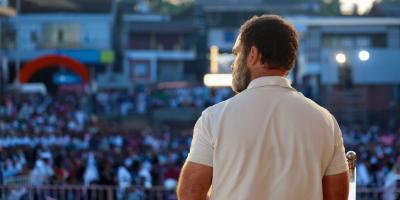
Rahul Gandhi. Photo: Twitter/@INCIndia
Anand Sharma is a senior Congress leader. He has written a letter to Mallikarjun Kharge, the first ever visible Dalit Congress president of the party after Damodaram Sanjeevaiah in the 1960s, opposing the promise of a caste census in the Congress manifesto for the 2024 general election. The letter’s principal ideological demand is that the party should continue its earlier stand of opposing identity politics.
In his letter, released to the media on March 21, Sharma wrote, “The Congress has never engaged in or endorsed identity politics, and a departure from this historic position on this critical and sensitive subject is a matter of concern.” He added, “It (the caste census) disrespects the legacy of former prime ministers Indira Gandhi and Rajiv Gandhi.”
Sharma’s opinion on a caste census is not his alone: it is shared by Dwija (Brahmin, Baniya, Kayastha, Khatri and Ksatriya) leaders and intellectuals in all parties. They are all against any measure – either legal or enumerative – which weakens the control of Dwijas on the political, social and spiritual systems of India.
It is well known that even the Bharatiya Janata Party strongly opposes a caste census and the removal of the 50% reservation cap – something that has to be scrapped if proportional representation is given to various castes in the state structure. But they prefer not to come out openly like Anand Sharma.
Also read: Rahul Gandhi’s Yatra Must Talk About Social Justice But Also Spiritual Justice for Shudras, Dalits
For Dwijas, the position of Jawaharlal Nehru, Indira Gandhi, and Rajiv Gandhi remains the reference point on all questions of caste identity politics, particularly reservations and the sharing of power. Anand Sharma and leaders like him think that Rahul Gandhi – who comes from that very family – is departing from his ancestral position and promoting identity politics. At the same time, they depend on him to get the Shudra/OBC/Dalit/Adivasi votes needed to bring the party back to power.
The RSS/BJP consciously Narendra promoted Modi, who came from a listed OBC caste. It is well known that Modi’s electoral success is based on his personal OBC identity politics and his efforts to mobilise most backward classes (MBCs) in states like Uttar Pradesh. How does Anand Sharma want Rahul Gandhi to defeat the BJP’s caste identity politics while sticking to the position taken by Indira Gandhi and Rajiv Gandhi?

Indira Gandhi and Rajiv Gandhi. Photos: Indira Gandhi (Wikimedia Commons/GODL License) and Rajiv Gandhi (Indian National Congress website).
Anand Sharma and his ilk want Rahul Gandhi to continue the pre-Mandal era politics, which will totally destroy the Congress. Leaders like Sharma are blind to the fact that the BJP and Modi have brought caste and religious identities in their full form into electoral politics.
If Indira Gandhi and Rajiv Gandhi were alive now, they would have neither been prime ministers nor would they have been fighters like Rahul Gandhi. They would have been where Anand Sharma is today, on the margins. Rahul, on the other hand, is adapting to the given situation, which is why his two yatras – the Bharat Jodo Yatra and Bharat Nyay Yatra – have had an impact.
On the question of religious identity which Anand Sharma raised, the Congress has seen the Muslim minority identity as a necessary element of politics. Indeed, the RSS-BJP has always labeled the politics of the Gandhi-Nehru family as ‘pro-Muslim’. The Sangh has traditionally accused the Congress of what it calls ‘appeasement’ but the BJP under Modi has now successfully used this charge to mobilise OBCs across the country as well.
What the Congress’s Dwija leaders who oppose Rahul Gandhi’s carefully crafted social justice agenda do not understand is that he is re-shaping the Congress in the context of post-Mandal developments and in the given context of the RSS/BJP’s ideological position on caste.
Caste identity, particularly, the OBC identity has become a force after the Mandal movement and V.P Singh’s regime implemented the Mandal Commission report (even if it was just one recommendation).
Since the Congress under the leadership of Rajiv Gandhi opposed the Mandal report implementation, the Shudras/OBCs started distancing themselves from the party. A large number of Shudras/OBCs believe that the Congress is a Dwija-Muslim party. They believe that is the identity of the party. That identity needs to change for the Congress to win national elections in which the Shudra/OBC vote matters the most.
Anand Sharma is wrong in saying that Indira Gandhi and Rajiv Gandhi did not accept identity politics. Nor is Anand Sharma free from identity politics. He believes that Sharmas have the right to define what is identity and what is not. His last name is a name that advertises his Brahmin identity. That identity brought him top political positions via nominations to the Rajya asabha even if he never won an actual election. He does not want to accept the Shudra/OBC identity because that will take away a portion of power from the Dwija forces. They think that the Shudras/OBCs should vote for them without asking for a share in power.
The Indira -Rajiv’s anti-OBC reservation policy led to the rise of the RSS/BJP in the country. That also led to the formation of many Shudra/OBC regional parties which weakened the Congress. They always recognised the Muslim minority identity in their politics but never accepted caste identities.
Anand Sharma’s notion of inclusive politics means the hegemony of Dwijas by encashing the votes of the Shudras/OBCs/SCs and STs. Of course, Muslims have been voting for the Congress and elite Muslims were given a (small) share of power. Now, the RSS/BJP combine – conscious of caste divisions among Muslims – is reaching out to the non-elite Pasmandas.
Sharma seems to live in the pre-Mandal era. In the past, the the Shudras/Dalits/Adiavsis voted for the Congress without getting a due share of power. That does not work now. The situation has changed. The OBCs understand what is Anand Sharma’s ideological aim in creating a crisis in the Congress just before the national election where the caste census is going to be an issue for vote mobilisation. He wants to weaken the Congress further.
The Congress must stand by Rahul Gandhi’s battle for social justice, as he made it clear in his two marathon yatras. While ending the Nyay Yatra on March 16 at Chaitya Bhoomi of Ambedkar in Mumbai, Rahul read out the preamble of the constitution, which focuses on the idea of justice (social justice is part of it), even as hundreds of people participated. I too was part of that pledge.
Anand Sharma was never seen either in the first Bharat Jodo Yatra or in the second Nyaya Yatra. Now his cat is out of the bag.
Kancha Ilaiah Shepherd is a political theorist, social activist and author. His latest books are The Clash of Cultures—Productive Masses Vs Hindutva Mullah Conflicting Ethics and The Shudra—Vision For a New Path.
-
Gerontocracy in leadership: From India to US old men aren’t leaving us any wiser
In India the BJP took the right decision to retire its leaders when they reach 75. But the Congress and other regional parties never bothered about age.

A collage of Donald Trump Narendra Modi and Joe Biden
13 Mar 2024
America is the oldest constitutional democracy in the world. It is witnessing a dearth of political talent among young people of that country since the 2020 elections. In that election the two oldest men Joe Biden and Donald Trump fought the election almost in an unethical atmosphere. Again the same men are going to fight the 2024 election, in a more vicious atmosphere.
Biden is 81 and Trump is 77. Both of them forget many things in public and their mental faculties have been questioned. Biden tumbles on the stage and falls down, yet does not want to leave the presidency. Trump is facing many cases, including one that involves rape of a woman and he is convicted too. He does not want to leave the presidency. What is more surprising is that both parties chose these old men with doubtful health and notorious character (in case of Trump) in their primaries making their next fight inevitable.
The United States seems to have run out of young creative and competitive people in the political realm.
Young created its constitution
It was brought into the realm of a first written constitution by young people, George Washington, Thomas Jefferson and John Adams. Three of them were young freedom fighters against British colonialism and served as its founding presidents. Washington became the president at the age of 57. Jefferson became president at the age of 58. John Adams became president at the age of 62.
The founding presidents established the philosophical, ideological, constitutional and the moral basis of that nation. That was in the eighteenth century.
After these three greatest presidents, again three young Americans, Abraham Lincoln, John F Kennedy and Barack Obama emerged on that very land. They also became presidents at a young age and left an indelible mark on the global democratic systems and human history. Lincoln became president at the age of 56, Kennedy became president at the age of 46 and Obama the first black American became president at the age of 47.
Now that talent is not forthcoming from among the young American men. What is the situation among American women? The first woman who became the Vice-President is an Indian American at the age 55. The first woman who reached the stage of presidential nominee from proper American women is Hillary Clinton at the age of 69. No young American woman of the age group of the first founder three presidents or later greatest three presidents could emerge as a ruler of the country. The first woman who competed till the last day of primaries from among Republicans is again an India American Nikki Haley 52. No proper American Republican woman of younger age could come to reach Nikki Haley’s political competition level till date.
Women leaders in the world
What does that suggest about women’s liberation movements in America? It was known globally as a country of feminist activists and theoreticians from the 1960s onwards. It is a country of the most educated working women. Yet no young or old woman could come to reach the White House.
Third world countries have produced quite talented young women leaders who lead their countries. Sirimavo Bandaranaike of Sri Lanka became the first woman PM of a nation in the world at the age of 44. Indira Gandhi became the PM of India at the age of 49. Benazir Bhutto became the first women Muslim PM in the world at the age 35 in Pakistan.
Even Great Britain in recent years seems to have lost its ability to produce young dynamic political leaders from its original native stock. A young Indian origin Rishi Sunak became its PM at 42.
Why are young leaders not emerging?
This raises the question: what is happening in America, in particular? Why is it that the country with such a vibrant education system is not in a position to produce young talented political leaders like what it did earlier? Maybe because American universities do not train young men and women in university level elections to become future politicians. Their campuses, though became a model for good standards in education, there is no college and university students unions election system. Such a system would have put students to compete and train themselves at university level in practical political life. De-politicization of campuses was introduced by America itself. Now it is spreading around the world.
The best example for a woman leader emerging from campus student union elections and becoming a good leader in her country is Benazir Bhutto. She contested Oxford University Student’s debating society in 1977 and became its president. That experience seems to have taught her about the leadership role back in her country.
What about India?
In India too old people becoming Prime Minister is allowed. Morarji Desai became PM at the age of 81. PV Narsimha Rao became PM at the age of 70. Manmohan Singh was made PM at the age of 70, Atal Bihari Vajpayee became PM at the age of 75 in 1999.
Power is a poison. People do not want to leave once it is in their hands. If there is a scope to capture it even while one is incapable of handling it with dying human energies they capture it. once in it they do not want to leave it.
Gerontocracy
A theoretical concept for such old people not leaving power is ‘Gerontocracy’. In simple terms it is known as the rule of old where new ideas and creativity died down. Such old people ruling any country would engender a host of power managers from behind either from one’s family or from relatives or friends.
Nikki Haley demanded a mental ability test for all those who run for high offices after 75. She is absolutely right.
In India the Bharatiya Janata Party took the right decision to retire its leaders when they reach 75. But the Congress and other regional parties never bothered about age. However the question is: will Modi retire when he reaches 75?
He and his party made it clear that he will be the next PM with 370 seats on their own and 400 seats for the NDA alliance. Modi becomes 75 in his mid-third term, if he becomes PM after the election. The BJP and RSS seemed to have reached a stage, what will happen to their power after Modi? Hence depend on him as long as he delivers. But how long? Even beyond 75 at the cost of principle.
-
Priest-PM Modi is ‘Hinduising’ the state and ‘stateising’ the religion
Kancha Ilaiah Shepherd
6 Mar 2024
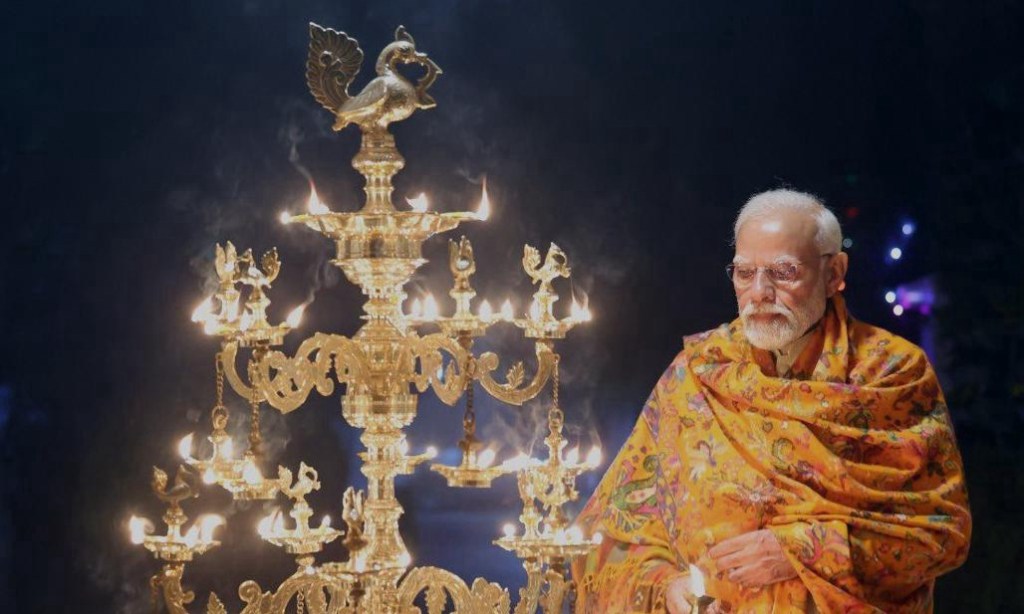
It was a unique event where a prime minister, hailing from the OBC community, consecrated the idol of (Ram Lalla) inside the sanctum sanctorum of the temple. File photo shows Prime Minister Narendra Modi at the consecration of the Ram temple in Ayodhya.
Modi has managed to arm-twist the RSS into accepting his version of Hinduism, with his strong grip over the BJP and the OBC vote-bank
The upcoming general elections are set to establish a new relationship between the Indian constitutional democratic state and ‘Sanatana Dharma’ – a phrase used by the Sangh Parivar to define its version of Hinduism.
Prime Minister Narendra Modi is playing a skillful role to de-secularise the Indian state with the conscious support of the massively-grown monopoly capitalist class of western India.
Quite consciously and systematically, the film industry has also been integrated into the whole process of de-secularisation of the nation-state. Three networks – the RSS-BJP combine and the state institutions under its control, the monopoly capitalist class, and the cinema industry – have joined hands to use temples against schools, which are a natural ally of modern democracy.
Ideally, it is schools that run the state. But it won’t be long before temples replace schools in chartina the future of the nation.
The PM who is a ‘priest’
The process took a new turn with the prime minister’s inauguration of the Ram temple in Ayodhya. The event wasn’t just well-timed, coming days ahead of the Lok Sabha polls, but saw an enormous participation of people from all walks of life.
The magnitude of the whole affair stopped the Left-wing intelligentsia and secular narties like the Condress and the I eft in their tracks. Their old methodology failed to give them a clue on how to respond to the development or take the next step forward.
It was a unique event where a prime minister, hailing from the OBC community, consecrated the idol (of Ram Lalla) in the sanctum sanctorum of the temple. This gave Modi the dual identity of a Prime Minister and a ‘priest’, something that India had not seen so far.
RSS caught surprised
Even though the RSS, the ideological fountainhead of the BJP, wouldn’t have traditionally allowed the prime minister to take up the double role, the organisation clearly did not see it coming. It was evident that Modi, who rose through the ranks – from a grassroots worker to the most influential figure in the party – no” has an iron grip on all matters.
After the consecration of the Ram temple in Ayodhya, Modi appears to have taken over the position of priest with his own ideological operation. Just before the consecration of the temple on January 22, 2024, he made an 11-day tour of temples of South and North India. He declared that he was fasting for 11 days to “purify” himself.
He performed all sorts of rituals in several temples. Even after the temple consecration, he continued with his ritual performance in many temples.
Shunning old traditions
Notable was the way Modi snubbed traditional Hindu practices to assert his version of religion, displeasing the Shankaracharyas in the process.
As he is an OBC from the Modh Ghanchi community of Gujarat, his role as consecrator of the Ram temple for updates
opposed by the Shankaracharyas, religious heads who are heading the four Adi Shankara ‘peeths’ or ‘mathas’ in the country. The beeths. which are Shaivite-Brahminic
Shudras, Dalits and Adivasis, whom the RSS and BJP are organising into a major vote bank, have no interaction with these peeths as they practise a strict ‘varna’ system (social hierarchy). These mathas are not mass devotional centres like Tirupati or like
‘Sammakka Sarakka Theertham’ of Telangana.
While the boycott by the Shankaracharyas had little impact on Modi, the RSS also remained indifferent to it, keeping the larger picture in mind.
Powered by capitalists
Since the Ram temple issue is the product of a long-drawn ideological fight against India’s Islamic past, the BJP was successfully able to rally the capitalist class around the cause.
The decades between 1992 and 2024 saw a majority of Indian industrialists embracing the Hindutva ideology. Top industrialists from western India, mostly from Mumbai and Gujarat, established deeper relations with Modi and BJP leader and Union Home Minister Amit Shah, particularly from 2002 onwards – the year the intercommunal riots in Godhra polarised Gujarat.
Getting the monopoly capitalist class to support the Ram temple cause was a herculean task even for Uttar Pradesh Chief Minister Yogi Adityanath. But it was Modi and Shah who carefully organised the whole network.
But, in the process, the state apparatus moved to the control of top industrialists of the country. And India is not China, where pure authoritarianism of state power can control even the monopoly cap getting out of hand.
All for ‘Hindu Vatican’
The Ram temple, which is becoming a mass devotional centre drawing pilgrims in lakhs, is being endorsed not just by industrialists and film stars who are donating money and gold, but also by NRIs. All this to project it as a Hindu version of the Vaticanor Mecca.
Not just that, the Sangh Parivar is also making every effort to bring tribal shrines and rituals under its version of Hinduism.
Seeing the popularity of the Sammakka Sarakka Theertham, a tribal fair in Telangana which draws lakhs of devotees every year, the Union government last year named the new Tribal Central University at Mulugu as Sammakka Sarakka University. The fair this year is said to have drawn over 4 crore devotees.
The RSS-BJP has also Sanskritised several tribal temples by installing Brahmin priests there. The Koya tribes of Mulugu were opposed to this strategy of the Sangh Parivar, but Modi managed to outwit them by naming the tribal university after Sammakka and Sarakka, two tribal goddesses they worship.
Behind Modi’s unquestioned authority
The most critical question is why the RSS gave a free hand to Modi, allowing him to don the role of a priest even at the cost of snubbing the Shankaracharyas, whose word is considered sacrosanct in Hindu religion.
The answer lies in ‘Hinduising’ the state and ‘stateising’ the religion. Modi has become an agent of this new process. He has managed to arm-twist the Brahmin-led RSS into accepting his version of Hinduis strong grip over the BJP and th support he enjoys.
Even when Atal Bihari Vajpayee was the Prime Minister, the RSS did not depend on
accepting his version of Hinduism with his strong grip over the BJP and the OBC support he enjoys.
Even when Atal Bihari Vajpayee was the Prime Minister, the RSS did not depend on him as much as it depends on Modi for managing the state and religious affairs.
This is an unexpected development in modern constitutional democracy. And this has been possible because of the unwavering support of the monopoly capital class to Modi.
Even RSS cadres – although they continue to be in denial – have come to adopt a new lifestyle, including the patronage of industrialists, state protection, security, and capitalist comforts. They have come to understand what ‘Ram Rajya’ means. Modi has become the deliverer of that ‘Rajyasukha’ to RSS and BJP leader and cadres after about 100 years of waiting for it.
Kancha Ilaiah Shepherd Kancha Ilaiah Shepherd is a political theorist, social activist and author.
-
Andhra Pradesh’s “Transformation Of School Education” Tableau Is A Challenge To Other States
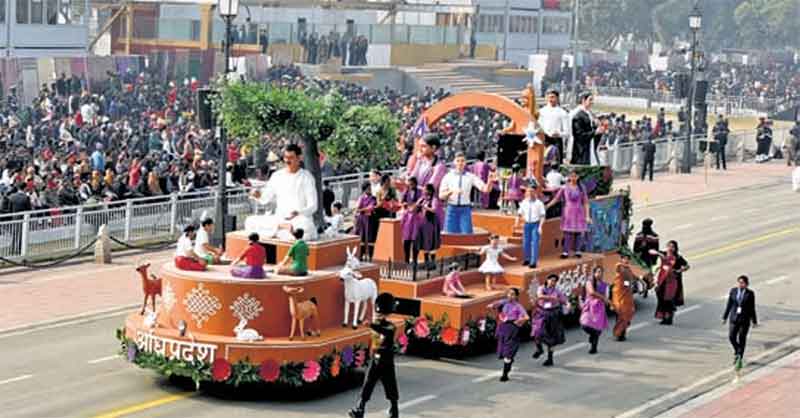
In Andhra Pradesh the Government on 30 January, 2024 entered into an agreement with an international organization to start the school education with IB (Baccalaureate Syllabus) syllabus from class one onwards. This is another major step in linking up the Government school education in English medium to global standards. The students will get a joint certificate. The focus of the AP Government on school education by spending huge amounts as a future investment for building knowledge India, is reflected in the Republic Day parade Tableau that the Andhra Pradesh Government put before the nation and the world.
The Republic Day parade, 2024 in Karthvya Path, New Delhi, displayed a new vision of the future with the Andhra Pradesh Government putting out a Tableau with the theme “ Transformation of School Education” before the global and national leadership. It required courage and confidence on the part of the AP Chief Minister to put out a tableau creatively constructed by the officials with school children and teachers singing and dancing on and around the tableau as it kept moving. The international and national viewers were clapping quite enthusiastically as it marked a major difference from other state tableaus. The Tableau song:
Sakala Vidhyalaku Me Me Saati
Vishwa Vidhyaku Me Me Poti(We are capable of learning all forms of Education
We can compete with Global Education).The song tells about the quality of English medium education that the AP Government is providing in all the Government schools for the poorest of the poor children. The students in their school uniform were showing their tablets and bilingual books, and the teachers were helping them learn skills and knowledge. This is the most futuristic tableau of India to tell the world that India will produce world-class philosophers, scientists, engineers, and doctors from its rural school education, which is being given free for every child. A translator was explaining to the French president, Macron, about the message of transformation of school education and he was looking at it with curiosity.Name: Email:
No state Government during the last 74 years of Republic Day parades presented the innovative school education model of that particular state. The only state which could dare to show its literacy rate, if not its quality education was Kerala. But even Kerala also did not think to celebrate its school educational achievement as the AP Government did in this year. Perhaps one of the reasons is that Jagan is going to 2024 elections making his education model a vote catcher.
Of course, every ruling political party tries to win the election based on its performance and policy programme. But the new English medium school education that he introduced, along with the improvement of school infrastructure is a heartening thing in a democracy that thinks of becoming global power house. Jagan shifted the idea of quality school education from private to public. The children of the poor in remote villages are hoping to get into national and global markets with confidence and dignity while learning modern global skills in their own village schools. Jagan seems to have chosen this model of development in opposition to the development model of his predecessor, Chandrababu Naidu. He invested the state resources in pooling 30,000 acres of land to build a Singapore like capital city. His model is private-sector investment model without bothering much Government sector. Even education sector he promoted private investors.
CONTRAST TO OTHER TABLEAUS
The AP tableau stood in contrast with other state tableaus, which either presented their past glory or symbols of freedom struggle, or religious symbols or tribal or life of women from their states. The parade was meant to specifically present women’s empowerment in India. It was designed to show the world in every field how the country is encouraging women—in all wings of army, scientific activities like ISRO and so on. The ISRO put its own women power in space science on its tableau. That had its own futuristic merit. The tribal states and traditional states like Rajastan, Madhya Pradesh, Uttar Pradesh (which brought a tableau on Ram Lalla) put out tableaus with dancing traditional women. But AP was the only state that showcased school education as future of this nation, with modern well equipped English medium education in the globalized world.
The challenge before other states is what about the future of tribal (North East, Chattishgharh or Jharkhand and so on) or non-tribal women who still hang on to semi-medieval life systems. No Tableau has shown what is the status of Muslim women. At least one tableau should have been brought from Kashmir. Ultimately the betterment of women of all states points to the model of Andhra Pradesh school education.
It is one thing to showcase the history of the state; it is another thing to showcase the future of the country through a well-planned education of the nation’s children. AP had done that with a clear vision. Prime Minister Narendra Modi was carefully watching the school education tableau as the AP tableau was moving. Even his own Gujarat model did not work on well-defined English medium education for its students studying in Government schools. Gujarat also now depends on its quality English medium education in private schools. But That is accessed only by the rich.
When India aspires to compete with the West and China the only way is quality education preferably in English medium with a good grounding in their regional language.
The Andhra students’ confidence comes from the quality English medium education with a conscious effort by Jagan Mohan Reddy. He has now made that as his poll plank. With that idea the showcasing of school education in Republic Day parade in Delhi.
THE POSITIVE SIDE OF IT
Any major positive step in school education by the Centre or a state must be appreciated. There lies the future of the nation. Ideological differences could be there on any issue, but certainly not on providing quality school education in the Government schools on par with private schools, so that the child’s future cannot be setback. Any child can learn two languages quite easily and in our case, it has to be English and the regional language of the child. One hopes that even the central Government understands and appreciates the Andhra model.
Kancha Ilaiah Shepherd is a political theorist, social activist and author of many books.
-
Kanaka Guru Pitta Must Start English Medium Schools And Connect Shepherds To Global Knowledge
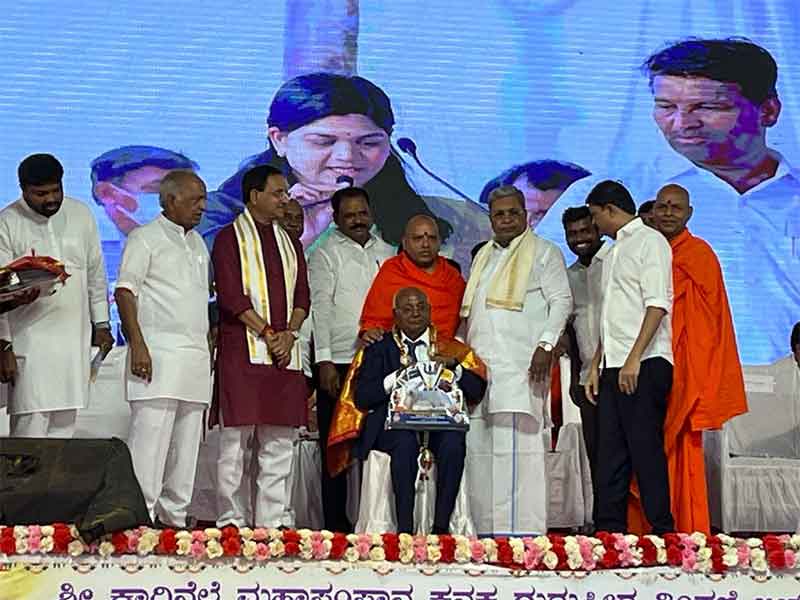
On 13 January, 2024 the Kanaka Guru Pitta headed by Sri. Niranajananda Swami in a massive public meeting attended by the Karnataka Chief Minister Mr. Siddaramaiah, central minister Mr. Bhagwanth Khuba, Planning and Urban Development Minister of Karnataka Mr Bairati Suresh and other Pittadhipatis, amidst thousands of shepherds (Kurubas) from all over the state, presented “The Sun of Our Community” (the Halumatha Bhaskara) title award to Kancha Ilaiah shepherd. The award consisted of a plaque and Rupees 50,000. The plaque read, ” We wish him the best by awarding the title Halumatha Bhaskara in recognition of his achievements as a strong voice against the religious persecution of the Indian aborigines and against caste oppression”.
Siddaramaiah congratulated him for doing great intellectual service to the oppressed and exploited masses of India.Name: Email:
SHEPHERD’S ACCEPTANCE SPEECH.
At the outset I am extremely happy to have been given this unusual award, called Halumatha Bhaskara) “The Sun of Our Community”.
I thank the Kanaka Guru Pitta for honouring me with this significant award. I thank the Pittadhi Pathis and the Chief Minister Sri Siddaramaiah and other ministers for their presence on this significant occasion.
The community here refers to all shepherding castes and communities across the country, which built the meat and milk economy of India for millennia. They built the most classical economy by grazing sheep and goats, an animal species that became the food and warm clothing resource of global people from most ancient days. Shepherd is universally known as a human being of an ideal image of God. It is said that God created human beings in his image. The shepherd was created as an earliest image of that God. He/she loves animals, nature and all other humans. But In India this community suffered inhuman indignity and were kept by the Brahminic spiritual system as untouchable.
The first ever known liberator of this community of such spiritual untouchability was Kanakadasa of this region. I am fortunate to have been born in his community and also for receiving this award associated with his Guru Pitta.
In Karnataka this community is known as Kuruba, in two Telugu states Kuruma. In Maharashtra it is known as Dhangar. In North India it is known as pal, Bhagel, Ghaderia and so on. This community is there in every state in India. Even among the Tribals this occupation is part of Tribal life. Animal economy is their main source of survival.
Kanakadasa who lived between 1509 and 1609 in the present Karnataka region was a shepherd saint, poet, singer and spiritual philosopher. In his long life of about a hundred years he fought many anti-social forces. He worked as a shepherd in his early days and later became a soldier. Thereafter he turned to spiritual engagement by singing Bhajans, keerthanas to abstract God. During his time the Shudras were also not allowed to enter into any temple that was being managed by Brahmins, mainly around Vedic and Puranic deities.
In India for millennia agrarian and artisanal Gods/Goddesses and Sanskrit textual Gods/Goddesses differed in theory and practice. For example Rama, Krishna temples were managed by Brahmins with the support of kings. They were said to understand only Sanskrit. The poojaris were only Brahmin men who treated all other communities and their own women as unworthy of learning the Sanskrit language. They were treating the Shudras and Dalits as untouchable. They were also treating agrarian production as pollution.
Kanaka had to fight a big spiritual battle in Krishna temple, where entry was denied to him. Though the story goes that Krishna himself appeared to him by breaking the wall of the temple, Kanaka had won a literary spiritual battle by appealing to all castes of Kannada society by defeating Brahminism. Defeating Brahminism in 16th century was not an ordinary task. It was much more difficult than defeating the British rulers in the 20th century. But Kanakadasa fought that battle and won. It appears that he was the first Shudra to attain a high spiritual status by creating a new literary and cultural saga. Though Basava fought against Brahmanism much before Kananaka, he was a born Brahmin and turned pro-Shudra and pro-production.
The Pitta that was established to continue the liberation spiritual ideology of Kanakadasa by Sri Birendra Keshavatarakanandapuri Swami has established several spiritual and educational centers in Karnataka. The Pitta has become a critical spiritual mobilizer of the poor masses, alongside the Basava spiritual centers in Karnataka. This work has to expand to all India landscape and mobilize all shepherd communities with one national identity.
This becomes possible only when Pitta starts world class English medium schools and colleges to educate the children of shepherds cutting across all regional languages.
Since we are living in a globalized world, every young generation has to acquire skills in two languages—English and regional language. This is what Brahminic spiritual institutions are doing. Brahma Samaj has done that for Brahmins. But our children have not yet entered into that global knowledge domain.
Kanaka learnt reading and writing when a Shudra was prohibited to learn. Our children are now systemically prohibited to learn quality English right from class one. The Brahminic institutions do not allow teaching of Dignity of Labour to children as they are opposed to all productive work like tilling land, grazing cattle, pot making, shoe making and so on. But the God that Kanaka visualized was with shepherds, shoe makers, tillers, pot makers and so on. His God existed around fields but not just in temples. God for him was neither a war hero nor a dance master. God for him was food producer, animal economist, road sweeper, cook in the kitchen.
At a time when Brahmanism was separating milk from meat in the domain of food culture, with a funny theory of God drinks milk but does not eat meat, Kanaka as a shepherd knew that for God meat and milk are like body and soul. Neither of them could be taken out of human plate. As a shepherd he knew that God comes in the form of composite food for sustenance of the human body and soul. God does not separate meatarian from vegetarian. Both Kanaka and Basava taught that plural food culture is divinely respectable.
Kanakadasa knew how a shepherd grows hundreds of sheep and sells only a few for human food in the form of meat. The living ones keep supplying milk while denying enough food for their new born. Hence, the shepherd dedicates his life to sustaining his flock un-diminishing. No shepherd subscribes to the theory that God is vegetarian or meatarian. God is a supplier of food in all forms that are not poisonous.
God in the form of Shepherd supplies milk and meat for human survival and supplies wool for protecting human beings from cold and heat. Hence the shepherd is most respectable in the realm of God. But Kanaka, in the incarnation of shepherd of God, was denied entry into a temple that Brahmins were managing. He then turned their unethical divine theory on its head and went into productive masses telling them how God loves them more than a priest who hates food production work but eats the labour power of people, who keep on producing food by working all day believing in God.
He also broke the myth that God understands only Sanskrit in a prayer or Pooja, but not other people’s languages. He went on singing in people’s Kannada in the villages around the fields and around temples. That has shaken the Brahminic control over God. The masses became aware of God in a popular sense. Now the very same Brahminic forces educate their children in English in private costly institutions.
Hence the shepherd communities across the country have to turn to learn English, without leaving their regional language base.
When I added the name shepherd to my name the idea was to tell the nation and the world that my parents’ and ancestral occupation is sheep rearing and I am proud of that occupation as it is a revered profession globally. The first city builder of India with the name Harappa was built in the name of a man called Harappa two thousand years before the Aryans came here. He was a shepherd and animal economy builder. That history connected me to all the shepherd castes in the country. By adding shepherd to my name I have overcome my historical inferiority. No regional language could give that stature.
My writings have acquired greater recognition and seriousness once they were reprinted with that name shepherd. The global universities and intellectual forces take my writings seriously and read and recommend them.
The shepherd community lives labour as life but not leisure as life. It is a community that lives a life of honesty and truth. Kanakadasa’ message and ideology of democratic spiritual practice should be taken to all productive communities so that a religion called Kanakaism will emerge in future. That will be an extension of Buddhism and Basavaism.
I once again thank the Kanaka Guru Pitta for honouring me with an award of great significance. If I will be of any help to this pitta and Karnataka state being ruled by the Congress, a liberal democratic party, under the leadership of Sri. Siddaramaiah, in English education I will certainly do my bit.
Kancha Ilaiah Shepherd is a political theorist, social activist and author of many books.


You must be logged in to post a comment.