-
ANTI-FREEDOM EXPRESSION OF LEFT-LIBERALISM HAS REACHED A FRENZIED PHASE: I CONDEMN AND GIVE A CALL TO STOP IT.
ANTI-FREEDOM EXPRESSION OF LEFT-LIBERALISM HAS REACHED A FRENZIED PHASE: I CONDEMN AND GIVE A CALL TO STOP IT.
PRESS STATEMENT
On 2 October, 2024 I was scheduled to speak in the Malayalam Manorama Arts and Literature Festival at Kozhikode held from 1to 3rd November. The organizers under the directorship of a retired IAS officer, NS Madhavan, disinvited me on the pretext of possible protests against my article in Sakshi, a Telugu newspaper with the title, The only Way out to ISRAEL-PALESTINE IS TWO NATION FORMULA . After my air ticket was booked, they called and informed me that my presence could provoke protests and possible violence. Neither the CPM Government, nor the Malayalam Manorama group of Kerala realized that opinions on national and international issues should not be allowed to result in threats and cancellation of invitations to speakers; this has potential to destabilize Indian democracy itself.
The second dis-invitation for a Library opening programme by a Marxist-Leninist group called the Rajanna group to be held on 11 November, 2024 at Vemulawada is more shocking. The group’s popular singer Vimalakka called me on 31 October, and asked me to be the chief guest of a library building opening programme built in memory of Rangavalli, who was brutally killed by the police 25 years ago. At that time, I was a civil rights activist and knew her in her early activism days. Though normally I do not associate with Maoist-Naxalite group meetings, even as a speaker, I accepted this invitation because Rangavalli was a woman leader and opening a library in her memory was a positive development, that too in a rural area.
Quite shockingly, after three days a Whatsapp message comes from Vimalakka that there are serious objections to ‘your Sakshi article on the Israel-Palestine issue; you must re-think’. I replied that I have my position. It was for them to agree or disagree. This invitation too followed a similar dis-invitation.
One is a major newspaper in Kerala and the other is a Marxist-Leninist party. Both disrespected my freedom of expression and self-respect.
Left liberals joining hands with fundamentalist Muslim youth have become the stick on social media to attack my right to freedom of expression. Actually, they are only pushing the Muslims of India into a deeper crisis in the world order led by Trump, Modi and Netanyahu. They also seem to be bent on instigating youth to disrupt the liberal atmosphere in Telangana, available because of Congress rule.
Leftists think that the Jews should be thrown out of Israel; only Palestinians have a right over that land. Leave alone Ambedkar who supported the settlement of Jews in Israel in 1948, they have not read what Lenin and Marx said on the Jewish question.
It is up to them to live in their blissful ignorance, but they have no right to insult me and abuse my right to freedom of expression and self-respect.
I am open for a debate on my stand on this issue in any public forum.
Kancha Ilaiah Shepherd
Hyderabad, 9 November, 2024.
Prof. Kancha Ilaiah Shepherd
Former Director, Centre for the Study of Social Exclusion and Inclusive Policy,
Maulana Azad National Urdu University, Gachibowli, Hyderabad-32
Ph.No.- 040 23008335 Mob- 9704444692
http://www.kanchailaiah.com -
Cancelling Kancha Ilaiah Shepherd And Freedom Of Expression
in India
I request the Indian media to publish this e-mail correspondence between me and Mr. N.S. Madhavan, as it involves the issue of Freedom of Expression, which is a lifeline of democracy. As a citizen of India and as a writer I strongly oppose any force that threatens, the freedom of expression, which is the sole of democracy. Here is the Hindu news link for your understanding.
STATEMENT BY KANCHA ILAIAH SHEPHERD
THREAT TO FREEDOM OF EXPRESSION IN KERALA
Correspondence between NS Madhavan director, Malayala Manorama Arts and Literature, 2024 at Kozikode me.
I was invited to the Malayala Manorama Arts and Lit Festival 2024 being held at Calicut, Kerala to speak in a session on 2 November afternoon. Suddenly on the 29th late night the curator of the Fest Bandhu Prasad called to say that there an Intelligence Bureau input that if you come to the to the Fest there is likely to be a big protest by the Pro-Palestine forces against the article that you wrote in the Telugu daily Sakshi, with a title Rendu Deshaluga Bathukademe Dari ( Living as Two Nations is only Solution). If a minority community that is in stress of intolerance itself turns intolerant and attacks Free Speech it is not only harmful to Democracy but very harmful to themselves. I condemn this kind of intolerance. If this is allowed democracy itself will be in danger. The organisers would have asked for police protection and allowed me to participate in the Litfest.
Kancha Ilaiah Shepherd
30 November, 2024 .
Mr.NS Madahavan’s reply to my mail
Dear Dr. Shepherd
Greetings from Hortus. We acknowledge the receipt of your email.
The Malayala Manorama office has received information from the Intelligence Bureau wing of the Police indicating the possibility of a protest or disruption at your session scheduled for November 2nd. This information stems from an article you recently published on a Telugu online media platform, in which you expressed your views on the Israel-Palestine conflict. As it involves both a matter of public safety and safety of one of our guests, you in this case, we thought that you should be informed urgently.
Accordingly my colleague at the festival, Mr. Bandhu Prasad, has apprised you of the situation and the challenges we face in ensuring the peaceful conduct of the festival programs. While our viewpoints on the subject of your article may differ, (which we haven’t read, since it is in Telugu) we firmly believe that differing opinions should be expressed in a democratic and peaceful manner.
The festival has requested that you speak on a topic entirely separate from the aforementioned issue, and we leave it to your discretion whether to attend the festival and speak on the agreed-upon topic. Although there is a potential for protest or disruption during your session, which could impact the festival’s peaceful atmosphere, we want to assure you that you remain welcome. The festival values diverse opinions and fosters an environment where concerns are expressed and listened to with camaraderie.
Warm regards,
NS Madhavan
1 November, 2024
Dear Mr. Madhavan
Thank you for your mail and for clarifying your stand on the protests. But you left my going to Kozhikode entirely to my decision. But you did not say anything about the necessary police protection in view of such great dangerous information given by the Intelligence Bureau working in Communist Government. I could have understood if it were the BJP Government, who are opposed to all my major books like Why I am Not a Hindu, Post-Hindu India, Buffalo Nationalism and so on. You should have informed the Home Ministry of Kerala and given enough protection to me and the conference. Malayala Manorama is a major newspaper in the state. It was your responsibility to take a stand against such Hamasism, perhaps, taking root in Kerala too. In your mail you said “This information stems from an article you recently published on a Telugu online media platform, in which you expressed your views on the Israel-Palestine conflict. As it involves both a matter of public safety and safety of one of our guests, you in this case, we thought that you should be informed urgently. You, further, wrote ” While our viewpoints on the subject of your article may differ, (which we haven’t read, since it is in Telugu) we firmly believe that differing opinions should be expressed in a democratic and peaceful manner.. For your information my Telugu article was not published in an online portal. It was published in the largest circulated Telugu daily, Sakshi. I do not know when a major paper like Malayala Manorama could not come to know its contents ,how the protesters in that state who cannot read Telugu understood what I wrote and planned for a protest of that magnitude. Bandhu Prasad mentioned that it could be a violent protest. It is Malayala Manorama’s responsibility as a major newspaper to investigate and name that organization which planned this kind of terrorising network. In such a far off war situation like the one in West Asia information about it could differ, stands about it could differ, but terrorising writers, with whom these forces disagree and threatening a major national Arts and Literature festival poses a great threat to the Freedom of Expression of India and the world. If this is being done by Muslims of Kerala then the threat to India is larger. Name: Email:
I request you to publish the news as the Hindu newspaper has published along with my opinion on 31 October ( see the link) and the organiser’s opinion. So that the Kerala Government and the Central Government and major political parties will come to know about such dangerous forces in India.
Kancha Ilaiah Shepherd is a writer
-
Book Release – Sudhra Rebellion
-
What Should the Shudras Do?
in Book Review
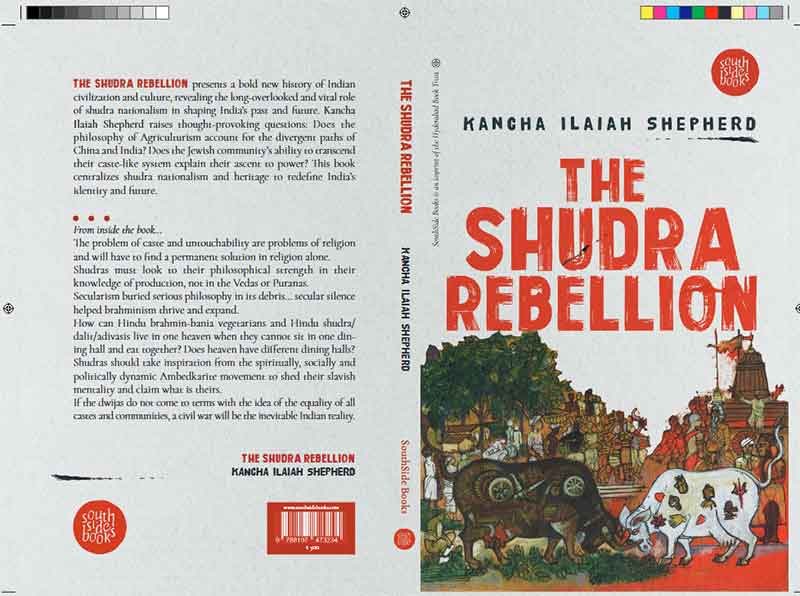
This is the final chapter of Kancha Ilaiah Shepherd’s, groundbreaking work ‘The Shudra Rebellion‘ that promises to reshape our understanding of Indian civilization and culture. In this compelling book, Ilaiah boldly unveils the often-overlooked role of shudra nationalism in both India’s past and its future. Ilaiah’s work pushes us to reexamine the very fabric of Indian identity through the lens of shudra heritage. This book is not just a historical account; it’s a call to awareness and action. Ilaiah’s insights resonate in today’s socio-political landscape, making it an essential read for anyone seeking to understand the complexities of caste, identity, and the future of India.
The history of the Shudras is far older and deeper than brahminic written history. It goes far beyond the Vedas, Ramayana, Mahabharata and Upanishads, and remains outside all these books, without getting mentioned in any significant way. However, shudra history survives and exists in the furrows of agrarian lands and in artisanal fossils and living tools. The living shudras are also a huge repository of their past and present history. India’s science exists in these unwritten furrows and in the deep wells of the wealth of labour. This nation’s future has to be built, taking lessons from these sources.
RECLAIMING SHUDRA IDENTITY WITH PRIDE
The shudras must deploy the identity ‘shudra’ as superior to the identity of the brahmin. Though shudra civil society is fragmented into myriad layers—each layer with its own name as caste or jati, their classical unified identity as shudra must become a political entity. Any identity acquires respectability only when its owners are proud of being identified with it. In modern times a woman is proud of being a woman, a dalit is proud of being a dalit. Similarly, a shudra has to be proud of being a shudra. This pride demoralizes the Other who earlier used that identity as undignified.
Secondly, the shudras must look to their philosophical strength in their knowledge of production, not in the Vedas or Puranas. They cannot look for their strength where it does not exist. They cannot look for their strength in the history of some shudra rulers. No shudra ruler in Indian history operated outside the framework of brahminism, particularly after Kautilya wrote his book Arthashastra and Manu wrote the Dharma Shastra. All shudra rulers were converted to kshatriya status and forced to obey the orders of Brahmin priests.
The day-to-day discourses of shudra food producers are replete with philosophical, economic and scientific thought. Unfortunately, this thought has not been recorded and textualized. Since most of their socio-economic and spiritual history is in the villages, young intellectuals of good calibre must engage in textualizing it.
Shudra civilization is spread out in many regions and states and is recorded in some regional languages and oral histories. Several scholars must undertake the painstaking work to study and write about shudra philosophy, science, and economics, in all regions and states mainly in English. Though it is not an easy task, given the denial of their history for millennia, it is possible to retrieve it.
UNEARTHING SHUDRA HISTORY THROUGH TOOLS OF PRODUCTION
There is a major task at hand for shudra voters, activists, leaders and rulers, whether at the state or central levels, to establish good museums of artefacts of production, social use, cultural use and architectural value that survived the historical neglect of the brahminic negative knowledge system. Indian agriculturist and artisanal forces constructed highly sophisticated tools like spades, buckets, pots, plough, ropes, construction materials like bricks, cots, hunting and fishing instruments as time, production, and survival demanded. By the time the shudras built the Harappan civilization, they constructed houses with burnt bricks and built their homes with crafted wood. At the time, the migrant Aryans had no knowledge of such civilizational technologies. Tools and technology development happened much before the Aryans arrived and constructed the ideology of brahminism. They did not help in the scientific process of life. The dwijas do not exist in these realms of knowledge even today. They consider that making technological instruments is an act of ritual pollution.
Millions of instruments went into oblivion without getting written about or their shapes and uses sketched. Pre-Independence times stored brahminic music or written material in museums, libraries and temples. Kings, whether shudra or dwija, gave importance only to divine idols and sculpture. Even the erotic life of brahminic society was preserved in the Khajuraho and Konark temples, but no king built an agrarian artisanal museum. No ruler had a contemporary sculpted plough placed in a temple. This only shows that agriculture, which is the mother of all cultures, had no value in any mode of civilizational history under pre-colonial, colonial or postcolonial rulers. So far, shudra rulers have not shown any concern for agrarian artefacts or understood the need to museumise them.
As a result, this ancient civilization did not preserve the fundamental source of its culture, science, technology and history. Anti-science brahminism made us slaves of the Euro-American knowledge systems. Hence India borrows science and social science knowledge from them even in post-colonial times.
The shudras must now strive to build many museums of agrarian and artisanal instruments, and write about their modes of use. For example, there is repeated mention of soma (in modern times, this drink is known as toddy, called kallu in Telugu) even in brahminic books like the Vedas. But nobody wrote about what kind of technology was used to tap the drink from trees. Toddy tappers use moku, mutthadu and guji to climb a tall toddy tree, even in modern times to harness the drink. In ancient times too, the tappers of soma must have used several instruments and techniques, but there is no record of these technological instruments.
A toddy (sura) tapper has to climb a tall tree that has no branches to tap the drink at the top and bring it down. Using these instruments and risking their lives, tappers do this hard labour with great scientific skill. Every day, the tapper climbs several trees and brings down the drink from the top of the trees. They use the moku to support their back, placing this around the tree stem, while their hands are pressed to the tree. The guji keeps the feet pressed to the tree. The mutthadu holds all kinds of sharp knives that are used to cut the trunk to get the drink from the tree.
Likewise, several shudra occupational groups use different technological instruments to perform their skilful tasks. Many such technologies are going out of existence and their history erased if they are not written about. Museums of such tools will be great historical resources of knowledge to remain for millennia.
THE DECLINE OF SHUDRA SCIENCE UNDER BRAHMINISM
Parasitism always sustains itself by constructing myth as philosophy. Whether they are philosophical ideas like Dwaita or Adwaita, Vaishnav or Shaiva, they operate outside the realm of production. They are different names for brahminism. Shudra thought has to operate outside this realm without fear or sentiment. Courage emerges out of conviction. Even in modern times, the shudras have not shown courage in the realm of constructing knowledge and ideas. Not that they do not have ideas, but the fear of the brahmin destroys that energy that could give a concrete written shape to their ideas. Not that they do not have spiritual ideas that sustain their socio-spiritual life in villages where brahmin mythical philosophy and recitation of mantras are not around them. The agrarian people survived for millennia without any connection with a brahmin. But brahminism spread to every nook and corner of village society and made the whole shudra population believers in mysticism. The injection of mythical philosophy now controls their consciousness.
Ever since their ancestors asked questions about agriculture like how a seed placed in the ground germinates and grows, how a bird flies while a man walks, where the wind that touches the human body or sweeps over their crops originates and where it ends, they discovered new things. Our shudra ancestors who were the initiators of seeding and growing crops from the earth and who interacted with birds and animals daily, must have concluded that an unknown power was operating behind all these movements of nature. This spiritual resolution was a higher philosophical one than the question that the brahminic dwaita or adwaita thinkers asked. When the answer was found, it made sense to them only concerning seed, plant and crop. The historical shudra spirituality was a mix of Science and God. Brahminism negated this scientific spirituality and advanced mythical spirituality killing the capacity to reason out the process of life. Once brahminism gripped shudraism, Indian agrarian and artisanal science began to stagnate.
DEVELOPING A SHUDRA INTELLECTUAL MOVEMENT
A well-trained intellectual force must emerge from among the shudras. Though compared to dalits, the shudras have more land and property, they have not yet produced an intellectual force that can focus on writing their history and philosophy. Since their wealth operates mostly around the agrarian economy, they still have the peasant understanding that reading and writing are not important.
Most agribusiness is in the hands of upper shudras. They have emerged as real estate financers around urban centres. They are also well-established in regional politics. The OBCs within shudra society have become conscious of the necessity of reservations and also education but they live only in non-philosophical realms. Low-end achievements in medical science and engineering are visible among them. But a broad historical and philosophical knowledge requires deeper involvement in philosophical, sociological, and spiritual discourses with the ability to read and write methodically in these schools of thought. Even rich shudras have no conscious intellectual force trained in Indian or foreign universities to handle these philosophical and social science issues. They have to get out of the grip of brahmins and their superstitions. Mere literacy and technical education do not reframe their mental abilities.
A strong will to have an identity for themselves, outside the boundaries of brahminism is a prerequisite. Brahminism now operates in the new construct, ‘We are all Hindus’. The shudras have no equal space in this Hinduism. Shudra thinkers and writers should operate in their production-centred philosophy and sociology as hegemonic, even in the domain called Hindu.
The ideas of hegemony are constructed consciously by thinkers to control the Other. Shudras were and are the historical Other for dwijas, though they do not realize this. Normally, the construction of philosophical knowledge not only comes from deeper study of the society that one lives in, but also comes from constant engagement with ideas. This requires leisure and resources. It is the rich shudras who need to spend part of their wealth in the philosophical sphere. Among the shudras, the marathas (Maharashtra), reddys and kammas of the Telugu states, patels (Gujarat), jats (Uttar Pradesh and Punjab) and others have to get into this identity discourse and invest their resources in training their youth in India and abroad.
Though the nairs of Kerala are shudras they want to be in the fold of the dwijas; they want to be called savarna and are not willing to oppose brahminism. They also work as anti-reservationists, just as the dwijas do. One of the strong historical reasons for this is that nairs had a deep blood relationship through the system of sambandam with the brahmins of Kerala. However, their agrarian and artisanal roots are still strong. In the 21st century when the RSS/BJP rule with the idea of turning India into a classical varna dharmic state called the Hindu Rashtra, it is for them to take a call towards serious study of their millennial roots and history as shudra agrarian people.
Shudra intellectuals must acquire sophisticated skills to build a written knowledge resource of the history of production. Global knowledge to create modern literary texts is equally important along with reading what is available in India.
SCRIPTING A LANGUAGE OF EQUALITY AND DIGNITY IN REWRITING SHUDRA HISTORY
Shudras must realize that they must fight for English medium education in government schools. Only when a large number of children who are still engaged with the agrarian environment, labour and nature are in school, is it possible for them to emerge as world-class intellectuals over some time. But all of them must get English medium school education in their village environment. The theory that English is a foreign language and very difficult to learn in Indian village schools is a lie. All children, irrespective of their caste, and class can learn English if a conducive school environment is provided to them anywhere. The village environment, which is surrounded by agrarian production, is better suited for dignity of labour centered English medium school education. Reading, writing, and formulating intellectual energy should begin at the school level. Shudra children were denied this learning for millennia. They must get it at least now.
The history of the shudras was ignored in writings in Sanskrit, Persian, and other national languages all these years. Now this history must be written in English to receive universal recognition and use value for global scholars. A history written in a rich global language will get global attention and the use of that knowledge will help the world, not just India. Shudra history, unlike brahminic history, has many global commonalities. Added to this, a new philosophy, if written in a rich language like English, displays depth and force. Shudra youth do not have to spend their energy to study Sanskrit, when dwijas themselves have shifted to English; they should not waste their time and energy to retrieve a dead language.
This history must be written in the collective combination of shudra/ dalit/adivasi intellectuals so that it unravels all forms of exploitation and oppression by dwijas who injected human untouchability among the dalits and kept adivasis outside modern civil society. Intra-productive community problems should be resolved outside the caste cultural framework. Man-woman equality in all communities should be a common concern. There is great need for dwija women to engage with this knowledge construction because this history has the potential to weaken patriarchal control over Indian society and the state.
A NEW FRAMEWORK FOR SHUDRA HISTORIOGRAPHY
Shudra history, if properly written by applying the Marxist method, could have given Indian Marxists a better direction to change this nation in a meaningful way. A creative Indian communist ideology rooted in the nation’s production relations could have prevented the growth of Hindutva nationalism. Shudra nationalism and brahmin nationalism are antagonistic in day-to-day operations. In a situation of all-round failure to write and preserve production knowledge in this country possessing the oldest civilization in the world, shudra thinkers must write this unwritten history in a new creative way.
My attempt to study Indian history through the shudra experience, starting with Why I am Not a Hindu (1996) and finally writing this book on shudra history tracing back to the Harappan civilization is a step forward. It is meant to help future historians, sociologists, and philosophers to do more concrete work on shudra civilization, culture and philosophy. The slogan `garv se kaho hum shudra hai` that reverberated in Uttar Pradesh in 2023 while opposing the anti-shudra and anti-women narrative of Ramacharitamanas of Tulsidas has to become an all-India narrative. I hope this book gives enough impetus to future generations to carry the shudra/dalit/adivasi legacy forward consciously.
Kancha Ilaiah Shepherd is a political theorist, social activist and author.
https://countercurrents.org/2024/10/what-should-the-shudras-do/
-
Pro Kancha Ilaiah’s new book ‘Sudra Rebellion’

The Shudra Rebellion, a groundbreaking work by Kancha Ilaiah Shepherd that promises to reshape our understanding of Indian civilization and culture.
In this compelling book, Ilaiah boldly unveils the often-overlooked role of shudra nationalism in India’s past and future. He challenges us to consider provocative questions: How has the philosophy of agriculturism influenced the divergent paths of India and China? What can we learn from the Jewish community’s ability to rise above caste-like divisions? Shepherd’s work pushes us to reexamine the very fabric of Indian identity through the lens of shudra heritage.
This book is not just a historical account; it’s a call to awareness and action. Ilaiah’s insights resonate in today’s socio-political landscape, making it an essential read for anyone seeking to understand the complexities of caste, identity, and the future of India.
Don’t miss out on this transformative read! Get your copy of The Shudra Rebellion at SouthSide Books today and join the conversation about the future of our society.
Order here: https://www.southsidebooks.in/product-page/the-shudra-rebellion-kancha-ilaiah-shepherd -
On Indian English Day, we must look at strengthening English medium in govt schools
The previous Andhra government started an important experiment in bringing English medium education to government schools. The present regime – at the state and national level – wants to erode it for private gain.

Image for representation
Written by: Kancha Ilaiah Shepherd
While the world is adopting English as a school level teaching language, the Indian ruling class is setting the clock back to pre-English education days with a design. Ever since the Bharatiya Janata Party (BJP) came to power in India, the theory that English is a colonial language has become more pronounced. But linking the English language to colonialism is a major mistake. As we mark Indian English Day, we must acknowledge that the language plays a big role in the power that upper caste, globalised Indians hold – that they want to methodically deny to Shudra, Dalit, and Adivasi children who depend on government schooling.
After the alliance of Telugu Desam Party (TDP), Jana Sena, and BJP came to power in Andhra Pradesh in the 2024 elections, there has been a push back to the first ever major experiment to English medium education in government schools in India that the previous government under Jagan Mohan Reddy had brought in. Already, the new government has withdrawn the CBSE syllabus that was made compulsory in all government schools along with private schools. The financial assistance of Rs 15,000 per year given to mothers of school going children – called Amma Vodi – has been silently stopped.
The private-political nexus
It’s important to understand that the three parties that came to power in alliance are against introducing English medium in government schools because they strongly support the private sector English medium education.
Look at the Cabinet of Chief Minister Chandrababu Naidu – he has made the private sector educational tycoon Narayana, who owns the Narayana chain of private English medium schools and colleges, a minister once again. This is a clear signal that he will go all out to dismantle the government sector English medium education and revert back to Telugu medium in all schools.
The National Democratic Alliance regime at Delhi is also clear about not allowing English medium education in government schools. All the major leaders of NDA including Narendra Modi, Amit Shah, Nitish Kumar, and Chandrababu Naidu are on the same page. Nitish Kumar does not even want any party leader or official to speak in English when he is present in meetings.There is an attempt to force even the Supreme Court and High Courts to use regional languages even though Article 348(1)(a) of the Constitution of India states that all proceedings in the Supreme Court and in every High Court, shall be in the English language only.
The Congress in Andhra Pradesh and at the national level is silent about this kind of an education policy. This only shows that even in the future, government school educated youth have no scope to compete with the private English medium educated youth, reservation or no reservation. Since the most talked about Andhra model is being nullified, the hope that it created will get dashed. The Indian Communist parties and groups have also become a stumbling block to expansion of English medium education in government schools.
Who is afraid of Indian English?
English education started in 1817 in India. This is the 207th year of that language’s birth in India. October 5 is Indian English day. Every year, every language day celebration takes place in India. But those who learnt English as a global and Indian language of opportunities and benefited from it do not celebrate English as a language. Though they use it as a language of power, wealth, and global mobility, they keep condemning it as a colonial language from public platforms.
The notion of public and private remain opposite to each other in this sphere quite consciously. The people who have benefited most from the English language are the upper castes, particularly Brahmins, Banias, Kayasthas, Khatris.
The historical Indian ruling caste Ksatriyas have only recently realised the power of this language and are educating their children in the English medium. Look at the Dwija empowerment with this language and their spread in the global economy.
Upper caste global players and English
Kamala Harris, a Black and Indian origin Brahmin woman is likely to become the first female president of America in its 245 years of constitutional democratic existence. No White woman has been able to become the President or Vice-President in that country so far. Kamala Harris has already become the first woman Vice-President of America.
Could this have become possible without English as a global language – more so if it had not come to India during colonial times? Would her mother Shyamala Gopalan, a girl born and brought up in a Tamil Brahmin conservative family, have gone to America and made her life there, and educated her two daughters Kamala and Maya to become what they have? Can we imagine a woman from an ordinary, middle class, single-mother family like Kamala becoming a lawyer of her stature, becoming the Vice-President of the most powerful country in the world, and getting a chance to challenge the richest white American – Donald Trump – in the presidential race, without English as a language with her?
Can we imagine Rishi Sunak, from a Khatri family from western India, becoming the Prime Minister of Britain – a country that ruled India for more than two hundred years – without the English language in India to educate his parents?
English had changed the cultural environment in the homes of upper castes by the time India achieved Independence. But the very same people, who benefitted in multiple ways by using that language’s reach and power, do not want the children of farmers and labourers to learn that language. Is this not a paradox?
English and Europe now
The European Union this year declared that hereafter, English will be its official language instead of German. Most countries in the world are shifting to English medium school education along with their native language. France, Japan, China and the two Korean nations have started teaching English in their schools right from the beginning, even though these countries operate with one national language. India has several regional languages that disconnect people from region to region.
Nationalism getting linked to language has started receding in the globalised world. All non-British nations were very language sentimental in the post World War II context. But they realised that English is essential for every European country’s economic development. Even the former French and Spanish colonies are slowly shifting to teaching English in their schools. It’s not as if the globalised English educated upper castes do not know this aspect of change.
The Indian nation is fragmented into several small language speaking nationalities with a sentimentalised mother tongue theory. And because of this, the Shudras, Dalits, and Adivasis are stuck in a small language world of their own. This kind of linguistic confinement does not allow them to grow into a proper citizenship role.
The experiment like the one started in Andhra Pradesh should not be allowed to die with a design of diabolical political forces.
Kancha Ilaiah Shepherd is a political theorist, social activist, and author. His latest book is The Clash of Cultures—Productive Masses Vs Hindutva-Mullah Conflicting Ethics.
-
Kangana Ranaut’s Neo-Hindutva Disruption
Share:
Share on WhatsAppShare on FacebookShare on X (Twitter)Share on TelegramShare on RedditShare on Email
DOUBLE-EDGED FEMINISM
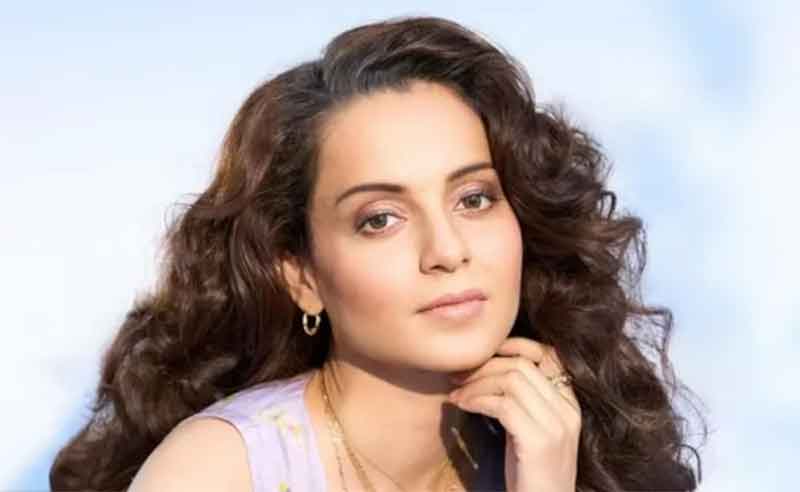
In the cultural tradition of upper castes, particularly the Dwijas, the parampara represented by Amrapali of Magadha times would be condemned as un-Hindu. Their ideal women in mythology are women like Sita and Sati Savitri. A famous artist like Amrapali, who was respected in the Buddhist tradition was never respected by the Brahmanic tradition. What is significant now is that the Rashtriya Swayamsevak Sangh (RSS) and Bharatiya Janata Party (BJP) have owned up Kangana Ranaut, a Kshatriya Bollywood actress, with all her complex personality. She has become a contemporary Amrapali in the RSS/BJP armour. The RSS/BJP are okay with her now because she serves a political purpose. On one hand, she occupies an Amrapali-like space of a feminist artist in Bollywood. While on the other hand, in her political capacity as a BJP member, she is anti-Dalit/Shudra/Adivasi women as they are farmers.
Any art cannot survive without food. Historically, food is not produced by Brahmin, Bania, Kshatriya, Kayastha, or Khatri women. It is produced by Shudra/Dalit/Adivasi women. Kangana fully supports the BJP/RSS agenda to hand over the agricultural lands of small and medium farming women to Adani and Ambani. She has been repeatedly calling farmers—women and men—who fought against the three farm laws, terrorists. When women farmers were on the roads to fight for their rights, she accused them of selling their souls for money. It appears that for RSS/BJP, she is a modern Kshatriya queen fighting against the poor women of India. For them she represents their parampara and also Sanathana Dharma.
Kangana’s fight against male authority in the cinema industry is certainly progressive, but her fight against poor women in the country is not. Making cinema against Indira Gandhi, the first woman Prime Minister of India, who fought all feudal men in the sixties and seventies is part of Kangana’s neo-Hindutva nationalist ideology. It seems that as a result of her Kshatriya upbringing, she is okay with wealth getting accumulated in the crony capitalist monopoly houses as they all come from Dwija background.
KANGANA’S EARLY FIGHT
Kangana walked out of the parampara of Sati Savitri and Sita in her personal life. As a liberated Kshatriya woman, she does not hide her encounters with men. She walked out of the Rajput regimentation and cultural weight of Sati-sahagamana and the parampara of permanent widowhood. She not only became a liberator of herself from that male chauvinist culture but also wanted to fight to liberate other women. How did the RSS/BJP forces reconcile negotiating with her freedom-loving self while upholding the RSS ideology of preserving the ancient Vedic and Puranic control over women? Kangana has thrown away the Hindu Nari dress codes and challenged the oppressive authority of men over women in relationships. She has thrown away the RSS-type anti-dating, anti-valentine friendships.
She entered into Western fashion shows. And then moved into the gold mine of Bollywood. But that world was totally strange to her. Not only that this world was inimical and exploitative at every level and, as a collective, refused to engage with her, but her lack of sophisticated Bollywood-style English became her prison house. She became a victim of that brutal money-and-mafia exploitation. She fought that culture. Finally, she found her own production company, which is something admirable. She learnt English to compete with them. Here too she did not take the anti-English route of treating English as a foreign language, like the RSS/BJP do.
She fought exploitation, deceptivity, and captivation of young girls who came there with an ambition to make a glowing glamorous life as a cinema heroine. She ran from pillar to post, lived in cramped hostel rooms, and became a victim of lures of those influential manipulative men of the industry. She fought against such brutes to become what she was by the time she won the election in 2024 as a BJP candidate. Now she is a force to reckon with in that field—a negative force at that.
She withstood all that oppression and remained in Bollywood because back home her traditional Kshatriya family and caste culture would not allow a better window of freedom for women. She was practical and had an assessment of her own freedom and future.
When her own Government asked the censor board to stop the film Emergency from getting released on 6 September 2024, she said that she had become a favourite target for everyone and that it was the price one has to pay for awakening a sleeping nation. The nation that got freedom in 2014 under Modi’s leadership has become a sleeping nation within 10 years, and she has become an awakening goddess like Durga.
In the recent past, the relationship between Bharatiya Janata Party (Rashtriya Swayamsevak Sangh involved) and Kangana Ranaut has taken a very interesting twist. BJP had to distance itself from Kangana’s statement on the farmers’ protest. Secondly, her film ‘Emergency’—made with a tacit agreement with the BJP and RSS ideologues to put the Indian National Congress in the dock—had to be stopped from getting released as scheduled on 6 September, 2024. This happened just before the state elections in Maharashtra, Haryana, Jharkhand, and Jammu and Kashmir.
The life story of Kangana has a double-edged implication for the RSS/BJP ‘s notion of cultural nationalism itself. As of now, the nation does not know whether the RSS/BJP is leading her or she is leading them with her neo-Hindutva feminism.
An RSS supporter and promoter of the idea of Hindu Rashtra, she is a new nationalist and a new cultural phenomenon. She is an avowed opponent of Muslims, Sikhs, farmers, Congress, and male monopoly in Bollywood. She is a new phenomenon in Bollywood history.
She is a feminist in a mostly male-chauvinist political and social network. More than all these pro- and anti-ideological dramatic displays, she is a strong supporter of Prime Minister Narendra Modi, particularly since she made a shocking statement that “India got Independence only in 2014, not in 1947”. In turn, she gained the silent support of Modi. The RSS, a hundred years old organization, is obviously supporting Kangana, and hence she is a member of the BJP and a member of parliament.
FREEDOM IN 2014
The RSS/BJP upper-caste cadres celebrated her courage, nationalist spirit, and wisdom for making such a bold statement that India got freedom in 2014. Nobody from those ranks opposed such a statement. By the very statement, she proved her disloyalty to the present Indian constitution adopted in 1950. Perhaps, that could be one of the main reasons she has become a darling of the RSS/BJP.
This statement of hers seems to have deeply impacted Modi. Since 2014, the entire Modi government has defended her in all her battles—both within and outside Bollywood—supporting her statements, whether right or wrong, and standing by her in every dispute, big or small. This emboldened her with a new sense of freedom to establish a Hindu Rashtra. It could be first seen when she started attacking Shiv Sena in Maharashtra as it fell out of the RSS/BJP line. But her Hindu Rashtra will not be dominated by the same male monopoly. It will be a Neo-Hindu Rashtra with feminist upper-caste women in the lead. She wants to be the queen of that Hindu Rashtra. She has never shown concern for Dalit/Adivasi/OBC women in her fight. Any talk of caste is equivalent to dividing the nation. Her slogan is ‘bantenge to tutenga’ (if you divide, we will break). This idea seems to be popular among RSS circles that the present Federal Union of India will lead to disintegration. Perhaps it should become a unitary monarchic theocratic state by dismantling the present constitution.
She does not have any sympathy for the poor, illiterate, toiling Indian masses, who hardly have anything to eat. Accumulation of wealth by upper castes is nationalism for her. Her feminism aids and abets the rich in a neo-capitalist way. She seems to be happy with the growing Dwija crony capitalism.
A DISRUPTER
She has become an entertainer, engager, and disrupter of the Indian civil society and also the RSS/BJP structures in her own way. As of now the nation does not know whether she is reforming the RSS or the RSS is reforming her by making her an MP so that she would use her full-blown upper-caste feminism. She has taken the battle into the Congress and Sikh society by making an anti-Indira Gandhi and anti-Sikh film. She has also given a call to bring back the Three Anti-Agrarian Farm Laws.
LIFE STYLE
In her lifestyle and man-woman relationships, she does not live in the RSS ideological framework, as that framework has many things in common with her Kshatriya family’s male chauvinism. She was in conflict with her own family’s patriarchal heritage right from her school days. She was a child who rebelled against her family. She walked out of her family right after school education and joined a fashion company in Delhi. She lived on her own with all the struggles that a lonely teenage girl could encounter in the Indian male chauvinist society. From there she reached Mumbai in search of cinematic life. This adventure of a Kshatriya girl who normally lives a very protected life is itself a cinematic story. Now she has reached the stage of being an adventurous actor with a lot of support from the BJP/RSS and emerged as a political entity, if not as a leader.
Interestingly, she is also disrupting the most conservative Kshatriya caste community of India that Yogi Adityanath, the patriarchal Chief Minister of Uttar Pradesh hails from. According to her own admission, he is her strong supporter. This is a paradox.
Hence, she makes an interesting female personality with a determination to fight many forces at the same time. As an RSS bhakt, she constantly shouts Jai Sri Ram in public, but does things that go against the ideology of RSS in her personal life. She does not adhere to the Ram Rajya ethic, as that ethic controls women under the authority of men. She wants to control everything, including the social narrative through social media. Let us assume that she was a Dalit or an OBC woman, acquired the same status in Bollywood, and had such a disruptive personality. Would the RSS/BJP have supported her fight in Bollywood and given her the same protection that Kangana got? Would they have admitted her into the BJP and made her an MP? This is where caste matters. Since she is a Kshatriya woman she becomes a darling of RSS/BJP upper echelons.
FROM ANTI-RAHUL TO ANTI-INDIRA
The RSS/BJP leaders support her because she promotes their ideology through political messaging. And also, because she is anti-Congress, more particularly an anti-Rahul Gandhi’s family, as Modi and many other RSS/BJP leaders are. She shifted from acting in films like Gangster, Fashion, Queen, Raaz, and so on to playing the roles of political women leaders.
She made the film Manikarnika (Jhansi Lakshmibai) to establish herself as an anti-British nationalist. Then she acted as Jayalalitha on Thalaivii. Just before the 2024 elections, she made Emergency, a film in which an attack on Indira Gandhi’s history and personality seems to have been encoded. But at the same time, her anti-Sikh rhetoric was brought into the film, as the trailer of the film shows. The film seems to have stepped into the complex post-emergency history of the 1980s, depicting Indira Gandhi’s actions against Bhindranwale, and her tragic murder by her Sikh bodyguards at her official residence. According to Makhan Lal, who already viewed the full film, she did not show the anti-Sikh riots of 1984. Perhaps the RSS/BJP are upset with that mistake. The Sikhs are very angry against her for projecting Bhindrenwale as a terrorist.
Now the RSS/BJP does not know whether the film is against Indira Gandhi or Sikhs. The Sikhs are saying it is against them and the Congress is saying that it is against India itself.
Through all of this, perhaps, she wanted to make way for a “Congress Mukt Bharat”, a slogan that Modi has used repeatedly, right from the 2014 election campaign. But she did not stop there. She also wanted to attack Sikhism, as the Sikh farmers were the backbone of the 2021-22 Farmers’ movement. This was the movement that made the Modi-Shah eat a humble pie. Meanwhile, the BJP was using the anti-Sikh riots of 1984 against Congress to deflect attention from the 2002 anti-Muslim riots in Gujarat.
She hates agitations in Modi’s India but loves such agitations against Indira Gandhi. She views any anti-BJP agitation as terrorism. The student movements that rocked the country around Rohit Vemula’s systemic killing or the student protests at Jawaharlal Nehru University were labelled by the BJP forces as part of tukde-tukde gang, accusing them of breaking the nation. Any movement by people around their rights is attacked as anti-national. Kangana is carrying this meaningless ideology forward, in whatever way possible. But the pro-feudal JP movement becomes nationalist in the film.
PRO-LANDLORD JP MOVEMENT
The Kashmir Files fame actor, Anupam Kher, plays the role of Jayaprakash Narayan in her film Emergency. After the BJP came to power in 2014, a strong anti-Congress team came together in Bollywood and started making a series of movies against the Congress regime and Muslims. Kangana and Anupam Kher are the leading forces in the pro-RSS network of Bollywood. Thus, it is obvious that in the film, the JP movement of the RSS version will be foregrounded.
Jayaprakash Narayan, popularly known as JP, led an anti-Indira movement in the pre-emergency days, advocating for a ‘Total Revolution’. Narayan called for Indira Gandhi and the CMs to resign and urged the military and the police to disregard all unconstitutional and immoral orders from them. In that anti-Indira agitation, Modi himself was an agitator. For the Hindutva school that hated the idea of socialism, JP, a Kayashta socialist, became a great national leader very much acceptable to them. In that movement, in order to overthrow Indira Gandhi, the RSS/Jan Sangh combine, very opportunistically accepted Gandhian socialism as their ideological agenda. Her election from Raebareli in 1971, after almost four years, was declared invalid by a court.
In fact, the 1971 election was a turning point in India where the Dalits/OBCs/Adivasis gained something through the policies of Garibi Hatao, the nationalization of banks, land reforms, and the abolition of privy purses. The RSS/Jana Sangh network was very upset with this pro-poor agenda of Indira Gandhi. All the landlords of India turned against her. The JP movement, unfortunately, was a pro-landlord one. JP’s earlier socialist image was used to fight pro-poor policies of Indira Gandhi, which led her to declare emergency. The movement was led by Hindutva forces.
In that election, Indira Gandhi gave a pro-poor slogan “Garibi Hatao” and promised nationalization of banks and the abolition of Privy purses and because till then the freedom was seen almost as landlord freedom. In the 1971 elections, Dalits and Adivasis were not allowed to vote by the Reddy Congress and the right-wing landlord forces all across the country. Indira Gandhi was attacked as a communist. The JP socialists were part of pro-landlord agitations in the post-1971 elections. The unemployment problem of that time was not greater than the unemployment problem in the Modi regime. Kangana wants to portray that agitation as nationalist but keeps on attacking any anti-Modi Government agitation as terrorist and anti-national. However, the BJP/RSS are now worried about the unintended effects of the Movie that Kangana made.
RSS and Jan Sangh were totally opposed to all these pro-poor welfare agendas of India Gandhi. To counter all these forces and to retain her power position she imposed emergency. Of course, during the emergency all opposition leaders were put in jail and many Naxalites and active trade union leaders were killed. Naturally, the emergency was opposed by large masses of India and in 1977 Indira Gandhi had to lift it and go for election. She lost the election so badly that she never recovered from that negative history of emergency.
At a time when the Modi Government is opposed to all forms of agitations, including those by farmers, Kangana is trying to justify anti-Indira agitations led by the RSS/Jan Sangh, while attacking Sikh socio-spiritual movements at the same time. The Sikh movement in the 1980s was started to get the Sikh religion a separate recognition, not for the creation of Khalistan.
She attacked the farmers’ movement as a terrorist or Khalistani movement. The women participants were derogatorily called ‘women worth 100 rupees’. It was for this anti-Sikh, anti-farmer, anti-women statement that Kulwinder Kaur slapped her at the Chandigarh airport after she became MP and was going to Delhi from her constituency Mandi, Himachal Pradesh.
FARMERS AS BANGLADESHIS
No RSS/BJP leader asked her not to go after farmers. After she attended her first parliament session, she again said, “Bangladesh-like anarchy could have happened in India also, in the name of Farmers’ protest. Outside forces are planning to destroy us with the help of insiders. If it wouldn’t have been the foresight of our leadership (meaning Modi and Amit Shah) they would have succeeded”. Not only that, she also said, “bodies were seen hanging and rapes were taking place” during farmers’ protest against the now-repealed three farm laws. Only BJP distanced from the statement. The RSS was totally silent. What should the nation read from these major events in her life?
There is an agreement with her persona among the top leaders of the RSS/BJP. Otherwise, she would not have got the BJP membership and a ticket to contest elections as an MP. By her own admission, she was offered a ticket in the 2019 parliament elections itself. But she refused to contest. Perhaps they did not discover her by the 2014 parliament elections, but they discovered that her ideology aligned with their ideology by the 2019 election.
As a reward, she was honoured with Padma Shri and national film awards. And now made a member of parliament with all the support she needed—money and manpower.
PLAYED CONTRADICTORY ROLES
Kangana played roles in a variety of films that no RSS/BJP man would normally accept. Before she entered the shoes of Manikarnika (Jhansi Lakshmi), Thalaivii (Jayalalithaa), and Indira Gandhi she played the roles of women who were partners of those involved in the Mumbai underworld and had love affairs. She appeared on screen in slim-fitting outfits and also shared images of herself in swim-suits on social media. With films like Manikarnika, Thalaivii, and Emergency, she wants to become a don. But something seems to be going wrong. The proposal to release the movie Emergencycoincides with the BJP giving a call for mass condemnation of Emergency as “Dark Days of Democracy”. The political communication between RSS/BJP and Kangana’s Emergency movie making was consciously cultivated. But the story inside the movie seems to misfire, even after release.
HINDUTVA AND WOMEN
Hundreds of young Indian women have gone through unbridled attacks by Hindutva brigades in public parks for simply sitting with their boyfriends. How does Kangana feel comfortable in the company of such forces, both outside and inside parliament, who still believe that Indian women should be Hindu Naris, and never do such anti-Manu Dharmic things?
Having come from a Rajput family of Himachal hill state, that never aspired for high-end English education, leaving their feudal love for local authority in the local language, she faced the sophisticated English-speaking Brahmin, Kayastha, Khatri Bollywood domain. All her auditions were humiliating, despite her suitable Aryan looks. She got rejected time and again. She had to fight to make an entry into the industry, with the film Gangster. She still retains her anger against the Bollywood male monopoly and control.
Yet she won over the world’s biggest conservative, anti-Valentine’s Day organization’s brainchild party and made them accept her and offer her a seat in the parliament. Name: Email:
The Kangana Ranaut-RSS relationship is changing the history of that organization as well. An organization that promoted the Hindu Nari discipline has allowed the BJP to field her in the election. How that relationship came to be established when she was fighting Bollywood with her own strong and weak personality, more particularly how did the BJP give her a ticket if it did not approve her attack on farmers as terrorists? After becoming an MP, she is taking the same anti-farmer, anti-Sikh, and anti-Congress battle forward.
Where this relationship between the neo-Hindutva feminist Kangana and conservative RSS and its political wing BJP will lead remains to be seen.
Kancha Ilaiah Shepherd is a political theorist, social activist and author.
https://countercurrents.org/2024/10/kangana-ranauts-neo-hindutva-disruption/
-
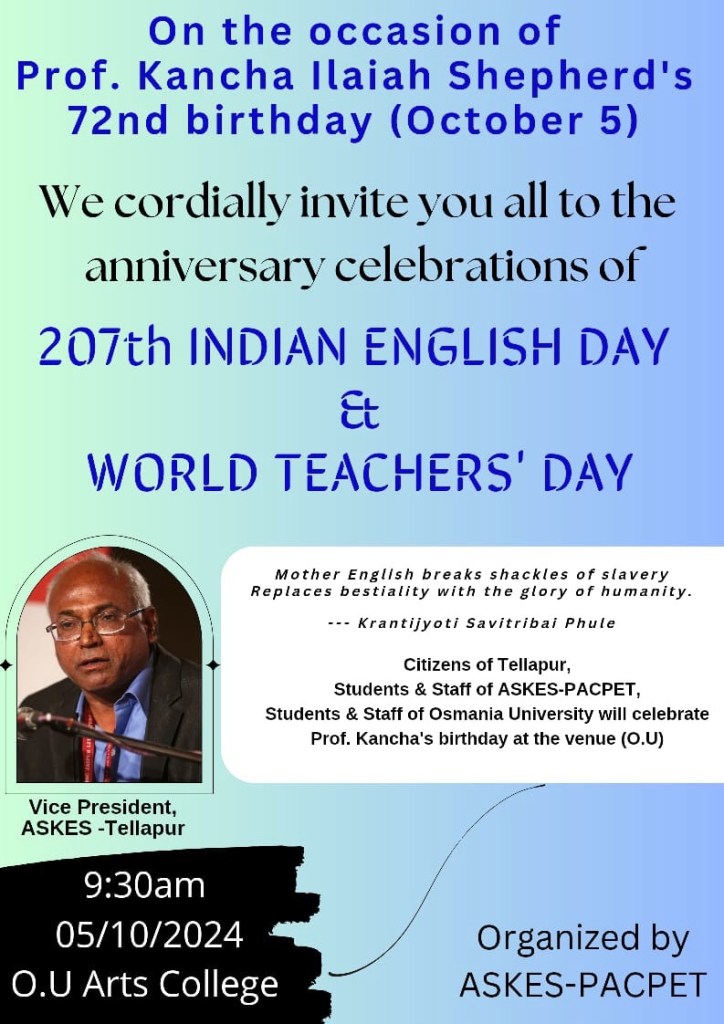
Celebrating 72nd Birthday of Prof Kancha Ilaiah as Indian English Day
-
कोटा के तहत कोटा ले लिए जातिगत जनगणना आवश्यक
हम यह कह सकते हैं कि उच्चतम न्यायालय के निर्णय में केंद्र सरकार को उसी तरह की जातिगत जनगणना करवाने का निर्देश दिया गया है, जैसाकि 1931 में की गई थी और यह आरक्षण कोटे के उपवर्गीकरण की पूर्व शर्त होगी। पढ़ें, कांचा आइलैय्या शेपर्ड का यह आलेख
कांचा आइलैय्या शेपर्ड September 2, 2024
Share on FacebookShare on Like on FacebookShare on X (Twitter)Share on WhatsAppShare on Telegram
उच्चतम न्यायालय के हालिया निर्णय, जिसमें सरकारी नौकरियों और उच्च शैक्षणिक संस्थानों में आरक्षण के संदर्भ में अनुसूचित जातियों (एससी) और अनुसूचित जनजातियों (एसटी) के उपविभाजन को हरी झंडी दिखलाई गयी है। इसके बारे में विरोधाभासी प्रतिक्रियाएं सामने आईं हैं।
हालांकि शीर्ष न्यायालय की सात जजों की खंडपीठ संयुक्त आंध्र प्रदेश और पंजाब में एससी के लिए निर्धारित आरक्षण कोटे के उपविभाजन की मांग से संबंधित मामले में सुनवाई कर रही थी, लेकिन अदालत द्वारा सुनाया गया निर्णय सभी राज्यों और राष्ट्रीय स्तर के आरक्षण कोटे पर भी लागू होगा।
अतः इस निर्णय के कार्यान्वयन के दूरगामी प्रभाव होंगे।
ओबीसी उपविभाजन
इसी तरह, यद्यपि उच्चतम न्यायालय के सामने मुद्दा एससी के उपविभाजन का था, मगर यह निर्णय ओबीसी और एसटी आरक्षण कोटे पर भी लागू होगा। वर्तमान में केवल कुछ राज्यों में ओबीसी का उपवर्गीकरण किया गया है। मगर यह उपवर्गीकरण आनुभविक आंकड़ों पर आधारित नहीं है और ऐसे आंकड़ों की ज़रूरत काफी समय से महसूस की जा रही है।
अनुसूचित जातियों के श्रेणी के भीतर भी टकराव की स्थितियां बन रही हैं, क्योंकि कुछ अनुसूचित जातियों को ऐसा लगता है कि उनके साथ अन्याय हुआ है। इसके चलते पूर्वोत्तर के राज्यों में बड़े पैमाने पर हिंसा भी हुई। तेलुगू-भाषी राज्यों में लमबाड़ा आदिवासियों और कोया एवं गोंड जनजातियों के बीच टकराव उतना ही गंभीर है, जितना कि माला और मडिगा अनुसूचित जतियों के बीच।
सर्वोच्च न्यायालय ने क्या कहा है?
सर्वोच्च न्यायालय का 6:1 के बहुमत से सुनाया गया फैसला साधारण भाषा में यह है– आरक्षण की जद में आने वाली जातियों का इस उद्देश्य से उप-वर्गीकरण कि उनमें से जो हाशिये पर हैं, उन्हें कोटे का आनुपातिक हिस्सा हासिल हो सके। यह औचित्यपूर्ण और संवैधानिक दृष्टि से वैध है।
सबसे बड़ी अदालत ने यह भी कहा कि कोटे का उपविभाजन न्यायपूर्ण होना चाहिए, उसका आधार संबंधित जाति या जातियों के संबंध में निष्पक्ष आंकड़े होने चाहिए और इस आशय के प्रमाण उपलब्ध होने चाहिए कि संबंधित जाति या जातियों की कुल कोटे में हिस्सेदारी, जाति समूह की आबादी में संबंधित जाति या जातियों की आबादी के अनुपात में कम है।
अब तक आरक्षण में हिस्सेदारी से संबंधित सभी फैसले व्यक्तिपरक संभाव्यता पर आधारित रहे हैं। जैसे, शीर्ष अदालत द्वारा आरक्षण पर लगाई गई 50 प्रतिशत की उच्चतम सीमा व्यक्तिपरक थी, क्योंकि जातियों की आबादी के संबंध में सटीक आंकड़े उपलब्ध ही नहीं थे।
इसी तरह, आर्थिक रूप से कमज़ोर वर्गों (ईडब्ल्यूएस) को 10 प्रतिशत आरक्षण देने का निर्णय भी व्यक्तिपरक था, क्योंकि आर्थिक पिछड़ेपन के संबंध में जातिगत आंकड़ा उपलब्ध नहीं था। अतः उच्चतम न्यायालय ने यह मान लिया कि सामान्य जातियों के 10 प्रतिशत परिवार निर्धन हैं और वे अपने बच्चों को इन जातियों के समृद्ध परिवारों के समकक्ष शिक्षा दिलवाने और उनसे प्रतियोगिता करने में सक्षम नहीं हैं।
प्रयोगसिद्ध आंकड़ों की ज़रूरत
शीर्ष अदालत ने जातियों का उपवर्गीकरण करने की इज़ाज़त देते हुए यह भी कहा कि प्रत्येक जाति की आबादी में कोटे में उसकी हिस्सेदारी के संबंध में विश्वसनीय आंकड़े एकत्रित किये जाने चाहिए। यह भी पता लगाया जाना चाहिए कि किस जाति को आबादी में उसके हिस्से के अनुपात में कम या अधिक प्रतिनिधित्व मिल रहा है।
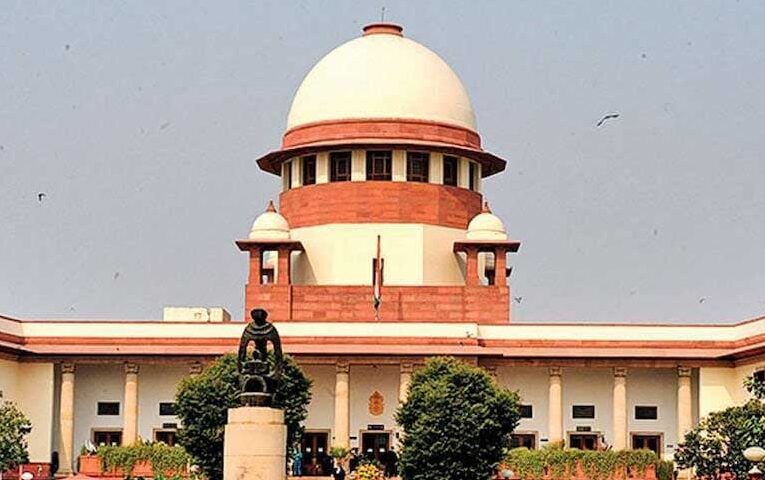
दूसरे शब्दों में हम यह कह सकते हैं कि निर्णय में केंद्र सरकार को उसी तरह की जातिगत जनगणना करवाने का निर्देश दिया गया है, जैसाकि 1931 में की गई थी और यह आरक्षण कोटे के उपवर्गीकरण की पूर्व शर्त होगी।सुप्रीम कोर्ट, नई दिल्ली
ऐसा इसलिए क्योंकि जनगणना के आंकड़ों से हम यह तो जानते हैं कि एससी व एसटी की कितनी आबादी है और देश के कुल आबादी में उनकी कितनी हिस्सेदारी है। मगर हम यह नहीं जानते कि इन समूहों में शामिल विभिन्न जातियों और उपजातियों की कितनी आबादी विभिन्न राज्यों या देश में है।
यहां तक कि हमें यह भी नहीं पता कि एससी/एसटी के बरअक्स कुल आबादी में ओबीसी की कितनी हिस्सेदारी है और सामान्य जातियों की कितनी है।
व्यापक निहितार्थ
मगर इसके बावजूद इस फैसले के आरक्षण के लिए पात्र सभी समूहों – एससी, एसटी व ओबीसी – के लिए निहितार्थ होंगे, क्योंकि पूरे देश में हर जाति की यह मांग है कि उसे राज्य एवं केंद्रीय पूल, दोनों में ठीक-ठीक हिस्सेदारी मिलनी चाहिए।
वर्तमान में उपलब्ध कोटे में विभिन्न उप-जातियों के हिस्से का मुद्दा केवल एससी व एसटी तक सीमित नहीं है। ओबीसी, जिन्हें केंद्रीय स्तर पर 27 प्रतिशत आरक्षण उपलब्ध है, के मामले में भी यह एक बड़ी समस्या है।
फैसला केंद्र को करना है
कई ओबीसी जातियां अपनी श्रेणी में से अपने लिए न्यायपूर्ण हिस्से की मांग करती रही हैं। उदाहरण के लिए महाराष्ट्र के धनगरों ने अपनी हिस्सेदारी के लिए लंबी लड़ाई लड़ी और अंततः राज्य में 3.5 प्रतिशत कोटा पाने में सफल रहे। मगर यह निर्णय संघ लोकसेवा आयोग (यूपीएससी) द्वारा आयोजित परीक्षाओं पर लागू नहीं होता। इस फैसले को यूपीएससी को भी लागू करना चाहिए।
मराठा भी आरक्षण के केक में अपना हिस्सा हासिल के लिए आतुर हैं। महाराष्ट्र सरकार ने उन्हें 50 प्रतिशत सीमा के पार जाकर 10 प्रतिशत आरक्षण उपलब्ध करवाया, मगर अदालतों ने इस निर्णय को रद्द कर दिया। अब वे कुनबी जाति के होने का प्रमाणपत्र हासिल करना चाहते हैं ताकि राज्य और केंद्र के 27 प्रतिशत ओबीसी कोटे में जगह पा सकें। इसी तरह, गुजरात के पटेल (पाटीदार) भी आरक्षण में हिस्सा हासिल करने के लिए संघर्षरत हैं।
ये सारे आंदोलन और मांगें, कुल आबादी में इन जातियों के हिस्से के अंदाजिया अनुमानों पर आधारित हैं। इससे भी बड़ी समस्या यह है कि सुप्रीम कोर्ट ने भी 50 प्रतिशत की उच्चतम सीमा का निर्धारण व्यक्तिपरक आधारों पर किया है। इसी तरह, ईडब्ल्यूएस के लिए 10 प्रतिशत कोटा के संबंध में निर्णय भी सामान्य जातियों में निर्धनता के संबंध में राष्ट्रीय स्तर के किसी भी आंकड़े के बगैर किया गया था।
इसलिए, अब केंद्र सरकार यह कहकर अपना पल्ला नहीं झाड़ सकती कि निर्णय राज्यों को लेना है। राज्यों द्वारा जिस तरीके से आंकड़े एकत्रित किये जाएं, अदालतें उन्हें विश्वनीय और वस्तुपरक नहीं मानेंगीं।
केंद्र की हिचकिचाहट
केंद्र सरकार जहां एक ओर सुप्रीम कोर्ट में आरक्षण के लिए जातियों के उपवर्गीकरण की बात करती है, वहीं दूसरी ओर वह जातिगत जनगणना नहीं करवाना चाहती।
यह इस तथ्य के बावजूद कि प्रधानमंत्री नरेंद्र मोदी ने हालिया लोकसभा चुनाव के दौरान विभिन्न राज्यों में अपनी सभाओं में एससी के अंतर्गत आने वाली कई उप-जातियों के साथ न्याय करने के वायदे किये थे।
जैसे, तेलंगाना में मडिगाओं की एक सभा में बोलते हुए उन्होंने कहा था कि एससी के लिए आरक्षण के उपविभाजन की उनकी मांग का सरकार समर्थन करेगी। मडिगा तेलंगाना की सबसे बड़ी दलित जाति है और भाजपा को 2023 के विधानसभा चुनावों और 2024 के लोकसभा चुनावों दोनों में उसके वोट चाहिए थे।
जाति जनगणना करवाने के प्रति केंद्र सरकार की हिचकिचाहट को समझा जा सकता है। यूपीए सरकार ने भी जनगणना के दौरान एक अतिरिक्त अनुसूची के माध्यम से जातिगत आंकड़े इकट्ठा किये थे, मगर गैर-शूद्र जातियों के दबाव के आगे झुकते हुए सरकार ने उन्हें सार्वजनिक नहीं किया।
जातिगत जनगणना की राह में सबसे बड़ा रोड़ा है– ब्राह्मण, बनिया, कायस्थ, खत्री और क्षत्रिय जातियों का विरोध। पहले तो जाट, पटेल और मराठा जैसी शूद्र उच्च जातियां भी जातिगत जनगणना का विरोध करती थीं, मगर अब वे कम-से-कम राष्ट्रीय स्तर पर तो ऐसा नहीं कर रही हैं।
ऊंची जातियों का दबदबा
सन् 1931 के बाद, जातिगत जनगणना इसलिए बंद कर दी गई, क्योंकि उपर्युक्त पांच जातियां, जो शिक्षित थीं और औपनिवेशिक काल व स्वतंत्रता के शुरुआती वर्षों में सरकारी नौकरियों पर जिनका लगभग संपूर्ण कब्ज़ा था, जातिगत जनगणना जारी रखने के पक्ष में नहीं थीं।
द्विज जातियों के बुद्धिजीवियों का तो यह तर्क था कि जाति प्रथा औपनिवेशिक निर्मिती है। यही ताकतें यह भी तर्क देती हैं कि केवल वेद ही असली भारतीय सभ्यता से हमारा परिचय करवा सकते हैं। वेदों, रामायण और महाभारत में वर्ण और जाति दोनों सामाजिक विभाजन की महत्वपूर्ण श्रेणियां बताई गई हैं।
चूंकि शूद्र/ओबीसी, दलित और आदिवासी अशिक्षित थे, इसलिए उन्होंने मिथकों को सच मान लिया। प्राचीन, मध्यकालीन और पूर्व-औपनिवेशिक संस्थाओं के लिए भी औपिनिवेशिक शासकों को दोषी ठहरा दिया गया और इसका कोई विरोध भी नहीं हुआ।
मगर अब यह नहीं चलेगा। अब शूद्रों, दलितों और आदिवासियों में पर्याप्त संख्या में बुद्धिजीवी हैं। और सच तो यह है कि वे शिक्षा और नौकरियों में आरक्षण की व्यवस्था से ही उपजे हैं। इस नए बौद्धिक वातावरण ने द्विजों, चाहे वे जिस क्षेत्र में काम करते हों, के दिलों में एक नया डर बैठा दिया है।
भारत के विवेकशील मुख्य न्यायाधीश
भारत के मुख्य न्यायाधीश डी.वाई. चंद्रचूड़ आरक्षण या सकारात्मक कार्यवाही (जैसे कि आरक्षण) के सामाजिक परिवर्तन की प्रक्रिया पर पड़ने वाले प्रभाव से वाकिफ हैं। उन्होंने अमरीका के हार्वर्ड विश्वविद्यालय से सकारात्मक कार्यवाही के तुलनात्मक अध्ययन विषय पर पीएचडी की है। उनका वह ज्ञान और विवेक निश्चित तौर पर उच्चतम न्यायालय के फैसलों में भूमिका अदा कर रहा है।
केंद्र को इस निर्णय का सम्मान करते हुए सामान्य जातियों और अन्य जातियों की गणना कराने का आदेश जारी करना चाहिए।
चूंकि मोदी सरकार ने आर्थिक आधारों पर सामान्य जातियों के गरीबों को आरक्षण प्रदान करने का कानून बनाया है, इसलिए उसे अब देश की हर जाति की आर्थिक स्थिति के बारे में डाटा इकठ्ठा करना चाहिए।
(यह आलेख वेब पत्रिका दी फेडरल डॉट कॉम द्वारा पूर्व में अंग्रेजी में प्रकाशित व यहां लेखक की सहमति से अनुवाद प्रकाशत है, अनुवाद : अमरीश हरदेनिया, संपादन : राजन/नवल/अनिल)
फारवर्ड प्रेस वेब पोर्टल के अतिरिक्त बहुजन मुद्दों की पुस्तकों का प्रकाशक भी है। एफपी बुक्स के नाम से जारी होने वाली ये किताबें बहुजन (दलित, ओबीसी, आदिवासी, घुमंतु, पसमांदा समुदाय) तबकों के साहित्य, संस्कृति व सामाजिक-राजनीति की व्यापक समस्याओं के साथ-साथ इसके सूक्ष्म पहलुओं को भी गहराई से उजागर करती हैं। एफपी बुक्स की सूची जानने अथवा किताबें मंगवाने के लिए संपर्क करें। मोबाइल : +917827427311, ईमेल : info@forwardmagazine.in
लेखक के बारे में
कांचा आइलैय्या शेपर्ड
राजनैतिक सिद्धांतकार, लेखक और सामाजिक कार्यकर्ता कांचा आइलैया शेपर्ड, हैदराबाद के उस्मानिया विश्वविद्यालय में राजनीति विज्ञान के प्राध्यापक और मौलाना आजाद राष्ट्रीय उर्दू विश्वविद्यालय, हैदराबाद के सामाजिक बहिष्कार एवं स्वीकार्य नीतियां अध्ययन केंद्र के निदेशक रहे हैं। वे ‘व्हाई आई एम नॉट ए हिन्दू’, ‘बफैलो नेशनलिज्म’ और ‘पोस्ट-हिन्दू इंडिया’ शीर्षक पुस्तकों के लेखक हैं।
https://www.forwardpress.in/2024/09/news-analysis-caste-census-supreme-court/
-
Olympic Games And RSS As Vishwa Guru
in India
02/09/2024
Jyothi Yarraji from Visakhapatnam, Andhra Pradesh, performed heroically in the 2024 Paris Olympics finishing fourth in the repechage round heat one. As she was in Paris fighting for a medal in the 100-metre hurdles, a Telugu TV channel went to her semi- slum house to interview her parents. Her father, who looked old, perhaps hardly in his early fifties, said when she was studying in a Government school they used to beat her telling her not to go for games, leaving classes. They wanted her to pass tenth and get married. Her mother said in the interview, ‘we opposed her in the beginning but now we are looking for her to improve our economic life. When she is in the Olympic Games we are more happy’. Of course, her mother was hoping that her daughter would get more money with a gold medal from the world’s biggest games competition. She won many national and international gold medals earlier. Most of them hang on the walls of that slum house.
The TV shows the sickly father going to guard a multi-storied building being built by his employer, obviously a rich builder. The national media wrote about her, “Jyothi Yarraji, the girl from Andhra Pradesh is set to debut in Paris. It’s an evolving tale of sheer grit, determination, and hard work. Jyoti Yarraji, the daughter of a security guard, is all set to run the race of her life in the 100-metre hurdles at the Paris Olympics 2024”
Jyothi reached that stage with the support of Government school teachers. Her teachers were playing a double role in her childhood life: convincing her poor parents telling them “your daughter has a great sports grit in running and jumping hence allow her to play”. And also they were taking her to various competitions in the state and outside, with their money spent on her. This is something unusual for Government school teachers.
Jyothi’s mother said “whenever she went out to play she was getting a gold medal and also some money”. Thus she began to become their hope. Since she missed a medal in the Paris Olympics she did not become a celebrity. Even Chandrababu Naidu and Pavan Kalyan Government did not felicitate her, did not even offer to take her family out of slum and provide a decent flat, at least, for her restful life when she is with her parents.
Jyothi’s life and struggle raise a major nationalist question.
India quite ashamedly lifted only 6 medals. It did not win a single gold medal. Our rank in the world in medal tally is 71. This Vishva Stithy (world status) in sports, which is a marker of our nation’s physical strength along with the general situation in sports, tells about the RSS/BJP attitude to sports. The Vishwa Guru was employing foreign coaches for Indian girls and boys even to get those 6 medals.
Vinesh Phogat praised her foreign coach for taking care of her in the most difficult times of her life in Paris after she lost a chance to wrestle in the final. Her praise for a foreign coach in the background of her long struggle against Brij Bhushan Sharan Singh, a BJP MP, who was president of Wrestling Federation of India, on several charges against him, is a serious pointer to cultural conditions within RSS/BJP.
AFTER TEN YEARS OF RSS/BJP RULE
The global status of 71 in the Paris Olympics is after the RSS/BJP ruled India for ten years with a full grip on the system, with a lot of money in RSS/BJP coffers with big offices in Delhi and Nagpur. The monopoly capitalists during RSS/BJP rule are competing with American and Chinese capitalists in exploiting people and competing to get first, second and third position amongst the global rich. But unlike other nation’s monopoly houses the Indian monopoly houses do not establish charity coaching centres for the poor children like Jyothi Yarraji to train themselves in sports. They do not sponsor, at least, the poor sportsperson’s training and travel. But they take cinema actors, political leaders to marriage parties to foreign trips in chartered planes. RSS/BJP leaders also get their luxury seats and berths in those tours. This is the new nationalism of RSS/BJP Raj.
For the last hundred years the RSS has been blaming the Congress for keeping the nation weak in everything, including sports. But even after its ten years uninterrupted rule with an iron grip the sports strength of India has not improved, rather it became worse. Why is it so? Where has their commitment to nationalism been shown in action on the world scene with a victorious self-avowal?
Unlike the Congress the RSS has its own very well spread private school network. Why did not their schools produce world champions to showcase on the world sport platforms?
WHY THE VISHWA GURU FAILED IN PARIS?
Sports is one area where their school system and drill culture in morning and evening, what they call shakha kavaths would have shown the world with a victorious nationalist brand, if their school kids or their shakha boys, of course, there are no girl in the nationalist shakhas so far, were to walk out with more gold medals than China or Japan. At least, these two countries as they too are Asian nations, the RSS nationalism with a vision of vishwa guru would have made sense.
The RSS leadership speaks a very contradictory language. They want to make India Vishwa Guru and at the same time protect the parampara of Puranas . That parampara does not consist of any strength in sports? Did the Brahminic Gurukulas teach gymnastics to all caste children? Their only focus was to teach Sanskrit slokas from Puranas and also teach banavidhya? Olympics as a global platform of sports came into existence from gymnastic culture of ancient Greece.
For example, the classical texts written by Plato and Aristotle asked for rigour in school education along with rigorous gymnastics. Where is such education in ancient parampara of Sanskrit Brahminism? When the children of agrarian forces of ancient and medieval India called Shudras had no entry to Gurukula education even to learn Sanskrit, Bana Vidya and Kattisamu (knife rolling skill), how could a collective and competitive sports culture take shape?
Europe particularly Greece allowed even the slave children to enter gymnastic education and it was that culture of human competitive spirit that allowed to evolve the Olympic Games. The rest of the Western world share the same sport cultural ethos. They allow the talented persons in their schools—whether they are black, white or brown– to train themselves and compete at global Olympic level. The rich in the West invest in sports along with general education.
China, which is also an ancient nation as India and Greece, had a strong sports culture. That is the reason why it now competes with America. What kind of sport cultural parampara Indian Brahminism developed? When the RSS schools keep operating with such good financial resources with a slogan that India should become Vishwa Guru in every field, it should have produced great sports talent from its nationalist schools. But there is an anti-collective competition culture in their history of parampara.
Look at the reality. The few that brought medals for India so far: P.T.Usha, P.V.Sindhu, Sania Mirza, Mary Kom to Neeraj Chopra, Raj Kumar Pal, Nikhat Zareen and so on did not come from the RSS school system.
The Indian topmost wrestler Vinesh Phogat was also from a village Government school, with a family background of rural wrestling. In Haryana the Khap panchayats train their own wrestlers and her heritage came from there but not from the RSS/BJP kind of Hindutva nationalist school system. What she faced was a roadblock to her talent by their MP.
If Jyothi were to have the Vidya Bharati kind of wealthy school atmosphere, financial help to train herself she would have brought a medal for the nation.
The nation’s physical energy and mental capabilities grow in properly designed school gymnastic education. Have the schools that the RSS network runs shown any capability in producing high quality sport power and also intellectual power? There is no evidence as of now.
WORLD’S BIGGEST AND RICHEST ORGANIZATION
The RSS is the world’s biggest and richest social organization working across India for hundred years. As per their own admission it’s a para military power capable of reaching the borders much faster than the nation’s regular army. But its sports power is not reaching the Olympic games at all. It now controls the central and several state Governments. But what kind of national capabilities is its cultural heritage presented in the most watched and discussed by children, youth and old across the world: Olympic Games?
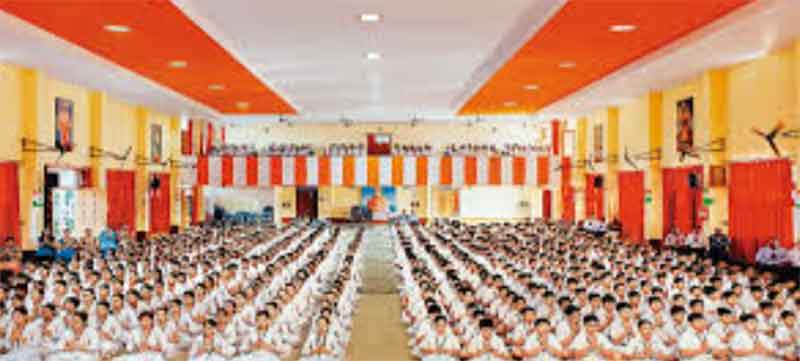
It claims that it runs thousands of schools, which are divided into two branches. In urban areas they run several Vidya Bharati schools and in the rural areas thousands of Saraswati Shishu Mandirs in the villages and tribal areas.
According to one source “Vidya Bharati, the education wing of the RSS, which controls more than 12,000 schools catering to nearly 32 million students across India”. An article written about its educational operations in West Bengal said “ West Bengal has roughly 92,000 students receiving an education in RSS-run 300 schools”. Where is sports strength coming from Vidhya Bharati schools and Saraswati Shishu Mandirs?
How many well trained sports girls and boys came out of these schools who reached the Olympic Games in 2024?Name: Email:
The carefully crafted Vidya Bharti objective says “ To instil a sense of nationalism, social equality and communal harmony. To inculcate a sensitivity to the concerns of the environment. To help students advance technologically without compromising our rich values and our cultural heritage. To prepare students for advanced academic study.”
What cultural heritage are they talking about? Whether the sports culture is part of it or not? Can they inform the nation in which age and in what kind of school system the sports culture of inclusive competition among all caste children existed in ancient India?
In the future what is the nation’s course for improving the sport strength of the nation? All ruling parties of India must think and unite in order to come out with a policy to strengthen our rural and urban sports strength.
Kancha Ilaiah Shepherd is a political theorist, social activist and author of many books.
https://countercurrents.org/2024/09/olympic-games-and-rss-as-vishwa-guru/


You must be logged in to post a comment.