The story focuses on the people of a village that will eventually play a pivotal role in the birth of the Harappa Civilization.
In 2015, I wrote an article titled ‘One Pound Capitalism, a Pinch of Democracy, and the Not-So-Holy Buffalo’. At the time, I was designing recipes as part of my discomfort foodart/essay series, and the recipe ‘Buffalo Jumbo Pav (BJP) #1 hypocrisy kebab bonda pav’ which accompanied the article was inspired by Professor Kancha Ilaiah Shepherd’s response to the Indian state of Maharashtra, which had extended a ban on cow slaughter to include bulls and bullocks but not buffalo. He had said of the ban, “It’s racism and casteism. It’s racial because the buffalo is black. Why is black bad? They want to kill it like the white Americans did. The Aryan racist idea came into that. They drink the milk because it is white. So, dark buffalo gives white milk but she doesn’t qualify as sacred?”
About seven years later, I was thrilled beyond words when Prof. Ilaiah approached me to illustrate his important novel HARAPPA: God’s City of Civilization, which was published by Unbound Script in July this year. His text flooded my mind’s eye with vivid imagery. I clearly had a lot to work with.
HARAPPA is a work of fiction, but not of fantasy. Prof. Ilaiah kept his story within the bounds of what is known about the place and time in which it is set. I too had to be sure that my illustrations would be consistent with what scholars have learned after researching the Harappa Civilization for more than a century. Most of all, I wanted the imagery to reinforce the deeper messages that one finds in every page of Prof. Ilaiah’s text.
The People
The story focuses on the people of a village that will eventually play a pivotal role in the birth of the Harappa Civilization. In the illustrations, I represented those characters in accord with what we know of their ancestry. Their family tree traced back to two populations. One consisted of hunter-gatherers who had migrated out of Africa tens of thousands of years earlier and eventually settled in what today is northeastern Pakistan. The other ancestral group, also African immigrants, followed a more westerly route into Asia, ending up in what today is western Iran; there, they took up agriculture and then, much later, migrated to the same region of Pakistan. By the time Prof. Ilaiah picks up the story, at about 5,500 years before the present, the two groups have been coexisting and commingling for millennia. They have thus become one people.
In the book’s images, I portrayed the villagers in ways consistent with their African ancestry, given with what’s known from archeology, genetics, and the communities of indigenous South Asians (Adivasis) who still live in places across the subcontinent. As one guide to their general appearance, I took into account the way Harappans portrayed their own people in the artifacts they left behind at archeological sites. Thus, I gave most of the men black hair braided in rows running tight, crosswise, across the top of the scalp and arranged in two buns, one above the other, in back. The women wear their hair in thick, long braids pinned up and across in back (yes, they had hairpins).
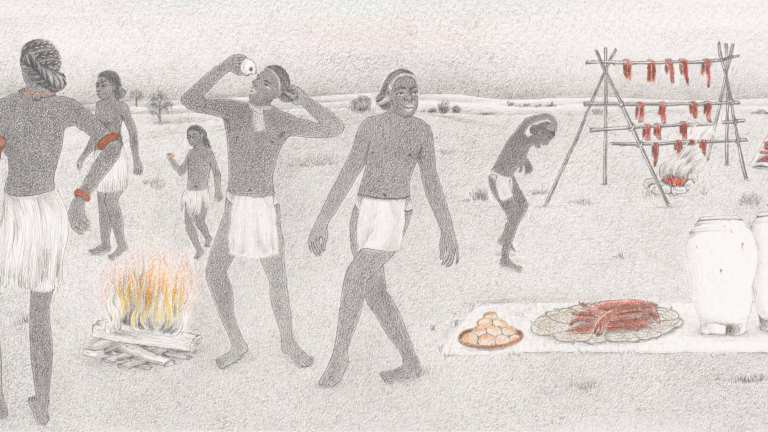
The “winter festival” scene in Chapter III features two stars of Harappa’s archeological remains. The most famous, the 4-inch-tall “Dancing Girl” of Mohenjo-daro, with her sassy, strikingly modern pose, has captivated scholars for almost a century; in the book’s festival scene, I have her cheekily turned her back to us. For another of the foreground figures, I “reconstructed” a badly broken Harappan artifact, a small sculpture of a male dancer whose body language suggests gender fluidity. Yet another festival-goer blows an egg-shaped whistle, examples of which have been unearthed by archeologists.
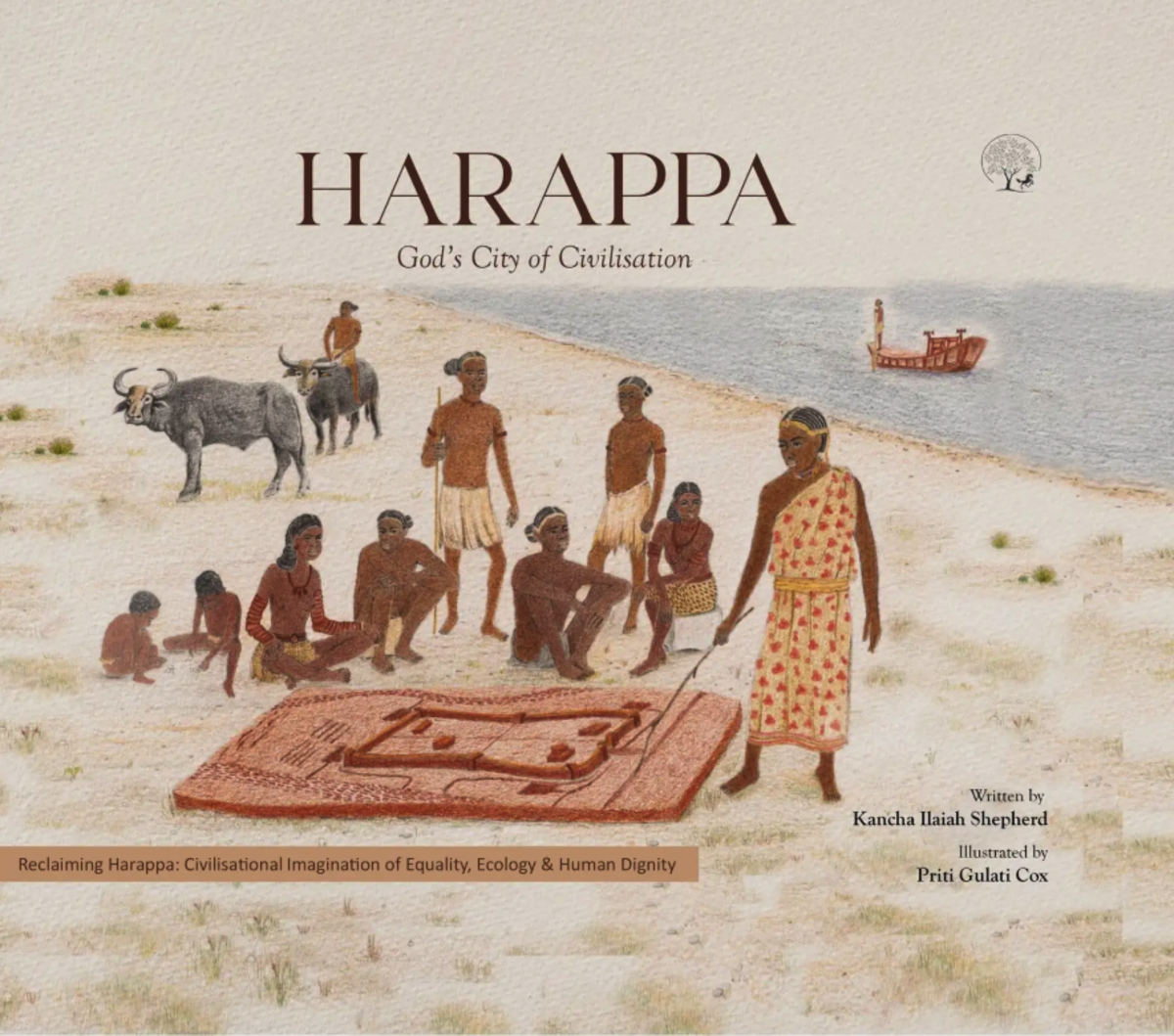
In the book’s cover image, I used still other Harappan sculptures as models for the sitting or squatting postures of people as they watch the main character, named Harappa, explain a clay model of the city that they will go on to build together. These resting postures remain common throughout rural South Asia today. The depictions of children in this and other of the images come from my observation of children at play in villages of south-central India.
For the scene in which a pottery-maker has sculpted an image of Harappa and offers it to him, I used as a model one of that civilization’s most well-known artifacts: the sculpture of a handsome, bearded man with the double-bun hairstyle known today as the “Priest-King.” (In the story, Harappa rejects the gift, saying, “I am not God. Take it away. We … must be above human worship.”)
A new character bursts onto the scene in the book’s closing chapters. Adidevudu (roughly, “first god”) is sort of a wandering philosopher. As Prof. Ilaiah describes him, “His lower body was covered with a lion’s skin, though it had several holes. Three harmless snakes were … coiling around his neck … He was the same color as Harappa. His hair was knotted on the top of his head.” He held a stick that had “three dried-up branches” on top.
Adidevudu is clearly meant to embody an indigenous South-Asian version of the god Shiva—centuries before Hindu gods were conceived of. Prof. Ilaiah clearly modeled him after several Harappan artifacts that are widely considered to be depictions of a “proto-Shiva.” These include several figures sitting in Shiva’s cross-legged yogic pose, as well as the aforementioned dancing-man sculpture, whose pose appears to presage that of the Nataraja or “Dancing Shiva.” Therefore, in the book’s five images of Adidevudu, a character who becomes crucial toward the end of the story, I portrayed him as a dark-skinned, somewhat eccentric version of Shiva.
Animal Domestication
Animals, both wild and domestic, played a central role in the society that would become Harappa, and the book highlights animal domestication as an essential step in the civilization’s development. Several illustrations follow the book’s descriptions of how the people at the root of the Harappan Civilization herded sheep and goats and initiated the domestication of jungle fowl—progenitors of today’s chickens. They also hunted buffalo and deer for meat; therefore, I included images of men killing buffalo with large ornamental spears. I based these images on ritual artifacts depicting buffalo sacrifice that were found at Harappan sites. The book also describes Harappa, as a young man, taming a baby buffalo, feeding it on sheep and goat milk as a first step in developing a full-blown buffalo economy.
At this initial stage of domestication, the above animals were visually indistinguishable from their wild progenitors, and I portrayed all of them as such. The Harappans are also reported to have at least partially domesticated the dog, elephant, and camel, but they are absent from the book; nevertheless, I included a drawing of an Indian pariah dog. An animal that is featured on many Harappan seals and other artifacts, probably more than any other, is a creature that never existed: a unicorn with the body of a water buffalo.
Water
The Harappa Civilization evolved in a low-rainfall region of South Asia, and the archeological sites include a variety of sophisticated systems for water storage, distribution, and use, as well as wastewater management. Prof. Ilaiah’s story credits the origins of these systems to the efforts of a young woman named Maisamma, who begins by creating mud-walled reservoirs and canals to convey stored water to the village and surrounding fields. I included images of both.
Prof. Ilaiah includes a character named Neetiman who launches Harappa’s boatbuilding industry. The Harappans designed their boats for travel and trade, not only through the region’s river systems but also on the sea to locations as distant as present-day Oman. (Yes, they were shipping through the Strait of Hormuz more than 4,000 years ago.) None of the vessels survive, except as images on tablets and seals, which I used as reference for illustration. Similar (though less lavishly ornamented) flat-bottomed boats are still used for crossing the Indus River in the Mohenjo-Daro area.
Food and Agriculture
Agriculture was fundamental to the founding of South Asian civilization. A plowed fielduncovered in the 1980s in the southeastern part of the Harappa region dates back 4,800 years, to the very early Harappa period, and is regarded as the world’s earliest evidence of a row-cultivated plot of land. In the book, I depict that field as part of a composite image arranged in an Indian rangolipattern, along with some of the crop plants grown in those days: wheat and barley (their staple grains), sesame, and mustard. Also included are a typical Harappan solid-wheeled cart for hauling grain; a young farmer holding her sickle, her pose based on a photo I took of a harvester in south-central India; images of round grain-threshing platforms made of bricks (modeled on remainsthat were unearthed in Harappa intact) and of men pounding bundles of plants on such platforms to knock out the grain (based on my observation of present-day threshing methods on small farms in India).
The pipal (aka peepul or bo) tree, Ficus religiosa) has been revered in South Asia for millennia, including during the Harappa period. Its leavesare used for myriad purposes to this day in South India. I included pipal trees in two of the book’s scenes; in one, Harappa, as a young man, has climbed the tree to escape a charging mother buffalo.
Another rangoli collage, at the start of Chapter V, highlights more uses of plants by the characters of Prof. Ilaiah’s story. It includes the weaving of fabric from jute and the making of plant-based dyes. Then there’s an image of the plant Ephedra gerardiana, a gymnosperm considered to be the most likely source of soma, a stimulant that plays an important role in the most ancient Hindu texts.
Soma is believed to have held spiritual significance for the Harappan civilization. For instance, in artifacts, the fantastical unicorn is almost always portrayed as facing toward a hard-to-identify, seemingly ritual object. The most plausible answer to the question, “What is that thing?” is that it was a device was used to distill and filter soma. (Near the end of the book, I included an image of this device in a sepia-toned rangoli pattern that reprises many images from throughout the book.) I also feature soma in the book’s winter festival scene. Prof. Ilaiah writes that there was ample soma on hand at the party, and it was served in pipal-leaf cups. I depict the cups, along with tall clay urns in which the soma was stored.
The Rest Is History
Illustrations early in the book are rendered in shades of gray, with the images of people, plants, and animals appearing as though viewed through the mists of deep time. Partway through Chapter III, I start adding a little color here and there, starting with a peacock and then, in the party scene, adding color to the Dancing Girl’s bangles, wood fires, roasted buffalo and deer meat, and some laddoos—small buns made with ground wheat and barley grain. Then, toward the book’s end, around the time the proto-Shiva figure Adidevudu shows up, the images take on full, often garish color.
Soon, Prof. Ilaiah introduces four new characters: pale-skinned, cattle-herding, beef-eating Aryans who’ve wandered on horseback out of Central Asia and descended on the Harappa region. At this point, where the plot starts turning some unexpected corners, my images become more explicitly symbolic. At the book’s beginning and again near the end, for example, I placed composite images modeled on the southernmost petals of the mythological lotus-shaped map of India known as the Jambhu-Dwipa (“Plum-tree Continent”). In chapter I, the center of Jambhu-Dwipa, and petals radiating from it contain gray-toned scenes from Harappa when it was still a village. By chapter VIII, those scenes have been replaced by Mt. Meru in the center, and in the petals, scenes from the Vedic culture that would soon be migrating to Jambhu-Dwipa, stealing and claiming ownership over everything Indigenous.
In the bottommost petal of the second Jambhu-Dwipa image, I scatter a few specimens ofAmanita muscarita across the landscape as a portent of things to come. Some scholars have suggested that A. muscarita (known as the fly agaric mushroom, bright red in color with white spots), not E. gerardiana, provided the active ingredient in soma. According to K.T. Achaya in his book Indian Food, those mushrooms exert “hallucinogenic effects of the kind described in the Vedas… Much of the poetic if rather cryptic imagery of the texts seems to fit the mushroom.”
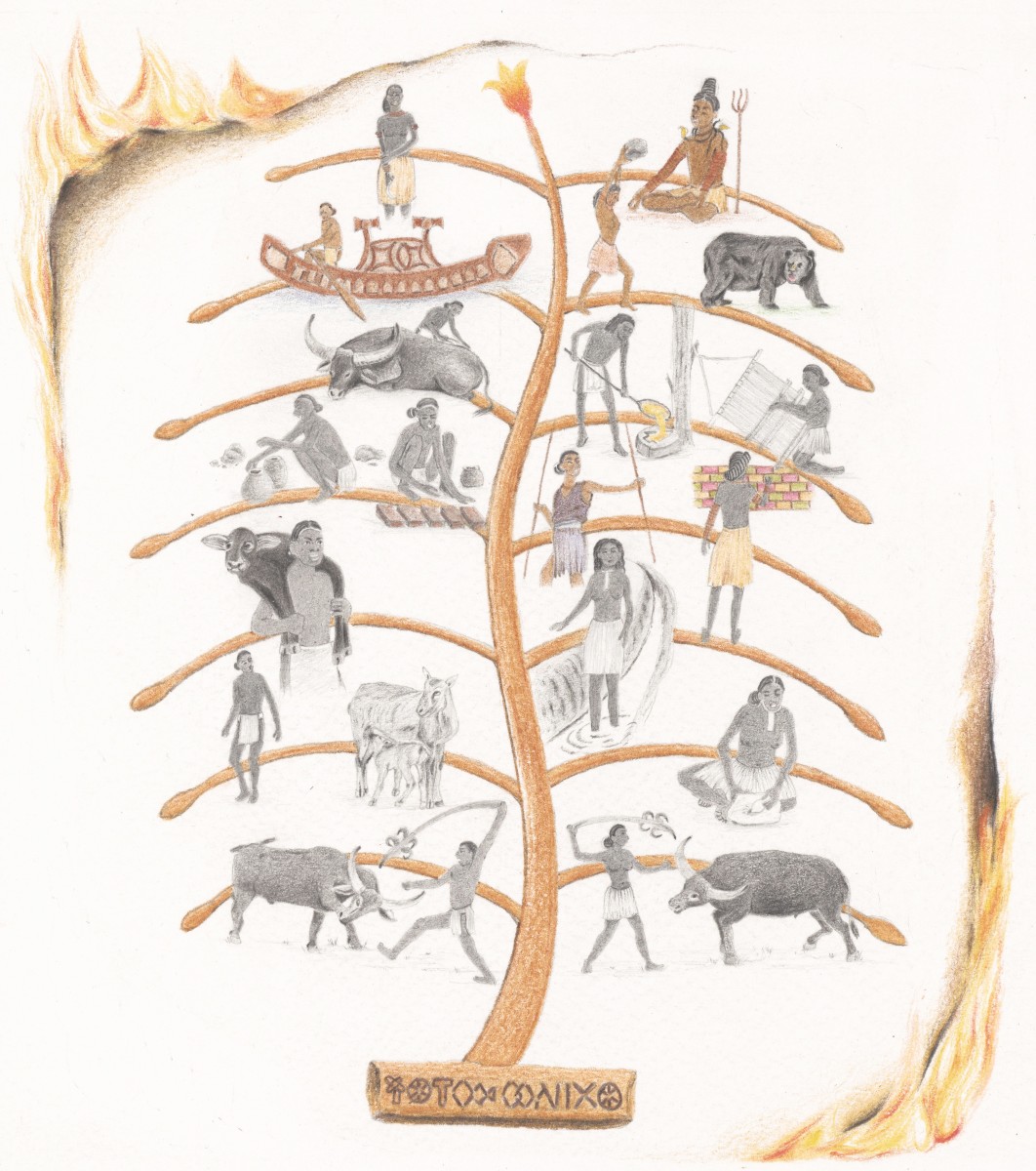
As a final sad farewell, I added a second pair of images. Each features a lively tree rendered on a terra-cotta tablet. It’s one of the most well-known artifacts from Harappa. At the end of Chapter VIII, I depict the tree with its leaves replaced by thumbnail versions of images we’ve seen earlier in the book, most of them depicting Harappan technologies and practices: water travel, leather-working, metallurgy, precision brickmaking, animal breeding, painting, weaving, and more. I place the same image at the end of the story, with one change: the edges of the paper on which it’s drawn are now going up in flames, a portent of the Harappa Civilization’s demise.
Prof. Ilaiah ends his book with the four Aryan wanderers gazing out over Harappa City for the first time, leaving us to consult nonfictional history for the rest of the story. Of course, the historical, archeological, and biological records show that as the itinerant Aryan pastoralists migrated to and settled in the Indus and Ganges basins, they usurped and exploited Harappan agricultural methods, technologies, sacred and artistic practices, and approaches to designing and constructing visually impressive, highly functional, city-states. They seized political and cultural power and, after a few centuries, consolidated that power through imposition of the caste system. And the rest, as they say, is history.
The opinions expressed here are solely the author’s and do not reflect the opinions or beliefs of the Hollywood Progressive.

https://hollywoodprogressive.com/art/art-through-the-mists-of-time-in-kancha-ilaiahs-book-harappa

