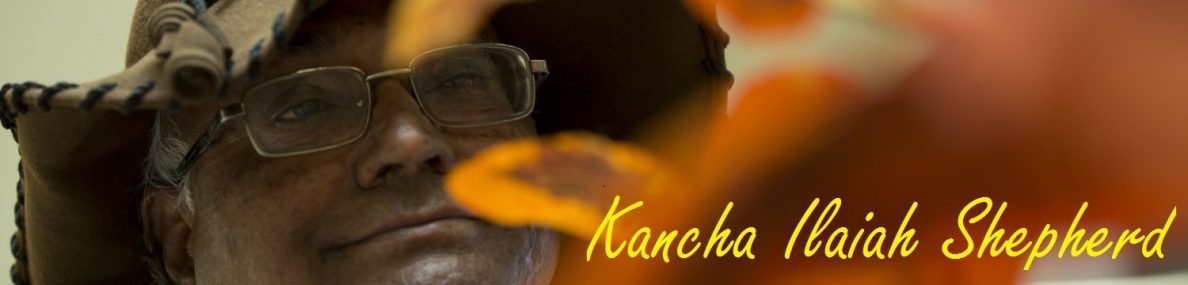
Kancha Ilaiah Shepherd’s latest book, which can also be read as an intellectual biography of his Kuruma community, demands an overhaul of how we see and measure knowledge, language, gender, and human dignity.

Kancha Ilaiah Shepherd at his residence in Hyderabad on October 1, 2017. | Photo Credit: G. Ramakrishna
Today, public debates over caste are centred on the caste census and quota sub-classification. This binary discourse misses an important contradiction. Agrarian working classes, classified as Shudras in the Rigvedic varna system, form a formidable voting bloc for every political party across India. Yet the intellectual history and the philosophy of these labouring communities remain ignored. Thinking and writing in India have historically been guarded property, “reserved” for those with the inter- and intragenerational luxury of “free time” and “elite schooling”. Professor Kancha Ilaiah Shepherd’s recent autobiography, A Shudra Life, serves as an alternative political history that challenges the gatekeeping of both the “conservative” Right and the “traditional” Marxist Left. Ilaiah’s autobiography can also be read as an intellectual biography of his Kuruma community. He demands a complete overhaul of how we “see” and “measure” knowledge, language, gender, and human dignity.
Ilaiah’s social consciousness, his advocacy for women’s agency, and the bedrock of his anti-caste feminist thinking and doing were shaped by the women in his life, especially his grandmother and his mother, Kancha Kattamma. In a habitus where his father was absent for long stretches of time grazing sheep, his mother was the matriarch and leader of their Kuruma community. Ilaiah points to the subaltern origins of his name, which derives from Iloni Mallanna, a legendary shepherd chieftain of the Deccan plateau who was revered as a local deity. This naming grounds his identity in local geography and history rather than in Brahmanical scriptures. He recounts incidents in which Kattamma bravely resisted extortion by local forest guards and dominant-caste authorities. This resistance came at a cost, though: she was brutally assaulted in a confrontation with a feudal landlord’s family. Ilaiah thus strips away any romantic notions of rural harmony and the rhetoric of village republics, neither of which he encountered as a young man.

A Shudra Life reminds us that the right to think, write, and create theory is a basic human entitlement that belongs to every human being, irrespective of birth-imposed identities. | Photo Credit: By special arrangement
A Shudra Life
By Kancha Ilaiah Shepherd
SouthSide Books
Pages: 200
Price: Rs.400
Hailing as he did from a Shudra shepherd community, Ilaiah entered school only after overcoming considerable opposition within the community, which stemmed from its limited awareness of formal education. His family, too, dreaded the idea, harbouring a multigenerational belief that Goddess Saraswati would kill Shudra children if they dared to read and write. Within the village’s caste hierarchy, literacy was seen as a spiritual weapon reserved strictly for elite castes. Today, as a critique of the education system, Ilaiah distinguishes between the “creative wealth” produced by manual labourers and the “non-productive lifestyle” of spiritual elites. He theorises that animal herding, soil management, and artisanal work constitute political philosophy. Echoing Brecht, he argues that it is the labouring hands of the Shudra and working collectives that have created human civilisation.
Buffalo versus cow nationalism
Ilaiah, who has mooted the study of the “sciences of production”, contrasts the state-sanctioned, sacred status of the “white cow” with the deliberate demonisation and neglect of the “black buffalo”. Despite being the chief driver of India’s dairy economy and the foundational capital of Shudra and OBC households, the buffalo has been marginalised in sacred literature and classical aesthetics. Ilaiah attributes this to the animal’s colour and its close association with Dravidian working-class labour. He also argues that a mythological figure such as Krishna, whom he reads as an indigenous, non-Aryan cattle herder and tribal deity of the Yadava clan, was co-opted and recast by elites as a warrior hero and an agent of orthodox ethics, thereby robbing pastoral communities of their organic spiritual icon.
Ilaiah exposes a contradiction in the postcolonial Indian state: the ruling classes publicly praised regional languages for the common people while quietly maintaining a monopoly on English. However, he also rejects the romantic view that regional languages are naturally pure or democratic, showing them to be social structures packed with historical hierarchies and marked by everyday insults. When the young Ilaiah saw an English-speaking Dalit District Collector whom the Reddy landlords feared, he concluded that “English” was the secret gateway to power and a means of annihilating the caste system. It was English that allowed a shepherd boy to communicate directly with global anti-colonial frameworks. This aligns with Frantz Fanon’s view of language in his brilliant work Black Skin, White Masks.
Ilaiah’s critique of caste also extends to the dinner table. He points to the patriarchy and hierarchies embedded in food cultures across communities. He shows how a dominant nationalism built on “pure vegetarianism” deprives gendered and subaltern bodies of essential nutrition and further upholds orthodox notions of purity and pollution, the very basis of the caste system.
He also critiques how patriarchy manifests on the plate, especially when women, particularly aged mothers, are pressured by society to abandon their meat and fish consumption under the guise of religious devotion. This makes the consumption of strength-giving proteins an exclusive luxury for the male head of the household. Through an episode describing the cooking and eating of fish, he also highlights how patriarchy is mirrored within his community.
During his student days at Osmania University, Ilaiah found himself torn between the traditional Marxist Left and the naxalite movement. Even as they claimed to fight feudalism, he found them both ideologically blind to caste. Moreover, their leadership was heavily monopolised by dominant-caste intellectuals, which is how varna and caste were consciously and subconsciously reproduced within the Left. According to Ilaiah, both movements used the labouring bodies of the Shudras merely for muscle power.
Ilaiah’s teaching career exposed him to the soft violence of academic gatekeeping, which functioned as a kind of neo-agrahara in education. As a Shudra professor, he was constantly under scrutiny; recognising the limits of academic discourse, he aligned himself with grassroots civil rights bodies. As a result, his work argues that there can be no grammar of human rights without confronting the brutal reality of systemic caste. He also contends that major violations of human rights stem from collusion between state machinery and local dominant-caste landholders. Ilaiah’s lived experiences and reflections have allowed him to ground his academic and political concepts in the everyday survival strategies of marginalised communities.
In a provocative inversion of Gandhian philosophy, Ilaiah argues that what the dominant nation state defines as “truth” is in fact a series of calculated “untruths”. From the Dalit-Bahujan standpoint, religious texts, historical chronicles, and nationalist myths are all deliberate fabrications that erase the history of production and labour. By deconstructing these untruths, he seeks to build an organic counter-hegemonic framework grounded in historical reality. Ilaiah believes that his work has won widespread acclaim on the global stage, securing his status as a pioneering political theorist. Yet, within India, he has faced, and continues to face, ostracisation from elite academic circles, along with a relentless barrage of criminal lawsuits, state-backed surveillance, and direct death threats.
While Ilaiah makes a powerful case for a unified labouring identity, he tends to glide past the deep schisms within the modern Shudra category and the actual politics at play. Many dominant, landowning farming communities under the Shudra or OBC label are themselves direct perpetrators of economic exploitation and physical violence against Dalit labourers. In one of his early essays, Ilaiah introduced the categories of upper and lower Shudras and urged readers not to treat the Shudra as a monolithic category. Even so, without a direct critique of Shudra landlordism, any theory of a unified working collective remains incomplete.
Today, the oppressed-caste youth are moving straight from agriculture into the digital gig economy. Driven by big data, apps, and hidden algorithms, this new digital proletariat requires a new critical vocabulary to track how old social hierarchies are reified and rewritten in software code. In the final pages, Ilaiah speaks directly to a younger generation of scholars trying to survive India’s hyper-competitive, corporate university system.
At a time when public discourse faces aggressive political flattening, Ilaiah’s work remains an essential counter-history. For Ilaiah, true social liberation demands a radical return to the material realities of physical work. A Shudra Life reminds us that the right to think, write, and create theory is a basic human entitlement that belongs to every human being, irrespective of birth-imposed identities.
Nikhil Sanjay-Rekha Adsule is a senior research scholar at IIT Delhi.
Summary
Kancha Ilaiah Shepherd’s autobiography, “A Shudra Life,” offers an alternative political history, challenging conventional narratives from both the Right and the Left. The book highlights the intellectual contributions of agrarian working classes, particularly his Kuruma community, and critiques the gatekeeping of knowledge. Ilaiah’s work emphasizes the influence of women in his life, the significance of manual labor as political philosophy, and exposes contradictions in the Indian state regarding language, food, and caste. He advocates for a radical return to material realities for social liberation, despite facing ostracization and threats within India.

