
Kancha Ilaiah Shepherd’s new book portrays the Indus Valley Civilization as cooperative and egalitarian—and challenges nationalist myths about India’s origins.
STAN COX AUG 19, 2026
Kancha Ilaiah Shepherd has a way of getting under Hindu supremacists’ skin. And the latest book by this political theorist, social activist, and former Osmania University professor—titled Harappa: God’s City of Civilization—is almost certain to elicit frenzied howls of outrage. This 90-page work of fiction, illustrated by Priti Gulati Cox (full disclosure: I’m married to the artist), is set about 4,500 years ago in a small village along a tributary of the Indus River. Over generations, its residents, working with people from neighboring villages, create in their home territory the city of Harappa, the likes of which have never been seen in South Asia—one that will become a nucleus for their region’s first (possibly the world’s first) great civilization.
There is much that we do not know about the lives of the people who were there at the dawn of Harappa. However, thanks to extensive archeological, anthropological, ecological, and genetic research, there is much we do know.
We know that the people living in Prof. Ilaiah’s fictional village would have been descended from the mixing of two populations: First Indians—that is, modern humans who traveled out of Africa into Asia tens of thousands of years ago, with some of them eventually making their way to the Indus Valley—and an agricultural people who migrated to the Indus Valley from the Zagros region of present-day Iran.
We also know that, at the time Prof. Ilaiah’s story begins, the Indus Valley people were farming and had learned how to domesticate animals, including sheep, goats, chickens, and water buffalo. And we know they would go on to create a written language and striking art, while developing highly effective structures for water management, sanitation, land and water transportation, urban housing, and public services.
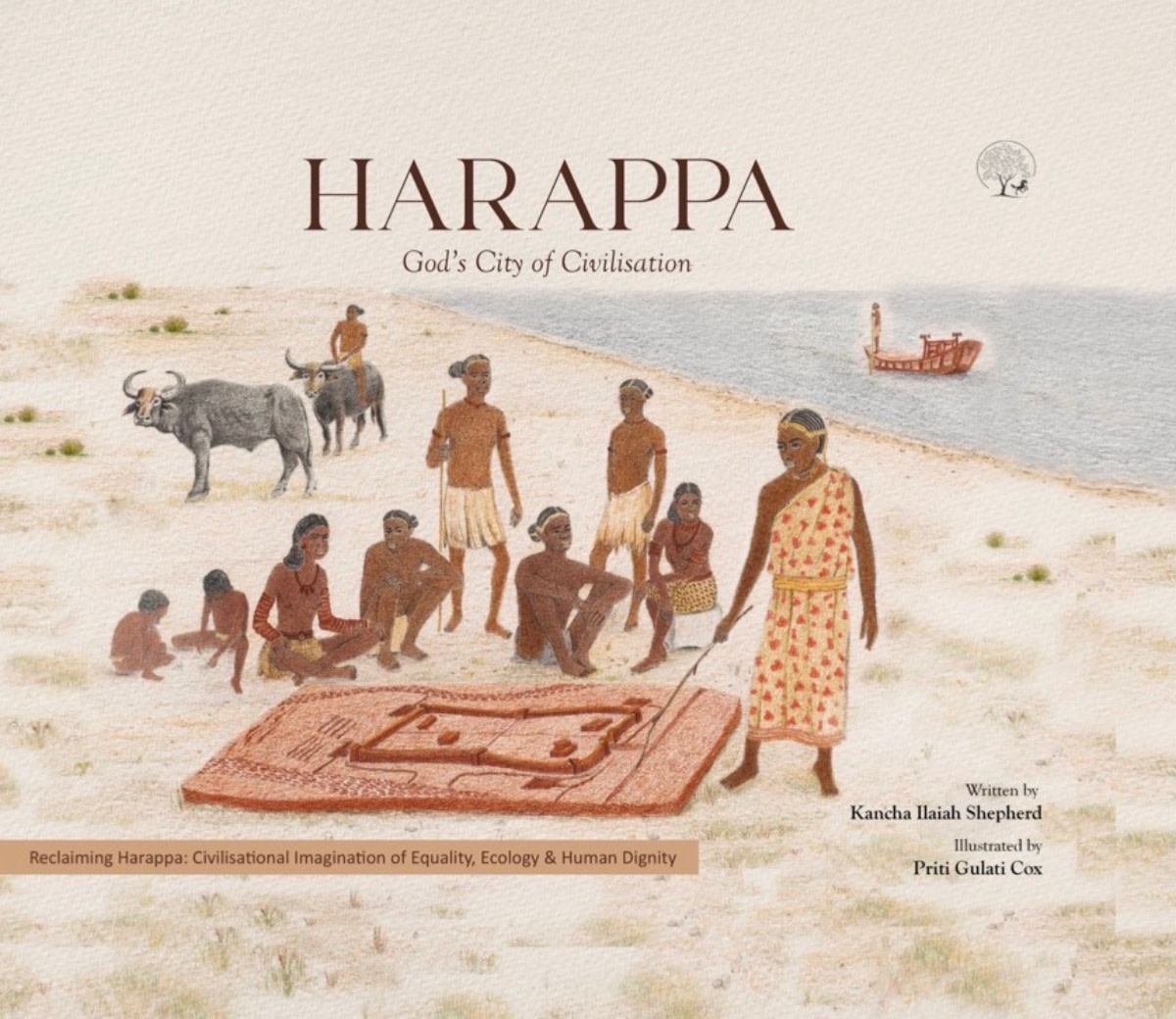
Harappan cities came to be scattered across a vast region one-third the size of present-day India. Archaeologists and historians have marveled at the highly functional and attractive layout of Harappan cities and their high-quality construction. They clearly were the product of well-thought-out urban planning; even the height-width-length ratio of the bricks used in construction throughout the region was standardized (at 1:2:4), as were weights and measures. But, in contrast to the ruins of other ancient civilizations, Harappa’s ruins contain no remains of grand, monumental structures. Their cities, full of home foundations that do not vary greatly in size, modest public buildings, and other utilitarian features, do not suggest wide class disparities. Accordingly, the book Harappaportrays a relatively egalitarian, cooperative, hard-working society.
Evidence points to a civilization built on the collective labor of its own people. That would stand in stark contrast to most other “great civilizations” of ancient and modern times, which usually achieved that status through conquest, territorial expansion, imposition of power over other peoples, grandiose architecture, and amassment of great wealth, with some intellectual and artistic accomplishments thrown in. Most importantly, in achieving all those things, those other civilizations depended heavily on labor provided by underclasses of their own people, or by those they conquered, or both. No such exploitation is evident in Harappa—neither in the village of Prof. Ilaiah’s book nor in the archeological remains of Harappan cities.
That first Indian civilization had quite a good run, from about 4,600 to 3,700 years ago. Its demise is attributed primarily to the drying-up of the rainfed rivers on which it depended. That drought brought down other Bronze Age civilizations as well. But research based on ancient DNA samples shows that Harappa’s people didn’t just die off; they emigrated, some venturing east to the Ganges basin, others to southern regions of the subcontinent. In both the north and the south, over centuries, they blended with local First Indian populations and kept on contributing to India’s development and culture.
Unfortunately, the next civilization to arise in northwestern India would, over the centuries, evolve in the opposite direction, toward inequality and injustice.
The Aryan Immigrants
A century of research and scholarship has established beyond all doubt that the Harappan Civilization was the Indian subcontinent’s first. But Hindu supremacists, whose political and cultural power has been increasing steadily over the past three decades, continue to insist that India’s first civilization was launched by a people who composed the Vedas, India’s oldest religious texts. In the first of these works, they identified themselves as the Arya. (Millennia, later, Western scholars would dub them the “Aryans”.)
There are big holes, though, in the claim that the Arya were the fount of Indian civilization. First is the timing. They didn’t start composing the first of their foundational works, a set of prose and poetry known as the Rigveda (which was originally transmitted orally and eventually written down in Sanskrit) until less than 4,000 years ago—at a time when India had already been hosting one of the world’s great ancient civilizations—Harappa—for centuries. On top of that, the Arya weren’t even ancestral Indians. In fact, at the time they composed the Rigveda, they were newcomers to the subcontinent—or may not have even arrived yet.
Nomadic cattle herders known as Arya migrated out of the steppes of present-day Kazakhstan around 4,000 years ago. They spread south through Central Asia and present-day Afghanistan, to finally end up, about 3,500 years ago, in a part or northern India that would become the Hindu homeland.
Hindu fundamentalists have long insisted on a wholly different history: that the Arya had always lived in what is now northern India and had founded a Vedic civilization more than 5,000 or even 10,000 years ago. At least one claim has them in India, working on the Rigveda, as early as 25,000 years ago (which might have had them mingling with the original immigrants who’d come from Africa). Still others claim that the Arya have been living in India since the beginning of time! Much of the “evidence” supporting these wild “estimates” is gleaned from tortured “analysis” of the Vedic texts themselves—a circular argument if there ever was one.
Meanwhile, Hindu supremacist claims regarding their origin are easily disproven. DNA samples collected from ancient human remains at archeological sites, from Africa to India to Iran to the steppes of Eurasia—particularly samples analyzed in the past decade or so—show
- that the Vedic Arya were recent immigrants from the Central Asian steppe who settled in northern India in the second millennium B.C.E. and
- the people who built the Harappa civilization, India’s first, carried DNA from First Indians and Iranian farmers and none from Central Asian populations.

The Downgrading of Labor
In contrast to Harappa, Arya-dominated civilization evolved in a severely hierarchical direction. They didn’t bring caste with them to India, and they mentioned no caste-like hierarchies in the early Vedas. Centuries later, as they were consolidating their power through imposition of the caste system, their rationale was based on economics much more than ethnic origin. By then, there were few or no “pure” Arya or “pure” Harappans or “pure” local First Indians living in the newly adopted Arya “homeland.” Each person’s genome most likely carried DNA from either two or all three of those populations, in various proportions. India had become a genetic melting pot of sorts. The evolving caste system was a socioeconomic hierarchy.
The caste system was designed by those claiming membership in the Vedic Arya elite, their goal being to consolidate their power over society. The system downgraded the types of labor that had created and sustained the Harappan Civilization while elevating the kind of abstract thinking and pursuit of conquest and power that had characterized most other ancient civilizations. (To be sure, most societies around the world have done likewise ever since; caste isn’t the only means to exploitation and oppression.)
To the extent that the word civilizationhas positive connotations for us, I expect that many of us who read Harappa: God’s City of Civilization’s text, view its images, and ponder the way of life, labor, and leisure portrayed, will close the book and think to ourselves, “That wasn’t just a village that would one day launch a civilization. That was a civilization! And a damn good one, too.”

Stan Cox is the author of seven books, including The Green New Deal and Beyond: Ending the Climate Emergency While We Still Can and Losing Our Cool: Uncomfortable Truths About Our Air-Conditioned World. His latest book is Anthropause: The Beauty of Degrowth. He writes from Dearborn, Michigan.

